

Powell’s Pals: Cyrus Thomas
Born in Kingsport, Tennessee in 1825, Cyrus Thomas began his eclectic career studying law. In 1849 he moved to Illinois, where he practiced as an attorney in Murphysboro, Jackson County, from 1851 to 1864. He married Dorothy Adeline Logan in 1853. Sadly she died in 1864. After her death, Thomas married Viola L. Davis in 1865 and he changed professions and became an Evangelical Lutheran minister.
In 1869, Thomas changed professions again as he was appointed as an entomologist and a botanist to the Geological Survey of the Territories. The survey, which was under the direction of John Wesley Powell’s adversary, Ferdinand Vandeveer Hayden, was chartered to conduct research in the Western Territories until 1873. The Hayden Geological Survey started in 1871 and explored northwestern Wyoming. Their survey led to the creation of Yellowstone National Park in 1872. Yellowstone was the first federally funded geological survey to explore and further document important volcanic and land features in the region.
During the expedition, Cyrus Thomas, Charles Valentine Riley, and Alpheus Spring Packard studied the behavior of destructive western locusts, leading to creation of the United States Entomological Commission. They found the locusts’ breeding ground, observed the effects of weather, and noted what determined the locusts’ direction of spread.
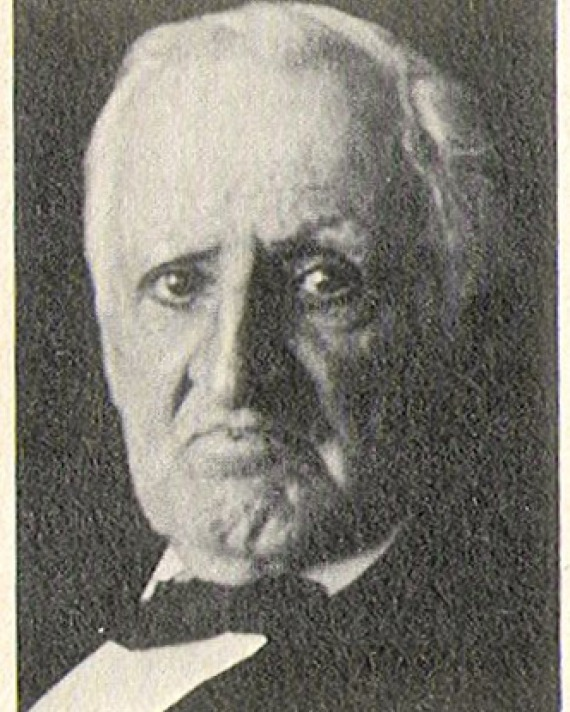
Before 1871, the first board of trustees for Southern Illinois Normal College (later Southern Illinois University) commissioned Thomas to collect artifacts for a museum, located in the original Old Main building in Carbondale, Illinois and opened to the public in 1874, when the college began holding formal classes. From 1874 to 1876, Thomas taught natural sciences at the local teachers’ college.
In 1875, Thomas was appointed to the Illinois office of state entomologist. He had been publishing entomological papers since 1859, while he was practicing law. His research focused on insects that caused significant damage to crops. While working as the state entomologist, Thomas also served with colleagues Riley and Packard for five years as a member of the United States Entomological Commission.
Back in 1868 Cyrus Thomas had stated that “Rain follows the plow.” He worked with John Wesley Powell as an archaeologist after that time. When the Johnstown Flood of 1889 occurred, Thomas regretted his prior guesses that rainfall had not impacted the streams and reservoirs in his part of the country.

Thomas, the Mounds Explorer
In his later years, he turned to the study of ethnology and archaeology. He became a local expert in the preservation of and research into the pre-colonial civilizations which built mounds in Illinois. He also studied all archaeological evidence of Mayan hieroglyphics in the region.
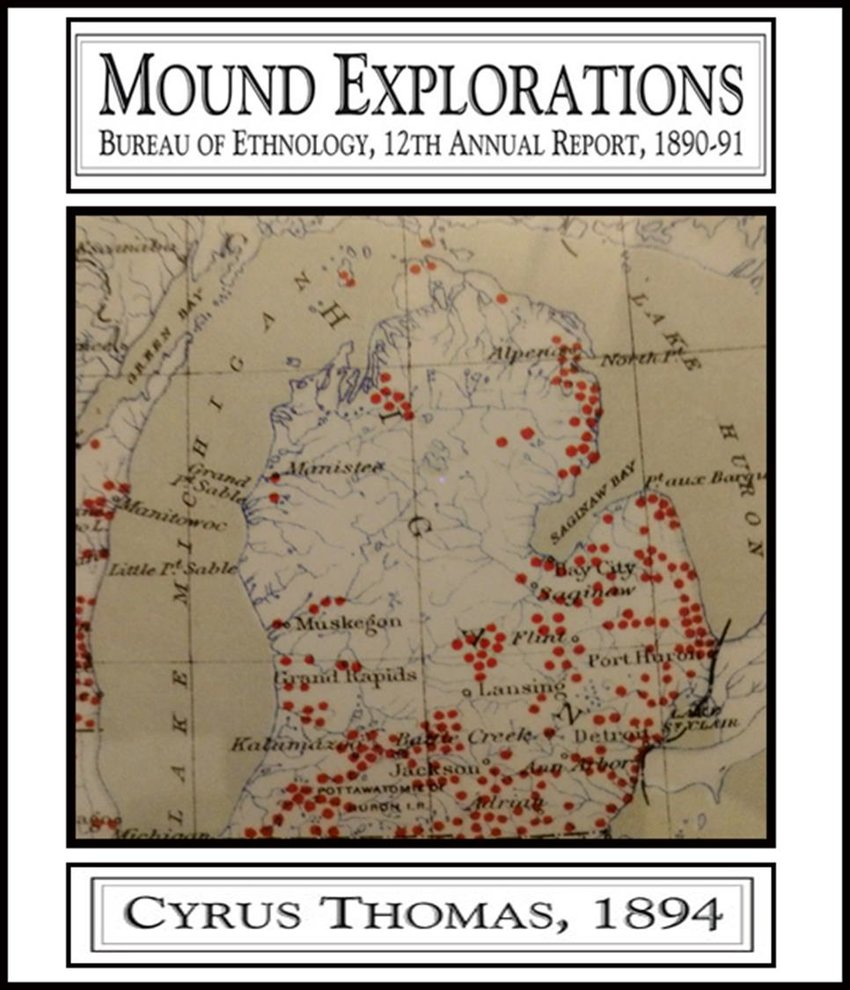
When Thomas began his investigations into the origins of the mound builders, he was under the impression that the mounds were made by a more advanced race that no longer existed. He argued that once America had been settled, the people tended to stay in one place, which meant that the archaeological record had been produced by the same people of that area through history. Although he did not do field work, he mapped out a plan of action for the mound excavations, and presented ten years of work in the 12th Annual Report of the Bureau of Ethnology for 1890–1891. By the end of his research into the origin of the mound builders, Thomas dismissed each argument advanced in favor of the vanished race theory. The Bat Creek Inscription was one artifact that Thomas used to support his hypothesis that “the Cherokee constructed many earthen mounds;” the evidence being that “the stone represented characters of Cherokee syllabary.”

Thomas divided the Illinois mounds into a northern section, which was divided into six sections, and a southern section, which was divided into two. These eight sections, Thomas suggested, represent more than one nation. Thomas thought that migration was the reason for the mounds being spread through the east, but also recognized that the idea for mounds diffused through the different tribes.
Cyrus Thomas died in 1910 in Washington, DC. He was years of age. He was buried in Frederick, Maryland.
References:
[1] https://en.wikipedia.org/wiki/Cyrus_Thomas
[2] Cyrus Thomas was one of the men with whom John Wesley Powell found some of his strongest kinship. The exploration of the relationship is outlined and discussed in another Powell’s Pals post on Thomas and eight other scientists and explorers from the Powell era.
 Henry E. Hooper