
Powell’s Pals: Col. Garrick Mallery

Garrick Mallery (1831 – 1894)
Col. Garrick Mallery
Garrick Mallery was born in Wilkes-Barre, Pennsylvania in 1831 and raised in the region. He graduated from Yale College in the class of 1850. After college he enrolled in law courses at University of Pennsylvania and soon thereafter passed the bar in his home state. He practiced law in Philadelphia from 1853 until the outbreak of the American Civil War in 1861. While serving in the army on the western frontier, he was promoted to the rank of Colonel and became interested in Native American sign language and pictography.[1]
After retiring from the military in 1879, Mallery was appointed to the newly created Bureau of American Ethnology (BAE) as one of its first ethnologists. In his work with the Bureau, Mallery pioneered the study of sign language and pictographs, examining them as a universal human phenomenon with a direct link to spoken language.[1]
In his work, Mallery collected and examined sign language vocabulary from Native American groups throughout the U.S. and Canada and regularly solicited contributions from collaborators. He also related his findings to examples from the wider world, comparing the formation of Native American signs to those in other areas by hearing individuals and by the deaf.[1]
Mallery completed several publications on the topic throughout the 1880s, notably “Introduction to the Study of Sign language Among the North American Indians” (1880), “A Collection of Gesture-Signs and Signals of the North American Indians” (1880), and “Sign-language among North American Indians Compared with that Among other People and Deaf-mutes,” which appeared in the BAE 1st Annual Report (1881).
While most widely known for his work with sign language, Mallery also undertook extensive research into Native American pictography. Like his work with sign language, he both conducted original research and solicited assistance from collaborators. He was especially interested in the representational images in Dakota winter counts and petroglyphs in the United States and throughout the world.
Mallery was gifted verbally and used his talent to interesting results. He was described by his colleagues as “humorous, somewhat ribald, quaintly and curiously learned.” With his speaking skills Mallery could turn a “scholarly lecture on tattooing into a hilarious smoker talk” or he could “attack a whole unmapped region of anthropological research with James Pilling’s thoroughness.” (See Powell’s Pals: James C. Pilling for greater context.)[1][2]
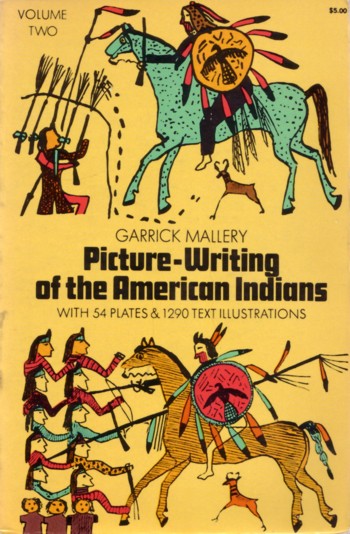
Mallery’s monograph on Native American picture writing, called a “preliminary report,” ran to 807 pages with 1,295 figures and 54 full-page plates. It proved to be one of the most exhaustive and one of the most lavishly illustrated of all the Bureau’s ambitious publications.
———————————————————————————–

Mallery Chronology:
1831 Born in Wilkes-Barre, Pennsylvania, on April 25
1850 Graduates from Yale College
1853 Earns LL.B. from the University of Pennsylvania Law School; Admitted to the Pennsylvania bar
1853-1861 Practices law in Philadelphia
1861 Enters the volunteer army of the United States
1862 Severely wounded in the battle of Peach Orchard, Virginia; Captured and held prisoner at Libby prison in Richmond, Virginia
1866 Completes service with volunteer army of the United States; Accepts commission in regular army of the United States
1870 Marries Helen W. Wyckoff
1879 Retires from the United States army due to disability; Appointed to the Bureau of American Ethnology
1880 Publishes: 1) “Introduction to the Study of Sign-Language Among the North American Indians as Illustrating the Gesture-Speech of Mankind” and 2) “A Collection of Gesture-Signs and Signals of the North American Indians With Some Comparisons”
1881 Publishes: 3) “Sign Language Among North American Indians, Compared with that Among Other Peoples and Deaf-Mutes”
1894 Dies at the age of 63, after a short illness in Washington, D.C., on October 24, 1894.
References:
[1] https://en.wikipedia.org/wiki/Garrick_Mallery
[2] Garrick Mallery was one of the men with whom John Wesley Powell found some of his strongest kinship. The exploration of the relationship is outlined and discussed in another Powell’s Pals post on Mallery and eight other scientists and explorers from the Powell era.
 Henry E. Hooper