

Plants: Ground Mat Cholla vs. Jumping Cholla
Question: Is there anything worse than a cholla cactus with arms that extend in every direction and seem to jump at you as a means of self-defense, when you come near?
Answer: Yes, there is a cholla that rests in waiting for you to step on it, lying hidden in the dark and so close to the ground.


When I was a camper with the Prairie Trek Expeditions, I made a misstep and fell into a cholla cactus that seemed to be everywhere on the ground around me. For my poor balance, I was punished with about 50 barbs that hooked their way into my hand and butt. One of our counselors, Rick Madden, took a pair of tweezers and proceeded to carefully twist and extract the barbs one-by-one. About an hour later, bleeding from nearly every punture wound, I hobbled to my tent for the night, swearing that I would never get close to a cholla again.
Grusonia parishii is a species of cactus known by the common names Matted cholla, Ground mat cholla and Parish club cholla. It is native to the Mojave and Sonoran Deserts of California, Arizona and New Mexico. Grusonia parishii grows in spreading mats along the sandy ground no more than about 20 centimeters tall. The segments are up to 9 centimeters long by 3 wide and is surfaced in fleshy tubercles bearing many spines each up to 5 centimeters in length. The seasonal flower is yellowish and the fruit is yellow and up to 8 centimeters long.
Not to be confused by the other bad buy cholla, the Jumping Cholla (Cylindropuntia fulgida), which can be pretty harrowing.

If I were this gal pictured above, I would give that cholla a wide area of separation. She is almost embracing that plant (Cylindropuntia fulgida). Yikes! Also known as the jumping cholla, this desert plant is sometimes called the hanging chain cholla. It is among a large variety of cholla (Cylindropuntia) cactus that are native to the Southwestern United States.

The species has many common names, though the most common one is “jumping cholla,” which comes from the ease with which the stems detach from the main plant when brushed, and almost “jumping” onto passing animals (like us humans). They also go by the name “hanging chain cholla” and other colorful names listed below.
The jumping cholla is an arborescent (tree-like) plant with one low-branching trunk. It often grows to heights of 4 m (13 feet), with drooping branches of chained fruit. The stems are light green and are strongly tuberculate, with tubercles (small, wart-like projections on the stems) measuring from 1⁄4 to 1⁄3 inch or 6 to 9 millimetres. Together, the plants form forests that may range over many hectares.
Flowers are white and pink, streaked with lavender, and are roughly 1 inch wide (2.5 cm). The flowers are displayed at the joint tips (or old fruit tips), blooming in mid-summer. Interestingly: According to naturalists/writers Henry and Rebecca Northen, a curiosity of these flowers is that C. fulgida opens its flowers at exactly 3:00 p.m. solar time, and can be used to set one’s watch.
Most of the fleshy, green fruits are sterile, pear-shaped to nearly round, wrinkled with a few spines. They are typically about 4 cm (1+1⁄2 inches) long, often producing flowers the following year which add new fruits to those of previous seasons. It is these hanging chains of fruit which give it the name “hanging chain cholla”.

Like other cacti, the plant’s leaves have been reduced to spines, 6 to 12 of which grow from each areole. Young branches are covered with 2 to 3 cm or 3⁄4 to 1+1⁄6 inches silvery-yellow spines, which darken to a gray color with age. These spines form a dense layer that obscures the stems. Slower growing or older branches have sparse and/or shorter spines. As the spines fall off of older parts, the brown-black bark is revealed. It becomes rough and scaly with age.
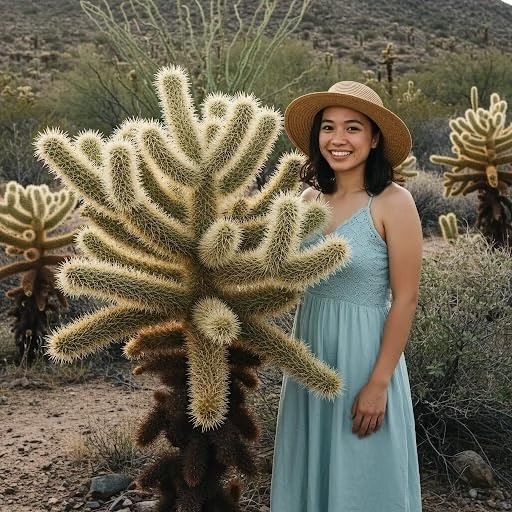
Different species of cholla cactus have colorful common names and nicknames inspired by their appearances or prickly behavior:
- Teddy Bear Cholla (Cylindropuntia bigelovii) – Nicknamed the jumping cactus or teddy bear cactus because its dense, fuzzy-looking golden spines and loosely attached segments make it seem to “jump” onto passersby. In Spanish, it is called cholla guerra (blond cholla) or cholla del oso (bear cholla).
- Chain Fruit Cholla (Cylindropuntia fulgida) – Also called the jumping cholla, this species gets its primary descriptive nickname from its dangling, successive chains of fruit that remain on the plant for years.
- Cane Cholla or Tree Cholla (Cylindropuntia imbricata) – Widely known by nicknames such as walking stick cholla, candelabrum cactus, chainlink cactus, and velas de coyote (coyote candles). In Australia, where it is an invasive weed, people call it devil’s rope cactus. [1, 2]
- Staghorn Cholla (Cylindropuntia versicolor) – Named for its long, branching stems that mimic the antlers of a stag deer. [1]
- Diamond Cholla (Cylindropuntia ramosissima) – Named for the distinct diamond-shaped patterns left on its stems by the tubercles. [1]
- Buckhorn Cholla (Cylindropuntia acanthocarpa) – Named for the open, branching growth pattern that resembles the antlers of a young buck

