
Birds of Scott
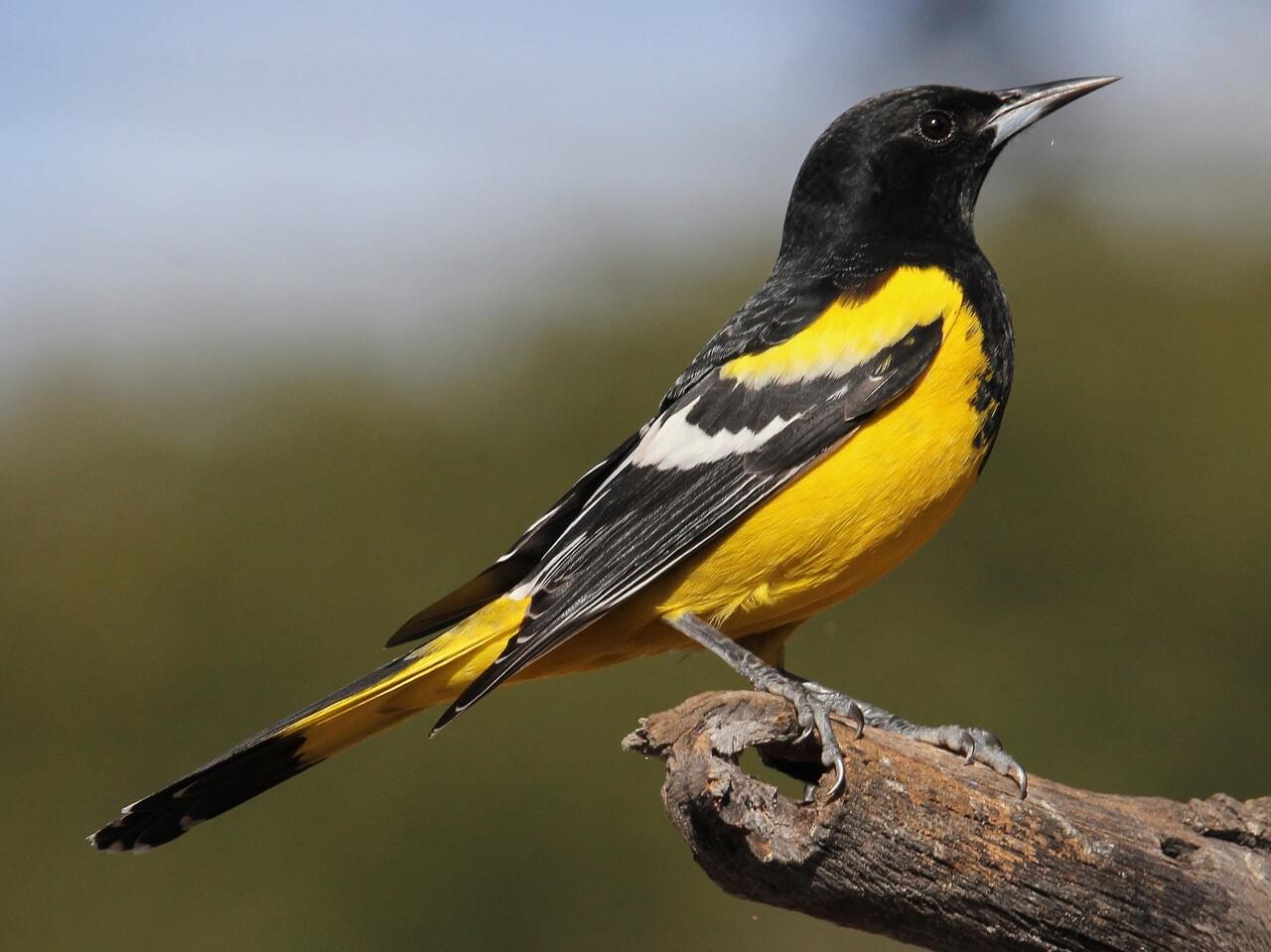
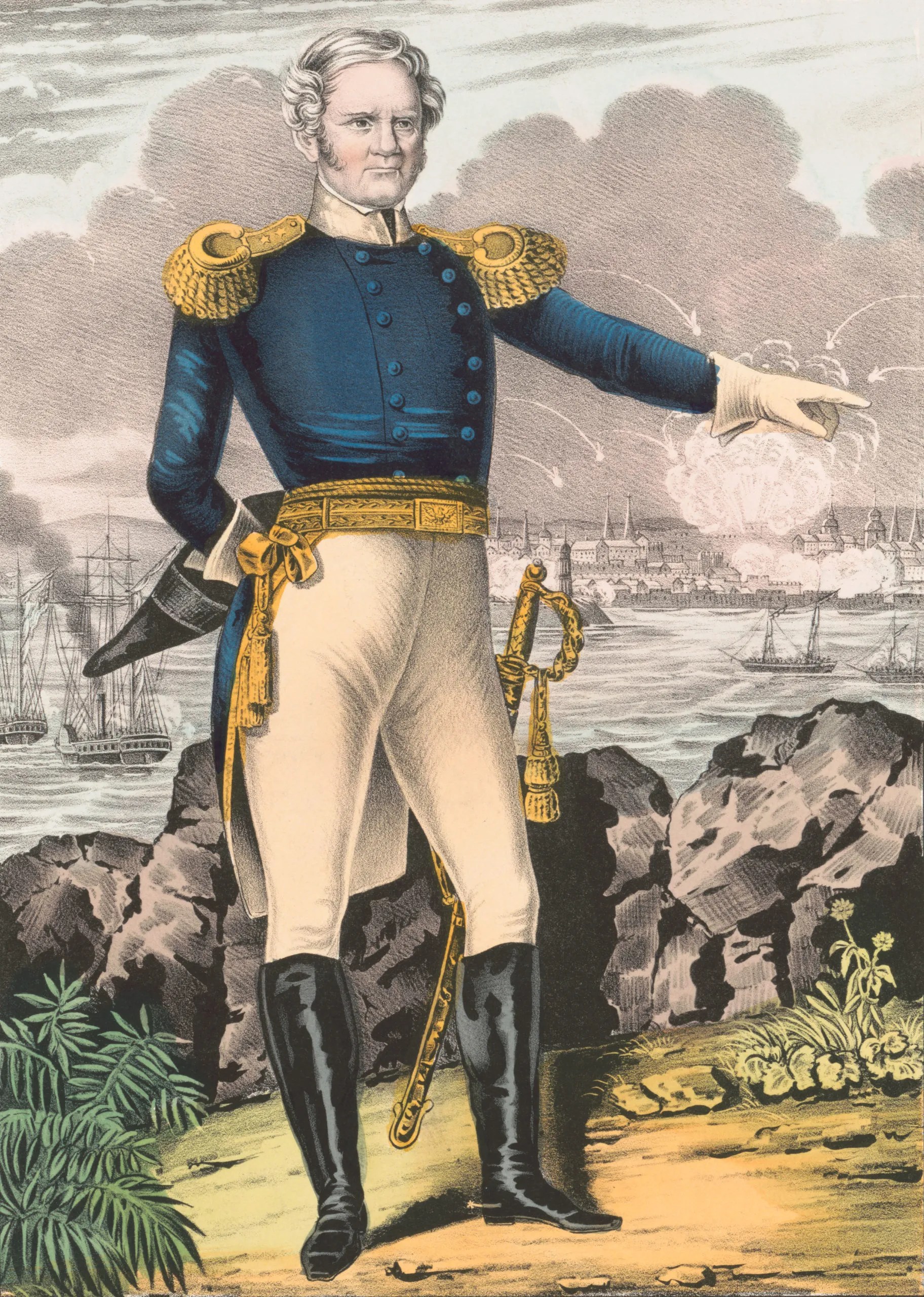
First of all, the Scott eponym, as in Scott’s Oriole, was not a birder, not a naturalist, nor was he a scientist. He was a General in the U.S. army — Gen. Winfield Scott. One of the most famous American soldiers of the 1800s, Scott had nothing to do with the oriole that was named after him. A junior officer, Lt. Darius Couch, who served under Scott, named the bird after the General. That’s partly why the name upsets people so much: it honors a man known for forcing Native people off their land, many dying due to the long walk, AND he had zero scientific contributions to weigh against that negative impact on Native Americans.
How did a general’s name ended up on an Oriole? The bird was scientifically named first. Charles Lucien Bonaparte had previously described the nest weaving oriole in 1838 as Icterus parisorum. Bonaparte was honoring the Paris brothers, who had funded several French natural history expeditions to the U.S. and Mexico in the 1820s. In 1854 Darius Couch, an Army officer and amateur naturalist, saw the striking black-and-yellow oriole and called it “Scott’s Oriole” after his commander, Winfield Scott. One account says Couch first tried to name it Icterus scottii. Once he learned it already had a scientific name, only the English common name survived. Three decades later, the American Ornithologists’ Union’s first checklist of English bird names made “Scott’s Oriole” official.
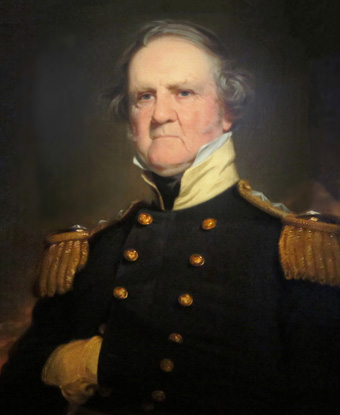
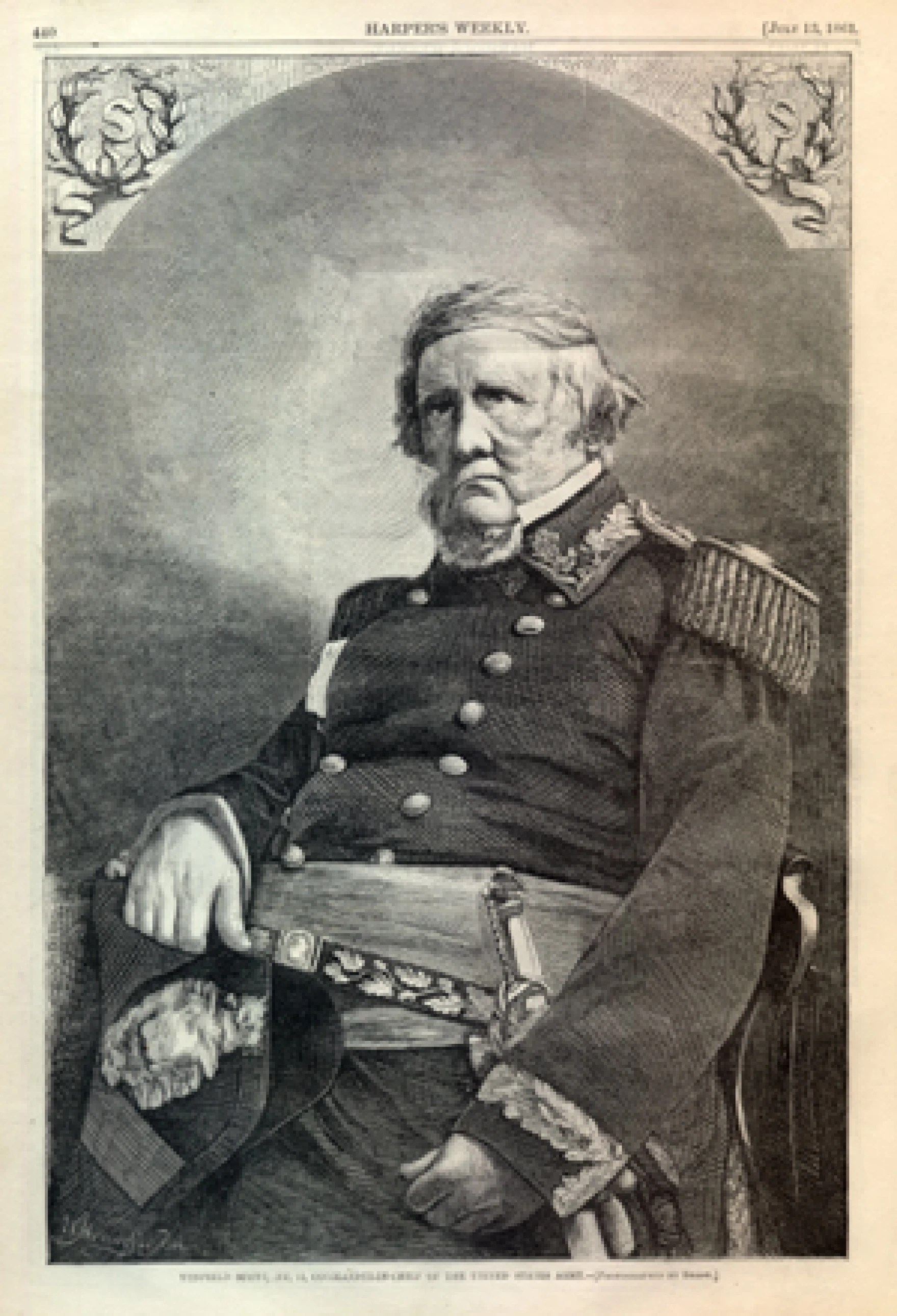
Who Was Winfield Scott?
Winfield Scott was born in 1786, near Petersburg, Virginia. His father, a small landowner and Revolutionary War captain, died when Winfield was six, and his mother raised the four children until her own death in 1803. Scott trained as a lawyer before joining the Army in 1808. He stayed in the Army for decades and served as a General on active duty longer than anyone else in American history. Over a 47 year period he commanded troops in the War of 1812, the Black Hawk War, the Second Seminole War, the Mexican-American War, and briefly the Civil War.[1]
In March, 1817, he married Maria Mayo, who was from an influential Richmond family. They settled in Elizabethtown, New Jersey, and over the years had seven children. Grief ran through the family. Genealogical records show two sons who died young: John died in 1820 as a baby, and Edward died in 1827 at about four. Not long after the boys’ deaths, their daughter Maria died in 1833 at age 14.
Scott’s wife, Maria Mayo Scott, whose health was plagued by a chronic bronchial condition, spent much of her later life traveling in Europe. She died in Rome in June 1862, at age 62, and Gen. Scott died at West Point, New York in May, 1866, a few weeks before turning 80.
Why was Scott Revered?
In the War of 1812 Scott led a brigade at Chippawa and Lundy’s Lane, where he was badly wounded. His insistence on discipline and proper uniform annoyed his mostly volunteer soldiers, but his toughness turned them into an excellent fighting force, and it earned Scott the nickname “Old Fuss and Feathers.” His greatest achievement came in the Mexican-American War. After a string of victories including Cerro Gordo, Churubusco, and Chapultepec, he entered Mexico City in September, 1847, which ended the war.
The Whigs nominated Scott for president of the US in 1852, but he lost to Franklin Pierce, mostly because the party was split over slavery. Even so, he was promoted to brevet Lieutenant General, the first American since George Washington to hold that rank.
Although Scott was a Virginian, he opposed secession and stayed loyal to the Union. At the start of the Civil War he devised the Anaconda Plan: blockade Southern ports and take the Mississippi to strangle the Confederacy economically. It was mocked at first, but it later became the core of the Union’s winning strategy.[1]
Q: Why is Scott so maligned? A: For the Trail of Tears.
The reason for his bad reputation was due to his command of the Cherokee removal. The legal basis for the removal was the 1835 Treaty of New Echota, signed by a small group of Cherokee tribesmen. It signatures were apparently secured dishonestly, and moved forward despite Principal Chief John Ross’s efforts to stop the removal. On May 10, 1838, on orders from US President Martin Van Buren, Scott, backed by more than 5,000 troops, issued a proclamation ordering the Cherokee to leave their homeland. His soldiers rounded up all of the Cherokee families and held them in stockades for the move west. So many were abused and robbed during the roundup that Ross begged the government to let the Cherokee manage their own removal.
Some reports describe the prisoner stockades as rat-infested with little food, and many people died there before the journey even began. Death estimates vary. One account puts it at about 3,500 dead or missing, while Cherokee authorities estimate 6,000 men, women, and children died on the 1,200-mile march to “Indian territory” in Oklahoma. The Cherokee call the Trail of Tears a death march. They say it was “Nu na da ul tsun yi,+” which translates as “the place where they cried.” Scott’s earlier Army service also matters to critics, since he fought in the Creek War of 1836 and the Second Seminole War against the Seminole in Florida.[2]
The Complicated Scott-Side of the Issues.
Critics don’t see Scott as a simple villain, which makes his story difficult to tell. His General Order No. 25 told troops to show every possible kindness compatible with removal. The order included a command to severely punish any soldier who wantonly harmed or insulted a Cherokee. He also ordered special care for infants, the elderly and the vulnerable. His biographer, John S. D. Eisenhower, argues that Scott was not enthusiastic about the removal and was troubled about whether it was just or not. Scott agreed to Cherokee leaders’ requests for delays and for the Cherokee to lead later detachments themselves. He even traveled with the first detachment as far as Nashville, TN, when he was reassigned to handle tensions on the Canadian border.
The common framing by writers is that Scott personally “removed 60,000 people from five Native American nations” and they died in droves heading west. Facts on the Trail of Tears include that General Scott commanded the 1838 roundup of about 16,000 Cherokee into military stockades. His troops directly removed about 2,800 by river that summer, and he then approved and supplied the Cherokee-led removal of most of the rest if the tribe. Scott didn’t stay to see the removal through to Oklahoma. He wasn’t present for the winter march, when many of the Cherokee deaths occurred; however, the overall operation remained under federal authority. Earlier in his career Scott also fought in the Creek and Seminole campaigns. But the removals of the Choctaw, Chickasaw, Muscogee (Creek), and Seminole, as a whole, took place across the 1830s under the watch of other Army commanders and agents.
Critics answer that humane wording didn’t change what happened to Cherokees on the ground: one analysis calls his approach “coercion combined with an appearance of concern,” and thousands of Cherokee people suffered and died. Both views are reasonable, and are challenging to weigh.
Why is Scott’s Oriole among the most disliked bird names?
The most vocal critic against Gen. Scott is Stephen Carr Hampton, a Cherokee Nation citizen and biologist who sits on the AOS board. His great-great-grandfather, Thomas Jefferson Parks, was 17 when he drove a wagon carrying his own people to Oklahoma on the Trail of Tears. Hampton considers the name so ugly that he won’t say it out loud. In a 2021 blog post he listed other bird names tied to violence against Native people, such as Abert’s Towhee and Townsend’s Warbler, but wrote that “nothing irks me like Scott.” Three things set this name apart. First, Scott contributed nothing to ornithology. Second, he was the commander of an event the Cherokee still mourn. Third, the oriole lives in the Southwest, nowhere near the Cherokee homeland, so the name has no connection to the bird. Biologist Robert Driver, who earlier pushed to rename McCown’s Longspur, has argued that tying Scott’s legacy to a bird only adds to the erasure of the removal, since the actual stockade sites are hard even to locate today.
Where does the renaming stands?
Scott’s Oriole is one of the six species in the AOS pilot project to replace harmful English names. The name most often proposed is “Yucca Oriole,” which fits the bird well: it forages on yuccas, drinks yucca nectar, weaves its nest from dead yucca fibers, and hangs it from live yucca leaves. As far as I could find, the AOS hasn’t officially adopted a new name yet, and major references still list the bird as Scott’s Oriole. It’s worth checking the AOS site from time to time to see if an announcement answers the naming question on Scott, Townsend, McCown, Abert, Audubon and others, once and for all.
References:
[1] https://en.wikipedia.org/wiki/Winfield_Scott
[2] Russell Thornton’s book, “Cherokee Population Losses during the Trail of Tears: A New Perspective and a New Estimate” gives a broader perspective on the deaths that were suffered by the Cherokee nation
Appendix
Overviews of the Cherokee and All Five Nation Removal
- Ehle, John. Trail of Tears: The Rise and Fall of the Cherokee Nation. Doubleday, 1988.
- Perdue, Theda, and Michael D. Green. The Cherokee Nation and the Trail of Tears. Viking, 2007. Perdue and Green’s book is the best short scholarly history and a good place to start. Ehle’s is more of a narrative history, readable but less rigorous.
- Foreman, Grant. Indian Removal: The Emigration of the Five Civilized Tribes of Indians. U of Oklahoma P, 1932. Foreman’s 1932 book is dated in its language but still the most detailed account of each nation’s removal, drawn from War Department records.
- Saunt, Claudio. Unworthy Republic: The Dispossession of Native Americans and the Road to Indian Territory. W. W. Norton, 2020. Saunt’s book is the essential recent study. It won the Bancroft Prize, was a finalist for the National Book Award, and shows how slaveholders pushed removal into national policy. It also covers the deadly federal operation to deport 80,000 men, women, and children from their eastern homelands. That figure is useful for your Scott post: removal as a whole was even larger than the “60,000” framing suggests, which underlines how much of it happened outside Scott’s command.
- Thornton, Russell. “Cherokee Population Losses during the Trail of Tears: A New Perspective and a New Estimate.” Ethnohistory, vol. 31, no. 4, 1984, pp. 289–300. This is the standard article on how many died. Thornton argued that counting only deaths understates the losses, and that the total, including births that never happened, may have been about double the usual estimate of 4,000.
Gen. Winfield Scott
- Eisenhower, John S. D. Agent of Destiny: The Life and Times of General Winfield Scott. Free Press, 1997. Eisenhower’s biography is the one I cited earlier for the view that Scott was troubled by the removal.
- Johnson, Timothy D. Winfield Scott: The Quest for Military Glory. UP of Kansas, 1998. Johnson’s is the more critical scholarly account.
- Peskin, Allan. Winfield Scott and the Profession of Arms. Kent State UP, 2003.
- Scott, Winfield. Memoirs of Lieut.-General Scott, LL.D., Written by Himself. 2 vols., New York, 1864. Scott’s memoirs are useful for his own version of events, but he wrote them decades later and they are self-serving.
Cherokee Leaders and Internal Politics
- Moulton, Gary E. John Ross, Cherokee Chief. U of Georgia P, 1978.
- Moulton, Gary E., editor. The Papers of Chief John Ross. 2 vols., U of Oklahoma P, 1985. The Ross papers include his correspondence with Scott about the Cherokee taking over their own removal.
- Wilkins, Thurman. Cherokee Tragedy: The Ridge Family and the Decimation of a People. 2nd ed., U of Oklahoma P, 1986. Wilkins covers the Ridge faction that signed the Treaty of New Echota.
Primary sources
- Butrick, Daniel S. The Journal of Rev. Daniel S. Butrick, May 19, 1838–April 1, 1839. Trail of Tears Association, Oklahoma Chapter, 1998. Butrick was a missionary who traveled with the detachments and kept a firsthand diary.
- Perdue, Theda, and Michael D. Green, editors. The Cherokee Removal: A Brief History with Documents. 2nd ed., Bedford/St. Martin’s, 2005. Perdue and Green’s document reader includes Scott’s May 1838 orders and Cherokee petitions.
- Rozema, Vicki, editor. Voices from the Trail of Tears. John F. Blair, 2003.
Other Native American Removal Stories
- Akers, Donna L. Living in the Land of Death: The Choctaw Nation, 1830–1860. Michigan State UP, 2004.
- Haveman, Christopher D. Rivers of Sand: Creek Indian Emigration, Relocation, and Ethnic Cleansing in the American South. U of Nebraska P, 2016.
- Mahon, John K. History of the Second Seminole War, 1835–1842. Rev. ed., U of Florida P, 1985.
- These cover the Choctaw, Creek, and Seminole removals, which fell largely outside Scott’s command. Haveman and Mahon also cover Scott’s part in the Creek and Seminole campaigns.
Reliable Websites
- “Cherokee Indian Removal.” Encyclopedia of Alabama, encyclopediaofalabama.org/article/cherokee-indian-removal/. Accessed 7 Oct. 2026.
- “Removal of the Cherokee Nation: Forced Cherokee Removal.” Native Knowledge 360°, National Museum of the American Indian, Smithsonian Institution, americanindian.si.edu/nk360/removal-cherokee/forced-removal.html. Accessed 7 Oct. 2026. The Smithsonian’s Native Knowledge 360° pages were developed with Native communities and are especially good for a general audience.
- “The Trail of Tears and the Forced Relocation of the Cherokee Nation.” Teaching with Historic Places, National Park Service, www.nps.gov/articles/the-trail-of-tears-and-the-forced-relocation-of-the-cherokee-nation-teaching-with-historic-places.htm. Accessed 7 Oct. 2026.

