
Word Smith: Overton Window
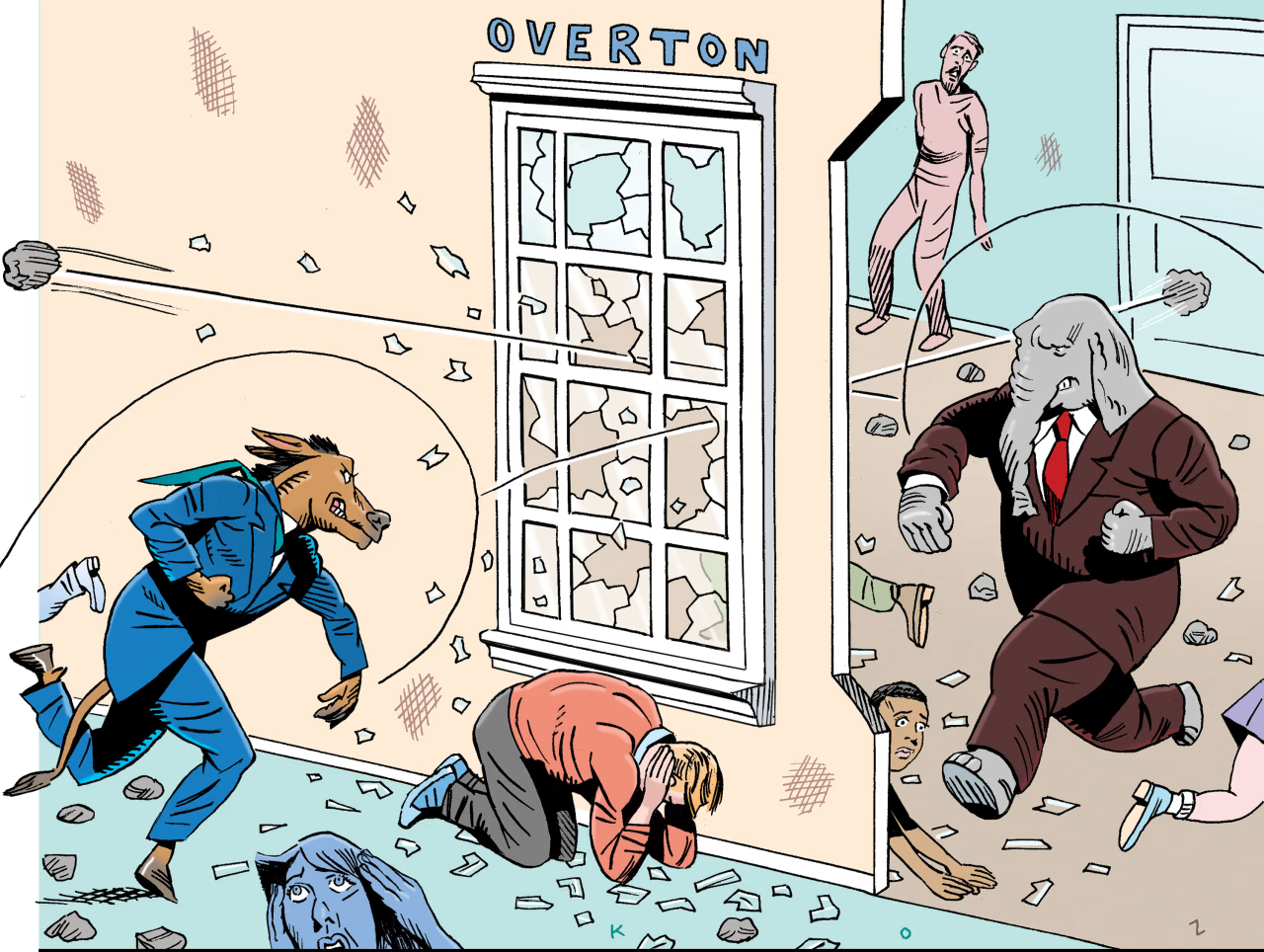
A Wall Street Journal op-ed argues that Donald Trump shifted the Overton Window (the range of socially acceptable political discourse) as a way to normalize radical left-wing ideologies associated with the Democratic Socialists of America. The authors of the article suggest intense opposition to Trump allowed mainstream Democrats to adopt previously fringe views. Read the full opinion piece by Clifford Asness and Aaron Brown from June 28, 2026 from the Wall Street Journal. [1]
This WSJ article has the subtitle description as “Democrats’ hatred for Trump led them to tolerate radical, vicious ideas that are colonizing their party is about the political concept.” (For more insights on the original 2010 novel by Glenn Beck, see The Overton Window. [2])
So, what are these politicians talking about?
The Overton Window is the range of subjects and arguments politically acceptable to the mainstream population at a given time. It is also known as the window of discourse. The key to the concept is that the window changes over time; it can shift, shrink, or expand. It exemplifies “the slow evolution of societal values and norms.” And it emphasizes that many observers do not even notice these shifts, while others are sounding the alarm bells.
The term is named after the American policy analyst and former senior vice president at Mackinac Center for Public Policy, Joseph Overton, who proposed that the political viability of an idea depends mainly on whether it falls within an acceptability range, rather than on the individual preferences of politicians using the same term or similar concept. According to Joseph Overton, the window frames the range of policies that a politician may recommend without appearing too extreme, in order to gain or keep public office given the climate of public opinion at that particular time.
Summary of Overton’s Idea
In the early 1990s, Overton described a spectrum from “more free” to “less free” with regard to governmental intervention, which he presented graphically on a vertical axis to avoid comparison with the left-right political spectrum. The concept assumes that these are “windows” of discourse. To extend the metaphor, the window can change in size and scale; however, they are clear and not fogged, tinted or opaque. And as the spectrum of discourse moves or expands, an idea at a given location on the scale may become more or less politically acceptable. Overton claimed that politicians typically act freely only within the “window” of those policies seen as acceptable.
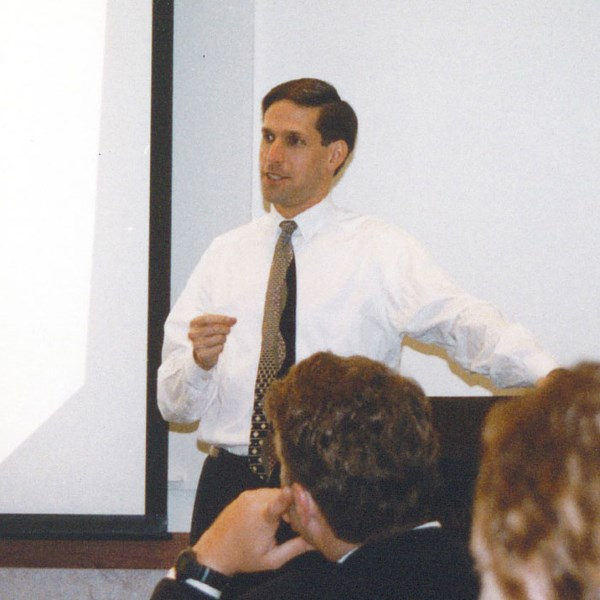
Sadly, Joseph Overton died in a plane crash in 2003. He was 43 years old. He passed away from injuries sustained when the aircraft he was piloting went down shortly after takeoff from the Tuscola Area Airport.
Joseph Lehman’s Enhancement
After Overton’s death, his colleague at Mackinac Center for Public Policy, Joseph Lehman, further developed the original ideas and named the Window after Overton.
In an interview with The New York Times, Lehman said:
“[The Overton Window] just explains how ideas come in and out of fashion, the same way that gravity explains why something falls to the earth. I can use gravity to drop an anvil on your head, but that would be wrong. I could also use gravity to throw you a life preserver; that would be good.” [3]
The most common misconception of the Overton Window is that lawmakers themselves are in the business of shifting the panes of glass. Lehman contends that this concept is absolutely false. Lawmakers are actually in the business of detecting where the window is, and then moving policies to be in accordance with it. Lehman presented the concept as simply a description of how ideas operate in public discourse, and not about advocacy of extreme policy proposals.
For Context: Joshua Treviño

The political commentator Joshua Treviño next added context to the Overton Window by postulating six degrees of acceptance of public ideas. “Roughly” stated, those degrees are:
- unthinkable
- radical
- acceptable
- sensible
- popular
- policy
On this expanded basis, the Overton Window comprises the politically possible ideas: those in the lower part of the list, from acceptable downward. Proponents of policies outside the window may then seek to expand the window, by highlighting their own proposals or others similar to them (or more extreme), or to shift the window by devaluing opposed ideas. Proponents of current policies, or similar ones within the window, might attempt to narrow the window by convincing people that policies outside the status quo should be deemed unacceptable. (See Treviño’s shifting degrees of acceptance of the Overton Window in the image above.)
Treviño emphasised that while this analysis originated on the political Right, and is mainly in use there, it is equally available to think tanks on the liberal Left of the political spectrum.
Think tanks on the political Right include The Heritage Foundation, the American Enterprise Institute , the Hoover Institution, the Cato Institute. Think tanks on the political Left include organizations such as the Center for American Progress, the Economic Policy Institute, the Center on Budget and Policy Priorities, and The Century Foundation.
The concept of a Window, similar to the Overton Window, is the acceptance of a shifting range of acceptability in any discipline. The concept has been applied in many areas of research and science that are unrelated to political policy, as far afield as neonatology.
Other Concepts from Wikipedia [4], similar to the Overton Window, worth considering in discourse:
- Anchoring effect – Tendency to base judgments on an irrelevant anchor
- Argument to moderation – Informal fallacy that the truth is always a compromise
- Comfort zone – Psychological state
- Creeping normality – Process by which a change can be accepted through happening slowly
- Door-in-the-face technique – Starting with an unreasonable offer to make the next one more appealing
- Hallin’s spheres – Theory of media objectivity
- Horseshoe theory – Posited similarity of the far-left and far-right
- Moral relativism – Philosophical positions
- Normalization – Social processes through which ideas and actions come to be seen as normal
- Opinion corridor – Theory of legitimate public discourse
- Paradox of tolerance – Logical paradox in decision-making theory
- Political spectrum – Visual analogy for political or ideological positions
- Ratchet effect – Restrained ability of human process reversal
- Sanewashing – Downplaying the radical aspects of a person or idea
- Single-issue politics – Political campaigning or support based on one policy goal
- Value pluralism – Idea in ethics; many principles are true at the same time
References:
[2] The original concept of the Overton Window is from the book with the same name: The Overton Window. Written by Glenn Beck, the concept was incubated and discussed at length at the Mackinac Center for Public Policy, and coined by Joseph Lehman. Overton was a lawyer, an ardent Libertarian, an American policy analyst, and the former senior vice-president at the Mackinac Center.
[3] Article by Lehman in the NYT: The New York Times

