
Word Smith: Savikalpa Samadhi
Q: What is it like to be in space? How do you feel? What do you experience?
Questions like these always seem to arise whenever we see dramatic space launches, like we did in April, 2026. The Artemis II capsule was dashing around the dark side of the moon. While the four astronauts did a great job explaining their tasks and the glory of the images ouside of their windows, we often grasp at metaphors to capture more deeply the human experience.
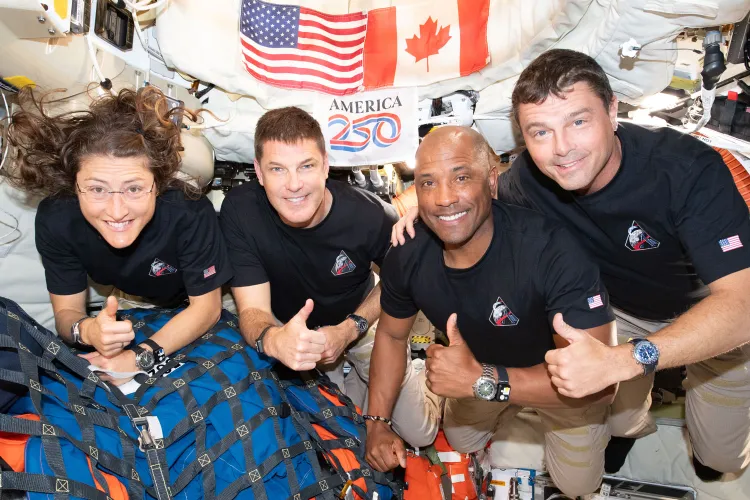
Artemis II astronauts described their lunar flyby using some emotional language, highlighting a “shift in consciousness,” and a profound sense of “fragility” when seeing Earth from the moon. They described the experience as “otherworldly,” “peaceful,” and a “transformational” perspective that highlighted human unity. Christina Koch called the planet Earth a “lifeboat hanging in the universe” and a “mirror reflecting you.” The crew had their own moments highlighting their intense, close-knit bond, with Reid Wiseman stating, “That’s the closest four humans can be and not be a family.”
The crew, including Victor Glover, also described the intense, “3D depth” of space and the overwhelming emotion of the trip, which required them to “lean into” the experience to process it.
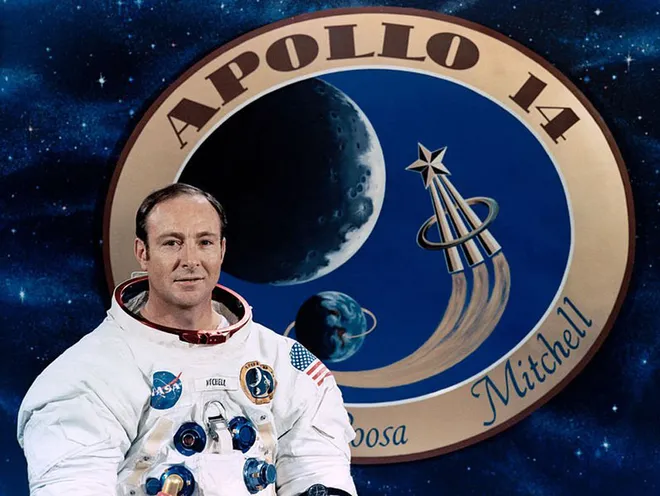
Apollo 14 and Sanskrit
In 2007, Edgar Mitchell, on the Apollo 14 trip to space, used the Hinduism and Yoga expression, Savikalpa Samadhi, a Sanskrit phrase to explain his “shift in consciousness,” while weightless. He was attempting to explain the connection he felt with the universe. His language helped portray the spiritual senses of awe, peacefulness, and unity that he experienced out there.
Savikalpa Samadhi literally translates to “absorbtion with differentiation” or “meditative state with options” (from Sanskrit sa = with, vikalpa = doubt/differentiation/modification, and samadhi = absorption/oneness). It represents a state of yogic absorption where the mind is focused on an object, but still perceives a distinction between the meditator and the object.
News outlets, such as the New York Times and Wall Street Journal, are often reluctant to veer from the scientific approach of the space launch, so the journalists do not force questions of religious faith (Hinduism or Christianity), spirituality, or rapture on the astronauts.
Perhaps it is time to go deeper into the experiences of interstellar travel to learn and hear what it is really like up there! Perhaps some Hinduism, Yoga and Sanskrit expressions are needed for us to understand what shift in consciousness is happening in space.
Bring it on!!

