
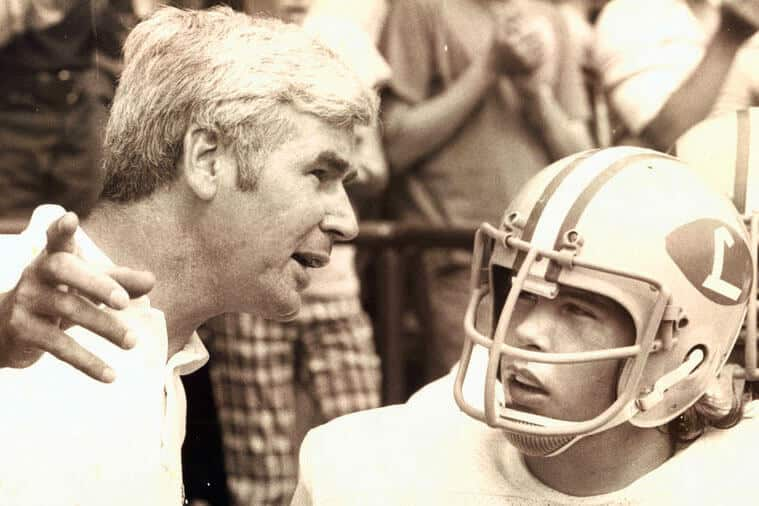
Witness Post: J. Joseph Brune, Jr.
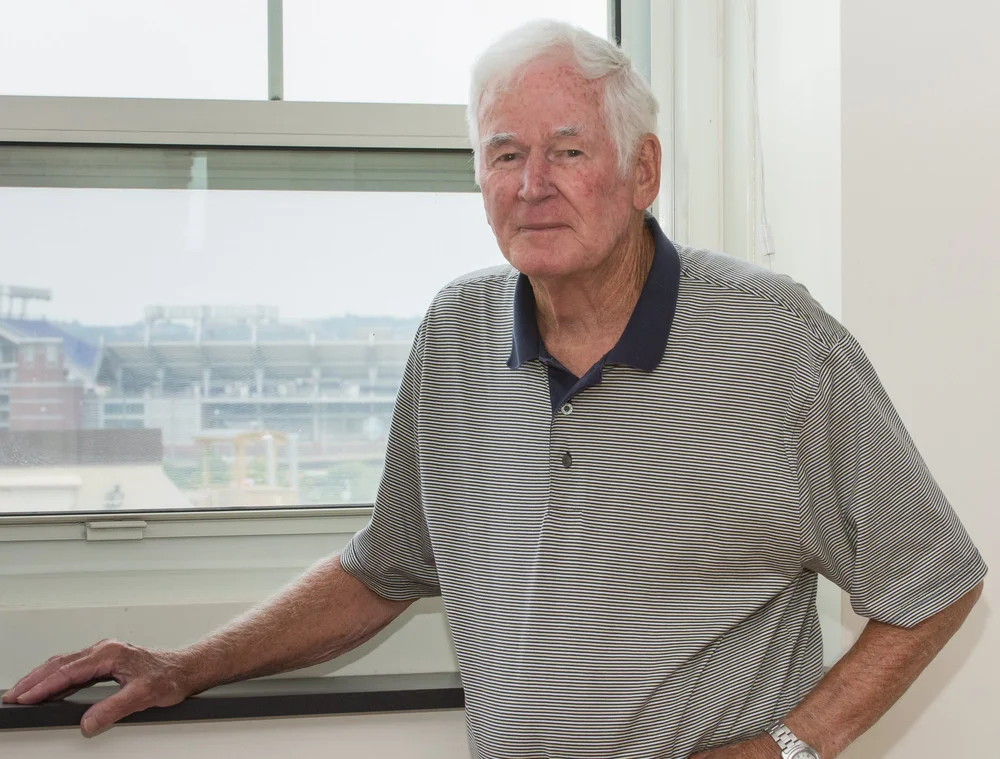
Standing on the sidelines of a youth girls’ lacrosse field, I was coaching and rooting for a team, which included two of our early-teenage daughters. The year was 2006 and the lax tournament was in Lake Oswego, Oregon. Across the field and cheering for the opposing team was a man immediately recognizable as my silver-haired high school football coach, Joe Brune. Yet, out of place / out of context, I could not square what he was doing there. When the game was over, I went up to the distinguished man and verified that this silver fox was indeed Joe Brune from Baltimore.
It turned out that his daughter, Meaghan Brune Davis, lived in Seattle, Washington, and she was with her daughter “and visiting father” at a Portland area lacrosse tournament for the day.
It was just like Joe Brune to be on the sidelines of a lacrosse game, as he had been my defense coach as a student at Loyola Blakefield in Towson, Maryland. And he was more famously revered as a head football coach. This Witness Post is a tribute to Mr. Brune: the teacher, the coach and the force for change. Plus there are some Joe Brune stories along the way!
Brune the Teacher
At Loyola in our era, the late 1960s and early ’70s, Brune was the head of the English Department and he taught Advanced Placement and Honors English to juniors and seniors. As a high school teacher and football coach, it was hard to make a living, especially while raising a large family. Most teachers considered summers as a critical time to fill in the income gaps and make money for their families. There were few ways to make “big money” in Baltimore, but since it was a solid blue collar town, if you were willing to sacrifice and put in the work, there were some enterprising blue collar jobs that paid well. One of those places was on the docks in the inner harbor. These were not the safest places in the city, but if you knew your way around, and were willing to work odd hours, you could make a lot of money. Joe Brune was one of those unusual men. He “made the time” to work as a longshoreman in Fells Point on holiday weekends and during the summers. At the same time he prepared the perfect lesson plans to help his English students understand poems by Emily Dickenson and Robert Frost, novels by James Joyce and William Faulkner, and plays by William Shakespeare and Tom Stoppard. He found these divergent passions to be perfectly compatible.
Brune guided each of his students with the same care and conviction that defined his coaching. He believed deeply in the power of language, the recognition of story, and the ability of each student. He was convinced he could help shape their desire to grow into their fullest potential. As a college counselor, Mr. Brune offered steady encouragement and wise counsel to young men, who were navigating one of the most formative moments of their lives. He seemed at his best, while helping them discern their paths beyond Blakefield.
Brune the Coach
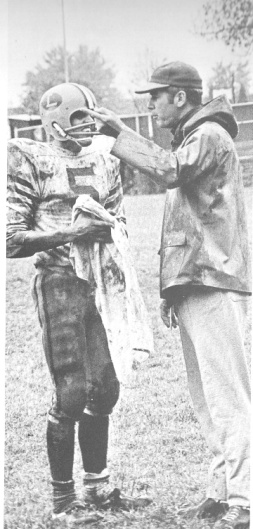
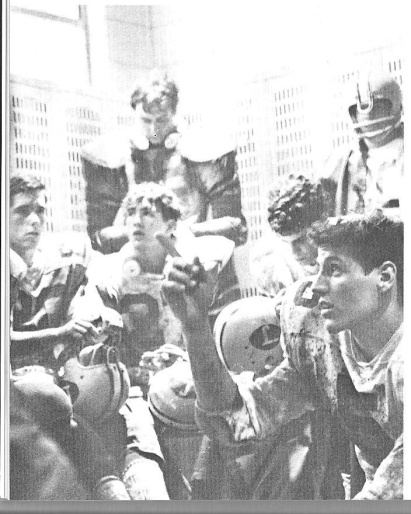
Coach Joe Brune, a scholar athlete in the class of 1952, returned to coach football and lacrosse at Loyola in 1967. He became the quintessential Loyola High School’s varsity football coach. He had some quotable ingredients that he used to keep it simple. Brune often reminded us of the eleven man team concepts during weekly film reviews of the last game: Offense was all about short bursts of energy; explosiveness in execution; and intense focus on timing. Defense was all about controlled aggression, reactive power, watching for offensive clues, and making the perfect tackle. [Tackling, by the way, was the art of putting your “hat” or helmet on the ball, wrapping your arms around the mid-section of the ball carrier, and driving the runner to the ground.] Brune and our assistant coaches would point out the good versus the poor execution in excruciating detail. Practice sessions consisted of repetition of those ingredients: practice makes perfect and perfection wins games.
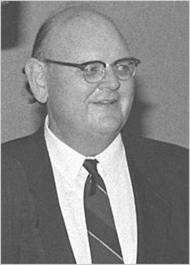
By the late 60s Brune was a veteran football coach, having played college football at Bucknell and having spent several years studying coaching under George Young at Baltimore’s City College. City, back then, was one of the most successful high school football programs in the state. Young was a standout athlete at Calvert Hall College (a high school) in Baltimore, and then at Bucknell. He entered into the NFL draft in the same class of 1952 as Joe Campanella, Sr. Both Young and Brune had played ball in college along with a slew of other athletes, including Nick Schloeder (tennis and football coach and AD at Gilman School, Baltimore) and Marty McKibbon (English teacher/tennis coach at McDonogh School, Owings Mills). All of these men grew up with their teams and proved capable of coaching high school powerhouse programs.
George Young went on to play pro football and later he became the VP/GM of the New York Giants. He was heralded as a Hall of Famer and as an executive in the NFL. The gymnasium at Calvert Hall is named in honor of George Young.


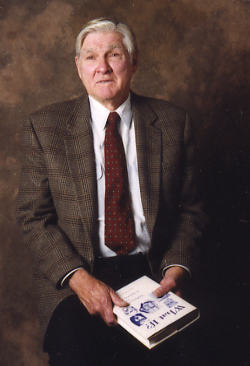
Coach Brune was a George Young protégé and he often gave major credit to Young for his coaching style. Brune also brought some ideas and techniques of his own. To Brune’s way of thinking, what better way to accomplish superior offensive and defensive play than by drilling, with or without the rest of the team on the line? And the backfield can even drill without the offensive line! Small clusters of players can spread out and drill all day long. But how does a coach effectively and realistically simulate an offensive line and the defense without 22 players on the field?
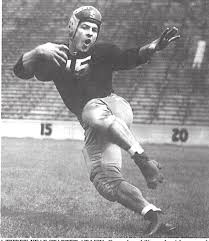
The Tapes Story
To explore the idea behind the tapes story, imagine a line on the field that is not made of lime powder (like the typical white yard markers) but printed in such a way that you could take it up and put it down anywhere, anytime. The line would simulate the spaces between players on an offensive line. Such a portable tool has a few challenges: how do you secure the line to the field and not trip on it? How do you make it durable enough to withstand constant cleats and all that mud? And how do you store it? Brune discovered his “tapes” in Fells Point in Baltimore harbor.
Well, that takes imagination. Brune’s imagination brings to mind “the tapes” story.
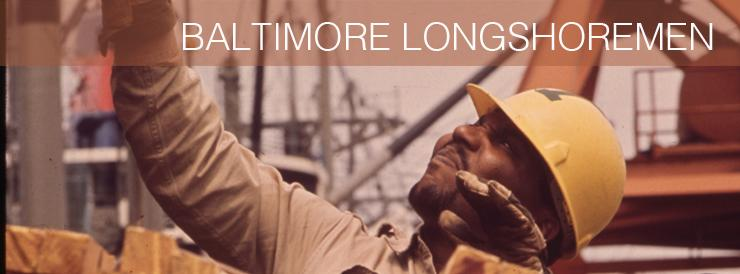
As a dock hand and longshoreman, Coach Brune developed a good relationship with the dockworkers who served as the pier firemen. Brune earned a reputation as a hard worker and he had developed a relationship with the dock fire chief. One day he asked for and was given some old and leaky canvas-covered hoses, that needed to be replaced. For fire protection, the new hoses were ideal because they rolled up neatly in out-of-the-way places, and would easily expand when attached to a hydrant and filled with water. The old hoses leaked a bit, but would work for Brune’s purposes.
One nice aspect of these hoses is that when dry, they lie perfectly flat. Brune cut the old hoses into strips about twenty feet long, put stakes in each end to secure them in place and painted bright vertical lines on them, representing “holes” for the center, two guards, two tackles, and two ends. These canvas and rubber strips became “the tapes.” A quarterback, running back, and fullback could line up on the tapes and drill power plays and bellies, counters and sneaks without needing linemen. The imaginary players were simulated by the slots painted on the hose. The faster the quarterback can get the ball to the halfback, and the faster the fullback can lead the way into the hole, the better the execution, and the more yardage could be gained. Simple, right? While the linemen were off practicing blocks, and shoving the sled, or drilling versus the bags, the backfield was getting the timing of these critical running plays down to routine execution.
In August of my junior year at Loyola (1970), we were playing summer football and “running the tapes” with the other offensive backs. Quarterback John Baer was drilling with fullback Ken Smith (Smitty), and running back Joe Campanella (Campy). Kenny Kopro and Fred Cook would alternate with Campy, and I would alternate with Smitty. We would work for hours, drilling to improve the timing and execution among the call, the snap, the hand-off, and the run. I learned quickly that if I wanted to block for Campy, it was best to move fast and keep running to avoid being trampled.
Nearly every day, before practice you could find Campy pulling out a rolled up hose of tape from the container and shoving the stakes on each end into the ground for some practice. That portable offensive line was part of his consistent routine. There were several sets of “tapes” ready for anyone who wanted to go out and drill on his own. Few backs, except Campanella and Baer, ever volunteered without a “personal invitation” from Coach Brune or the assistant coaches.
We would practice for hours, drilling to get the timing among the call, the snap, and the hand-off. Those Maryland summers were steamy in August, even in the early morning. Humidity was about 75 percent and the temperature about 75 degrees at 9 AM when practice started, in preparation for those double sessions. The temperature would settle in the mid 90’s by mid-afternoon. Many mornings Campy was out there on his own, or with Baer, dressed in football pants, jerseys and helmets doing drills on the tape. Even from the locker room, you could hear Baer shout: “Even … Set!”, and knew from the echo that those guys were already at it. They would be sweating and grunting long before the rest of us arrived. I was so tired from the double sessions from the day before, I had no compunction to arrive early and join them, as they seemed to be on a separate mission. By the afternoon sessions the humidity was at about 90 percent and the sweat would be pouring off us. Salt pills and water breaks were critical parts of the regime.
After the second practice session, as it started to cool down, Campy would occasionally call Baer out for some final drills. “Odd … Set!” The rest of us were already out of the shower by the time they came into the locker room at the end of their drills. We knew that the extra time that they spent on the tapes was not to impress Coach Brune, and it was not about showing up the rest of us. It was about getting the timing and intensity perfect. With Coach Brune making the calls and Baer and Campanella drilling away, the rest of us were along for the ride.
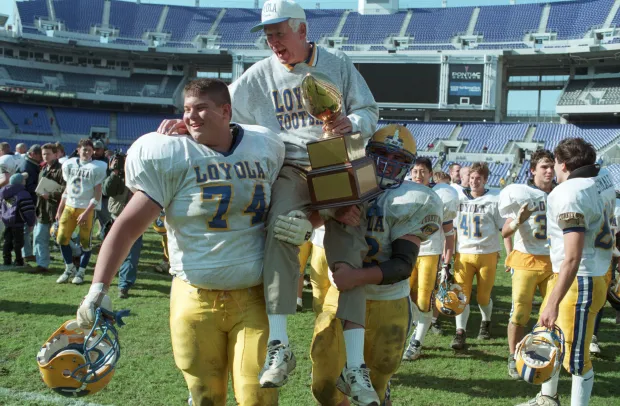
Under Brune’s leadership, Loyola football secured five MSA/MIAA Conference Titles and 19 unforgettable Turkey Bowl victories—accomplishments that reflect not only his strategic brilliance, but the discipline, accountability, and heart he instilled in every player who wore the Blue & Gold.
His legacy is captured beautifully on the plaque beside his bust overlooking Ed Hargaden Field, dedicated in 2015: “A coach who preached hard work, dedication, and accountability – Few have loved Loyola more.”
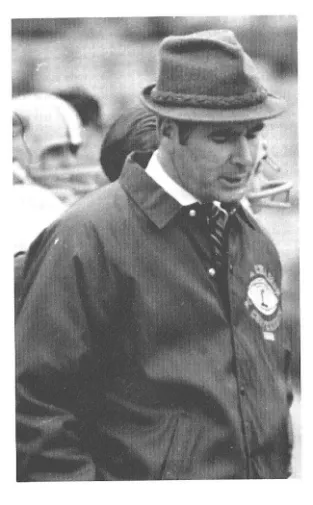
In recognition of his exceptional leadership and devotion to the school he loved, Joe was inducted into the Maryland Football Coaches Hall of Fame (1999) and became a member of the Inaugural Class of the Loyola Blakefield Hall of Fame (2002). He received Loyola’s highest alumni honor—the Rev. Joseph M. Kelley, S.J. Medal—in 2010.
Brune the Force for Change
In our senior year (1971-1972), all of the teachers were encouraged by the Loyola administration to “think out of the box,” about the school’s mission “Men For Others” within Jesuit education. Mr. Brune’s class was an advanced placement English class and the assignment was on public debates. Brune stated, “Now you will be expected to come up with an argument for or against a particular social issue of your choosing.” He gave us three choices: political boundary gerrymandering, redlining of home ownership, or destruction of certain neighborhoods through eminent domain. Not knowing much about these topics, we were encouraged to research the topics and choose one for a multi-page research paper describing the situation and presenting a thorough argument for both sides.
To get our creative juices flowing on these topics, Brune encouraged each group to “go downtown, go to the neighborhoods, and talk to people.” School outside on the streets of Baltimore? Yes! He wanted us to see for ourselves what the pros and cons of the issues would mean to the people who lived there.
Several classmates joined me in the Fells Point/neighborhood destruction debate. What we had not realized was that as a summertime employee at the docks in Fells Point, Brune was a seasoned longshoreman. He knew a lot about the turmoil that had erupted around the “finishing of the Beltway” debate. The Maryland state highway authority and DOT put on the ballot an initiative to extend the highway through the Inner Harbor. That extension would demolish residential and commercial neighborhoods as well as the docks in Fells Point. As voters in the upcoming elections, the impact of our research seemed important, so we took it seriously.
Off we went by car to talk to people. Several things struck us: 1) Most people were willing to talk, but they were more curious why we were “roaming the streets and not in school,” rather than the purpose of our research project. 2) The local residents who we interviewed at restaurants and bars were all opposed to the highway extension. And 3) those who were visitors to Fells Point and not residents fell into two categories: either they needed more information, or they were all FOR progress saying, “Yes, finish the Beltway. A belt has to buckle to a close, right?”
Instead of lecturing us on a topic he knew well, Joe Brune had encouraged us to “gather the facts,” and then “present the pros and cons of the argument,” taking one side in the debate. The novelty of the assignment was revelatory to us and we all gained tremendous insight on how to research a topic and how to write an argument. The written work became personal and we talked in class about what we had learned. All of us seemed more connected with the process of writing an argument than we could have imagined at first.
[By the way, all of us who went to Fells Point, wrote our final argument AGAINST the Beltway extension. See the Appendix for more images and insights.]

J. Joseph Brune, Jr. Beginnings & Endings
John Joseph Brune, Jr. was born in 1934 in Baltimore, Maryland, the son of John Joseph Brune, Sr. and his wife, Virginia. Joe, Jr. grew up in a family that was deeply rooted in the Catholic community. His siblings include Sr. Virginia Marie Brune (SSND), David Brune, Jerome Brune and Mary Frances Brune Johnston (who predeceased Joe). Both Joe , Jr. (LHS ’52) and his younger brother David (LHS ’58) were graduates of Loyola High School in Towson, Maryland.
Joe Brune had a strong bond of classmates and teammates, with whom he spent most of his free time. That Don crew consisted of Charlie Meade, Pickett Riehl, Buddy Orendorph, Justin LaPorte, Phil Brady, and Connie Buedel, among others. That crew was pictured in a human pyramid in their yearbook. They all had earned good grades and attended colleges such as Buchnell, Loyola College, Univ. of Maryland, Towson State, and the US Military Academy in West Point, NY.
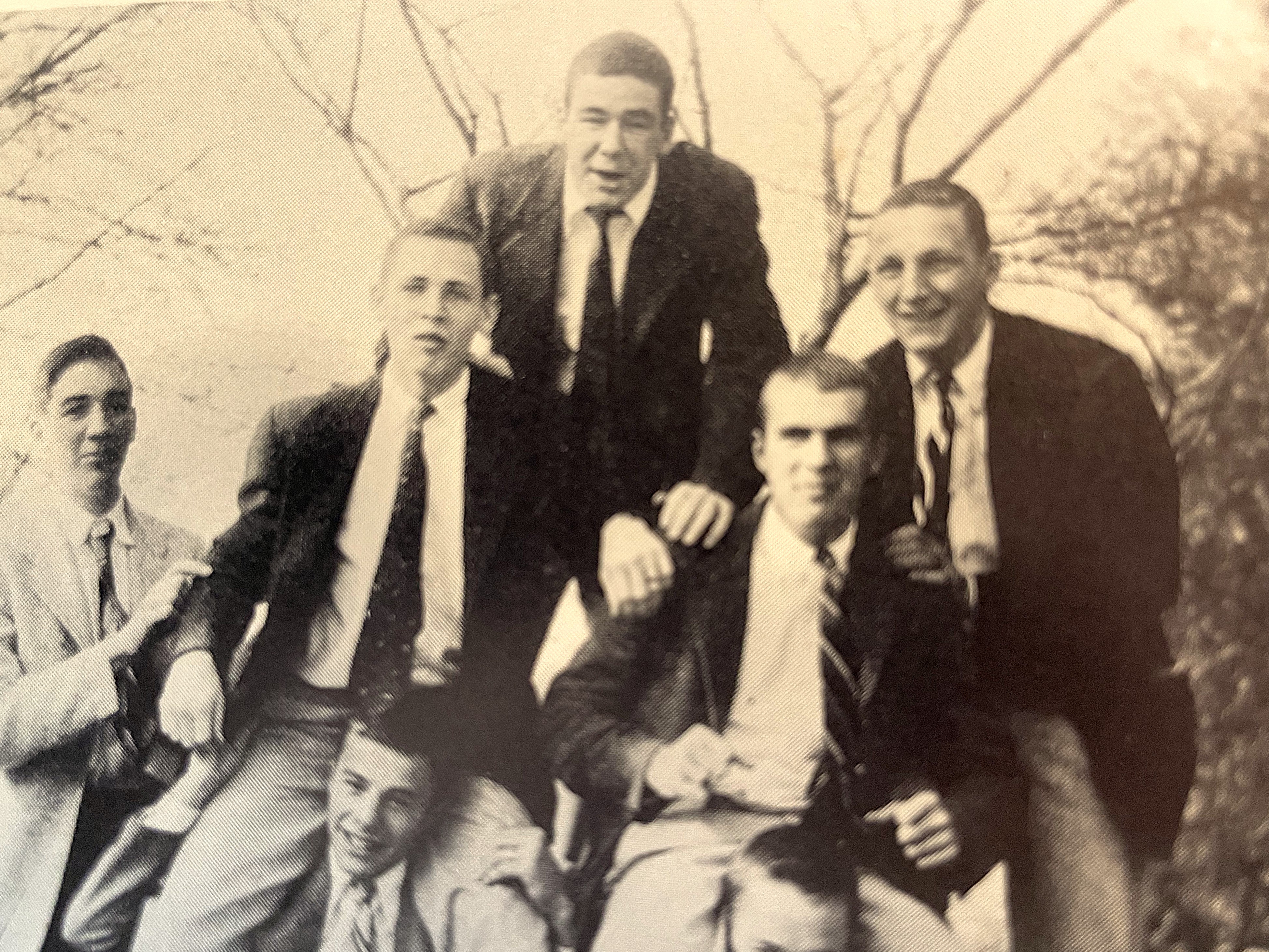
As a teacher, Joe Brune was always known for his humility, discipline and deep impact on Loyola students. All during those years and for decades afterwards Joe and Shiela Brune could be spotted on Sunday mornings for mass at St. Ignatius Church in downtown Baltimore. The pastor for many years was Rev. William J. Watters, S.J.
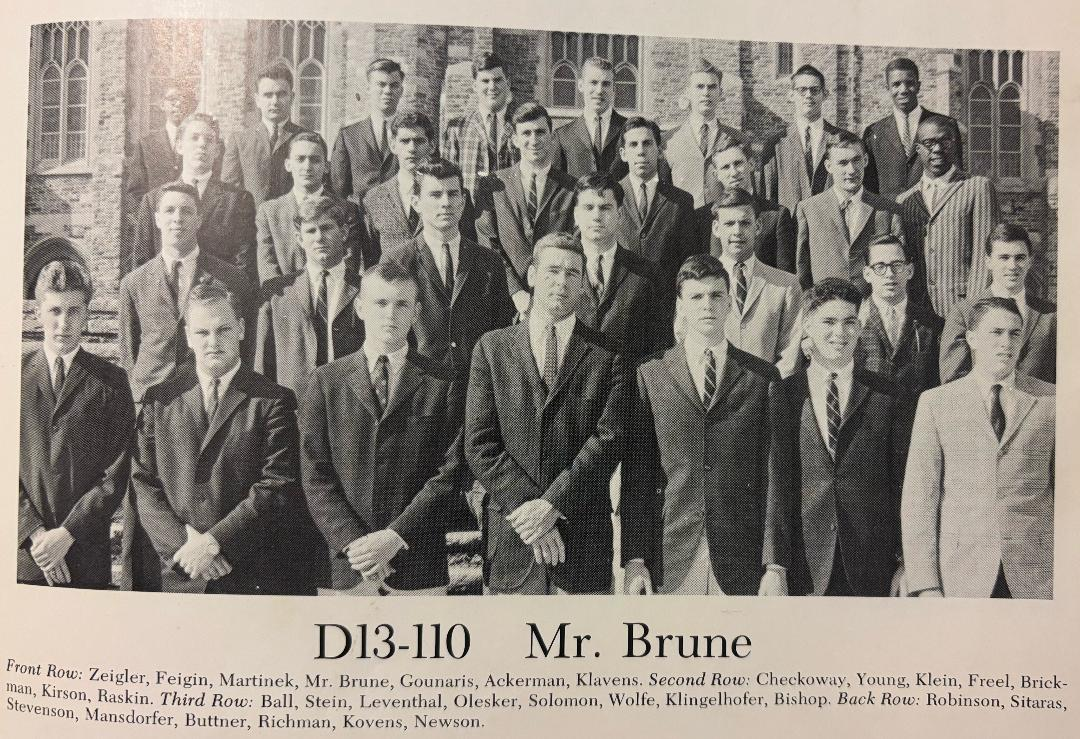
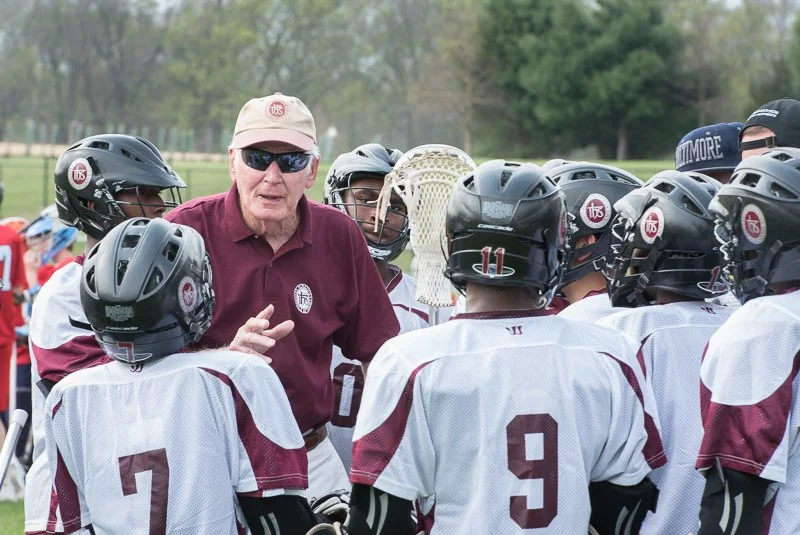
After retiring from Loyola Blakefield in 2002, Brune volunteered and eventually joined the faculty at St. Ignatius Loyola Academy, where he taught English literature and public speaking, and coached boys lacrosse. “He made an amazing difference to the boys . . . He was always asking ‘what else can I do to help our boys become men,’” said Fr. Bill Watters, S.J.
The Magis Dinner
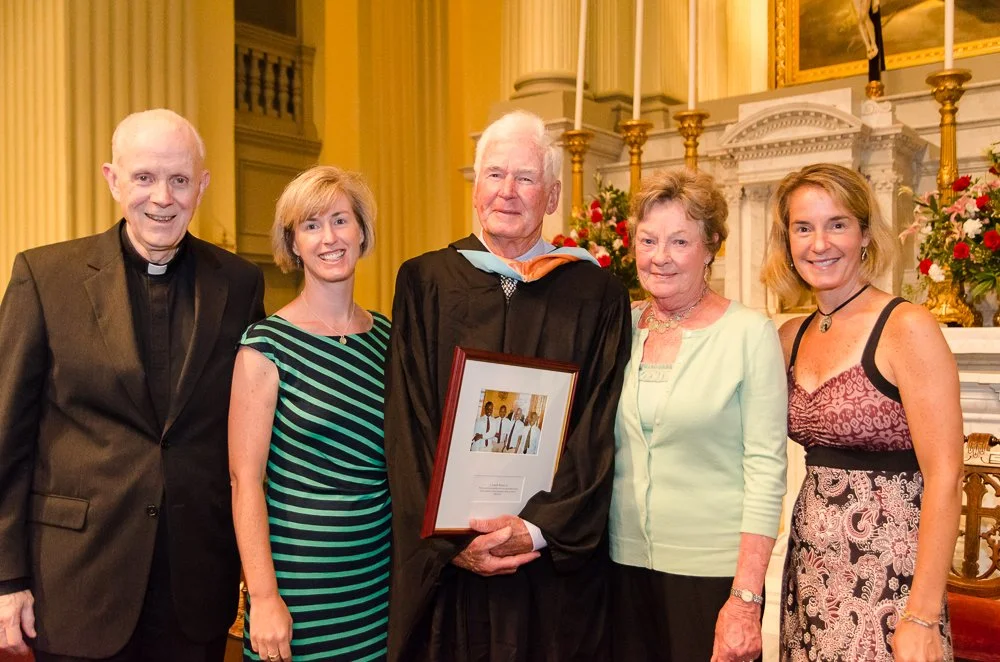
Fr. Watters was the emcee of a dinner in March, 2023 that honored Joe Brune for his years of service. Watters presented the award bearing his own name.
Magis is a Jesuit concept meaning more or greater. Particularly doing more for God and others. The award recognized Coach Brune’s accomplishments as a teacher, coach, mentor, and role model. His was truly a lifetime of service, a man for others in the Jesuit tradition.
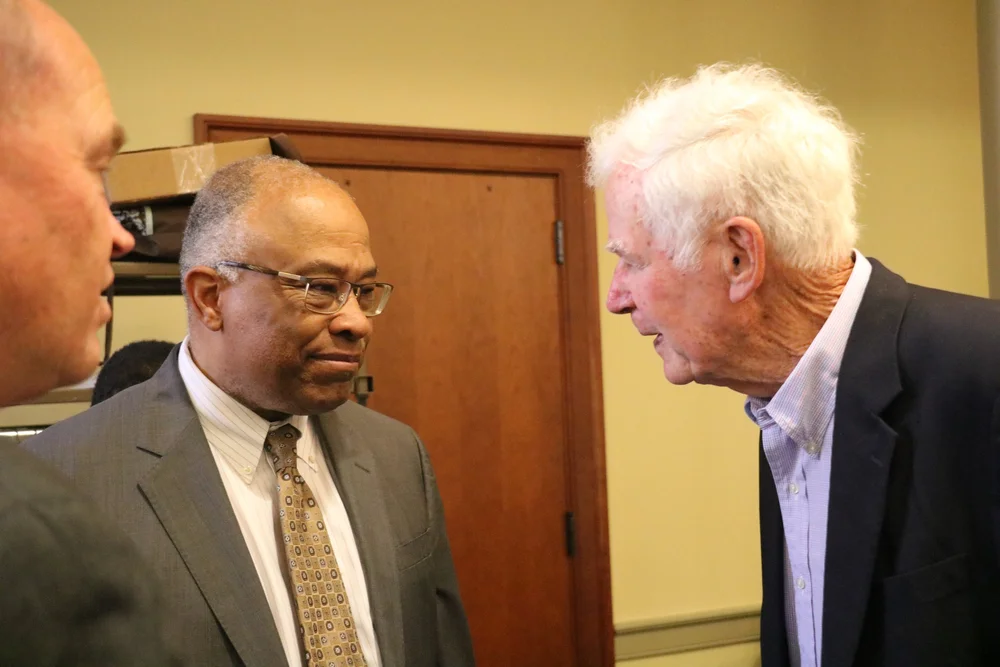
“We were so blessed to be coached by Joe Brune,” said Kurt Schmoke, former Mayor of Baltimore and now president of the University of Baltimore. Schmoke had played football and lacrosse for Coach Brune at City College High School, where he first taught and coached. When Brune moved to Loyola, Schmoke also helped defeat the Dons with his quarterbacking skills. Schmoke slashed out many rushing yards and threw two touchdown passes to City all-star tight end, Tom Gatewood, who carried half the Loyola team defenders down the field.
“Coach Brune stressed physical toughness, mental discipline and never give up and never give in,” said former Loyola Blakefield running back Bill Stromberg, Class of 1978, in one of several testimonials. As he and many others said, Coach Brune positively impacted thousands of lives on and off the football field, in and out of the classroom.
“Actually, the award means a great deal to me and to my family,” Brune said that night. “I appreciate all the nice things you said about me.” He added that teaching middle schoolers at St. Ignatius Academy was one of the “greatest experiences of my life.”
Among the guests were the presidents of Baltimore’s Jesuit institutions who joined Father Watters to raise a glass to Coach Brune, toasting him as “the embodiment of Jesuit character.” They are Terry Sawyer, Loyola University Maryland; Bill Heiser, Cristo Rey Jesuit High School; Anthony Day, Loyola Blakefield; and John Ciccone, St. Ignatius Loyola Academy.
The evening also included the launch of The Campaign for The Loyola School, to pay for the construction underway on five rowhouses across from St. Ignatius Church. They will be converted into 10 classrooms, a library, a chapel, an assembly hall, and more. Because of the generosity and commitment of the trustees and their guests, the campaign raised nearly $700,000 from the award dinner. The campaign was far from over, still needing $2.3 million to pay for the construction, said Board President Joseph Lombard.
“Without you and without your support, we could not do what we are doing at The Loyola School,” said Father Watters. The Loyola School proudly honored retired coach and teacher J. Joseph Brune with the inaugural William J. Watters, S.J., Magis Award during a festive double celebration March 30, 2023. The event, hosted by The Loyola School Board of Trustees, also marked the kick-off of a larger fundraising effort to raise $8.2 million to expand the school into five reconfigured rowhouses on Madison Street.
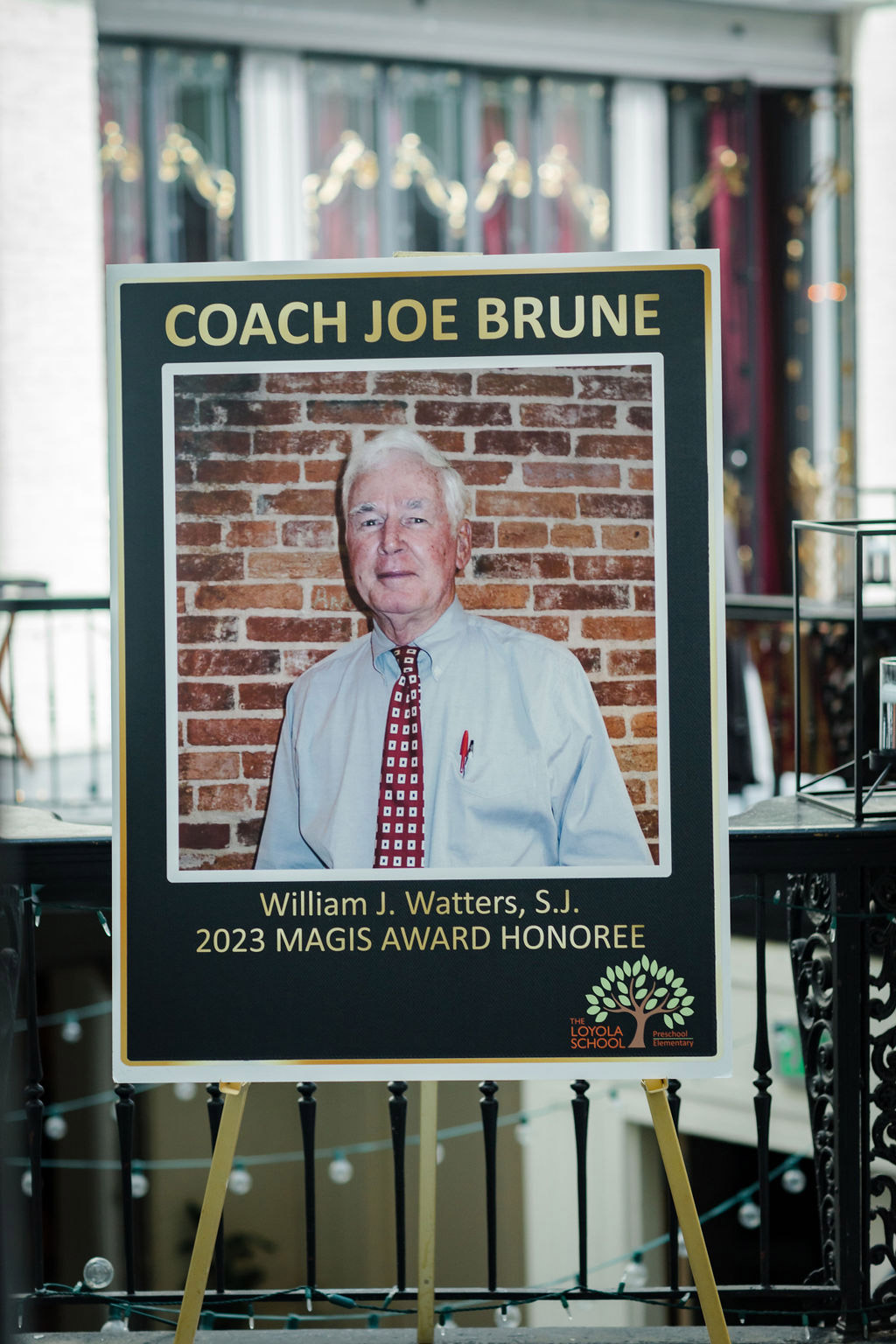
The evening ended with a surprise announced by Father Watters: “It is my honor, too, to announce that Coach Brune will be further honored and remembered – with a classroom named for him, the J. Joseph Brune Classroom, in our new building.”
APPENDIX
The Fells Point Debate:
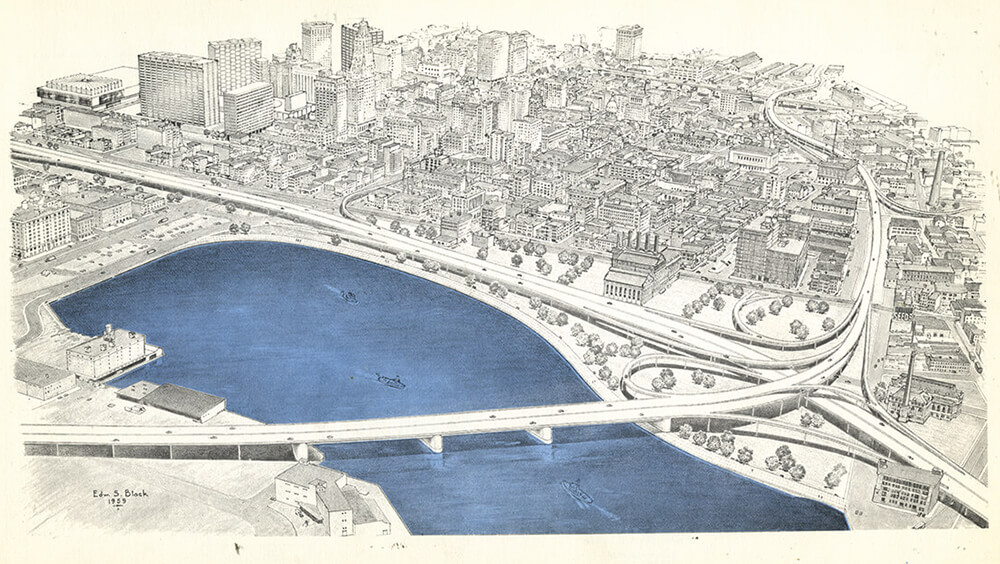
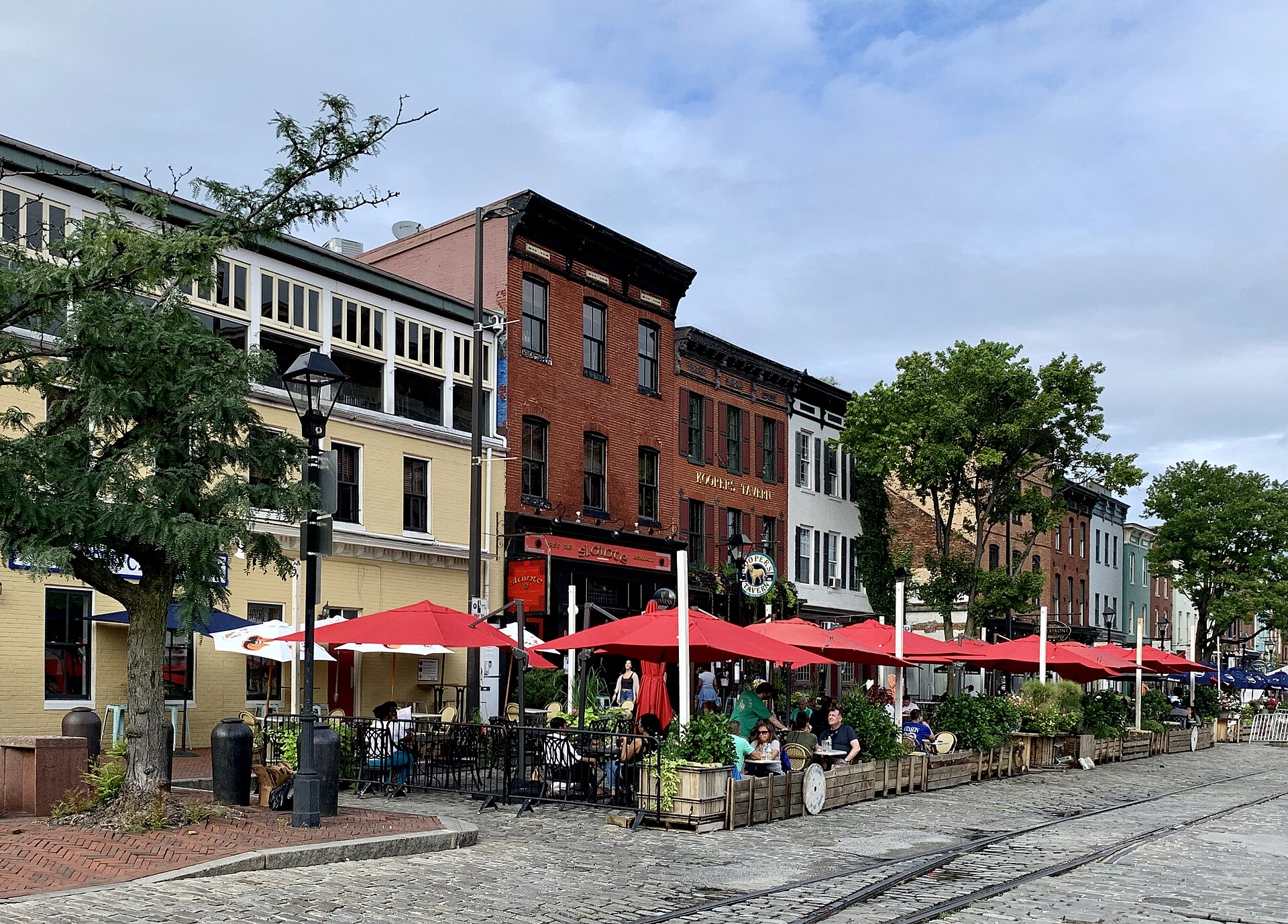
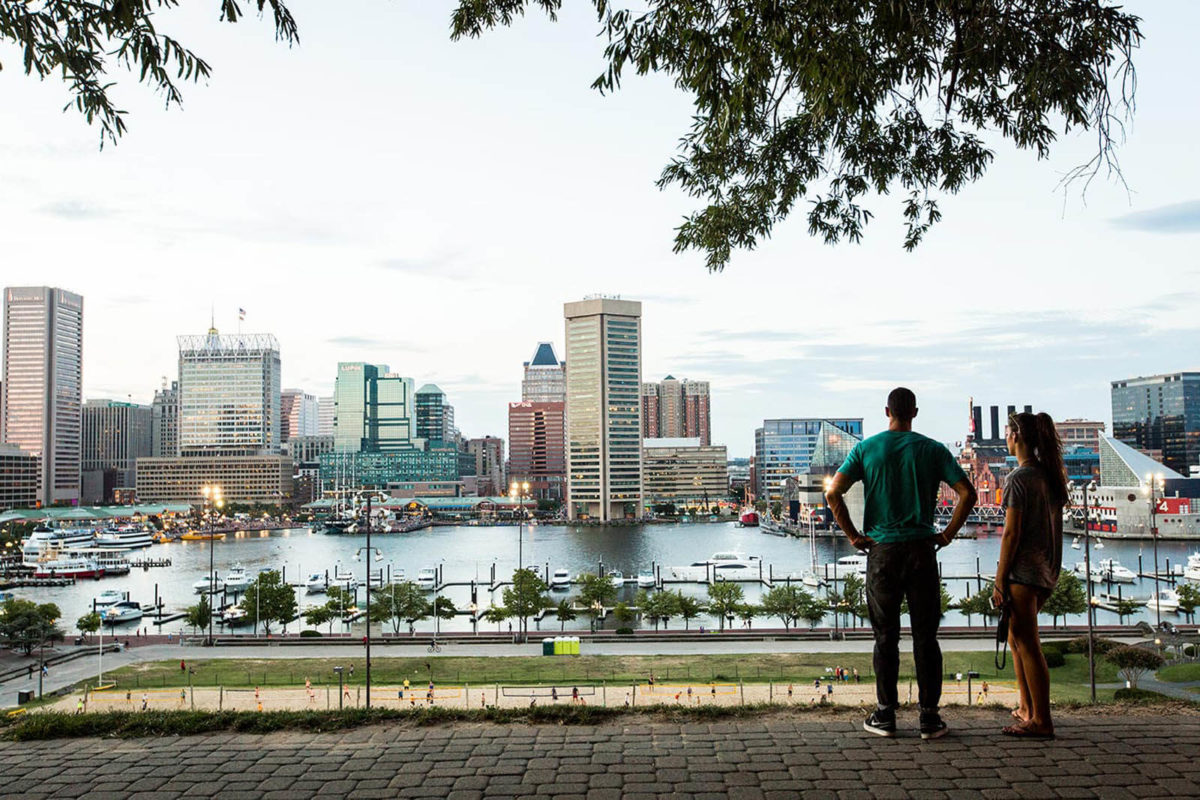
Fells Point in Baltimore was spared from destruction in the late 1960s, rather than destroyed, due to intense community activism against a proposed I-95 expressway extension. The “expressway revolt,” led by activists and the Society for the Preservation of Federal Hill and Fell’s Point, stopped the highway from cutting through the waterfront community, saving its historic structures, and the homes and shops of the harbor residents.
Key Aspects of the Fells Point Expressway Battle:
- The Threat: In the 1960s, city planners intended to run a raised highway through Fells Point and across the river to Federal Hill, which would have demolished homes, shops, and disrupted the waterfront.
- Resistance: Activists, including a young Barbara Mikulski, organized protests, created a “Fun Festival” to raise funds and awareness, and worked to halt the “bulldozers”.
- Preservation Success: The fight was won when the community successfully placed Fells Point on the National Register of Historic Places in 1969, making it illegal to use federal funds for the project.
- Recent Preservation Challenges: Modern threats to the historic district have focused on infrastructure, such as in 2025, when advocates criticized the city for using asphalt to patch the historic Belgian block streets, violating historic preservation guidelines.
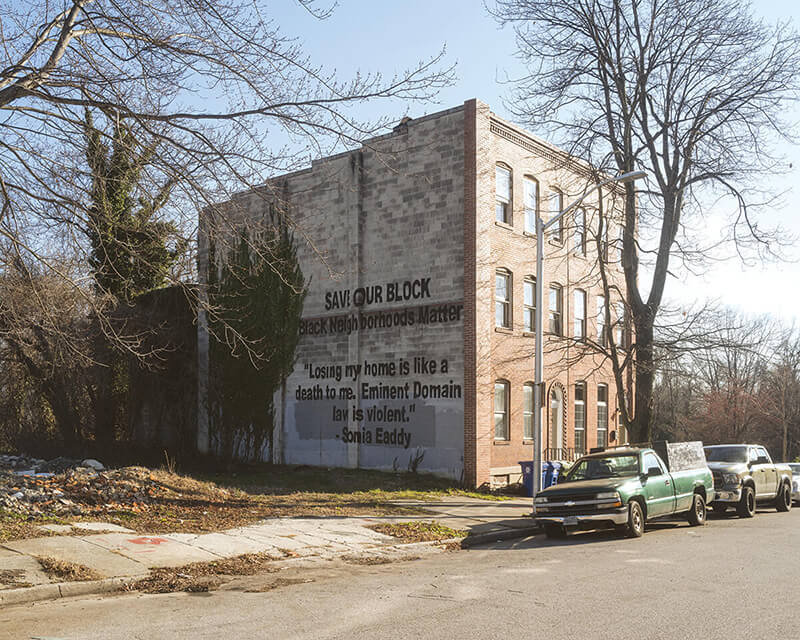
Unlike Fells Point, other Baltimore neighborhoods (like those affected by the notorious “Highway to Nowhere“) were destroyed by similar highway projects around the country in that era.



https://www.wmar2news.com/turkeybowl/turkey-bowl-100-joe-brune
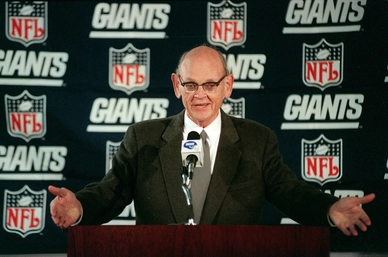
[4] https://en.wikipedia.org/wiki/George_Young_%28American_football_executive%29
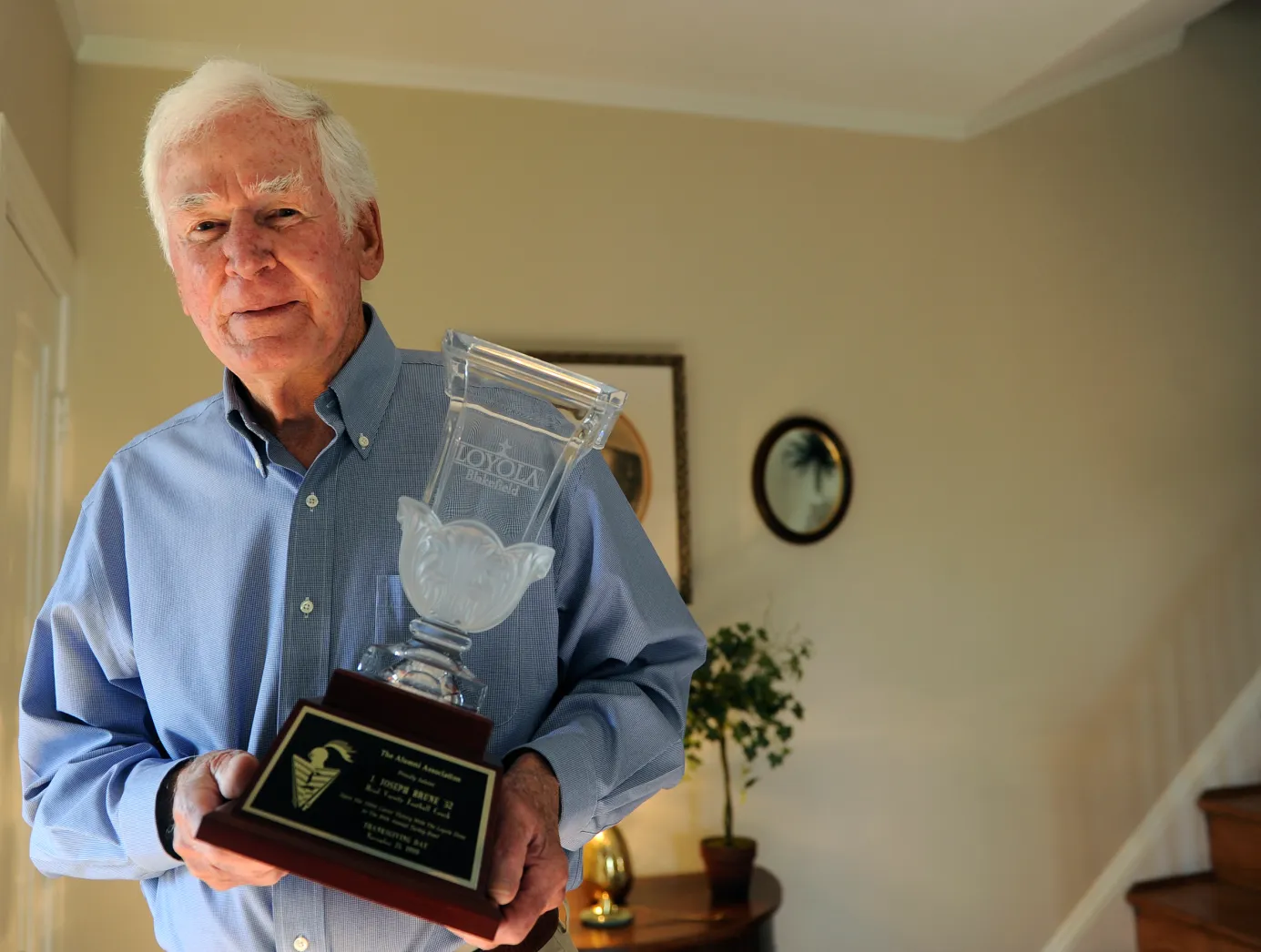
Article about Joe Brune by Michael Olesker
Joe Brune slips away, at 91, and leaves behind several decades of former schoolboys who remember him as their high school English teacher, football and lacrosse coach, and role model for a living, breathing municipal statue.
He had that kind of bearing. I knew him for 65 years and, for most of them, he seemed ageless. He was tall and muscular and lean, and had a thatch of hair that started graying in his 30s and turned white but never a follicle that deserted him.
He was so soft-spoken that it seemed to contradict his strict command of an athletic field. Out there, he was a rock. He coached football for about 35 years at Loyola Blakefield, where he led the Dons to a bunch of conference championships and 19 Turkey Bowl victories over rival Calvert Hall.
Before that, he spent most of a decade at Baltimore City College, where he coached the varsity lacrosse team and junior varsity football. Typical of Brune, when he got the lacrosse job, he said he wasn’t sure he could handle it.
“I know there’s a lot of talent on this team,” he said, “but I don’t know if I’m good enough to bring it all to life.”
Turned out, he was plenty good. In his second year, his 1962 City College outfit was the last public school lacrosse team to win the Baltimore area championship generally dominated by private schools.
That underdog ’62 City team beat a powerful St. Paul’s team, 7-5, on a sunlit afternoon at the Johns Hopkins University’s Homewood Field when Jerome Schnydman raced half the length of the field for a last-minute clinching goal.
That team included such prep legends as Steve Levy, Mike Oidick, Richard Alter, Joel Shaivitz, John “Butch” Fisher, Charlie Meadowcroft,[5] and a future U.S. congressman named C.A. Dutch Ruppersberger.
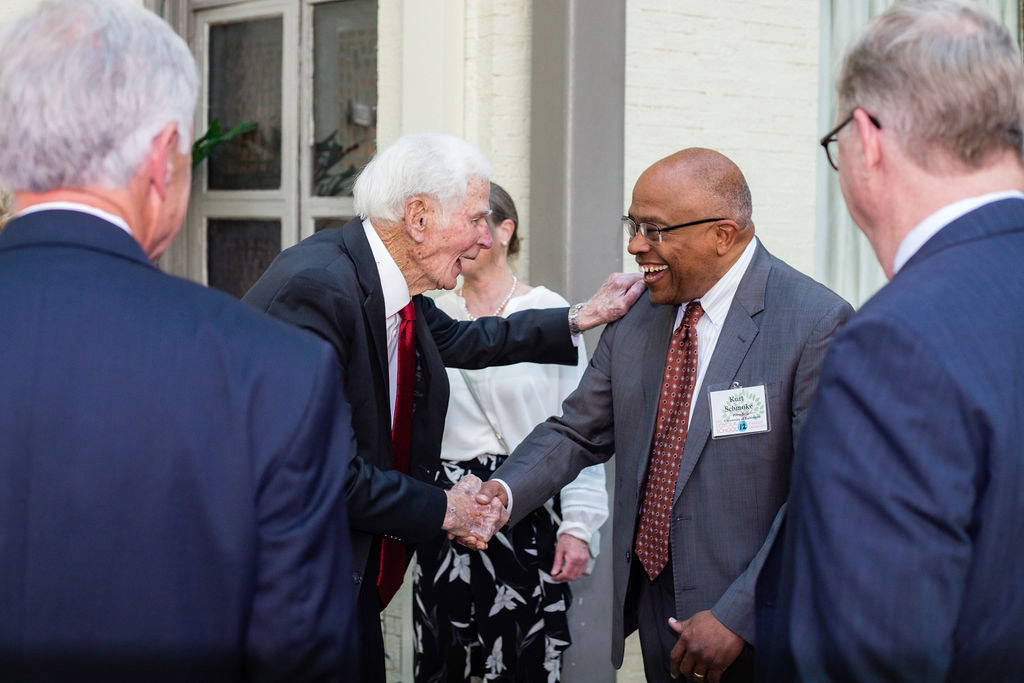
Brune was my homeroom teacher for two years at City College. I don’t remember him ever raising his voice, because he didn’t have to. He had a quiet strength about him that said, You don’t want to make this guy angry.
He had solid beliefs as well — and you paid attention, whether you agreed with Brune or not. In those days, school kids everywhere recited The Lord’s Prayer as part of their opening exercises.
On the morning after the U.S. Supreme Court outlawed organized prayer in schools, Brune marched into homeroom, firmly declaring, “I don’t care what that court said. In my homeroom, we’re doing The Lord’s Prayer.”
He was a man of faith, and of values, and no puny Supreme Court was going to tell him how to run a classroom.
It was George Young who brought Brune to City. Young coached varsity football and later became the general manager who led the New York Giants to a Super Bowl victory. Brune coached jayvee football. They were a couple of tough-guy coaches and good friends.
I was covering the football team for City’s weekly newspaper, The Collegian, in 1962 when the team only won two games. Every week, I had to write that the football team looked terrible once again. Apparently, my coverage displeased Coach Young.
Every week, I’d walk into homeroom where Brune would look my way with a sorrowful expression and say, “Uh, Mister Young would like to see you upstairs.”
In front of his entire homeroom class, Young would then bawl me out for writing bad stuff about his football team. It was years later that I bumped into Young when he was an assistant coach with the Baltimore Colts.
“I don’t know if you remember me or not,” I said.
“City College,” Young said. “I used to give you a tough time, didn’t I?”
Not really. What he and Joe Brune were both teaching was a set of standards. They were pretty high standards, and we were free to follow them, or not. But they were guideposts to life, and you paid attention to them.
Joe Brune spent decades holding those standards high for the boys at Loyola and City College. He leaves us now, but his values stay with us.
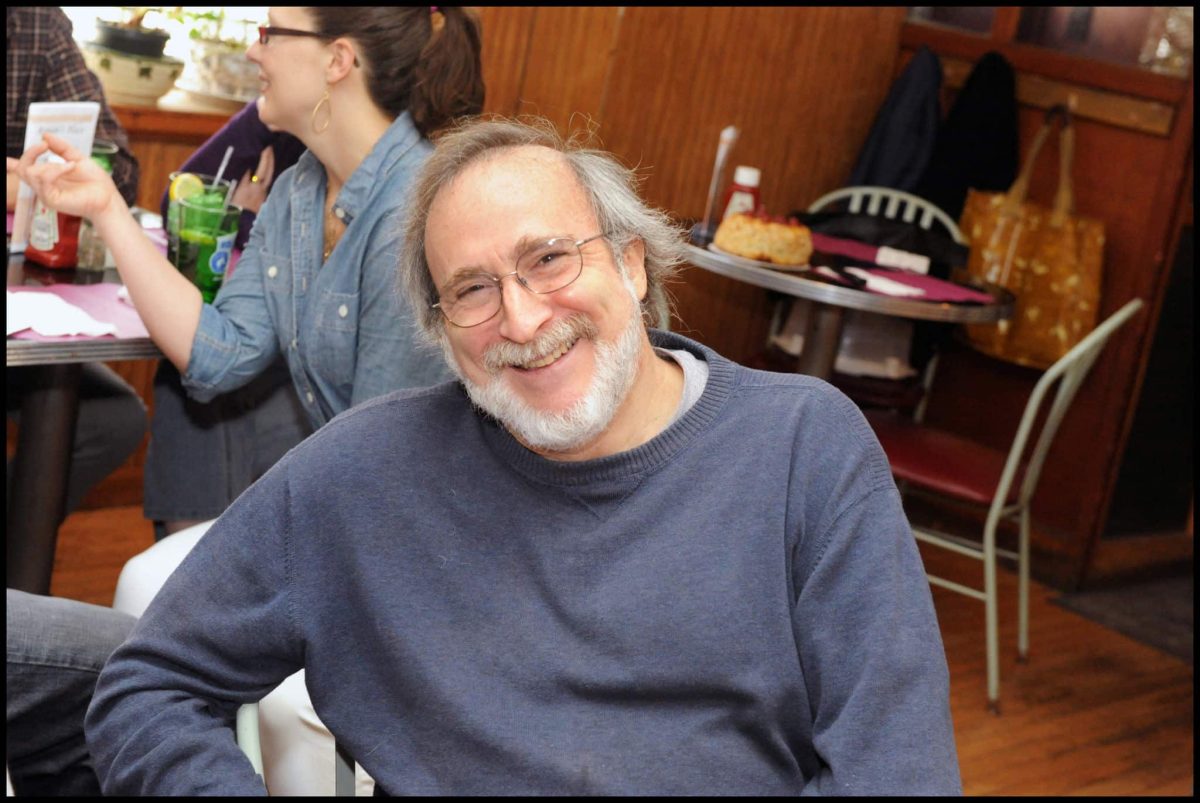
[5] Charlie Meadowcroft migrated from City College to coach football at Loyola Blakefield under Coach Brune. Charlie’s younger brother, Art Meadowcroft, was a three year varsity starter at Loyola. He was next a physical force at the University of Minnesota and the pros. The Meadowcrofts always felt challenged to be better football players and better men, under Coach Brune.

