
Witness Post: Chuck Wagon
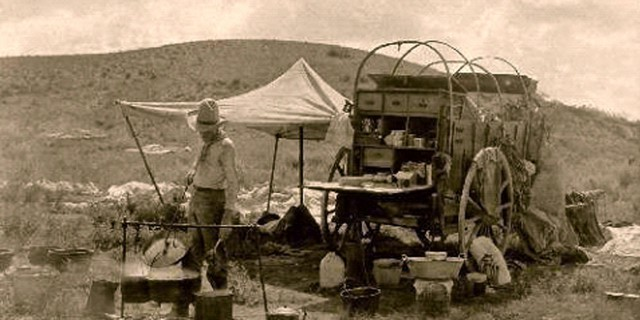
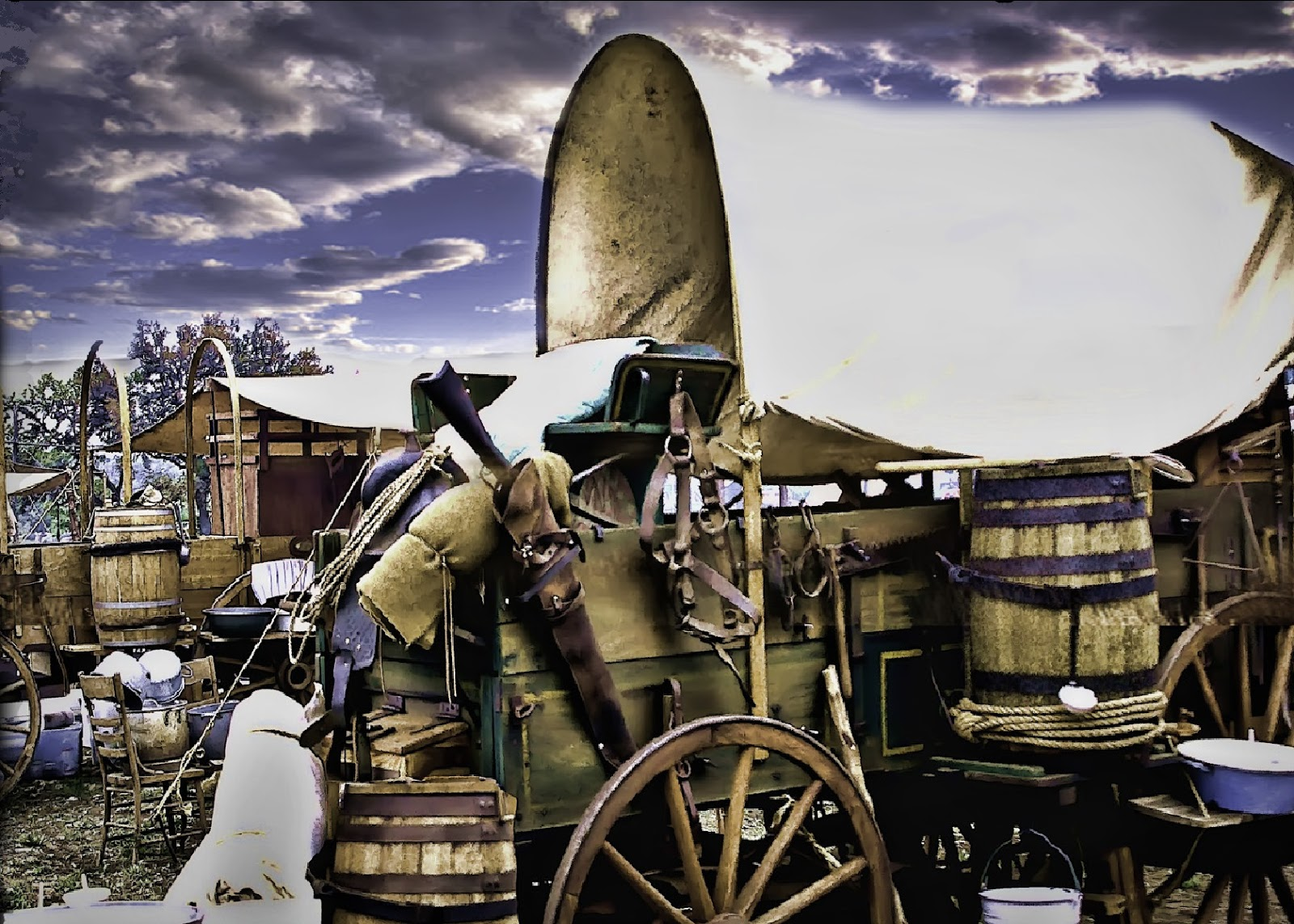
On the road cooking gear, methods and traditions mostly descended from the storied ways of the 19th century cowboy trail kitchens. The gear was hard to keep clean and ready for eating. These kitchens drew their creation from the iconic mobile stoves and tables known as Chuck Wagons. The horse drawn wagons were invented by Texas cattleman Charles Goodnight in 1866.
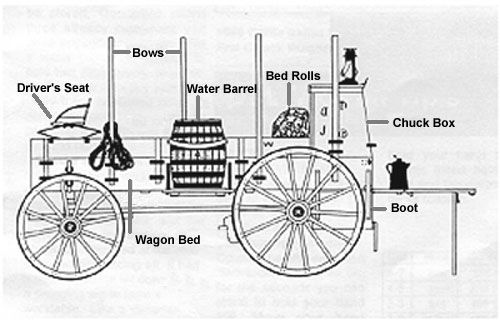
Back then Goodnight, a Texas rancher and Civil War veteran, first used an army surplus Studebaker wagon on the trail drive. The Studebaker proved itself sturdy enough to withstand trail drives that could last up to five months. After some “shake down cruises,” Goodnight designed and added a chuck box and a boot to the rear of his wagon. These additions and innovations became the prototype for all future chuck wagons. The wagon’s box was used to carry the cowboys’ bedrolls, guns, personal effects, bulk food supplies, feed for the horses, and other supplies.
Austin Troy’s Cooking at the Gulch
The heart of the Prairie Trek kitchen enterprise in the American Southwest was the Commissary Truck, which was the Cottonwood Gulch’s “modern” version of the Chuck Wagon (although the term “modern” is used in a relative sense—most of the Com trucks were built in the 1950s). The similarities with the Chuck Wagon were many, from its easily accessible side compartments to its two sturdy water tanks with faucets at the bottom. Coms were typically large enough to store large quantities of both cooking equipment and food, the latter of which traditionally came in the form of large cans, bags and boxes. [1]
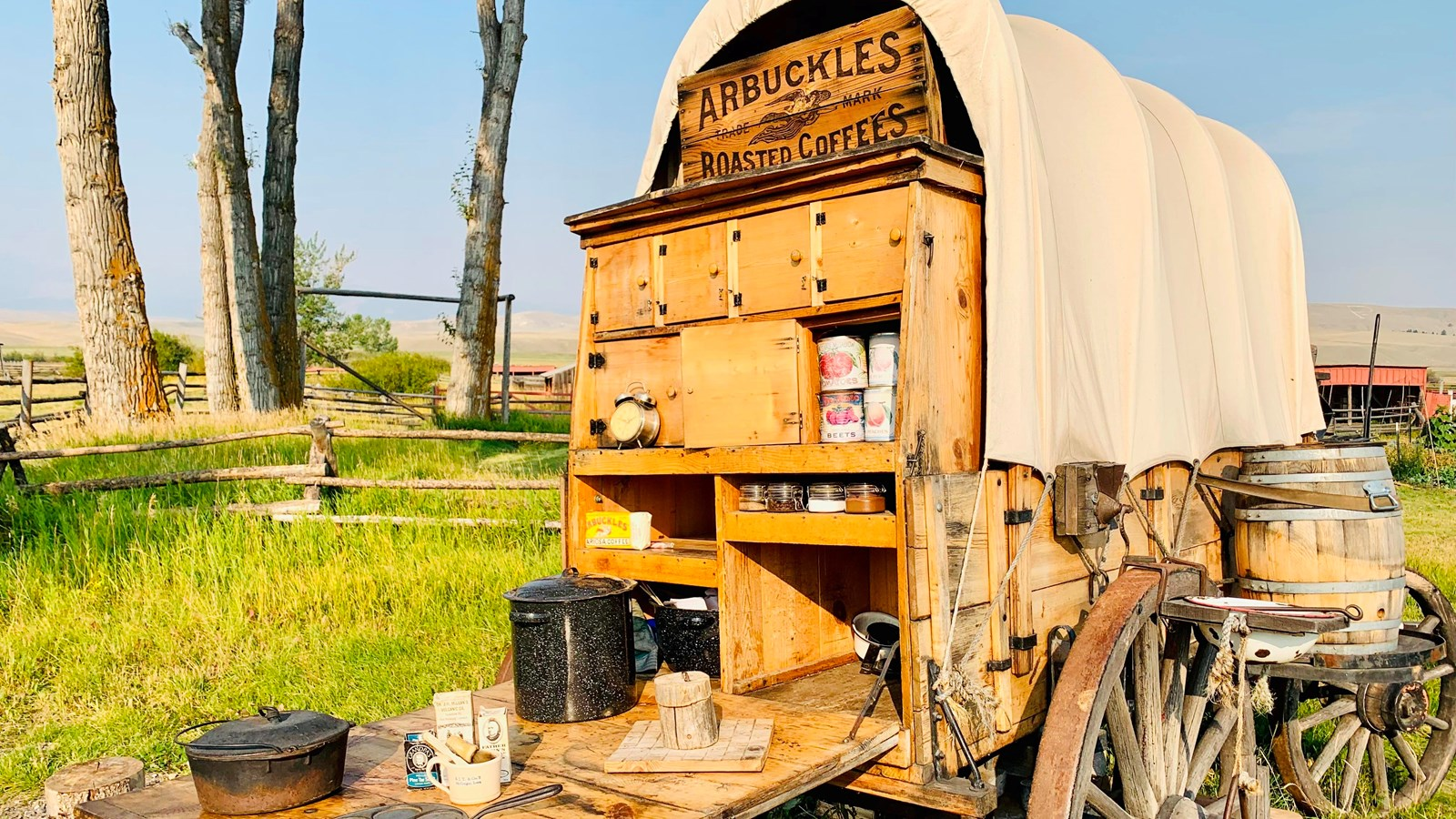
The largest collection of kitchen equipment could be found in the “scullery,” a battered old wooden chest with rope handles that lived in the back of the Com truck. Its analog in the Chuck Wagon days was called the “boot,” a large wooden cabinet with a hinged cover bolted to the back of the wagon. The scullery and the boot contained a similar assortment of pots, pans, skillets, Dutch Ovens, buckets, and the old fashioned “cowboy coffee kettle.” Both Com and Chuck Wagon also had an attached table that could be used for serving. On the Com it was a large wooden plank with metal latches that attached to the starboard side of the Com, such that it projected out perpendicularly about eight feet.[2]
Stainless Steel and Gulch Juice
Additional storage was found in stainless steel (SS) boxes that contained silverware, plates, knives, and the infamous SS cups. One of the SS boxes was known as the “spice box” and contained all the random flavorings we would throw into our creations. The stainless steel was used for this purpose because it was thought to keep out all critters. Another modern convenience was our coolers. Back in the 1980s and 90s, coolers were far inferior to today’s, so they didn’t keep perishables for too long, but they did still allow us to have milk, meat, cheese and few other luxuries for a couple days after visiting the grocery store. And finally, there was the “Gulch Can,” a stainless steel contraption that looked like a large cow milking can and was used to make our precious “Gulch juice,” which was usually made from powdered Kool-Aid and always came in a Day-Glo color.
Both Chuck Wagon and Com had a protective canvas tarp covering the kitchen area. The tarp was attached to grommets at the top of the Com on one side, and to large wooden poles on the other, which were secured with large nails attached to ropes. The result, if set up well, was a large protected area which would efficiently shunt the rainwater off to the sides, thereby protecting dinner. If it was insufficiently taught, the rain water would collect in an increasingly large depression in the tarp’s middle, which would invariably drip all over the table.
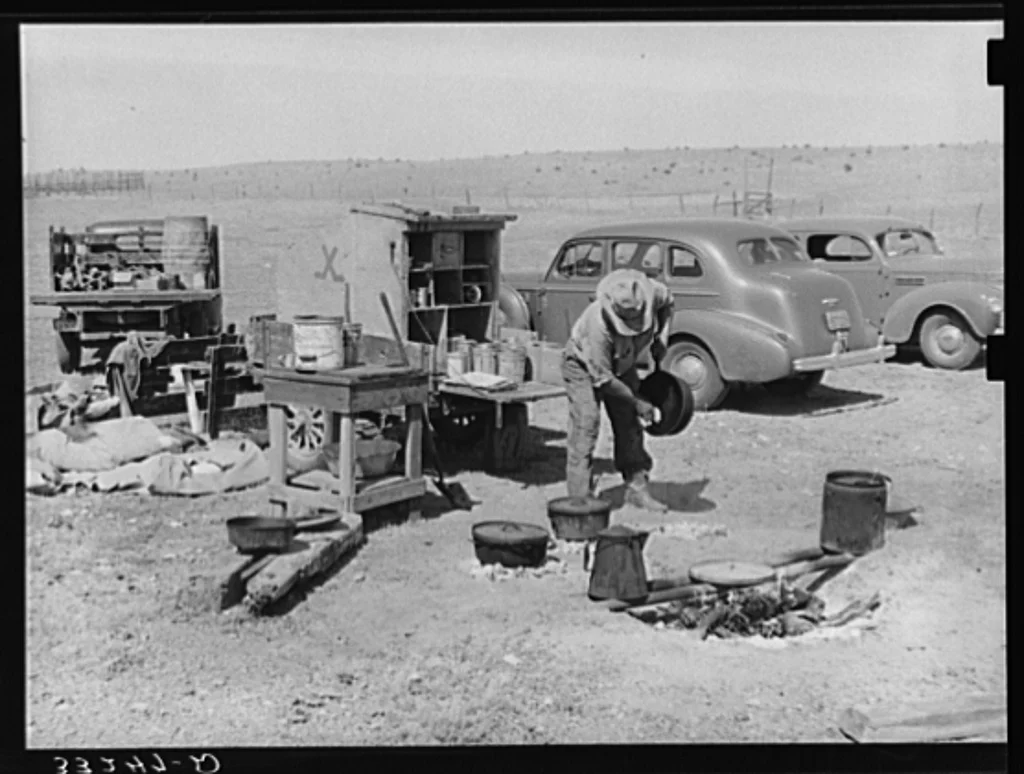
One key difference between the Com and Chuck Wagon was in the gear used to cook over the fire. In Chuck Wagons, gear for this purpose included metal grates that could be put over a fire pit dug by cookie or a larger “fire box” with metal sides that would keep the fire contained. In a Com, by contrast, we used the seemingly more primitive tool of “fire irons,” or two long iron bars with pivoting legs on each side that could be hammered into the ground over the fire. The irons would be hammered into a rough V shape so that narrow vessels could be put on one end and wide vessels on the other. Getting this right was a fine art. Too narrow on either side and dinner would pitch latterly into the fire if you applied too much pressure to one side of the cooking surface. Too wide, and a vessel would fall between the irons into the fire. If the soil was too loose to hold the irons firm, then all bets were off.
Life and “Eating On The Road”
As a road cook, I was typically the first person up in camp, usually well before 5:30 AM, followed shortly after by my trusty Cook’s Assistant (CA). The first order of business was getting the fire going and that meant that the wood would have already been split, stacked, and covered by the night before. The second order of business was getting cowboy coffee brewing. That meant putting our old and faithful blue speckled cast steel pot filled over the fire. No filters, percolators, or Italian espresso machines were involved, just two basic ingredients: water and a handful of grounds. The next step in the morning ritual was “morning bells,” which in the case of a road loop involved the Com horn (or if in a public campground a personal visit by the staff to each tent).
As the morning fire roared, various cooking surfaces were laid on the irons and, once hot, were adorned with any number of foodstuffs, from eggs to sausages to pancake batter. As the days elapsed from the last grocery run, breakfast increasingly came to include foodstuffs out of a Sexton #10 can—a vessel roughly the size of a heavy artillery shell—most notably the infamous “creamed chipped beef,” known by Trekkers as “SOS” (an acronym not able to be spelled out in polite company), a dish that is best known as a staple of the US military, and that the Hormel corporation described as “an air-dried product that is similar to bresaola [sausage], but not as tasty.” Another canned product that was popular at breakfast time was SPAM, a delicacy that frequently made it into egg dishes, cold sandwiches, rendezvous skits, and song lyrics. Occasionally, it would appear in a Trekker favorite, Hawaiian Delight, which consisted of fried SPAM slabs topped with melted cheese, and canned pineapple slices. If left out, it also served as an excellent bear attractant.
Everything Pancake
To minimize dinner leftovers, I came up with a revolutionary breakfast idea (which had probably been done by a hundred Gulch cooks before me): anything the Trekkers couldn’t finish from the night before would be put in tomorrow’s breakfast, usually as an ingredient of the pancake batter. After a few episodes of diced carrot and green bean pancakes, I found that the group learned to eat all the leftovers.
One last notable breakfast occurrence was the breakfast lineup song. I have no idea when this started or how many Trek groups did this, but Nate Lord, one of my group leaders in the 80s, introduced me to this excellent tradition. He would introduce a song one verse per day, which we would learn in the breakfast line, until after a week or two we had the whole thing down, which had to be performed in unison before breakfast could be served. Among the breakfast songs he taught us were Midnight in Paris by Michael Hurley (“You wear my beret and I’ll use your bidet, Cherie, I’ll be clean, you’ll be free”) and Positive Vibration by Bob Marley. When I was a cook a few years later, my breakfast-themed song of choice for the group’s morning lineup was Ham n’ Eggs, a rap song by the group A Tribe Called Quest which had the lyric “I don’t eat no ham n’ eggs, ’cause they’re high in cholesterol…” after which we all dug into our eggs and some random pork product.
Lunches were much less impressive, with the most interesting facet being the ubiquity of Miracle Whip, to my knowledge the only sandwich topping that requires no refrigeration, maintaining the same rubbery taste under all temperatures and reputedly also usable as an industrial lubricant.
Dinners could be a big deal. I’d often get started on a big dinner production just after lunch if we were at a campsite for multiple days, particularly if it involved a Dutch oven. A full KP crew would help me and the CA wash and slice vegetables, mix batters, season meats, and prep the dessert. Trek road dinner recipes (which in my case came exclusively from the Fannie Farmer Cookbook), included chili, stews, hamburgers, tacos, pastas, stir fries and, of course, SPAM. Dessert was a critical part of group morale, and so considerable thought and time went into these. These could get quite creative, ranging from fruit cobblers and crisps (always with filling from a Sexton #10 can), to pies and cakes.
Dutch Oven and Sheepherders Stove
Two key weapons in our fight against boring Trek dinners were the Dutch Oven and sheepherders stove, both of which were commonplace on the old Chuck Wagons. The Dutch Oven used by both the Gulch and the cattle drivers were made of solid cast iron, with a heavy lid and, to our observation, they were indestructible. They came in a range of numbered sizes, each optimized for a different kind of dish. While they are frequently used over a fire, my preference as a cook (and that of the cooks I apprenticed under) was to bury them. The burial technique required considerable finesse. First, you dug a hole, about 6 to 8 inches wider and about 4 to 6 inches deeper than the oven. Next, you layered the food to be cooked into the oven. Then you took hot coals from the main kitchen fire, shoveled a layer of them on the bottom of the hole, carefully placed the oven on top, added some more coals around the side and on top of the oven (its lipped lid allowed coals to perch there), then cover with dirt. After the appropriate cooking time (which could range up to two hours depending on the dish), it would be unburied and extracted. The result was a piping hot dish that had been cooked with extremely consistent and even heat, yielding a truly delicious result in almost all cases. Some of the most popular dishes to emerge from my below-ground cookery included lasagna (with up to ten layers!), stews, fruit cobblers, and, my personal favorite, corn pone pie, a cinnamon-tinged meat and veggie mixture topped with a thick layer of corn bread. Dutch oven dishes were universally popular among the Trekkers, but they did require a lot of time, often 2 to 3 hours.
The other historic slow-cooking device we used was the sheepherder stove, a small metal box with two chambers and a collapsible smokestack that nested in those chambers for storage. When assembled (which took some time due to the age and irregularity of the parts), one would build a very small fire in the first chamber and then insert the item to be baked in the other. In this way, heat was distributed to the baked goods, but not smoke. The baking chamber was quite small, so only one small baking pan at a time could be inserted, meaning that feeding the whole group often required multiple rounds of baking. Further because the fire box was so small, keeping the fire lit and consistently hot was quite a chore, requiring constant tending and checking. Many a baking attempt with this device failed due to the fire dwindling, or rain drops falling down the smokestack.
Managing all the food stores needed to keep a road outfit fed was quite complicated and invariably there would be bits of this and that left over towards the end of a loop—in quantities too small to use in a meal for all. My solution? A “gross bagel eating contest.” The proposition was simple: at the end of the loop there would be a contest to see who could have the most disgusting combination of toppings on their bagel, raided from leftovers. The staff would judge, and the winner would get to eat the largest share of the leftover sweets. While far more popular among the boys than the girls in my co-ed group, it did the trick. Our store of leftovers was largely devoured and, despite a few stomach aches, all had a great time. Another food eating contest that was not uncommon on Gulch road kitchens, although unsanctioned in mine, revolved around eating hot chili peppers. This was definitely a male-only pursuit, and while no rewards were offered other than bragging rights, the running noses and grimacing faces that resulted from such contests provided excellent fodder for our rendezvous skits.
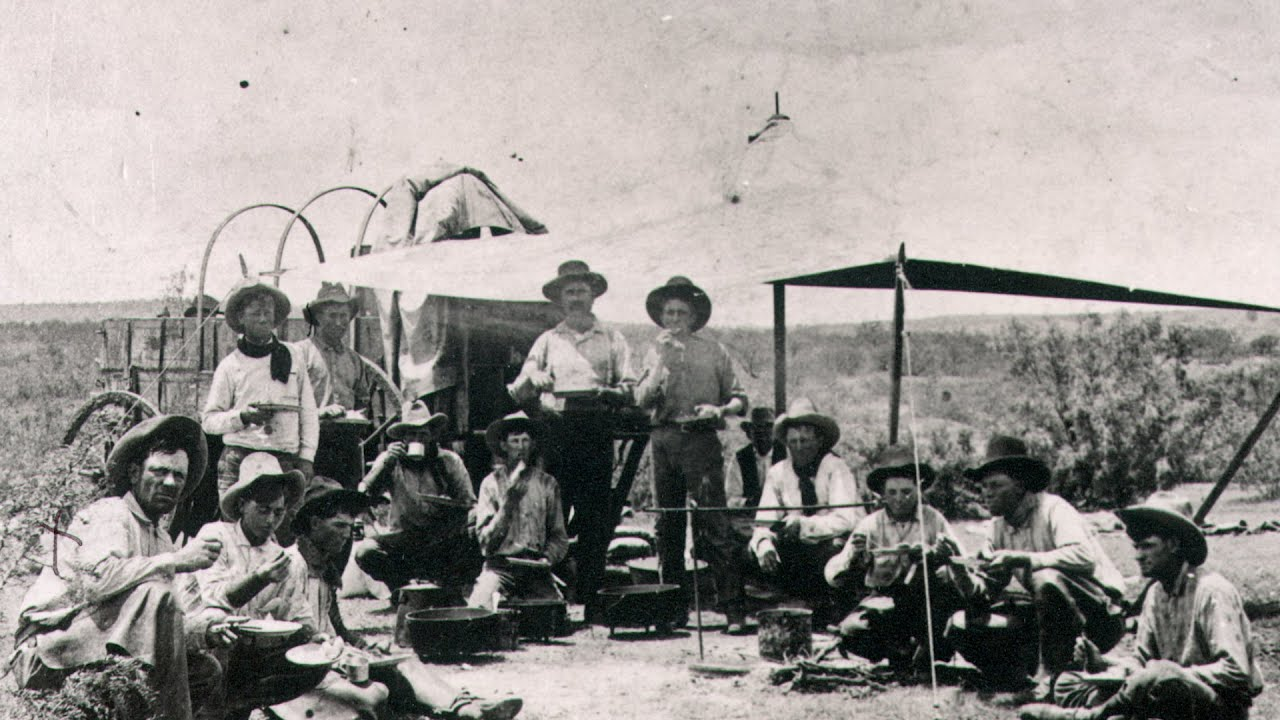
No discussion of the road kitchen is complete without mentioning KP. “Kitchen patrol,” a term which has its origins in the military, is one area in which the Trek kitchen differs from the Chuck Wagon. In the latter, the camp cookie was responsible for washing up. At the Gulch, by contrast, KP duty was rotated across all campers, with the exception of the CAs and Quartermasters (QMs). KP duty included helping to prepare food (primarily at dinner, but sometimes at breakfast too) and, most critically, washing all the pots, pans, griddles, dishes and silverware. The classic Gulch road dishwashing setup included three pans, one filled with warm water and soap, one with cold rinse water, and one with cold sterilizing water, with a few capfuls of Clorox. When Trekkers were done with their meal, they’d scrape their plates of any scraps in the garbage (on a Chuck Wagon the food scrap bin was called the “Squirrel Can”) and then put those dishes in that first pan, known as the “wreck pan,” just as that same pan was called on a Chuck Wagon. The KP wash crew, which varied in numbers depending on the size of the group, and used some combination of kerosene lanterns, flashlights and (later) headlamps to see their handiwork, would wash each item using small green sponges known as “greenie meanies,” then rinse, then leave in the Clorox water for about a minute, and then carefully stack them on the Com table. And woe to the poor soul who stacked poorly enough that a bowl or cup fell into the dirt!
Accidental dirtying of clean dishes did invariably happen on a road loop, but no such occurrence came close in its extent to an event I observed as a camper in 1984. After our second day on the road, we pulled into a heavily sloped campsite in the Carson National Forest after dark, exhausted and almost too tired to eat. Dinner was served, however, and KP completed. Just before lights out, one camper went up the steep hillslope to the lattie, carrying a lantern. On his way down, he did not realize how steep the pitch was and started running uncontrollably…right into the Com table stacked with KP dishes! Within seconds, all was on the ground, covered in glorious dirt. And another round of late night KP began!
The road kitchen footprint, known as the “KP area,” was sacrosanct territory. Its corners were typically demarcated by certain landmarks, like the garbage can, but some cooks/CAs would go so far as to lay ropes as boundaries. Nobody but the cook, the CA or the KP crew were allowed in it except during meals. Different road cooks took different approaches to enforcing the KP area, but in all of my experiences, including my own as a cook, infractions were strictly enforced and even draping one toe over the boundary could result in receiving the punishment of having to wash a pot. Many a KP-area daredevil would have fun by putting this boundary to the test, waiting for the cook to turn their head, then rapidly transgressing the boundary. When I was a CA, one person, in particular, went out of his way to violate the KP area as frequently as possible, just for laughs. He got so many pots that he wrote a song about it, set to the music of the Beatles’ Norwegian Wood: “I once had KP, or should I say, KP was me…” It went on from there, but the lyrics are lost to history.
As a cook, I was an active but fair enforcer of the KP area rules. But it was as a CA in 1987 that perhaps the most bizarre chapter in Gulch KP enforcement occurred. On the first day of our road loop, while we camped on the mesa at Basecamp, I happened upon the better part of a cow skeleton, all bleached clean with age. I fashioned the pelvis into a mask and took about a dozen vertebrae and strung them into a necklace. And finally I took a femur and held it in my hand as a kind of scepter. This became my KP enforcement costume, known by the Trekkers from that year as the “KP Bones.” For many days (until it got too uncomfortable), I wore this getup as I oversaw KP, pointing an angry cow femur at anyone who committed a KP infraction.
My experiences with the Gulch road kitchen represent a small slice in time, but I do think they capture the gear, practices and traditions that had been around for a long time, and whose origins stretch back to the chuck wagon days. Having not been on a road loop in over 33 years as of this writing, I can’t say how the road kitchen has changed and what traditions exist today. But I do know that with the transition from fire to propane, something that was dictated by necessity, there has been something of a break from the past. And recognizing that, I’m hoping that this little narrative can memorialize some of those practices for generations to come. However, I think it’s safe to say that if you ever encounter a Gulch road camp, please don’t enter the KP area without being invited. You will have to clean a blackened pot!
————————————————————————————————-
References:
[1] This witness post was written in its entirety by Austin Troy, a professor at the University of Colorado in Boulder, with light editing by Hooper.
[2] The term scullery is explored in detail in the following Word Smith: https://henryehooper.blog/word-smith-scullery/
[2] https://cowboyandchuckwagoncooking.blogspot.com/2013/03/chucks-on-come-and-get-it

