
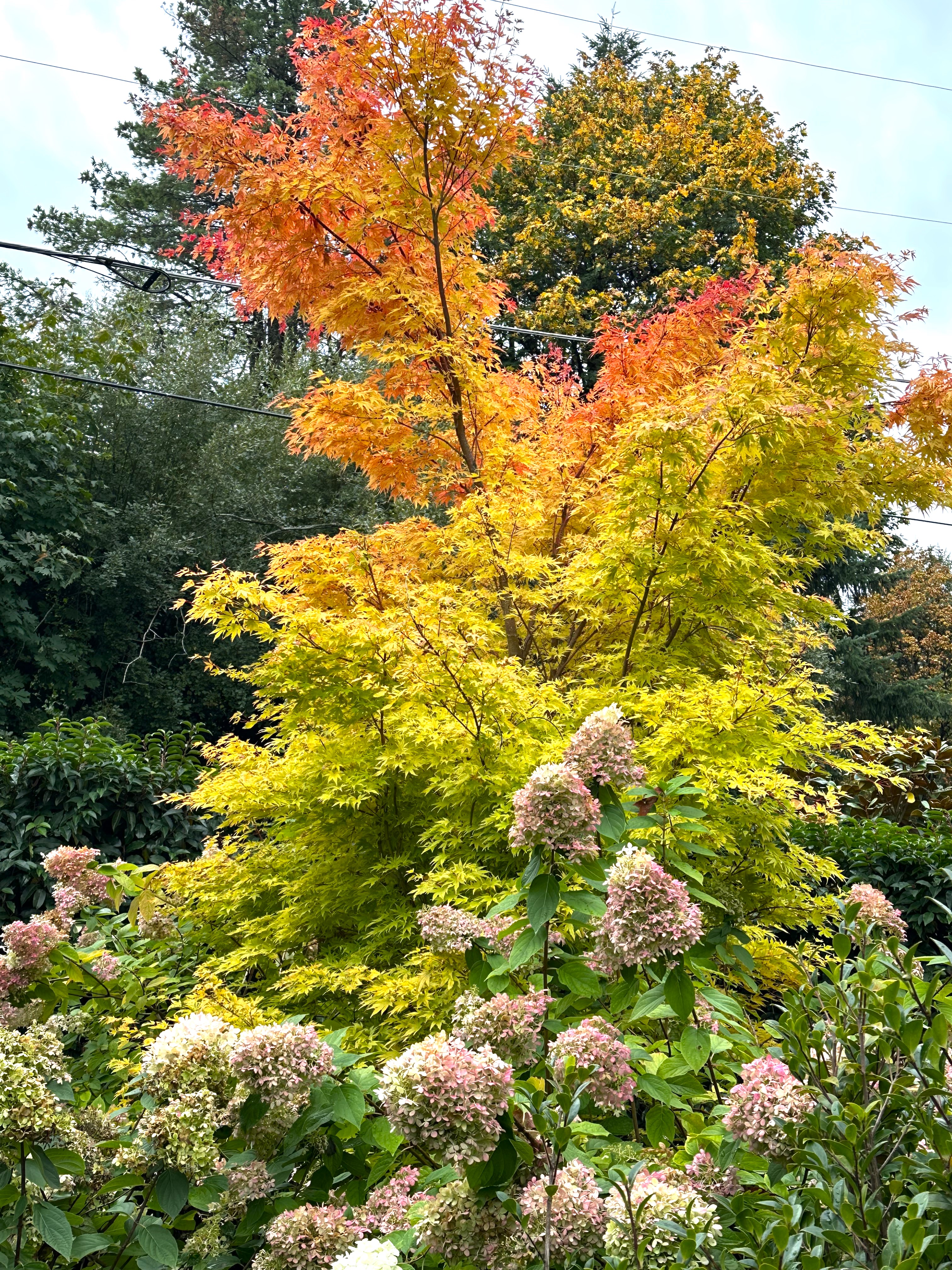
Acer palmatum ‘Sango Kaku’
Trees: Coral Bark Maple
The seasonally spectacular Coral Bark Maple, or more formally the Coral Bark Japanese Maple, is a garden pleaser year around. This beautiful small tree has brilliant red-coral colored bark on its young branches with that coral color intensifying in the winter. As seen below, in winter the deep red color stands out with the new fallen snow.

In spring and summer the foliage present deeply cut, pale green leaves that display attractive red margins. Come fall, the leaves turn a vibrant, golden yellow and pink. This garden gem thrives in bright dappled shade in warmer regions, or in full sun in cooler regions.
When planted in the right soil and location, the tree naturally grows slowly, so “keeping it small” might not be an issue, but our tree lost several key branches in an early season snow storm. We were concerned that the branches were too weak to sustain any ice, snow or wind, and we were correct. It has grown a lot faster and is more spindly than it is supposed to be. We love it nonetheless, though we should have pruned it along the way.
The Japanese name ‘Sango kaku’ refers to the the coral bark of this species of maple. In the wintertime the bark of ‘Sango kaku’ develops a bright, coral red that is quite striking and noteworthy. ‘Sango kaku’ is an upright growing Japanese maple with a tall and slender mature shape. Acer palmatum ‘Sango kaku’ is one of the most popular Japanese maples there is due to its strong growth habit, its excellent fall color, and its famous coral bark color. This maple has very small, palmate leaves with five to seven lobes.

The coral red branches of Acer palmatum ‘Sango kaku’ put this Japanese maple tree in the Red Wood category of Japanese maples according to official Maple Society classifications. The coral red color is most prominent and striking the winter but given the right conditions you can usually see some red color on the bark throughout the year. Spring is also an attractive time for ‘Sango kaku’ because the bark is still very red accented from its winter show, and it is contrasted with the fresh green leaves of spring. Usually, the summer bark will be greener with reddish hues, but there are often smaller twigs that are still bright red. By fall, the bark of ‘Sango kaku’ is transitioning back to its winter bark color and really shows off along with the golden yellow fall foliage.
Acer palmatum ‘Sango kaku’ is a tall and slender growing Japanese maple with a fast growth rate. They will typically reach about 16 to 18 feet tall in 10 years, when arborists consider this maple to have reached its mature size. However, as with most trees, ‘Sango kaku’ will continue to grow as long as it lives. Many ‘Sango kaku’ specimens have grown to 30 feet tall in 40 years. ‘Sango kaku’ is also a somewhat narrow growing tree that only gets about 8 to 10 feet wide at maturity. Even these old specimens are only about 15 feet wide at the canopy.
Young ‘Sango kaku’ trees can grow up to two feet in a year. This young, fast growth can sometimes result in leggy looking branches. These branches will typically thicken up and strengthen, but early pruning can also be very beneficial in developing a nice shape to the mature tree. Arborists typically state that the growth rate of ‘Sango kaku’ averages about one foot per year. Acer palmatum ‘Sango kaku’ is the perfect tree for someone that needs a tall tree that doesn’t take up too much space.

Acer palmatum ‘Sango kaku’ is hardy to zones 5-9. To produce the best colors, the ‘Sango kaku’ should be planted on a mound with mostly sun and some afternoon shade in well-draining soil. According to most arborist website, they recommend that, if you are a Japanese maple lover, the ‘Sango kaku’ can be planted along with green bark varieties such as Aoyagi or Kawahara. Some say no midori or yellow bark varieties such as bihou, gold digger, or Dixie Delight, but these varieties have interesting bark in the winter.
Although it exact date or origin is unknown, the Acer palmatum ‘Sango kaku’ is an old cultivar dating back to the 1800s. The name ‘Sango kaku’ means “coral tower.” This is a fitting name given the shape of this cultivar as well as the coral red color of the bark. ‘Sango kaku’ is also sometimes known as ‘Cinnabarinum’ or Cinnabar wood maple. ‘Sango kaku’ has also been mistakenly referred to as ‘Corallinum’, which is a completely different variety. ‘Corallinum’ is named for its coral red spring foliage rather than anything to do with its bark. ‘Sango kaku’ is probably referred to more frequently as the coral bark maple than by its actual name. However, no matter what you call it, ‘Sango kaku’ is a must have for a complete, four seasons landscape.
[1] https://japanesemaplesandconifers.com/products/acer-palmatum-sango-kaku

tree outgrowing your yard, you may want to rein it in before it gets too late and too costly to fix. Trimming the tree is a bit complicated, so you may want to bring in a pro and call in a licensed arborist at this point. But if you are confident in your abilities, it is doable as long as the tree is not too large. If your tree is small enough to reach the top grab a pruning saw and some pruners, it is time to learn to do what is referred to as the drop-crotch pruning.
What you should not to do is “top” the tree. Topping a tree is the pruning of large upright branches between nodes. Instead, you want a drop-crotch, which uses cuts that are precisely placed.
First, you will find a lateral stem at least one-third the diameter of the trunk or leader. Above this location, at the angle of the lateral branch, you will make your cut into your trunk; this angle should be no more than 45 to 60 degrees. Avoid lateral branches that are horizontal. Repeat this process yearly on all the vertical growth, and your tree will stay as small as you desire for as long as you keep at it.
 Henry E. Hooper