

William H. Donaldson (1931-2024)
SOM Revisited: Dean William H. Donaldson
June 14, 2024
As founding dean of Yale School of Management (SOM), Bill Donaldson laid the groundwork for the school’s distinctive mission and strategy. He personally interviewed and recruited the first class of students to the program. His own business career included decades of leadership in the corporate world, non-profits and government, making him the best example for public and private management in the school’s founding documents. He said to incoming students: “At some time in your career, you will serve on Boards of companies, non-profits, and government entities. All of the rigors you need for these endeavors demand the same synergy and energy, and similar skill-sets, all of which you will learn from the professors at SOM.”
William H. Donaldson died on Wednesday, June 12, 2024. His decades at the heights of business, government, and academia included tenures as chair of the Securities and Exchange Commission (SEC), chairman, president and CEO of Aetna, Inc., and chairman and chief executive of the New York Stock Exchange (NYSE). He also co-founded the influential investment bank Donaldson, Lufkin & Jenrette (DLJ).
“As the founding dean of the Yale SOM, Bill was a model for the school’s early aspirations, and his legacy will serve as an inspiration for generations of students and scholars to come,” said Yale University President Peter Salovey. “He was a man of great integrity, and he contributed his energy and skills to so many sectors, spanning government, profit, and nonprofit organizations. His view of what management professionals should be has left a permanent mark on SOM, Yale, and the world.”

Dean Donaldson at podium. Yale Presidents Kingman Brewster and Hanna Gray front row at his left. Robert McNamara is seated in back row to viewers right.
As founding dean of the Yale SOM, as the school was then known, Donaldson laid the groundwork for the school’s distinctive mission and strategy and recruited the first class of students to an untried program. He presided when the school opened its doors on September 13, 1976, offering a master’s degree in public and private management (MPPM).
A self-described “academic entrepreneur,” Donaldson had previously worked in both the public and private sectors, including as undersecretary of state for Henry Kissinger, an advisor to Vice President Nelson Rockefeller, and a founding partner of the investment banking firm Donaldson, Lufkin & Jenrette. He was named “Business Man of the Year” by the Associated Press in 1970. Donaldson had also served in the U.S. Marine Corps as a first lieutenant, a rifle platoon commander, and an aide-de-camp to the Commanding General of the 1st Provisional Marine Air Ground Task Force. He received his BA from Yale College in 1953 and an MBA from Harvard Business School in 1958.
With such an eclectic background, Donaldson was a perfect fit for a school whose mission it was “to train leaders for both business and government service.” In an oral history interview in 2017, he said that it was the entrepreneurial aspect of the position that drew him to SOM—he relished creating “something new in an old, ancient university such as Yale.”
Donaldson was a key fundraiser for Yale during it’s Campaign for Yale (1975-1978) and he helped raise over $360 million for the institution. He stepped down from a leadership role with the Campaign to become dean of the new graduate program. Yale always aspired to be the BEST at whatever programs it started. That said, with Harvard and Penn and Stanford already holding the top honors with their MBA programs, Yale’s founding was seen as more grass roots, programs more open to government and non-profit aspirants as well as traditional business people. Yale had classes in Organizational Behavior and crossover classes in Forestry, Nursing, Law and Economics, which were difficult to replicate at their competitor institutions. Eventually SOM allowed students to opt for an MBA degree, once the severe challenge of marketing Yale’s MPPM as an alternative to the other schools became evident.
Donaldson stayed on as dean at SOM until 1980. Announcing Donaldson’s departure, then Yale President A. Bartlett Giamatti praised Donaldson for creating a curriculum, building a campus, and recruiting students and faculty that, together, became “the embodiment of the school’s mission.” His continuing impact on the school was honored with the creation of the Donaldson Fellows Program in 2008, which recognizes SOM alumni whose lives embody the founding mission.
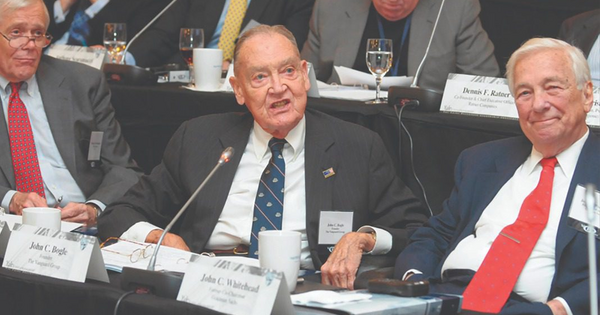
From left Donaldson, Bogle, and Whitehead at Yale’s CEO Summit in New Haven.
I had the pleasure of meeting with Bill Donaldson, and financial luminaries, Jack Bogle and John Whitehead at an SOM conference in 2002 held at Yale. Meeting with all of them in one room was proof positive to me of the convening power of a University like Yale: powerful and important to any institutional change.
Kerwin K. Charles, Yale SOM’s current dean, emphasized Donaldson’s impact on the school almost 50 years after its founding. “Bill Donaldson was in uncountable ways the founding spirit of Yale SOM. The entrepreneurial energy he brought to the task of starting a new and unprecedented professional school and his insistence that effective leaders must understand the workings of both the private and public sectors remained animating forces at the school long after he had moved on to other roles. I, like my predecessors as dean, benefited greatly from his wisdom and generosity. He will be missed by the whole SOM family.”

Following his tenure at Yale, Donaldson went on to his roles at the New York Stock Exchange (NYSE), Aetna, and the SEC. He served Yale in many capacities throughout his life and was a member of the Yale Corporation. He also served on the boards of numerous publicly held corporations and privately owned businesses, as well as philanthropic, cultural, and educational institutions. He was appointed to his role at the SEC by President George W. Bush and was a member of President Barack Obama’s original Economic Recovery Advisory Board.
Donaldson was a resident of New York City and Waccabuc, New York. Survivors include his wife, Jane Phillips Donaldson, and his children Kim, Matt, and Adam Donaldson. He is also survived by his three grandsons—Lars Kikoski, Will Donaldson, and Henrik Mark.
A memorial and celebration of his life will be held in the fall.

Jeffrey Sonnenfeld, a long time Professor at Yale SOM, wrote the following article in the Corporate Board Member magazine:
The Pathbreaking 27th Chairman of the SEC’s Insights on Governance and the Board’s Role.
June marked the passing of Bill Donaldson, former chair of the SEC, the longest-reigning head of the New York Stock Exchange and founding dean of the Yale School of Management. Among his many achievements, Donaldson served as Henry Kissinger’s Undersecretary of State, created the investment bank Donaldson, Lufkin & Jenrette as an entrepreneurial financier and led the turnaround of Aetna as its chairman and CEO. Working with him for almost 40 years, I was inspired by his appreciation of the social or cultural side of governance, which went far beyond check-the-box legal, accounting, economic and structural oversight.
Models of Governance
The photo a few pages up in this article shows Donaldson at a Yale CEO Summit alongside two peers, Vanguard founder Jack Bogle and John Whitehead, former chair of Goldman Sachs and a stentorian pillar of Wall Street. In honor of Donaldson’s passing, I’d like to share an excerpt from a 1999 Summit program in which he offered insights on governance and the board’s role.
“On the subject of board governance… corporate governance has become a cottage industry with lots of opportunists, and there’s some very superficial thought out there about what a board really is.
“To me, there’s at least two or three different models of what a board is.
“One extreme model is the function of a board is to strictly come to meetings and ask whether the CEO is doing a good job, and if the answer is ‘yes,’ then the next question is ‘when’s lunch.’
“The other model is the corporate board as a public board where there are warring constituencies. You have all sorts of people on the board, as you have with public institutions or in politics, who represent different viewpoints and different constituencies, and they fight like mad to represent their viewpoint. There’s no spirit of cooperation at all, in fact, it is just the opposite.
“My view is the board has a number of different functions. Clearly, the hiring and firing of the CEO, but that’s just one function. My view is it also has the function of support for the CEO. I think the CEO at times needs the support of the board. The board is the final authority, the group that when you’re faced with a tough decision as CEO, you say, ‘I have to take it to my board,’ and when you take a tough decision, the board supports you.
“Thirdly, I think the board’s role is to insulate the CEO from short-term considerations. The board does have a responsibility, in my view, which goes beyond next quarter’s earnings and beyond next year’s earnings. And it has a responsibility, although you can’t shout this from the pages of the Wall Street Journal, to serve something more than just the profit motives of the shareholders. I think the board provides an insulated jacket for that.
“But the least examined is that it is a social entity. It has human beings on it. And those human beings start to enter into alliances. They start to act like human beings do in any other organization. And the longer they’re there, the more allies they have, the more dislikes they have, the more irrational they become in terms of personal conflict. Nobody talks much about that. Everybody says, ‘Oh, you ought to have certain people on the audit committee because they’ll be independent, etc., etc.’
“There hasn’t been nearly enough work done on the social contract on the board and the recognition of what is really going on on that board. And a lot of times, what’s really going on bears the seeds of horror stories. Perhaps there’s a group that’s aligned improperly, and that group dominates either through tenure on the board or whatever and allows bad things to go on because nobody really recognizes what those interpersonal relationships are.”
Timeless insights on oversight from an inspirational colleague.
— By Jeffrey Sonnenfeld
 Henry E. Hooper