
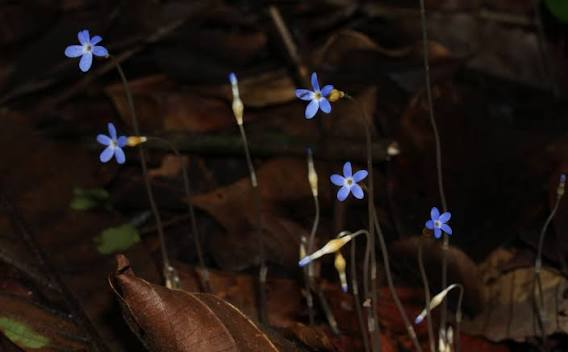
Plants: Voyria
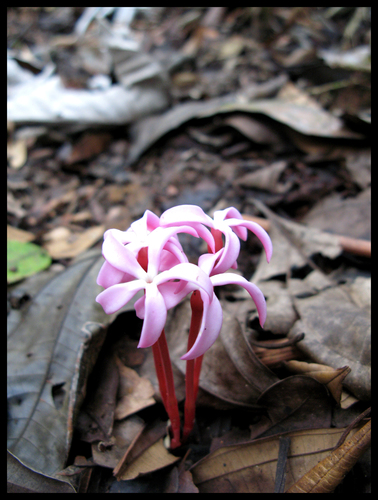
This tiny bluish flower on translucent stems sprouts almost impossibly from the dark brown forest floor. Often overlooked by anyone wandering in the woods, these are some rare and unique flowers. Unlike most of the plant kingdom, Voyria (Voyria tenella) cannot photosynthesize to generate energy or sugar, so it needs to get another plant to do the job. In this case, it saps carbohydrates from an intermediary: mycorrhizal soil fungi, which channel nutrients to trees in return for carbohydrates produced by photosynthesis.
According to Merlin Sheldrake, a predoctoral student at Cambridge, Voyria is a parasite that survives off the ‘wood wide web,’ an underground nutrient exchange where trees may be connected by fungal networks. “These plants demonstrate that there can be a meaningful transfer of carbohydrates from plant to plant because we know that Voyria can’t get carbohydrates from anywhere else,” said Sheldrake. “The flower also sheds light on the mutualism it hacks.”[1]
On a peninsula in Panama, Sheldrake found Voyria does not grow on a forest plot experimentally enriched with phosphorous. This is likely because the trees rely less on fungi for phosphorus and go straight to the soil instead, while providing carbohydrates to fungi. The fungi, in turn, seem to cut off Voyria‘s carb supply entirely. By studying this disrupted mutualism’s effects on trees (the cheaters), fungi (the cheated) and Voyria (the cheated cheater), Sheldrake aims to better understand the stability of the 400 million-year-old symbiosis between plants and their fungal partners.[2]
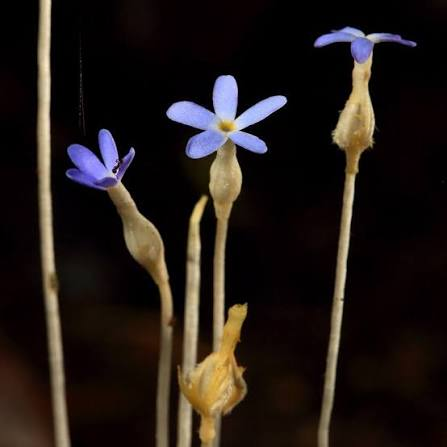
Voyria, which is commonly known as ghostplant, is a genus of about 20 different species of herbaceous perennial plants, belonging to the family Gentianaceae. The family of flowering plants has some beautiful shapes and colors. These species are mostly native to warm temperate and tropical regions of the Caribbean, Central America and South America.[3]
They do not contain chlorophyll, instead getting their food through parasitism upon fungi rather than photosynthesis. Their roots are thick and densely clustered, forming a “birds nest” that house their fungus host. Depending on the species, the flowers can be single or held in corymbs of many individual flowers. The stems are usually pallid, with reduced scale-like foliage. The flowers can vary in color, although white or yellow predominate, and blue and pink also occurring. Like all myco-heterotrophs, they are capable of living in very dark conditions, such as the floor of deep forests, because they no longer derive energy from sunlight.
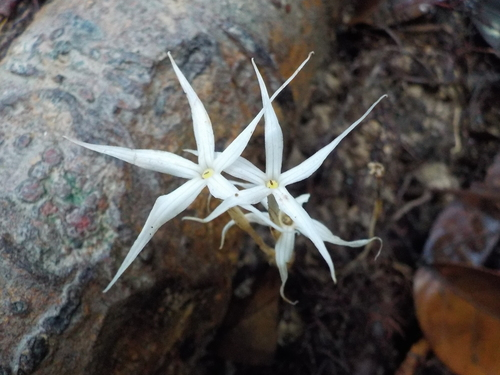
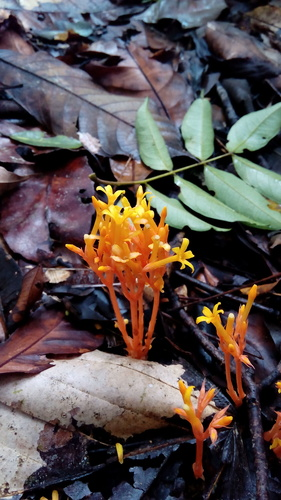
The lack of chloroplastic genes in Voyria has caused some difficulty in better understanding its relationships within the family. Interestingly, its seeds are dispersed by wind.[2]
References:
[1] https://stri.si.edu/es/node/888

