
Plants: Slime Molds
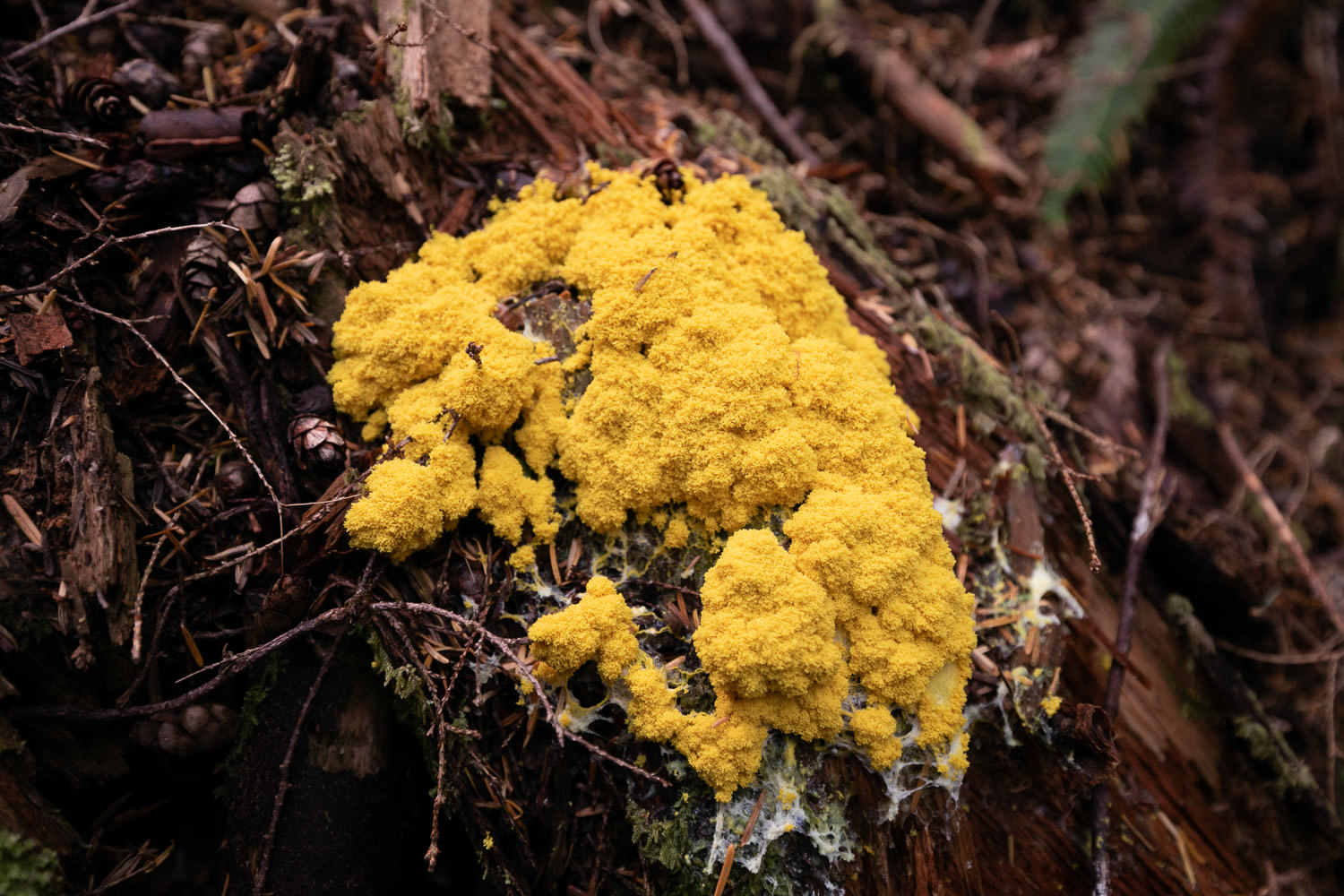
Slime mold seems to have a mind of its own. Might it be a sentient bring? Most people ignore the mold, thinking it looks more like “dog vomit” in the woods, and not worth touching. Others are fascinated by its apparent abilities to find food and make life enhancing moves in the wilderness.
Going by its scientific name, Physarum polycephalum, these molds are able to find direction by using a decentralized and adaptable location system that is based on sensory feedback. This feedback is part of the slime mold’s “decision-making” process, which relies on chemical signaling, physical memory, and internal oscillations. The process does NOT rely on what other plants and animals have: a central nervous system. Their process seems other worldly!
The “sentient-like attributes” of the Slime Molds that we will investigate here are: finding food via chemical signalling, physical memory (residual slime trails), internal oscillations and feedback, and mechanosensation.
Finding Food Via Chemical Signaling
These chemical cues are known in the plant world as Chemotaxis. The primary method that slime molds use to find food is chemotaxis, or sensing chemical gradients in their environment. The process has a few qualities:
- Attraction: Slime molds have receptors that detect attractants, such as the chemicals released by food sources like fungi or bacteria. When a part of the organism senses a nutrient stimulus, it causes the internal cytoplasm to stream toward the source.
- Repulsion: The organism also avoids chemical repellents like salt and caffeine. When it senses these substances, its directional movement slows or reverses.
Physical memory (Slime trails)
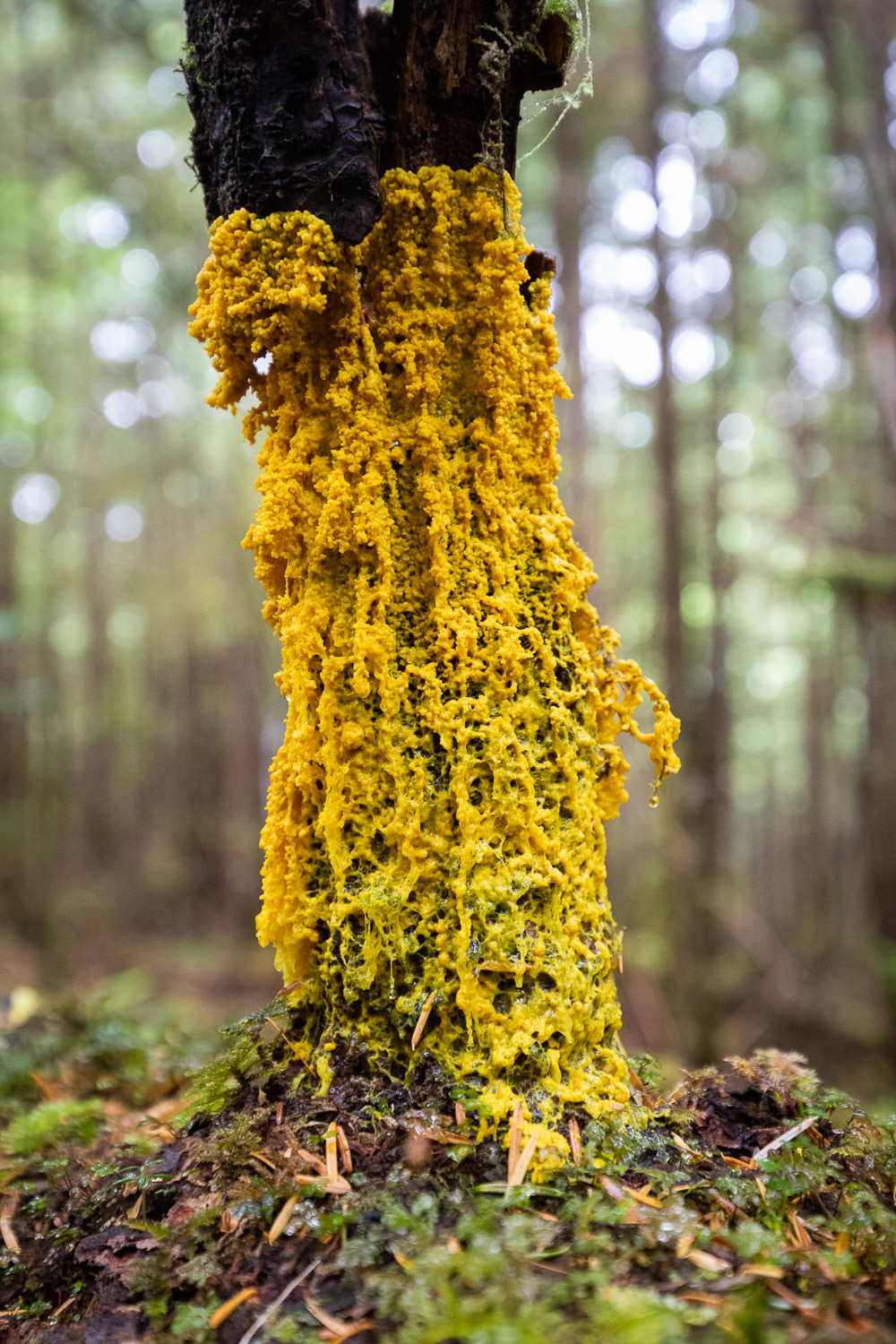
Slime molds produce an extracellular slime trail as they move, which serves as a form of externalized spatial memory. Like a trail of crumbs from a childhood fairy tale, they leave traces of their past movements.
- Avoidance: When exploring a new area, the slime mold avoids crossing its own slime trail. This prevents it from re-exploring the same territory and improves foraging efficiency.
- Navigation: In complex environments like a maze, the slime mold initially explores all available paths. The branches that do not lead to food eventually retract, leaving the trail of slime. The organism reinforces the branches that found food and follows the most efficient path, essentially “solving” the maze.
Internal Oscillations and Feedback
The movement of the cytoplasm within the slime mold’s tubular network is regulated by a system of internal oscillations that create a powerful feedback loop.
- Cytoplasmic streaming: The slime mold moves by “shuttle streaming,” rhythmically pumping its cytoplasm back and forth through its tubular network.
- Flow-driven changes: When food is detected in one area, the rhythmic contractions in the tubes leading to that source increase in frequency and amplitude. This increased flow strengthens and widens those tubes.
- Network optimization: Tubes with less flow shrink and are reabsorbed, creating a self-organizing process that reinforces the most efficient connections between food sources while eliminating less productive paths.
Mechanosensation
Slime molds can also sense physical and mechanical cues to inform their direction.
- Sensing mass: They can detect the mass and mass distribution of objects in their environment without direct physical contact. In one experiment, a slime mold grew toward a region with a greater number of glass discs.
- Translating stimuli: The organism translates these physical cues into electrical potential oscillations to guide its movement. It relies on channel proteins to detect mechanical stretching, similar to the mechanosensing mechanisms in animal cells.
Slime Mold Fascination Story
From an article in the New York Times online, by Daniel Mason (June 16, 2020)
They say everybody needs a hobby, and for the past six months, mine has been taking videos and photographs of slime molds in the oak and redwood forests near my home in California. Perhaps we’ve met somewhere on the trail? I was the guy on the ground with a lens clipped to his iPhone, the patient wife, the children asking worriedly from a distance whether a plant was poison oak. Perhaps you may have recognized my “slime-molding outfit”: the frayed Y2K jacket and Old Navy cargo pants caked with mud of many vintages. Perhaps, if you dared ask what I was doing, I popped up and (in those days when strangers stood close to one another) showed you my pictures.
I must have heard of slime molds at some point before the rabbit hole opened violently beneath me last December. For a tiny organism that doesn’t kill people, it hits the news with some regularity. Since making national headlines almost 50 years ago as a “mysterious, encompassing ooze” in a Texas backyard, slime molds have recurrently earned their 15 minutes for such improbable feats as recreating a map of the Tokyo subway system and modeling the distribution of dark matter in the universe.
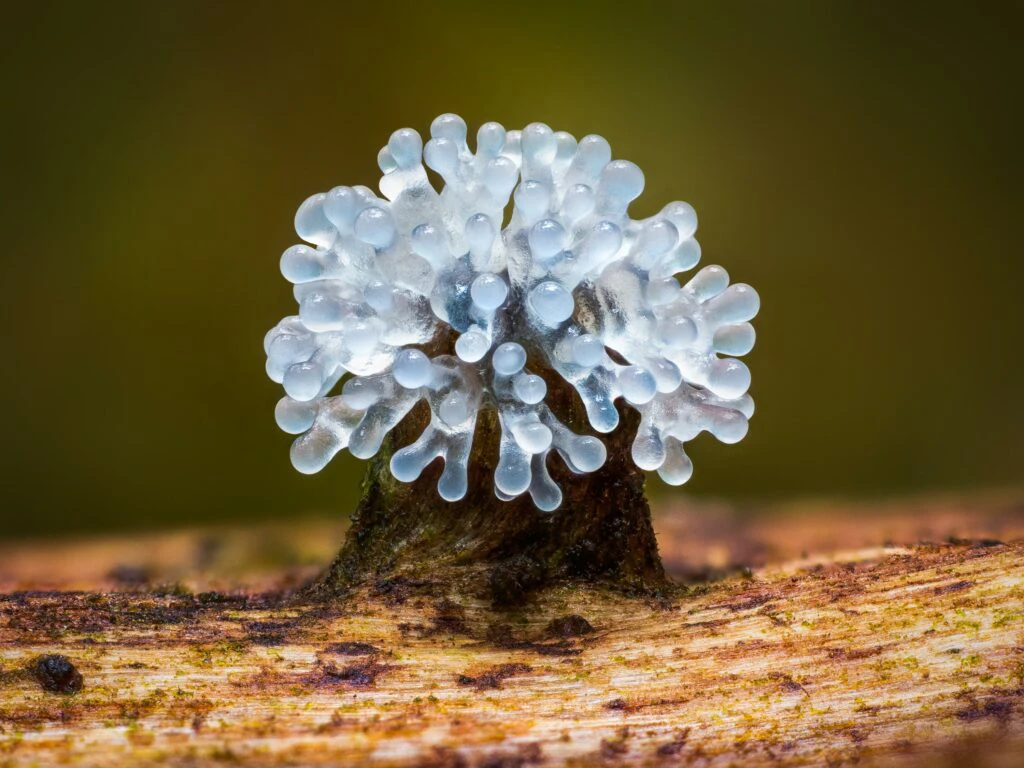
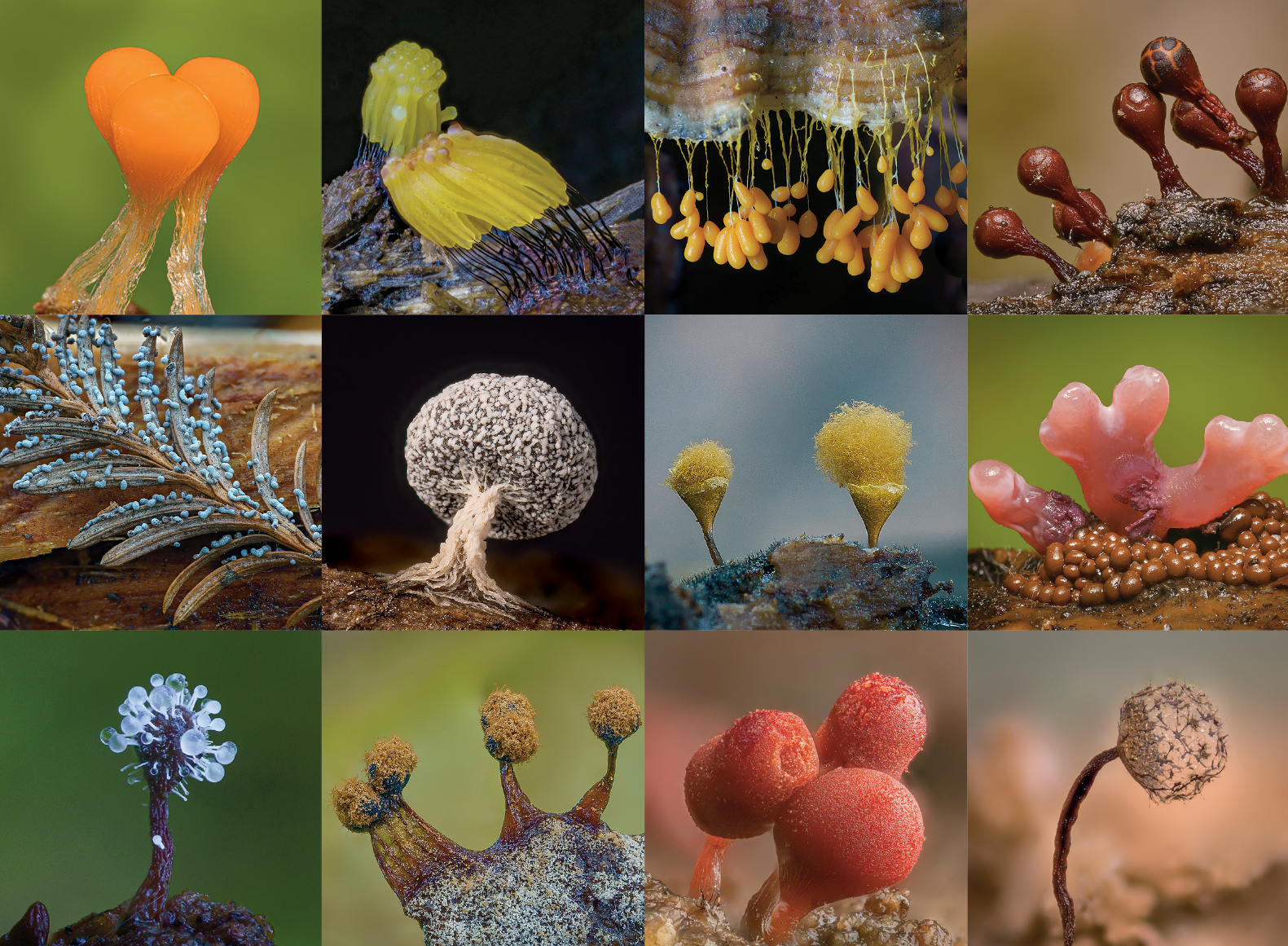
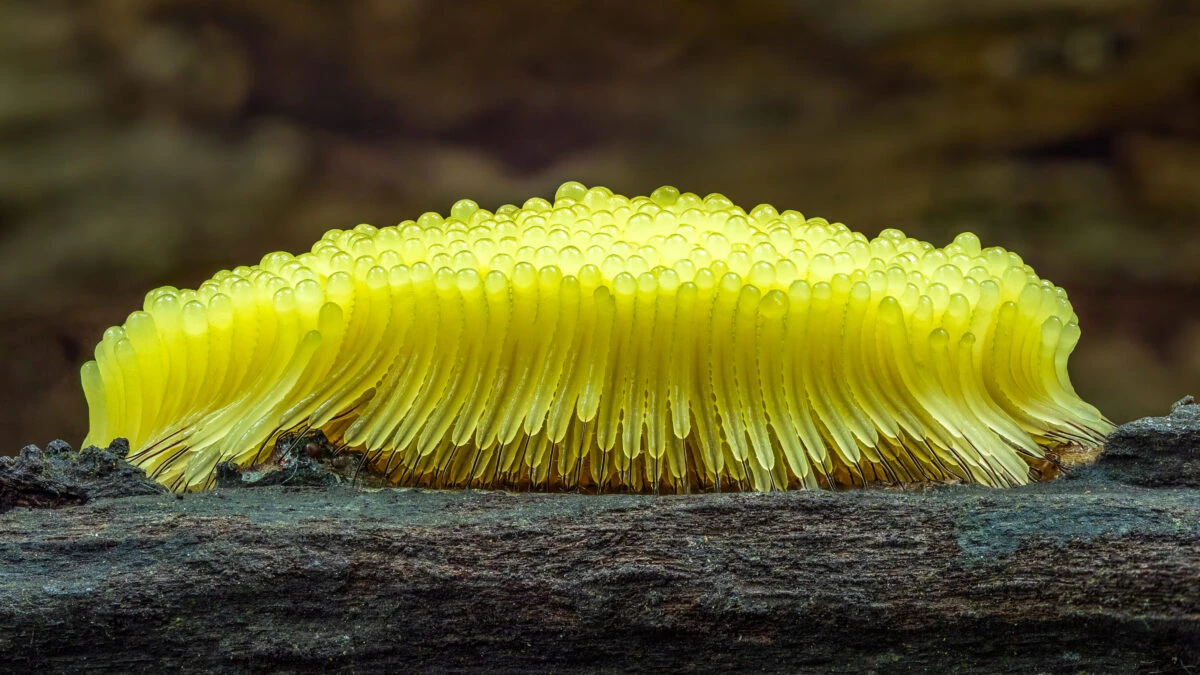
What sent me into the woods that month was not the creeping blobs of horror movies but rather a photo of iridescent purple Lamproderma posted to the citizen-science project iNaturalist. It was unlike anything I’d seen: Imagine ranks of glass-head pins in the belly of a leaf, and now imagine that those pinheads were made of frosted amethyst. This, I would learn, was the sporangial form of a slime mold. The pulsating blobs of Texas-backyard mystery are plasmodia — multinucleate masses that course the forest until conditions are just right for them to form the colorful fruiting bodies full of spores.
My fascination — immediate, convulsive — came not only from the beauty but also from my realization that such beauty had surrounded me during decades of wandering these woods, without my ever having noticed it. In my defense, slime molds make no appearance in my parents’ old Audubon guides, and the sole image in my mille-feuille college biology textbook is a blurry yellow smear. The only literary slime molds I know of are meditations in the notebooks of Octavia Butler and a telepathic invention of Philip K. Dick.
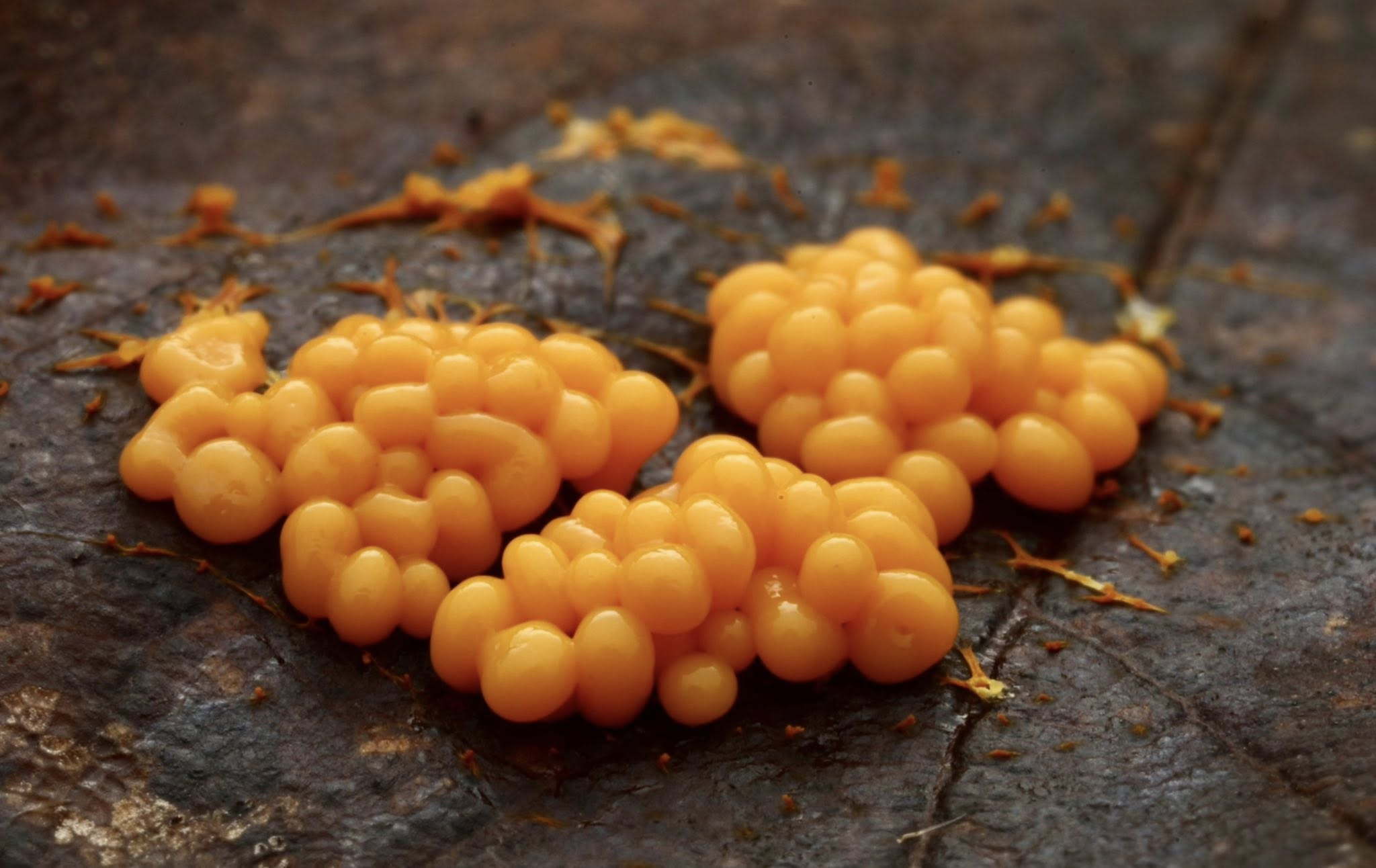
Still, enough excuses: I’d walked right past them. Past the bursts of carnival-candy slime mold, the salmon pearls of wolf’s milk, the tussled sheaves of chocolate tube slimes. My new awareness was nothing less than transportive. I was a sudden convert, an acolyte of leaf duff and rotting logs. Children were dispatched in tense reconnaissance — being of keen eyesight and closer to the ground, they make fine scouts. Part of the joy, we learned, was returning to a spot to track a discovery, such as a dog-vomit slime mold we encountered wandering in the redwoods, a dead ringer for a brand-new kitchen sponge. A crawling sponge, for we returned a few days later to find that it had journeyed on.
At times, we have followed a slime mold’s movements as one might a favorite team. Early in our adventures, my youngest son spotted a swath of gold so bright I thought it might be an abandoned signpost; closer inspection revealed a Badhamia plasmodium marching down a rotting log (like most slime molds, Badhamia, by virtue of obscurity, has no common name). Racing back the next day, we found that, having reached the south pole of the log, it had reversed course and was moving northward at such velocity that we could see it moving with the time-lapse function on my iPhone. The following week it began its apotheosis. The gold was gone; now bunches of grapelike sporangia glittered. A week later, they began to rupture, spilling twilight-colored spores. Two weeks later, only hollowed orbs remained, crystalline and breath-shivered. By then I had discovered a group of people posting their discoveries on Instagram with the hashtag #slimemoldsunday: intergalactic gem collections from the forests of Tasmania, Southern California and Prospect Park.
 Henry E. Hooper