
Lacrosse: Tewaaraton
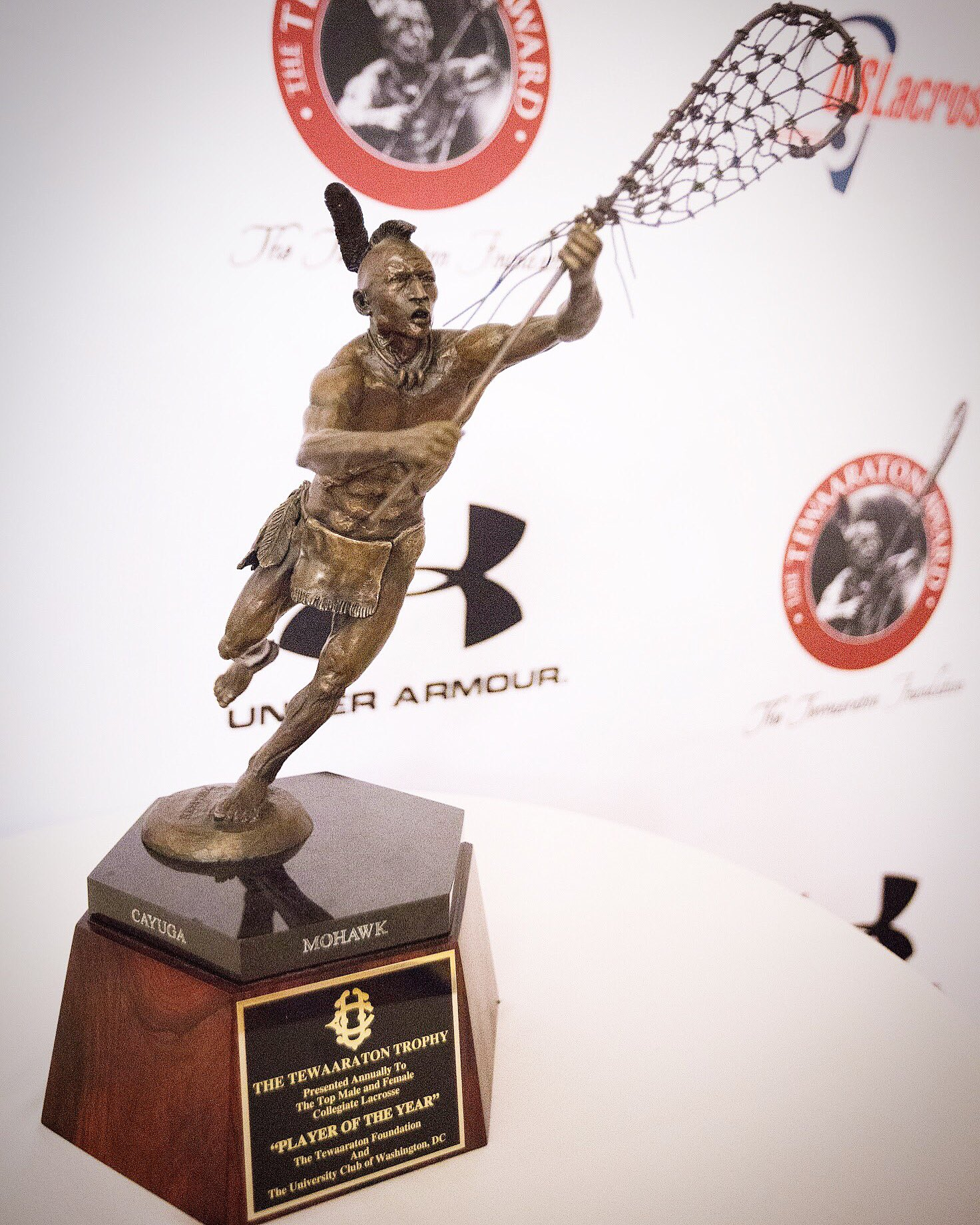
The bronze Tewaaraton Trophy featuring a Mohawk native was designed and created by Frederick Kail. [1] Spanning four decades, Mr. Frederick Kail has distinguished himself as an accomplished sports sculptor and pre-eminent lacrosse sculptor. With this timeless work of art, he captures the exciting spirit and powerful dynamics of lacrosse with meticulous attention to accurate detail. His depiction of a single unnamed Mohawk player, dramatically surging to the front, profoundly portrays the competitive human spirit and superior athletic ability required to win this award.
Adorned simply in a loincloth and golden eagle feather, the 12-inch figure is foundry-cast in a rich patinaed bronze. It is mounted upon a hexagon-shaped slab of black granite and handcrafted, highly polished exotic Cocobolo wood. The hexagonal base symbolizes the Six Nations of the Iroquois Confederacy: The Mohawk, Cayuga, Oneida, Onondaga, Seneca and Tuscarora tribes. With some minor decorative exceptions, the stick is a replica of a pre-1845 Cayuga stick belonging to the grandfather of Alexander T. General of the six Nations Reserve in Ontario. The stick was actually an original predecessor of the modern day stick. To assist with the historical authenticity, Thomas Vennum, Jr. the renowned Native American lacrosse historian, and author of American Indian Lacrosse: Little Brother of War, served as consultant to Frederick Kail through the development stage of the Trophy.
The original castings are part of the permanent collection and are currently on display at the University Club of Washington, DC and the National Lacrosse Hall of Fame in Baltimore, Maryland. Bronze replicas of this magnificent trophy are awarded annually to the most outstanding female and male varsity collegiate lacrosse player in the United States.

History
Lacrosse is one of the oldest team sports played in North America. Rooted in centuries of Native American tradition, the game took on many variations before reaching its present day form. “Tewaaraton,” is the Mohawk name for their game and the progenitor of present day lacrosse.

The Creator’s Game lacrosse statue by Jud Hartmann
“The Creator’s Game” in a Modern World
Lacrosse is commonly viewed as founded by the Iroquois Nation, or Haudenosaunee. The Iroquois say that lacrosse was a gift from the creator. They believe lacrosse is a holistic process that binds communities and the nations of the Haudenosaunee together. Lacrosse is also considered a “medicine” game because it promotes the health and strength of the Nation, ensuring a continuance of tradition and an understanding of their ways.
Lacrosse in America
Lacrosse participation in American colleges and high schools has surged since the 1960s. Much of this rising interest occurred first in New York and Maryland, but by the late 1990s it spread to other regions of the United States, particularly at the youth and high school level. Helping to fuel this expansion was the development of lacrosse sticks made from synthetic materials. Although several equipment manufacturers currently make most sticks, some Natives still craft traditional wood sticks by hand.
Beginning in 1971, the National Collegiate Athletic Association began sponsoring a championship tournament for men’s lacrosse, eventually expanding to include women’s lacrosse and incorporating all three NCAA divisions. Among the most successful collegiate programs are the Syracuse, Johns Hopkins, and Hobart men and the Maryland, College of New Jersey and Northwestern women. The federal mandates of Title IX greatly contributed to the expansion of women’s college lacrosse.

Lacrosse on a World Stage
Men’s world championship play began in 1967 among teams from the United States, Canada, England, and Australia. In 1990, the Iroquois Confederacy fielded a team, becoming the only indigenous people with representation in an international championship sports event.
Professional lacrosse became a permanent fixture in North America in 1987. Today, there are four pro leagues: The National Lacrosse League (Indoor) and Major League Lacrosse (Outdoor) and the Premier Lacrosse League (Outdoor) and the Women’s Professional Lacrosse League.
Honoring a Tradition
The proliferation of different types of modern lacrosse, along with an adherence by Haudenosaunee communities to continue playing competitive and non-competitive “medicine games”, forge a strong tie between past and present. Young people learn from their elders to respect the game and respect their opponent, as they also have been given the gift to play the game. The Lafayette High School boys’ lacrosse team in upstate New York, composed primarily of Onondaga Nation members, continues the tradition of thanking the creator for his gift by celebrating each goal with a rousing cheer in their native language.
[1] All of the language, photos and credits go to the Tewaaraton Award website, which is enclosed in this Lacrosse post: https://tewaaraton.com/
 Henry E. Hooper