
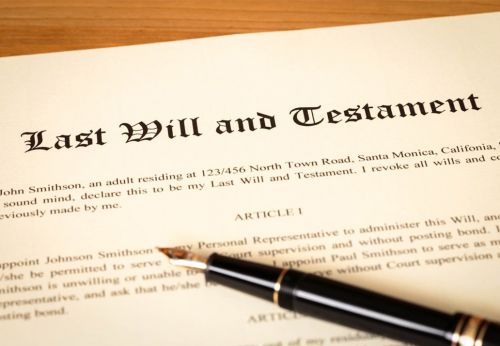
Friday Finance: Estates and Wills
One of the surprise wedding gifts my wife and I received 42 years ago, at our reception, was a Will, created by our brother-in-law, who knew we were going out of the country for our honeymoon. That gift worked for us for several years, and we were very grateful. It was a good source of comfort to us until we moved out of state and started to accumulate assets. It was time to revisit that document and looked to see what changes we would make if we started a family and bought a home. We wanted a document to give us peace of mind, that we were taken care in any emergencies.
The following Friday Finance post can be a triggering topic for many personal finance students, because the overarching question is, “What do you want to happen to your possessions if you were to die?” This post is written as a series of Lessons (5 lessons in this case) that are key to any discussions on the topic of Estates and Wills. The Questions and Answers format works well in a personal finance class. to get the conversation going.
Let’s start with some basic fact finding…. Dispite any misgivings, discussing these topics with clear eyes and sound mind can be a big relief to yourself and your loved ones later down the road.
Q: Why might you want a Will? A: Wills ensures that your assets are distributed according to your specific wishes rather than state laws. It allows you to designate guardians for minor children, appoint an executor to manage your estate, and prevent family disputes over your belongings. People also want Wills to maintain control over their legacy and to ease the legal and emotional burden of their demise and death on their loved ones.
Q: How many adults die in the U.S. today without a Will? A: Estimates range between 54% and 75% of adults in the U.S. (We will explore this topic in a minute.)
The technical term for someone who dies without a Will is “intestate.” The issue created by dying without a Will is that anyone can claim that you owe them money and challenge your estate by taking the case in front of a state-appointed judge in Probate.
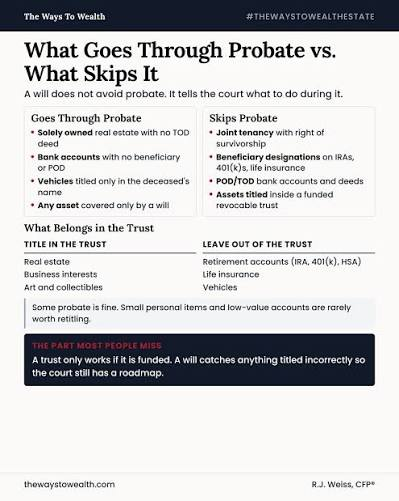
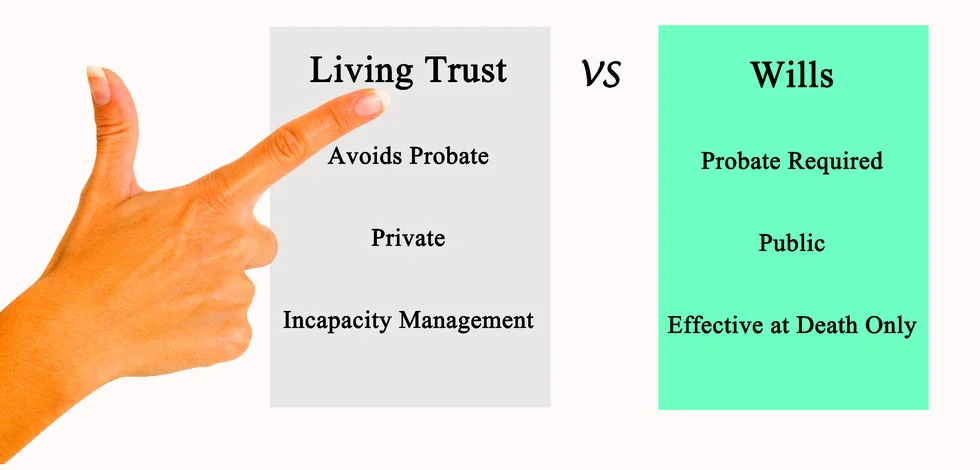
Q: What is Probate, you ask? A: Probate is the legal process whereby the court-supervised team authenticates a deceased person’s Will, settles any outstanding debts and taxes, and distributes their remaining property to creditors and heirs. We care about the process because it ensures that your family assets are legally transferred; however, BEWARE: Probate can be a lengthy, public and expensive process, which eats away at your hard-earned assets.
How Many Die Without a Will?
While there’s no official “intestate death count,” researchers survey living adults about whether they have a Will, and that percentage gets treated as a proxy for what happens at death. Recent estimates vary quite a bit depending on which survey is chosen:
- Caring.com’s 2025 survey (with YouGov) found only 24% of respondents said they had a Will, while 13% had a living trust, and 4% had other estate planning documents — implying roughly 76% of the respondents had no will. Caring.com
- Trust & Will’s 2025 report (10,000 respondents) found a Will is held by just 31% of Americans, with only 11% having a trust, and 55% having no estate plan at all. Trust & Will
- In 2021 a Gallup poll found only 46% of U.S. adults had a will, meaning 54% did not have a will. Retirement Living
So depending on the year and survey, estimates of Americans who would die intestate range from about 54% to 76%. Applying that range to total annual U.S. deaths (~3.1 million/year), that’s roughly 1.6 million to 2.4 million people dying without a Will every year. While this is a “back-of-envelope” estimate, and not an official figure, it assumes that the living-population survey rate holds among people who actually die that year (in reality, older people are somewhat more likely to have a Will than younger people, so the true intestate rate among decedents is probably lower than the population-wide rate, but the percentage and pure number of citizen without a Will is still substantial).
Intestate Breakdown by Education
An interesting factoid for students of Personal Finance, because the correlation is strong and consistent across sources, the higher your education, the more likely you will die with a valid Will. In other words you are LESS LIKELY to die intestate.
- Trust & Will’s conducted a post-pandemic survey and found a strong, direct correlation between level of education and estate planning: over half of Americans with a postgraduate degree have their affairs in order, versus just 23% of those with a high school education or less. That gap has been widening — since 2021, every education group’s planning rate has risen except the least-educated group, whose rate has actually fallen. Trust & Will
- Income (which correlates heavily with education) shows the same pattern: those with household incomes over $1M are twice as likely to have a will (66%) as those earning under $25,000 (33%). Trust & Will
- Put another way: ~77% of high-school-or-less Americans have NO estate plan, versus under 50% of postgrads. People without a college degree make up a disproportionate share of the intestate population — both because they’re less likely to have Will, Trust and estate planning documents and because non-college-educated adults are the larger share of the U.S. population to begin with. Trust & Will
Q: Do you want to die with a Will? A: The answer, from these lessons below, is YES.
These five (5) Lessons can be considered as individual thought pieces. Please understand: this Friday Finance post is not a thorough legal review of estates and trusts, but it touches on the legal concepts for further exploration with an estate specialist or a trust lawyer. Read these lessons carefully, and decide for yourself whether you want to have a Will (and the other “Power of Attorney documents”) for your own piece of mind, and to comfort your loved ones and heirs.
Five lessons for teaching students why estate planning matters, what each document does, and who they need to make it legal
Lesson 1: Why You Need a Will (The Cost of Doing Nothing)
Essential Question: What happens if I don’t do this Will creation thing in your lifetime?
Key idea: If you die without a Will, you die “intestate.” That doesn’t mean your stuff disappears. It means a judge, using a fixed formula that is written into your state laws, decides who gets your assets and liabilities. Not you, and not the people you would have chosen to divide your possessions.
Teaching points:
- Every state in the U.S. has its own intestate succession statute — a default distribution plan for people who didn’t properly document their own Will.
- Most Americans currently fall into this category. A surprisingly large percentage of U.S. adults (54% – 76%) have no Will, and will be without one at the time of their deaths.
- Intestacy doesn’t just redirect your assets — it can also mean:
- The court appoints an estate administrator (instead of you naming your own Executor).
- If there are minor children, a judge decides the guardian if you haven’t named one — even if you would have picked a specific relative or proxy as a Guardian.
- Unmarried partners typically get nothing under intestate succession, no matter how long the relationship has lasted (meaning there are no overarching common-law rights assigned to long-time partners).
- The process (Probate) usually takes longer and costs more without a Will or Trust guiding it.
Possible Class Discussion Prompt: “If you died today with $5,000 in a bank account and no Will, who do you think would legally get that money? Would that result match what you would really want?”
Lesson 2: The Core Documents — What Each One Actually Does
Essential Question: Writing a “Will” isn’t the whole plan; what else do you need to do, what does each piece do for you, and when do you use it?
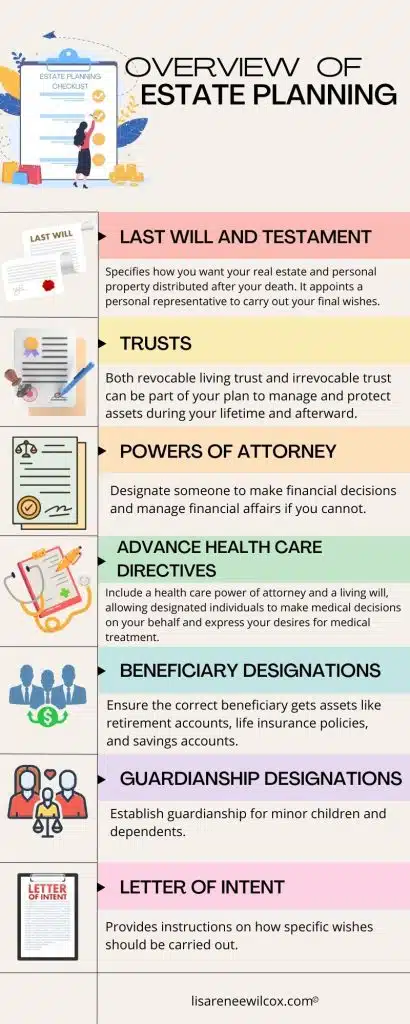
Walk through each document below as if answering a different question about a different moment in life (or after death):
| Document | Question it answers | When it’s used |
|---|---|---|
| Last Will and Testament | Who gets my stuff, and who’s in charge of distributing it? | After my death |
| Living Will (Medical Advance Directive) | What medical treatment do I want/not want if I can’t speak for myself? | While alive, but incapacitated (e.g., coma, terminal illness) |
| Durable Power of Attorney (Financial) | Who can pay my bills, manage my accounts, and handle money matters if I can’t? | While I’m alive, but incapacitated |
| Healthcare Power of Attorney (Medical) | Who can make medical decisions for me that aren’t already spelled out in my Living Will? | While I’m alive, but incapacitated |
| Executor | Who carries out the Will’s instructions and asset distributions after I die? | After my death |
| Guardian designation (if applicable) | Who do I want to raise my minor children if I can’t? | After my death, or incapacity |
Key teaching point — the two “phases”:
- While you’re alive, but can’t speak for yourself → Living Will + Power of Attorney (financial & healthcare) cover this.
- After you die → the Will + Executor cover this.
A lot of people only think about #2 (“I need a Will”) and completely skip #1 — which is actually the more likely scenario for most people (they may die in an accident, surgery complications, or illness), not from sudden death.
Lesson 3: Who You Need to Help You Build a Will
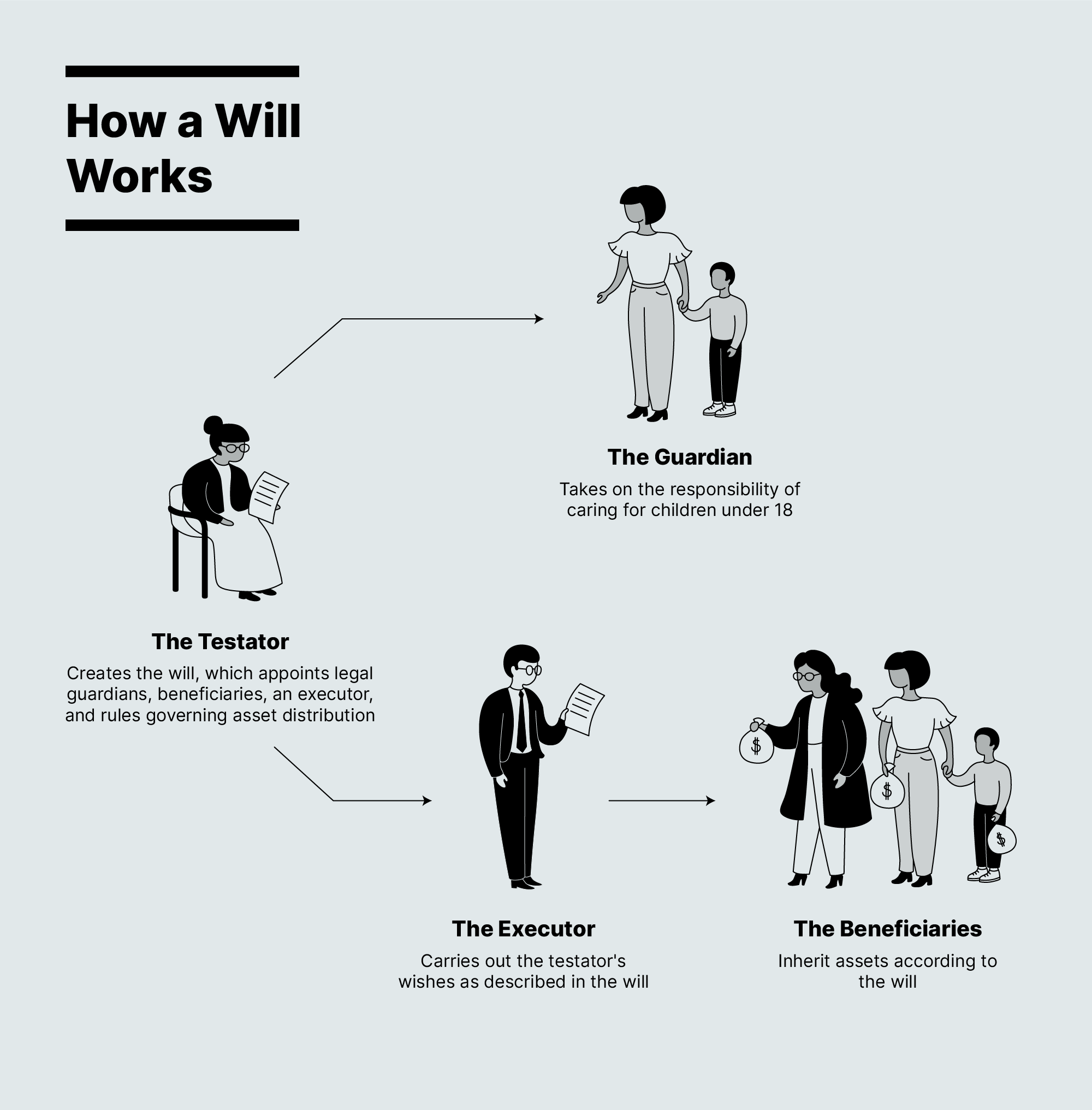
Essential Question: Who actually has to be involved to make this Will legally binding, and what does each person do?
(N.B. This is a part of Wills that students usually don’t know: A Will isn’t valid, just because you typed it up and meant it to represent your dying wishes. You must get the Will approved (signed, witnessed and documented) in your state of residence.)
The Differeent Roles:
- You (the “Testator” or “Principal”) — the person whose wishes these documents represent.
- An Estate Planning Attorney — not strictly required in every state for a basic Will, but strongly recommended, especially for anything beyond the simplest estate. They make sure the document meets your state’s specific legal requirements (states differ on witness rules, notarization requirements, etc.).
- Witnesses — most states require 2 adult witnesses (NOT beneficiaries of your will!) to watch you sign the Will. This guards against fraud or coercion claims later.
- A Notary Public — many states allow (other states require) a “self-proving affidavit” notarized alongside the Will, which speeds up probate by pre-certifying the signatures were legitimate.
- An Executor — the person named in the Will to actually carry out its instructions: paying debts, filing the Will with the probate court, distributing assets, etc. This should be someone the testator (you) trusts and discusses any particular instructions in advance. Being an Executor can be both an honor and real work. They will want to brush up on their responsibilities.
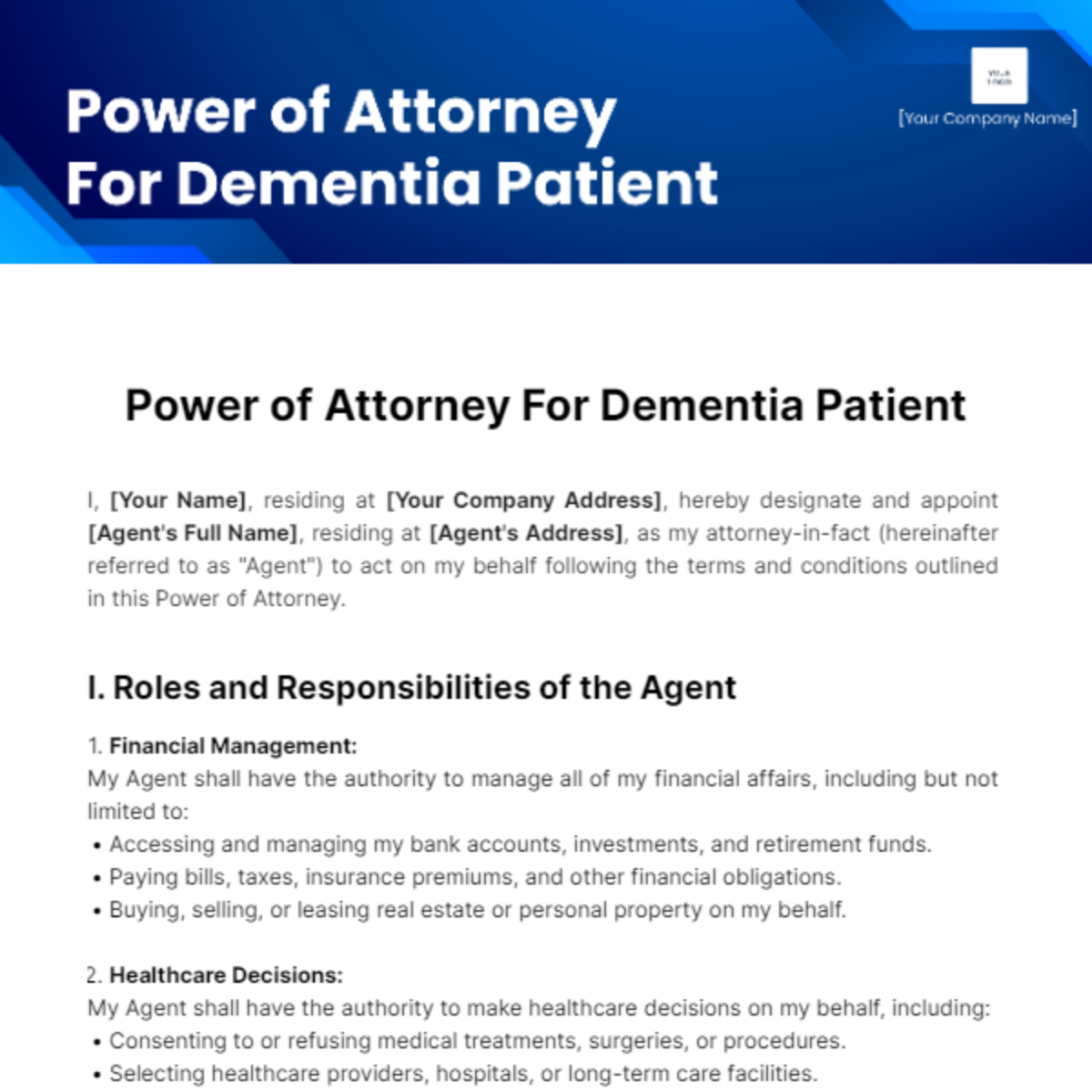
- An Agent (attorney-in-fact) — the person named in a Power of Attorney (POA) document to act on your behalf financially or medically while you’re alive but incapacitated. The Agent can be the same person as your Executor, or different, if you so choose.
- A Guardian (if you have minor children) — named in the Will, and subject to court approval.
Key teaching point: None of these documents are truly “done” until the right people have signed off in the right way. A Will that isn’t witnessed correctly, or a Power of Attorney (POA) that isn’t notarized where required, can be challenged or thrown out by a judge — which defeats the whole purpose.
Lesson 4: The Complication — When Dementia Enters the Picture
Essential Question: What if my incapacity isn’t sudden? What if it’s a long slow decline over years?
Key idea: Standard living Wills are usually written with sudden, catastrophic events in mind — a coma, a terminal diagnosis with a clear timeline. Dementia doesn’t work that way. It’s gradual, and a person can be legally alive and “aware” for years, while steadily losing the capacity to make or communicate their decisions.
Key teaching points:
- A standard advance directive often doesn’t specify what to do at different stages of cognitive decline — it may not address questions like: At what point should hand-feeding stop? Should specific end-of-life care be discontinued if I no longer recognize my family?
- Some states and organizations now offer a Dementia-Specific Directive (sometimes called a “dementia provision” or “dementia directive”) that lets someone spell out preferences stage-by-stage, in advance, while still legally competent to do so.
- This makes the Healthcare Power of Attorney especially important in dementia cases — that named agent will likely be interpreting and applying your wishes over a period of years, not making one clear-cut call.
- Legal weight of dementia directives varies significantly by state. PLEASE NOTE: this Dementia-Specific Directive is a new developing area of the law, not yet standardized nationally.
Possible Class Discussion Prompt: “If you couldn’t recognize your own family anymore, but your body was otherwise healthy, who would you trust to make decisions about your care? Have you ever told that person what you would want them to do on your behalf?”
Lesson 5: Putting It All Together — A Student Checklist
Here’s a wrap-up handout. Frame the people and process lesson of getting it right as follows: “Here’s the order that most people tackle these topics, once they’re grown adults with assets and dependents, or both.”
- Decide what you own and who should get it. (Even young people have something: a skateboard, a car, savings, digital assets that they revere. And possessions they want to go to a particular friend of family member.)
- Name an Executor. Someone you trust and have actually talked to about taking on that role in earnest.
- Draft a Will. Ideally you can co-create your Will with an attorney, or at minimum follow a state-compliant template. There are many examples on the internet, so be sure to pick one that is valid in your state.
- Sign it in front of the required witnesses. Get the Will notarized by a Notary Public, if your state allows a self-proving affidavit.
- Draft a Living Will / Advance Directive and decide, beforehand, what medical care you want or refuse if incapacitated?
- Name a Healthcare Power of Attorney and a Financial Power of Attorney. These two POA roles can be the same person as your Executor, or different people. Its up to you.
- If you have minor children, name a legal Guardian. Again, select someone you trust, who can follow your wishes for your children, until they are 18.
- Revisit all of the items above after major life events. This revisit is important because ideas change with life events: marriage, divorce, a move, a child, a big financial change, or a new medical diagnosis. Documents that are 10-15 years old often no longer reflect what someone actually wants, so review you will and associated documents again periodically throughout your lifetime.
Closing point to make to the class: The single biggest reason (excuse) that people give for not doing any of these five life lessons isn’t cost, importance or complexity — it’s procrastination. The paperwork is very doable in an afternoon. The hardest part of this task is just getting started.
Disclaimer for classroom use: This unit is for financial literacy education, not legal advice. Laws on wills, estates, witnesses, guardians, executors, notarization, and medical directives vary by state — encourage students (and their families) to consult a licensed attorney in their own state to create anything that you want binding.

