
Butterflies: Buckeye
Hiking in Sedona, AZ on the Cockscomb Trail Loop with our friend, Forrest Berkley, my wife, Tracy and I came across a set of eyes on the wings of a butterfly. It was early March (2026) and we were seeking a shakedown hike before we headed out in search of the energy of a Vortex or two nearby. By mid-day it was hot with direct sunlight glaring down upon us.
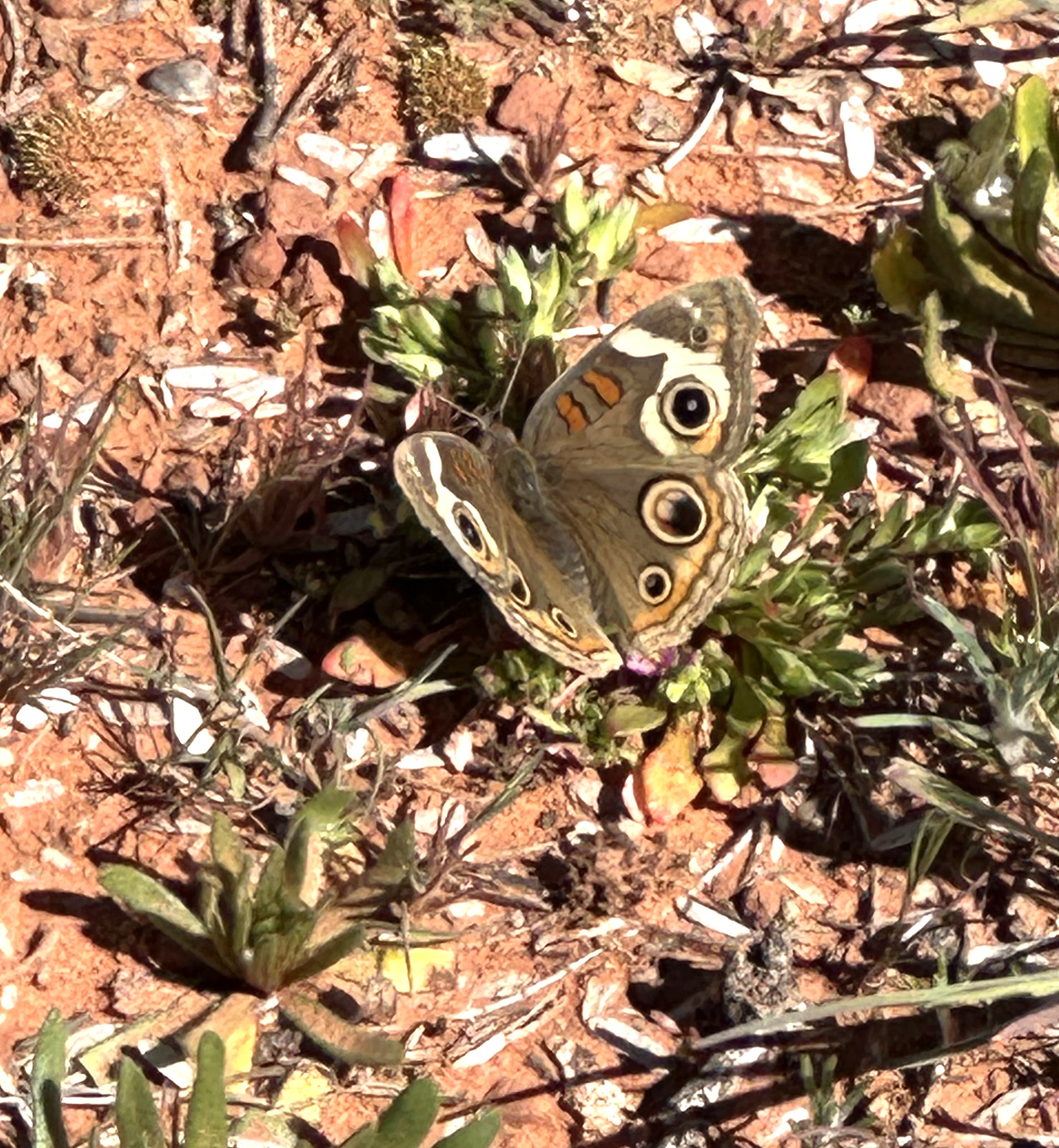
Suddenly sets of eyes were looking back at me, which caught our attention. Having seen this butterfly before, but not recalling its name, the identification app on my iPhone let me know the butterfly species was buckeye. I later found it to be a gray buckeye (west of the Rockies). It was climbing around some branches on the side of our trail, but I took some time to photograph it and make positive ID before moving on. It was a beauty, even in the deep red of the Sedona earth. We did not see the majenta that the butterfly sources all pointed to, but we were thrilled nonetheless.[1]
The wider species are known as common buckeye or buckeye, which are butterflies in the family Nymphalidae. According to Wikipedia, its range covers much of North America and some of Central America, including most of the eastern half of the US, the lower to middle Midwest, the Southwest (including most of California), southern Canada, and Mexico. Its habitat is open areas with low vegetation and some bare ground. Its original ancestry has been traced to Africa, which then experienced divergence in Asia.
The species Junonia grisea, which we spotted in Sedona is a unique species known as the gray buckeye. This species is found west of the Rocky Mountains and was formerly a subspecies of Junonia coenia.
Caterpillars of these butterflies appear to prefer plants that produce iridoid glycosides, which are bitter compounds that release a hormone called gastrin that activates the digestive system (i.e. hunger); therefore, iridoid glycoside producing plants stimulate and attract their appetites particularly when found in plants like Plantago lanceolata.
Interestingly glycosides are also found in Foxglove (Digitalis purpurea) which was the inspiration for another Plants Witness Post from my Oregon adventures many years ago. In fact, the presence of these metabolites may trigger oviposition behaviors in female butterflies so that descendant larval bodies may better incorporate iridoid glycosides. As a natural defense mechanism, iridoid glycolyside metabolites appear to have a growth-stimulating effect on caterpillars but a growth-reducing effect on its many predators.
Predators like ants, wasps, birds, and small animals prefer to feed on iridoid glycoside poor caterpillars rather than iridoid glycoside rich larvae, potentially due to these effects. Therefore, immunity of J. coenia larvae to predators like ants appears to be strongly related to the concentration of iridoid glycosides sequestered in their bodies. However, too much iridoid glycosides in the diet can negatively affect the immune response of these larvae and lead to increased susceptibility to parasitism.
Adult butterflies feed on flowers with certain pollinator cues: yellow flowers that are “pre-change”, or flowers whose color has not been changed due to insect visitation or other factors. Common buckeye caterpillars feed in isolation rather than relying upon grouping behaviors. Vulnerability to the Junonia coenia densovirus is another concern for survivorship of common buckeye larvae.
Adult butterfly
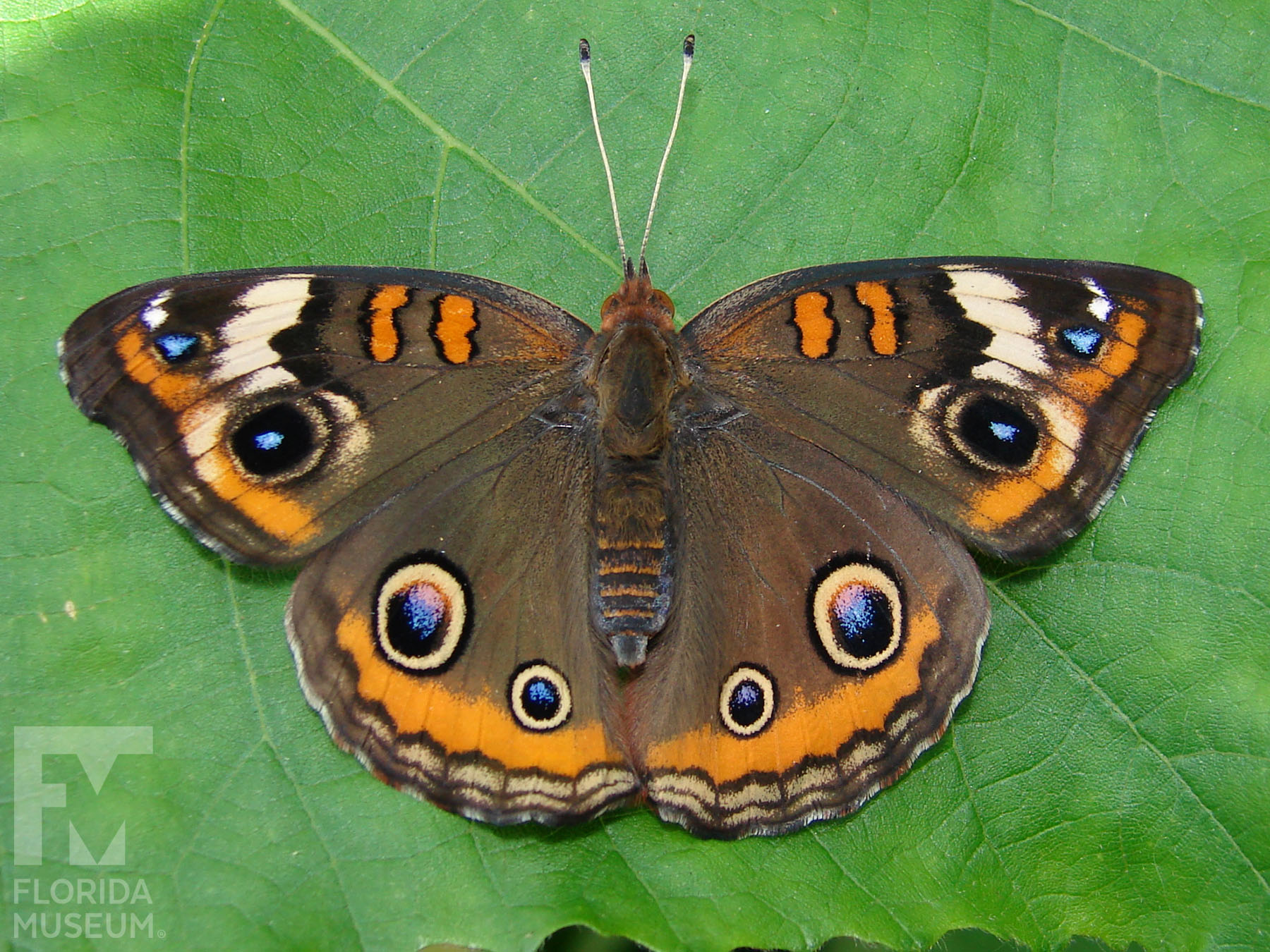
As I did some additional research, common buckeye butterflies are colored mostly brown with some orange, black, white, blue, and magenta. In technical insect terms, the forewing features two proximal orange bars and a postmedian white band, which surrounds a prominent black eyespot and borders a smaller, more distal eyespot; both eyespots have a bluish center and each border a distal orange mark. The hindwing is mostly brown with an orange band towards the edge and a brown and white margin. It also has two eyespots, one larger and one smaller, each with a black and white outline 2 and 2.5 inches.
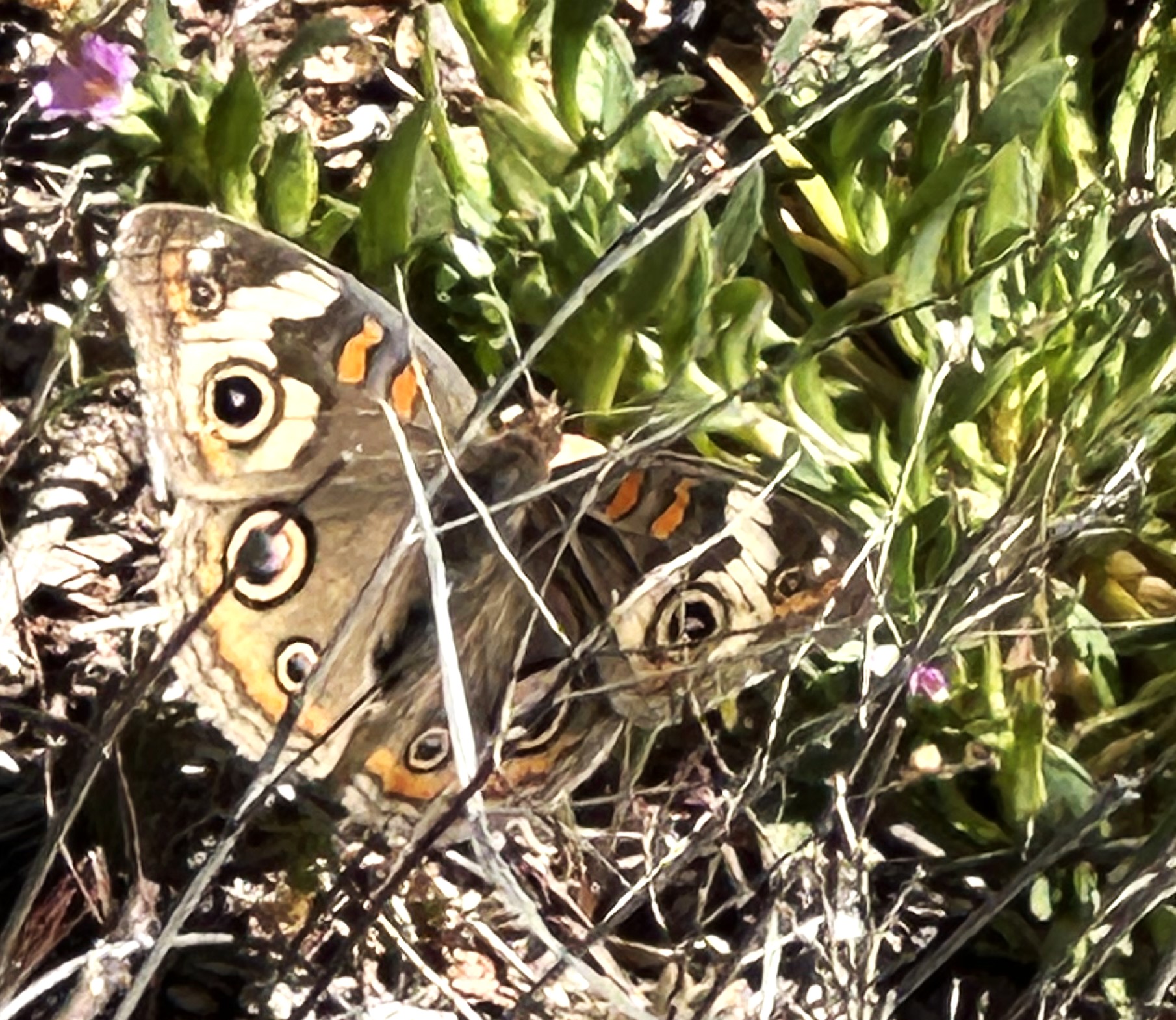
If you spot a butterfly with sets of eyes on its wings and believe it it looking at you from lots of difference angles, best guess is that it is a Buckeye!
========================================
References:
 Henry E. Hooper