
Birds: Roadrunner
Enroute to Mexico, in late summer 1979, we saw some great nature: rainbows, cloud formations, snow covered peaks, roadrunners and more rain ahead. We counted five roadrunners in about an hour near Socorro, New Mexico (and zero coyote). That bird tally was two more roadrunners than I had seen all summer in the Southwest in June and July that year. These are amazing birds to see in action.
Our family was on a birding and geology trek in New Mexico in 2026. The day we flew in from Oregon, we were in a van going to the hotel nearby, when we spotted a roadrunner resting in the median strip along the frontage road. I mention the sighting to our bird expert for the trip, Arch McCallum, and he said to us, “No, that doesn’t qualify. We only start the bird count on e-Bird with the days of the actual trip!” Let’s just say, the roadrunner may not have been on the trek’s official bird list, but it was certainly on mine!
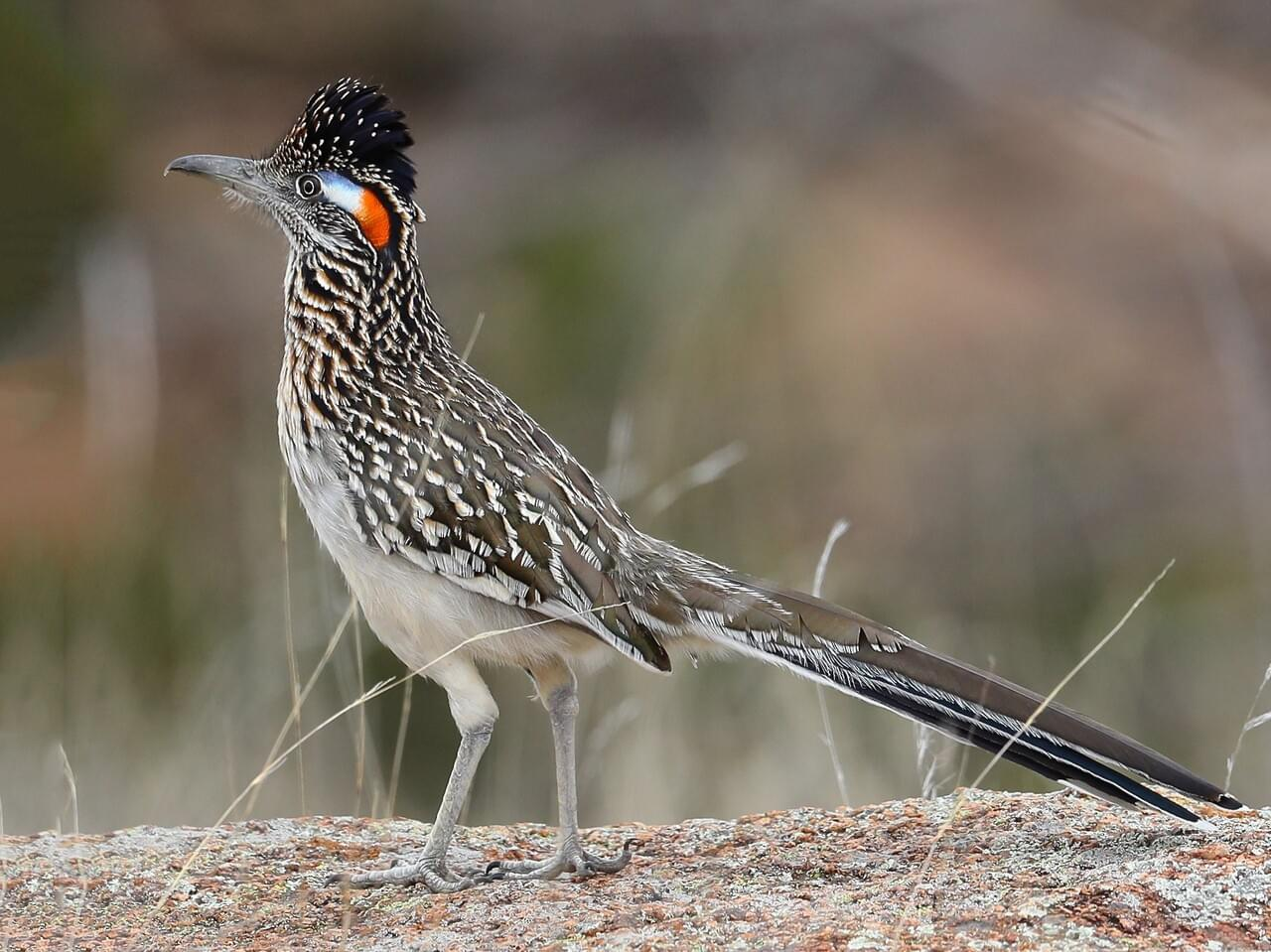
The roadrunners (genus Geococcyx), are also known by various names: chaparral cocks, paisano, Correcaminos Grande, and California earth-cuckoos, among others. They are from a species of fast-running ground cuckoos with long tails (for steering) and prominent crests. They are found in the southwestern and south-central United States, Mexico and Central America. They are usually spotted walking, or running in the desert. Although these birds are capable of flight, they generally out-run any predators. On the ground, some have been measured at speeds reaching 20 mph.[1]
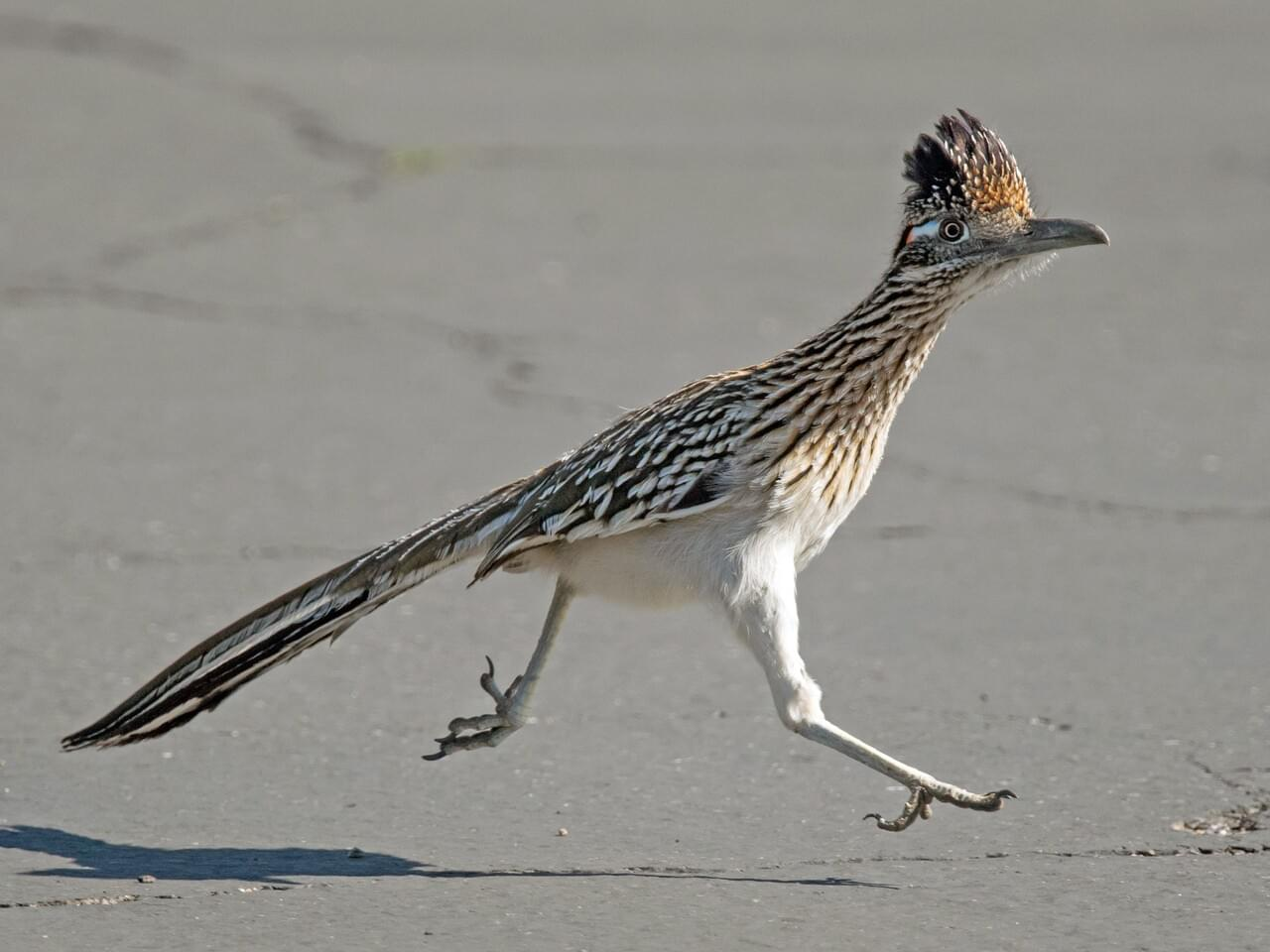
For a generation of Americans, who were familiar with the “beep, beep” of Warner Brothers’ cartoons, Roadrunner was the ever-present sound in the background of many Saturday mornings. Despite the cartoon character’s perennial victories over Wile E. Coyote, real-life coyotes in fact present a real danger. The coyote is a wiley mammal, and it can reach a top speed of 43 miles an hour — that is more than twice as fast as average roadrunner.

Roadrunners have evolved a range of adaptations to deal with the extremes of desert living. Like seabirds, they secrete a solution of highly concentrated salt through a gland just in front of each eye, which uses less water than excreting it via their kidneys and urinary tract. Moisture-rich prey including mammals and reptiles supply them otherwise-scarce water in their diet. Both chicks and adults flutter the unfeathered area beneath the chin (gular fluttering) to dissipate heat.[1]
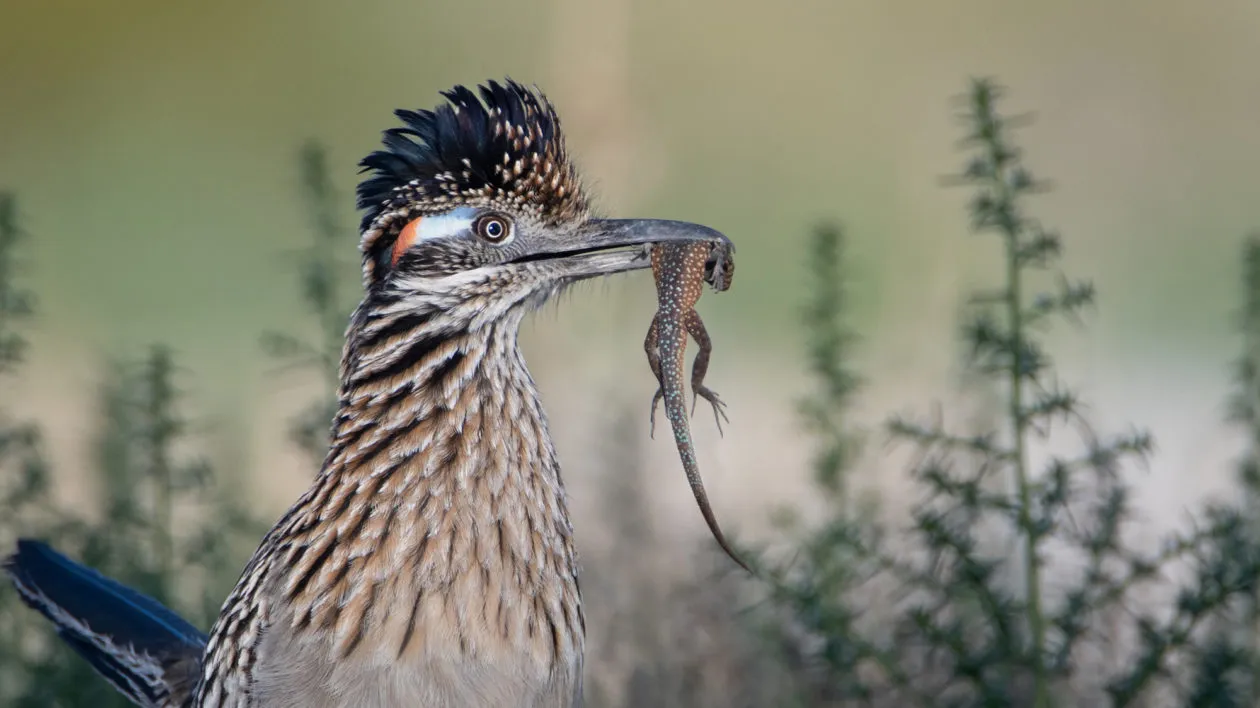
Greater Roadrunners eat poisonous prey, including venomous lizards and scorpions, with no ill effect, although they’re careful to swallow horned lizards head-first, with the horns pointed away from their vital organs. Roadrunners can also kill and eat rattlesnakes, often hunting and capturing the snakes in tandem with another roadrunner. While hunting rattlers, one roadrunner distracts the snake by jumping and flapping, the other sneaks up and pins down its head, then it bashes the snake against a rock.
If the snake or lizard is too long to swallow all at once, a roadrunner will walk around with a length of reptile still protruding from its bill, swallowing it a little at a time as the snake or lizard digests.
Based on bird banding records, the oldest roadrunner lived to be at least 7 years old.
Roadrunners hold a special place in Native American and Mexican legends and belief systems. The birds are revered for their courage, strength, speed and endurance.
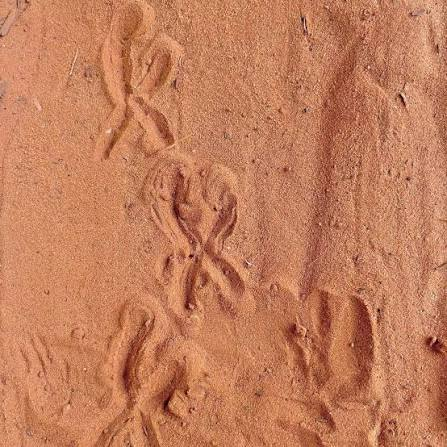
The roadrunner’s distinctive X-shaped footprint — with two toes pointing forward and two backward — are used as sacred symbols by Pueblo tribes to ward off evil. The X shaped footprint disguises the direction the bird is heading, and is thought to prevent evil spirits from following them on their hunting expeditions and back again to their nests.[2]

Sources:
[1] https://en.wikipedia.org/wiki/Roadrunner
[2] https://www.allaboutbirds.org/guide/Greater_Roadrunner/overview

