

Birds: Chicken
Claiming to be a bird lover with a “spark bird” and missing one of the most prolific avian creatures on earth, the chicken, could be an embarrassing oversight.[1] Or it could be an emphatic exclamation point! But then, like the pigeon, it could be a flat out mistake. The reason for the equivocation and personal reprimand? It is the obituary of the serious bird lover, Karen Davis. [2] The unheralded chicken is a remarkable avian survivor. It is worthy of its own witness post.

Karen Davis, “That Crazy Chicken Lady”
Elevated from a flightless cuckoo to a soaring person of interest, Karen Davis came to national prominence through the 2006 documentary called Animal People. She emerged decades earlier as an admirer of chickens, when everyone else was trying to do one of two things: 1) prevent avian flu or 2) reduce the cost of eggs and chicken per pound to the average American white meat eater.
In today’s era of free range chickens, it seems illogical to think back to crammed Perdue Chicken sheds: thousands of chickens in the Maryland Eastern Shore coops of mass production mayhem. However, the treatment of chickens is worth a pause. One of the techniques used by commercial egg producers at the time was forced moulting.[3] Not well known, the practice enhanced the number of egg-laying seasons for the short-lived hens. Forced moulting proved to be an effective artificial processes that chicken farmers used for generations to increase the yield of a flock. Karen Davis was one of the first to protest the practice. Other techniques that chicken farmers used included clipping wings (to keep them flightless), clipping their beaks (to keep the cramped birds from fighting and pecking cramped birds eyes out of their fellow inmates), and isolating the roosters from the hens (to keep the gene pool pure).
Karen Davis, an academic (English professor at the University of Maryland), turned animal-rights activist, campaigned on behalf of chickens, turkeys and other barnyard fowl. She thoughtfully argued for the dignity of “nonhuman animals,” as she put it, while promoting veganism. She spent the majority of her adult life crusading against the modern poultry industry. In the interim she turned her home in Machipongo, Virginia into a sanctuary for chickens.

Karen Davis backed up her beliefs by organizing, writing, lecturing and protesting on behalf of domesticated birds, including the more than 9 billion chickens slaughtered each year in the United States. Davis jokingly referred to herself as “that crazy chicken lady” but was unapologetic in campaigning on behalf of animals. She was soon gaining national attention through her efforts to overhaul a global food system that she likened to a form of mass murder.
“I spend my days with domestic chickens and turkeys, birds that have long been denigrated as stupid, despite ample evidence to the contrary,” she wrote in a 2005 letter to The Washington Post, responding to an article about avian intelligence.[4] “Just watch a hen calculate how to speed to her perch at night to avoid a certain attentive rooster in the way, and you know that a smart chick is looking out for her own interests.”
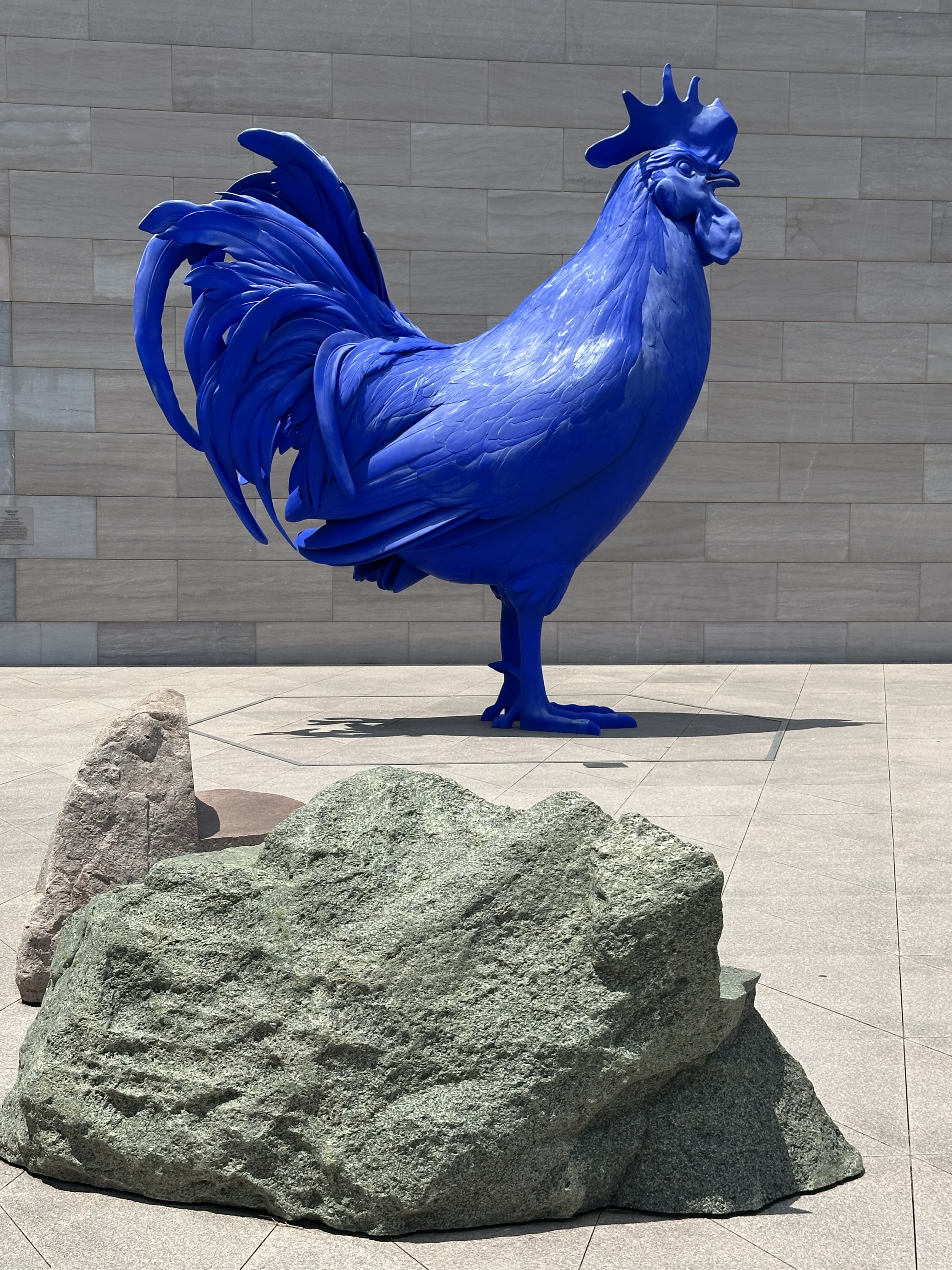
Image of a Blue Chicken from Museum of Art, rooftop sculpture garden, Washington, DC
In 1992, Ira Glass, creator of podcasts and National Public Radio series “This American Life,” started his fourth quarter Poultry Slam. His reasoning? As Glass claimed, if chickens had a personality and it was that they were a ‘pain in the ass.’ Besides, they are the stupid, hybridized animals of choice, along with the mocked turkey, for Thanksgiving to Christmas family feasts.

Ira Glass, Creator of This American Life
In 1998, after feeling the heat from Karen Davis, Glass went for an extended interview and tour of Davis’ bird sanctuary. A few months later, Glass was a guest on the David Letterman Show. Glass is quoted as saying, ”Every time after that [talk and tour], every time I ate a piece of chicken, I would think back to her chickens, and the shy ones and the outgoing ones.” He saw the wisdom of Davis’ arguments.[5] Glass ultimately gave up chicken and poultry all together. He claimed to be a vegetarian.
It is worth noting that in 2023, Costco alone (not including Walmart or Foster Farms) sold over 137 million rotisserie chickens, which was a 20 million increase from the previous year. Every year the number of chickens we grow and slaughter for human consumption in the US is staggering.
My wife Tracy and I were in Tampa, Florida, in the fall 2023 and we realized that the entire commercial area around Ybor City was a chicken and rooster loving zone. Chickens are allowed to roam freely throughout the City, thanks to a city of Tampa ordinance protecting them. These birds are living memorials to the founding and early days of Ybor City. They also remain a source of entertainment; it’s from the joy of visiting them and taking pictures of their little families and the hijinks they get into.
My friend, Jamey French, whom I have known since boyhood, was also a non-profit board chair colleague. He is also a life-long chicken lover. Jamey sent me a note recently, saying, “I still have my 15-20 girls—a few are in the assisted living section of our backyard Portsmouth Chicken-Hilton. With avian peace and no fox access, these hens will live to 8-10 years old.”
He added, “My current ‘pet’ is named Peony. She is a barred rock hen who is quite convinced I am her rooster. She comes when she is called and she is great with visiting kids (including our 18 month old grandson, Soren). Children can pat her without fear of a getting henpecked.”
“Happy Thanksgiving, friend. P.S. We eat a single select turkey from our farm in Hopkinton—where we raise around 150 free-range ‘happy’ turkeys each year.”
Thank you for the reminder, Jamey. And Karen Davis, thank you for your commitment to these creatures left to our care.
———————————————————————–
[1] In self defense I have written a bird post on pullets and cockerels as labels in the world of chickens. Age of the bird comes into play. When it comes to chickens, the simple way to remember the right terminology is: FEMALE young = pullet, older = hen; MALE young = cockerel, older = rooster. There are no gender confused chickens in the bird world, it’s cisgender all the way, all the time.
[2] https://www.washingtonpost.com/obituaries/2023/11/08/karen-davis-dead-animal-rights/
[3] Also spelled molting by many ornithologists and chicken farmers. This post uses the British Hen Welfare Trust (BHWT) spelling, which includes the letter U. Moulting is a normal process in chickens that allows them to shed damaged or loose feathers and replace them with a fresh, healthy set of feathers in the following weeks. Chickens moult because their feathers are constantly losing shine and breaking, and by the end of the year, their feathers are not appropriate for the duty of keeping the chickens warm in winter. Growing new feathers after moulting is key to their survival.
[5] Ira Glass https://www.thisamericanlife.org/44/transcript
 Henry E. Hooper