

Birds: Anna’s Hummingbird
Our year round visitor is a family of hummingbirds and we love them. It is one of only five hummingbird we see in the Northwest (Rufous, Caliope, Black-Chinned, Allen’s and Anna’s). Only two spend much time in the Portland metro area, the Rufous and Anna’s. We have gotten accustomed to our family, as they flit from the holly to the lucifer to the camellia and our fountain and back. I thought they nested in the branches of the large Douglas Fir in the back yard, but discovered a nest in an azalea.

The nest was cleverly camouflaged with moss and sticks and was secured wedged in a Y on a sturdy branch amidst the leaves and flowers. My disturbing of the nest chased the hummingbirds away to another spot, where they started all over again. So it goes.

The ostentatious male, with his flashy red face feathers is stunningly beautiful. The bright green iridescence on his back is also a joy to see, even on dark and rainy days. The female is more shy, but her long pauses at the feeder and her tongue zipping in and out of her beak is fun to watch.
According to Sheri Williamson, in her A Field Guide to Hummingbirds of North America, a Frenchman by the name of René Lesson named the Anna’s Hummingbird in the 1850s after Anna Labelle Masséna, the Duchess of Rivoli.[1]
The hummingbirds’ distinctive tisk-tisk call is audible from many yards away, as they perch on the top branches of neighbors trees.
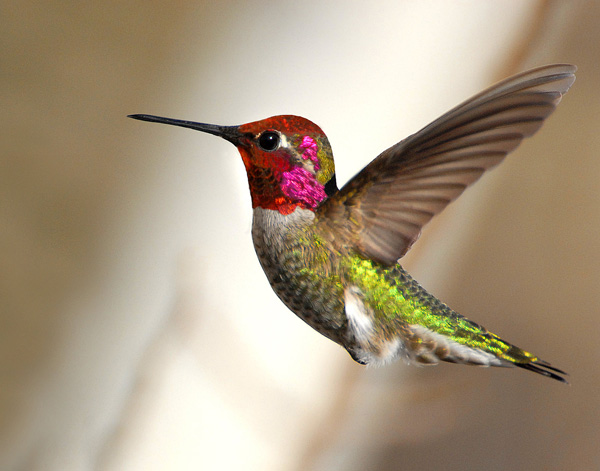
We hope they propagate well and stay around for years to come. They brighten our day.

One cool fact is that in the first half of the 20th century, Anna’s Hummingbirds bred only in northern Baja and southern California. Loving the nectar of tropical trees and bushes, as home owners planted exotic flowering trees and shrubs, they provided the sustenance and nesting sites, which allowed the hummingbird to greatly expand its breeding range. Our white azalea bush provided one such site.
==================================================
References:
[1] Williamson, Sheri, A Field Guide to Hummingbirds of North America. New York, NY: Houghton Mifflin Harcourt. p. 199.
According to Tim Melling, the Anna’s Hummingbird is about 10cm from bill tip to tail and weighs less than five grams. It was named after Princess Anna LaBelle the 19th century Duchess of Rivoli, wife of Prince Victor Masséna and son of one of Napoleon’s Marshalls. It was named by René Lesson, a French naturalist who also had the Pool Frog (Pelophylax lessonae) named after him. They used to be restricted to the extreme south of the Pacific coast of the US (plus Mexico) but exotic garden flowers providing nectar have enabled the bird to colonise this Pacific coast right up to northern Canada. Garden nectar feeders have even enabled these tiny birds to spend the winter in the north when there aren’t many flowers around.
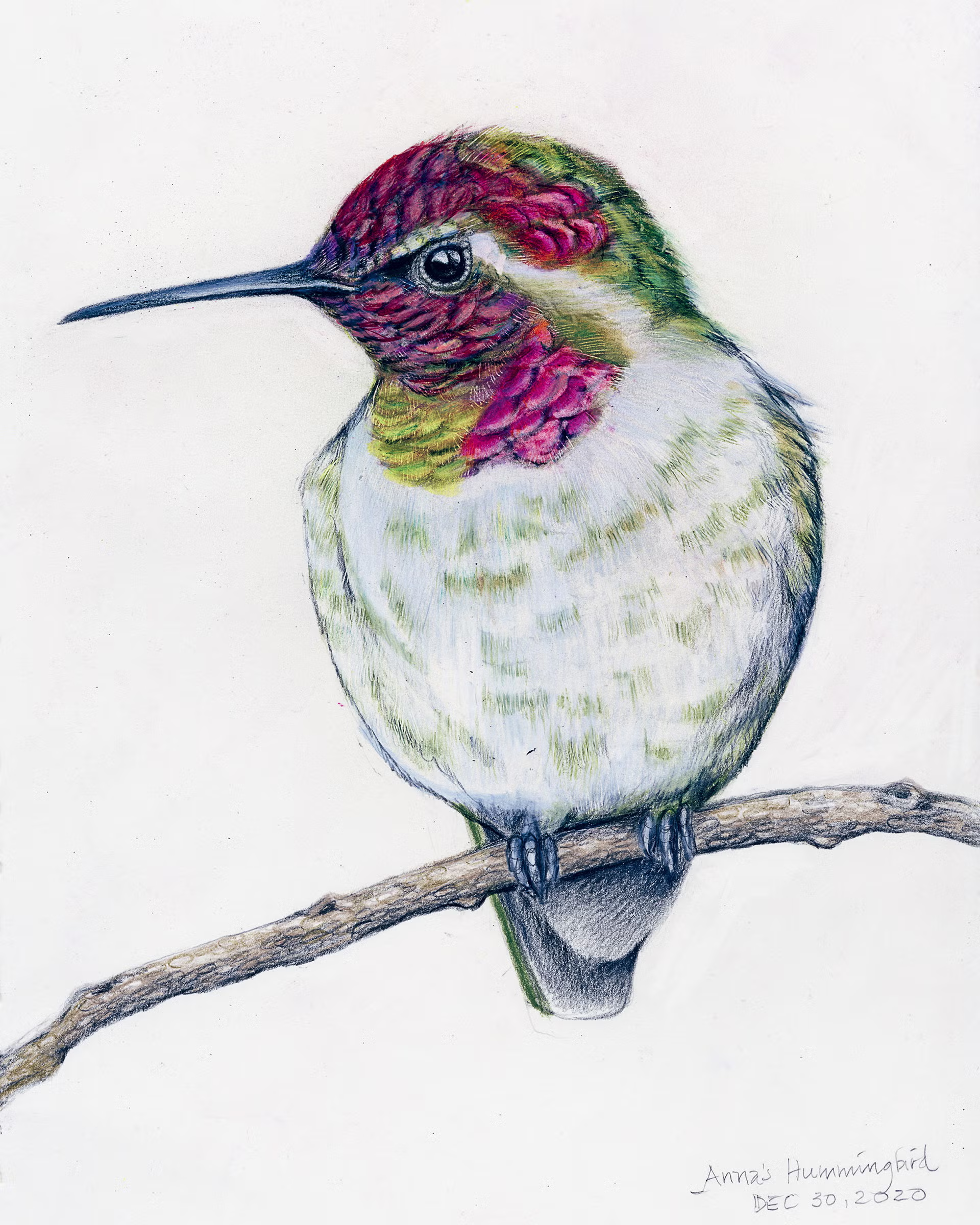
[2] Tan, Amy. Backyard Bird Chronicles, Knopf, 2024. Image from her chronicles in 2020.


I love this bird!! WOW. I just think to myself, how does an animal so beautiful exist?!
Saw yesterday for the first time one of these gorgeous birds feeding at my blooming Christmas cactus on the terrace! What a delight! In the past I’ve watched eggs hatch in a nest in my Brazilian pepper tree and in a nest in a bougainvillea in the atrium of the house. In the latter I was able to watch the birds first flight into an adjacent olive tree. Amazing creatures.