

Wrestling: Izzy Winters
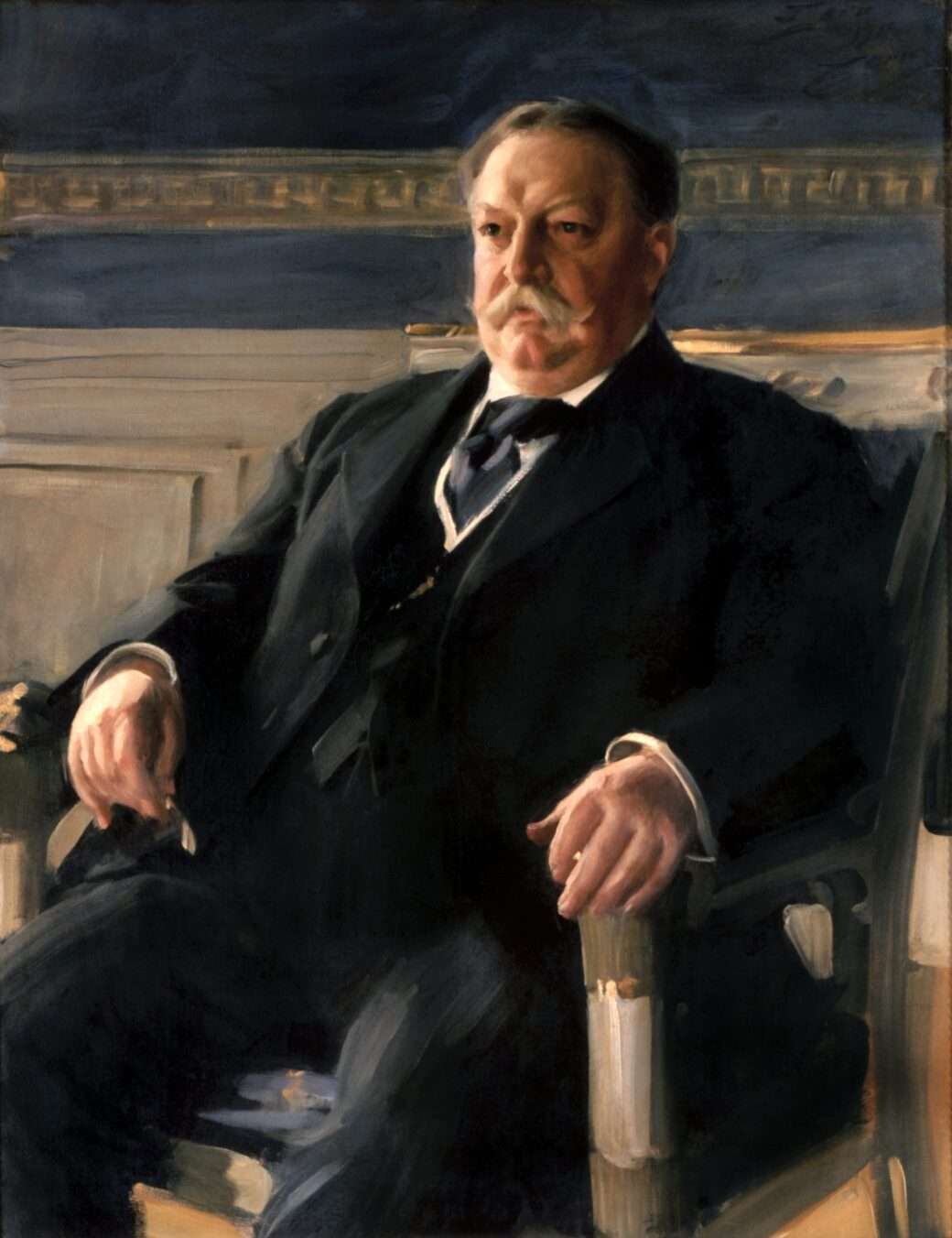
Yale College is reported to have had a long history of intramural wrestling, centuries before any competitive intercollege matches began. In 1876, for example, William Howard Taft (Yale 1878 and 27th U.S. President 1909-1913) declared that he had come from a long line of wrestlers. According to the Yale Daily News, Taft said he was a seventh generation college wrestler. He competed in the intramural leagues at Yale College and claimed he was Yale’s first intramural heavyweight wrestling champion.[2]
Biographers of Taft say that he was known for his super-sized bathtub in the White House. They also interestingly credit Yale’s “Professor” Izzy Winters with substantially reducing President Taft’s weight, through a combination of strict diet and regulated exercise. Other sources credit the British diet doctor, Nathaniel Yorke‑Davies, as Taft’s dietitian of record, but Winters, as an exercise crusader, was certainly a person of influence beyond New Haven.
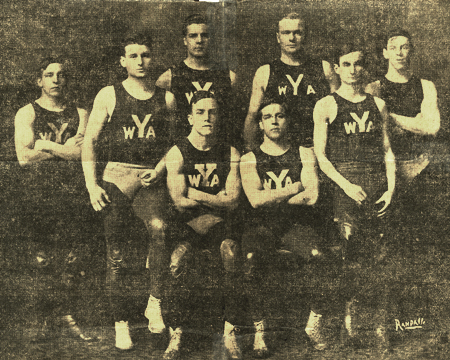
The coach of that first Yale intercollegiate team was the inimitable Isadore “Izzy” Winters, “a young man from the neighborhood.” Izzy Winters was selected by the athletic department for his wrestling prowess and his eagerness to be the head coach of the local college’s new collegiate wrestling team.
Yale officially started an intercollegiate wrestling program in March, 1903, with a match versus Columbia. That first contest was held in Morningside Heights, New York City on the Columbia campus. The rules of wrestling at the time were different than today: they had a “two-fall” requirement in order to earn a victory. There were four official matches that spring day: Yale won two of those contests. Columbia also won two, with the second by forfeit. (Yale did not have a heavyweight contender). The two wins a piece rendered the team score as tied. In the rematch, held in New Haven one week later, “Yale won.” Officially the Eli’s won two bouts, Columbia forfeited one, and one bout ended in a draw — giving the Yale Bulldogs a 2.5 to 1.5 point edge over the Columbia Lions.
Isadore Louis Winters, the first Yale coach in the intercollegiate era, was a character in his own right, thus the reason for this Wrestling Post.
Izzy Winters – Background
According to records, Isadore was born in 1886 in Zablatow, Austria, which is now part of Ukraine.[1] The family records mention 4-5 siblings with one son named, Samuel, who was with them when they immigrated. The family sailed to the US from Germany and they landed in New York in 1897. They moved to New Haven, Connecticut, soon thereafter. The family was Jewish and their first language was Yiddish. The Winters children were thrust into the local school district and forced to learn English. Izzy, Samuel and family lived on York Street (1900 census) on the outskirts of Yale’s campus and later on York Street (1910 census), south of Derby Avenue in New Haven.
Izzy Winters left school at the age of 14 and started to compete as an amateur wrestler. Two years later (1902) he achieved national prominence by winning the US lightweight wrestling championships. He was recruited to join a burlesque troupe of exhibition wrestlers as they went from town to town and toured America. The troupe included the pioneering female wrestling champion, Cora Livingston.

Winters’ coaching career started at Yale in 1903, after his American tour ended. He was 17 years old! And although he was tapped as head wrestling coach at Yale, Winters continued to wrestle professionally, touring with Livingston and many others competing in over 600 bouts in all.
Yale Wrestling
In the early years of collegiate wrestling, before the creation of the National Collegiate Athletic Association (NCAA), Yale competed head-to-head with the best college programs in the country. From 1903-1909, with Izzy Winters as coach, there were two phenomenal wrestlers on the Yale squad: George Dole and his twin brother, Louis. Originally from Ypsilanti, Michigan, the Dole family moved to Maine, and the boys attended Bath High School and later Milton Academy in Massachusetts. They were singular forces, each winning multiple collegiate wrestling titles. Louis Dole won three collegiate titles while at Yale. George Dole won 4 collegiate wrestling titles, and was the first collegian to achieve this record. After graduation, George won the gold medal for the US at the 1908 Olympics in London. With the success of the Dole twins and Alfred Gilbert, another skilled lightweight, Coach Izzy Winters guided Yale to become the annual Eastern league champs from 1905-1909 and a powerhouse wrestling program in that era.
Izzy Winters, by all accounts, was an exercise enthusiast and a coach of champions. He is credited with coaching a total of 19 championship teams of Yale grapplers. (One of those teams was captained by his nephew, Hyram Winters ’25S, Yale Sheffield Scientific School.) Winters also carefully studied other martial arts and he is credited with mastering jujitsu in his coaching career.
Coach Winters believed that getting any team in peak physical condition was even more important than teaching the specific fundamentals of either wrestling or martial arts. “When I’m judging a coach,” he said, “I look at the bench to see how many of his players are crippled. That shows whether he’s doing a good job” or not.[1]
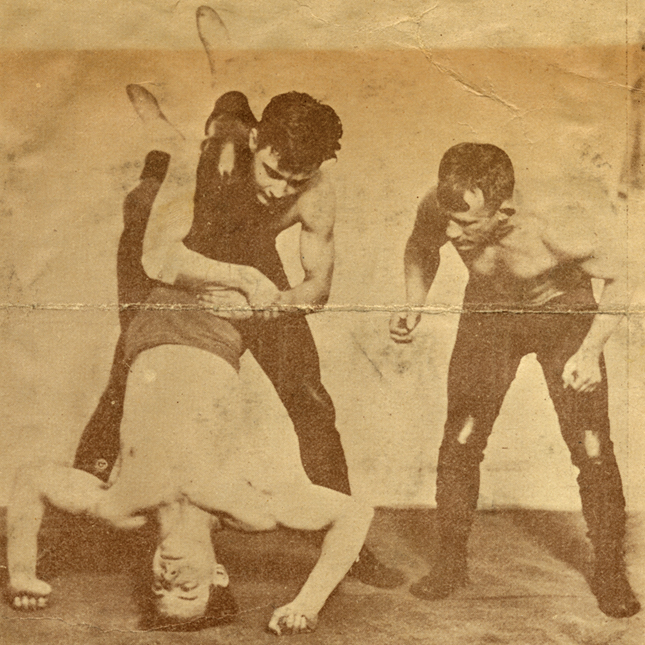
During World War I, Izzy Winters stepped aside from coaching and served in the Navy at the Pelham Bay Naval Training Station. Working for nominal pay, he taught all sailors and marines at the station the martial art of jujitsu. In 1921 he joined Yale president James Rowland Angell’s program for Yale’s well-known athletes and coaches to train community leaders.

According to the New York Times, the goal of President Angell’s 1921 program was to make New Haven “a great centre of athletics and recreational work for all classes.” The faculty of the New Haven “School of Coaching” included Yale wrestling coach Izzy Winters, football coaching legend Walter Camp ’80, Charles Taft ’18 (son of US President William Taft), and Yale boxing coach Mose King.[3] [4]

In 1926, Izzy Winters officially resigned from coaching at Yale. After that time he continued the physical fitness theme started by Yale President Angell. Winters expanded the fitness initiative to include community health and wellness. He founded a company called New Life Health Farm. And he dedicated his full-time effort to various institutes which promoted healthy diet, exercise and sweat. Izzy’s brother, Samuel, was a practicing medical doctor at this point. Having trained at Grace-New Haven Hospital, Samuel Winters, MD, co-ran some of Izzy’s health endeavors on the farm and institutes. Recruiting a physician on staff lent credibility to the new company and helped Izzy Winters expand his healthy life-style passions.
Izzy Winters in the News
In March 1932, Izzy Winters was featured in the New Yorker in a long article titled simply “Exercise.” The piece described his elite fitness business, which Winters highlighted with workout routines on canvas mats in the ballroom of New York’s Hotel Roosevelt. The writer stated that, “Izzy, a strange man amid strange machinery, … wrings from jaded metropolitan carcasses the metropolitan equivalent of honest sweat.”

In 1945 a columnist with the Utica Daily Press, recalling Yale in the 1920s, described a vivid memory of “Izzy Winters in his red Stutz racer” as a familiar figure in downtown New Haven.
Winters the “Horse Nut”

According to archivists, Izzy Winters was also a great horse fancier and trainer. An aspiring equestrian who came to Yale, William “Bill” Steinkraus (Y ’49), was a student/athlete of interest for Winters. They shared the joy and love of riding horses. Steinkraus was born in Cleveland, Ohio, and raised in Westport, Connecticut. When Steinkraus arrived at Yale, he was forced to look off-campus to find a horse to continue his training. Yale did not have an equestrian team at that time. Rumors around town were that Izzy Winters, the retired Yale wrestling coach, was a “horse nut,” always looking for fellow riders. (Winters named one of his champion horses “Sonny Boy,” after Al Jolson’s signature song.)
Upon learning that Steinkraus was in New Haven, Winters invited the lad to ride at his stables in nearby West Haven. There, Steinkraus was able to find a horse and train hard to pursue his collegiate and Olympic dreams. Steinkraus competed in six Olympiads overall, collecting four medals over a span of two decades. He led the United States to a team bronze medal in 1952 and team silvers in both 1960 and 1972, while winning individual gold medal in 1968.
“[The Olympiads] were all different,” Steinkraus said. “Each one reflected the country that was hosting the games, as well as the evolution of the Olympic movement and the equestrian sport. But they were all very fascinating.” Those medals might never have happened if not for Izzy Winters.
The Physical Fitness Movement
Through the 1950s Winters was featured in many newspaper and magazine photo spreads, proudly displaying his muscular torso and weightlifting strength. His health and exercise “institutes” in both New York and New Haven (one in West Haven and another in the Taft Hotel on College Street) predated even health and exercise evangelist, Jack LaLanne. Izzy Winters’ celebrity clients at the time included: the professional boxers — Gene Tunney and Jack Dempsey; acclaimed entertainers — Al Jolson and Eddie Cantor; as well as popular crooners from Yale — Lanny Ross Y’28 and Rudy Vallee Y’27.
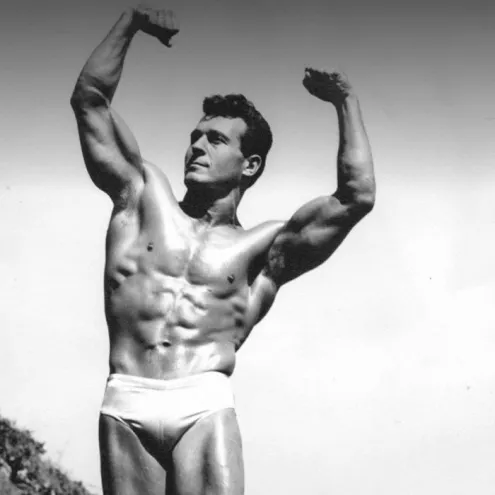
In 1956, a full thirty years after Winters resigned from Yale as wrestling coach, the Bridgeport Sunday Herald noted: “This Is Your Life has been extremely interested in doing a show on Izzy Winters, former Yale wrestling coach and present health farm operator. It would certainly make a tremendously absorbing teevee narrative because Izzy has built up an army of young bodies in his time and bodies that haven’t been so young.”
He was interviewed occasionally by curious reporters. When given the chance, Izzy Winters spoke with conviction on television and radio about the importance of maintaining fitness throughout one’s life. He was often quoted as asking, rhetorically, “Does it do any good to be the richest man in the cemetery?”

Winters, who never married, died in West Haven, Connecticut, in 1979. He was 93 years old.
As an epitaph, the varsity intercollegiate Wrestling program at Yale was demoted to a ‘wrestling club’ in 1991. That year the Yale administration stopped funding a coach and reverted wrestling to an intramural club sport. After 88 years, the intercollegiate program died. It is interesting to note that Izzy Winters was a Yale coach for 23 of those years. He was also an avid wrestling spectator, watching from the stands, for another 53 years. Quite a Yale and Coaching legacy to mourn!
References:
[1] Zablatow, Austria, is now in the Ukraine. The Winters family two parents and four to five children appears to have moved around while in the country. When Izzy was 11 years old, his family left Europe and arrived in New York on a voyage from Breman, Germany in 1897. Their family name in the 1900 census was listed as “Vinetroop” and their first language was Yiddish, although some records have the family name as Winthrop. By 1903, the family seems to have settled on the family name of Winters, although the dates of this name derivation are inconsistent. Isadore had a brother named Sidney, whose first name was changed to Samuel when they moved to New Haven. Samuel was a medical doctor who served in WWI. His draft card indicated that he was born in Kolomea, Galica, Austria. Later in life Samuel is credited with working alongside Isadore as co-leader in some of his brother’s health endeavors.
[2] The article in the Yale Alumni Magazine by Judith Schiff from July/August 2013 about “The Original Celebrity Trainer” is the inspiration for this Wrestling Post. It is also a great launch pad for Yale Sports specifically and Yale influence generally: https://yalealumnimagazine.org/articles/3705-the-original-celebrity-trainer
One area of exaggeration, in the William Howard Taft claim about intramual wrestling at Yale, is the generational Taft legacy. Yale College was founded in 1701. If you assume that a generation is 25 years (some say longer, others shorter) then seven generations would put the origin at 175 years before Taft. Taking his statement in 1876 at face value, 175 years prior places the first generation at the founding year of the college. We know that wrestling, as a sport, has been around for centuries; however, that seven generation remark by the blue blood Taft seems apocryphal, but what do I know? At least Professor Winters kept trying to keep him trim.
Taft also claims to be the first heavyweight intramural champion. Taft went on to serve as the Chief Justice of the US Supreme Court, so he surely would not deliberately tell a lie; however, this statement seems a “stretch.” Since Yale obviously had intramural wrestling for decades before intercollegiate competition, it is plausible that the college had held intramural matches for enough years to have declared another athlete as heavyweight champ before 1876.

[3] Walter Camp (Yale class of 1880) coached Yale’s football team from 1888 to 1892, achieving great success with a record of 67 wins and 2 losses. He is often cited as the “Father of American Football,” and the Walter Camp Award is given each year to Player of the Year in the NCAA Div. I football program. Camp also coached at Stanford in 1892, 1894, and 1895, essentially coaching at both Yale and Stanford in 1892. His role at Yale in those later years was more influential and ongoing than at Stanford, with Camp serving as an unofficial advisor until 1910, while working at The Manhattan Watch Company. The watch company had ties to his family owned New Haven Clock Company. Eventually Camp rose to become Chairman of the Board of the clock company, integrating mass-production ideas into his football training.

[4] Mose King served as Yale’s boxing coach for an impressive 46 years. Starting as an assistant coach in 1906, when he overlapped with wrestling coach, Izzy Winters, King held the head coach position until 1952, when boxing was discontinued as a sport at Yale. He was a legendary figure at Yale College, known for training athletes and even football players in boxing for peak conditioning. King later became Connecticut’s first boxing commissioner. As with boxing and later wrestling, pugilistic sports did not survive the test of time to the extent that revenue sports, such as football did.
 Henry E. Hooper