
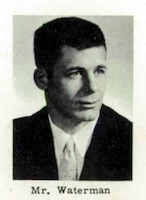
Wrestling: Bert Waterman
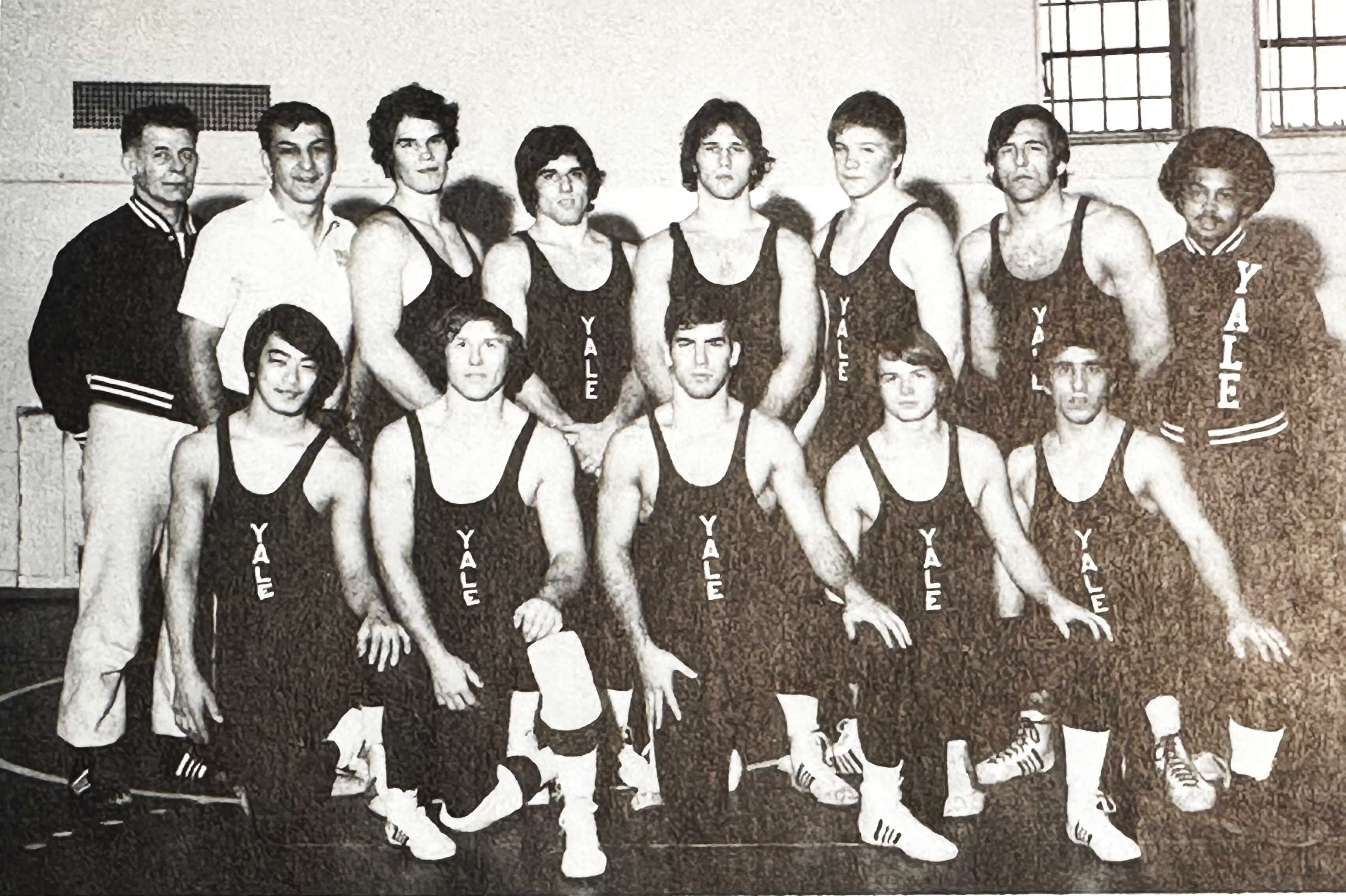
This Witness Post honors a college coach who was revered by his teams for every one of his 40 years – 16 seasons at Yipsilanti High School and 24 seasons at Yale University. It is interesting to note that Waterman was able to find two schools that start with the letter Y. And over the years, verbally and in writing, he made evocative use of the letter Y, and every other letter in the alphabet to challenge his wrestlers, the referees and competitor coaches in the wrestling matches.[1]
Starting with the history of Yale wrestling, this post is a tribute to the University and the sport. The Post will dive into several wrestlers in particular who were stand-outs for the Eli’s in those years. While many assistants and trainers and drop-in clinicians added to the quality of wrestling in the room, no one can argue that the Dole twins, Andy Fitch, the McEwan brothers, Neal Brendel and Jim Bennett are all worthy of the extra time and editorializing. Still, the one magnetic force in the late 1960s, 1970s, 1980s, and early 1990s was Coach Bert Waterman. His personal story sets the stage.
Beginnings: Bert Lee Waterman
Born in Nebraska in 1925 and raised near Omaha, Bert Lee Waterman was the consummate beginner wrestler. He had rolled around as a middle schooler and when he hit 9th grade, he weighed 155 pounds. He recalled with a grimace that his high school coach “threw me in” as a freshman to wrestle against a kid from Iowa who was in the Unlimited weight class. “I was quick and the coach hoped I wouldn’t get pinned,” by the much bigger wrestler. “I tried a double-leg takedown and couldn’t even move the kid. He picked me up and pounded down my ears. I was badly mauled, but did NOT get pinned!” That drubbing proved the first of many moral victories for Waterman.
The Waterman family moved from Nebraska to Michigan for the last three of his high school years, and by his senior year in 1944, Bert was a Michigan state champion. Immediately after high school, Waterman was drafted by selective service and he joined the Navy. He was stationed in the Pacific Theatre as a midshipman for two years. He was honorably discharged in 1946 and attended college at Michigan State University in Lansing, on the G.I. Bill. That same year he married his wife, Georgia, and they soon had a son, Randy. Bert said of his early marriage, “We got hitched, when we were young.” Bert and Georgia became inseparable. In the process she became a passionate and devoted supporter of her husband and later of all of his wrestling teams.
Waterman majored in physical education at MSU and wrestled among the middle weights (165 lbs). The furthest he advanced in his years as a collegiate wrestler at MSU was in 1948, when he finished second at the National AAU Wrestling Tournament. He mentioned to his wrestlers that he would probably would have placed in a national tournament, if he had not suffered from chronic problems with shoulders. He had near constant shoulder separations, which plagued him for many seasons. Waterman’s finite time in college was split as a wrestler, a spouse, a father and as a student during those years.
After his years in the Navy and his years in college as a student/athlete, Bert Waterman confirmed that despite his shoulder injuries he loved the sport of wrestling. He decided on a career in teaching and coaching. Those roles would be his podium to develop boys into young men. And in the process, he believed he could create durable wrestling programs.
Ypsilanti High Years
Always standing up for “the little guy,” Waterman asserted, “High schools which do not have wrestling programs discriminate against the smaller kids. There are eight weight classes below 150 lbs, and in wrestling the little guy has a fair chance to succeed and excel in athletics.” Waterman searched for a school program where he could indeed stand up for the little guy; he earned his first chance to teach and coach at Ypsilanti High School in Michigan. Located 10 miles east of Ann Arbor, the Yipsi teams were known as the Braves.
According to the Ypsi school newspaper, “Waterman led his team to their first of four championships during a 10-year span starting in 1956. Two Braves grapplers, Ambi Wilbanks and Walt Pipps, earned the state of Michigan titles, while three others finished second in their weight classes that year. The Ypsi Braves only lost one dual meet during the 1956 regular season, losing to rival Lansing Eastern, by a slim three-point margin.“
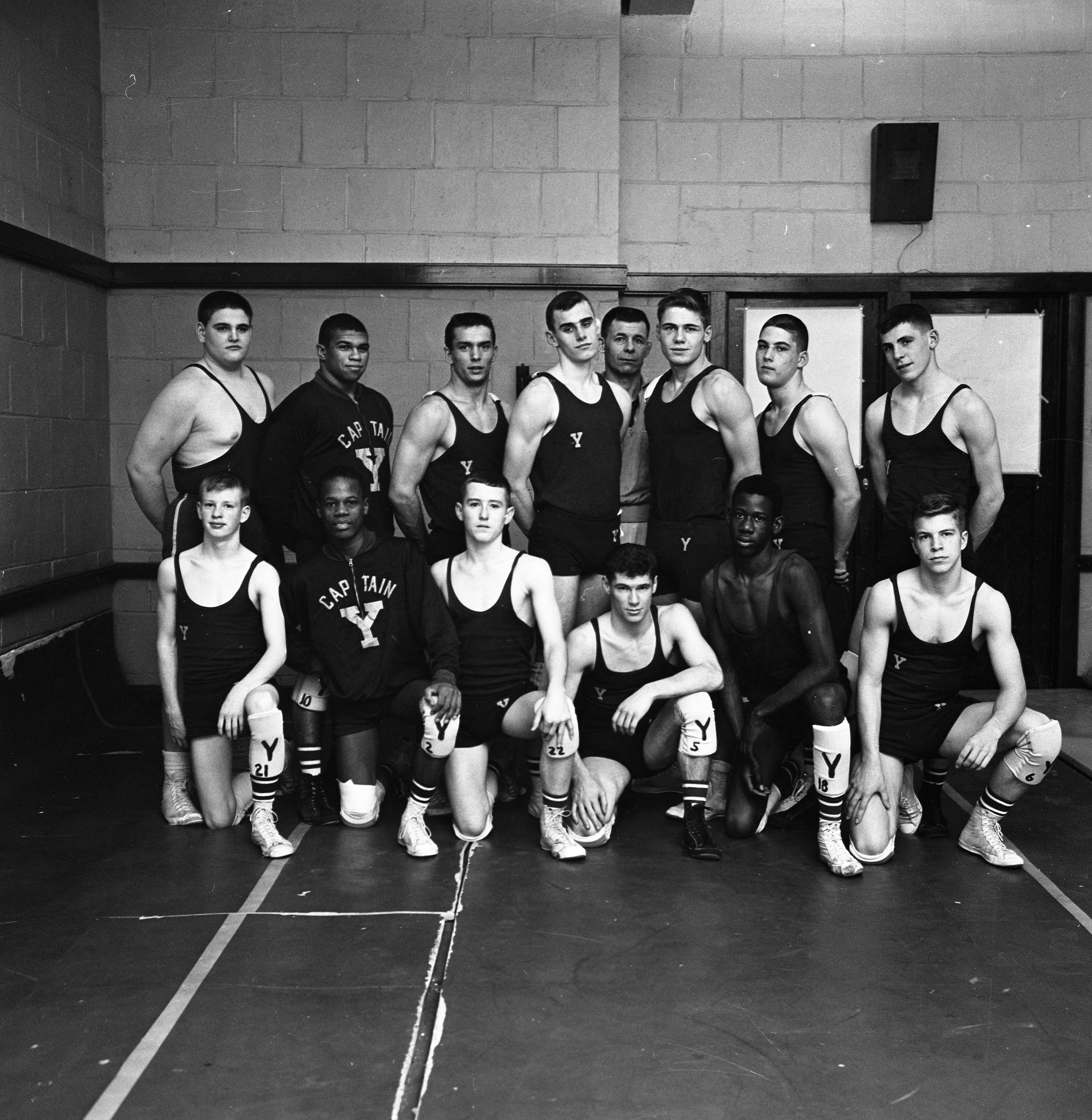
The wrestlers and their families at Yipsi all loved Waterman for his support of them as both students and athletes, no matter their size. Bert wanted to train good wrestlers and good men. And he succeeded. During Waterman’s tenure at Ypsilanti, the Braves teams posted a remarkable win-loss-tie record of 192-35-4 over those 16 seasons, which included 5 Michigan State Championships.
Waterman Moves to Yale
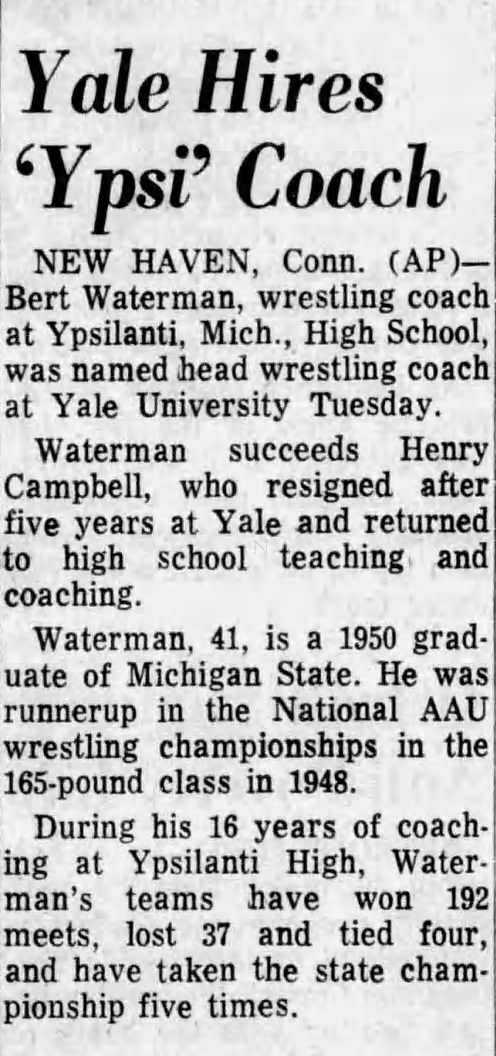
With the start of the 1967-1968 school year, Waterman was selected as the new wrestling coach at Yale. That season Waterman and Georgia moved to New Haven, Connecticut, and he embarked on a 24-year career as head coach at Yale University.
Yale Wrestling Legacy Started pre-1900 [2]
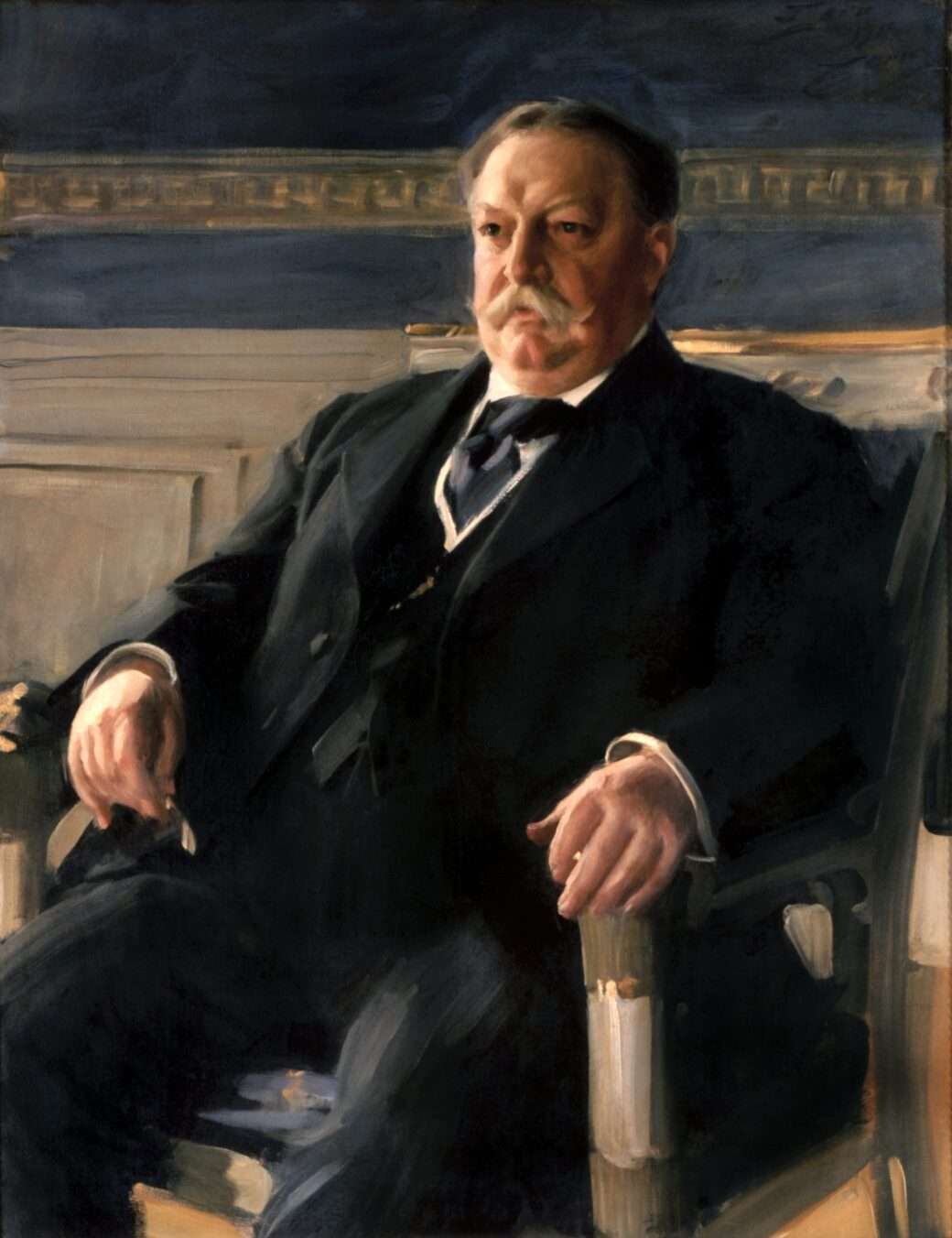
Yale officially started an intercollegiate wrestling program in 1903; however, it had a long history of competitive wrestling, even before there were inter-college matches. In 1876, William Howard Taft (Yale class of 1878 and 27th U.S. President) stated that he competed in the intramural leagues at Yale and, according to the Yale Daily News, claims he was Yale’s first intramural heavyweight wrestling champion.
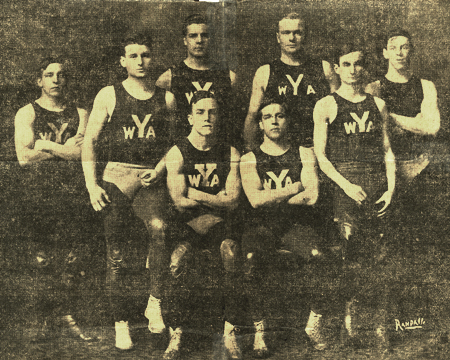
In the early years of collegiate wrestling, Yale could compete among the best college programs in the country. From 1902-1906, for example, George and Louis Dole were two phenomenal Yale wrestlers. Originally from Ypsilanti, Michigan (ironically), the Dole family moved to Maine when the boys were young and they attended Bath High School. George Dole went on to Milton Academy. The Dole brothers were singular forces, each winning multiple collegiate wrestling titles in their weight classes. Thanks to Coach Izzy Winters, the Dole twins and Alfred Gilbert, a lightweight, Yale become the annual Eastern champs from 1905-1909. Yale withdrew from the league in 1910, in a dispute over the use of graduate students in competitions, and then emerged victors again when they re-entered the Eastern intercollegiate competitions in 1916.
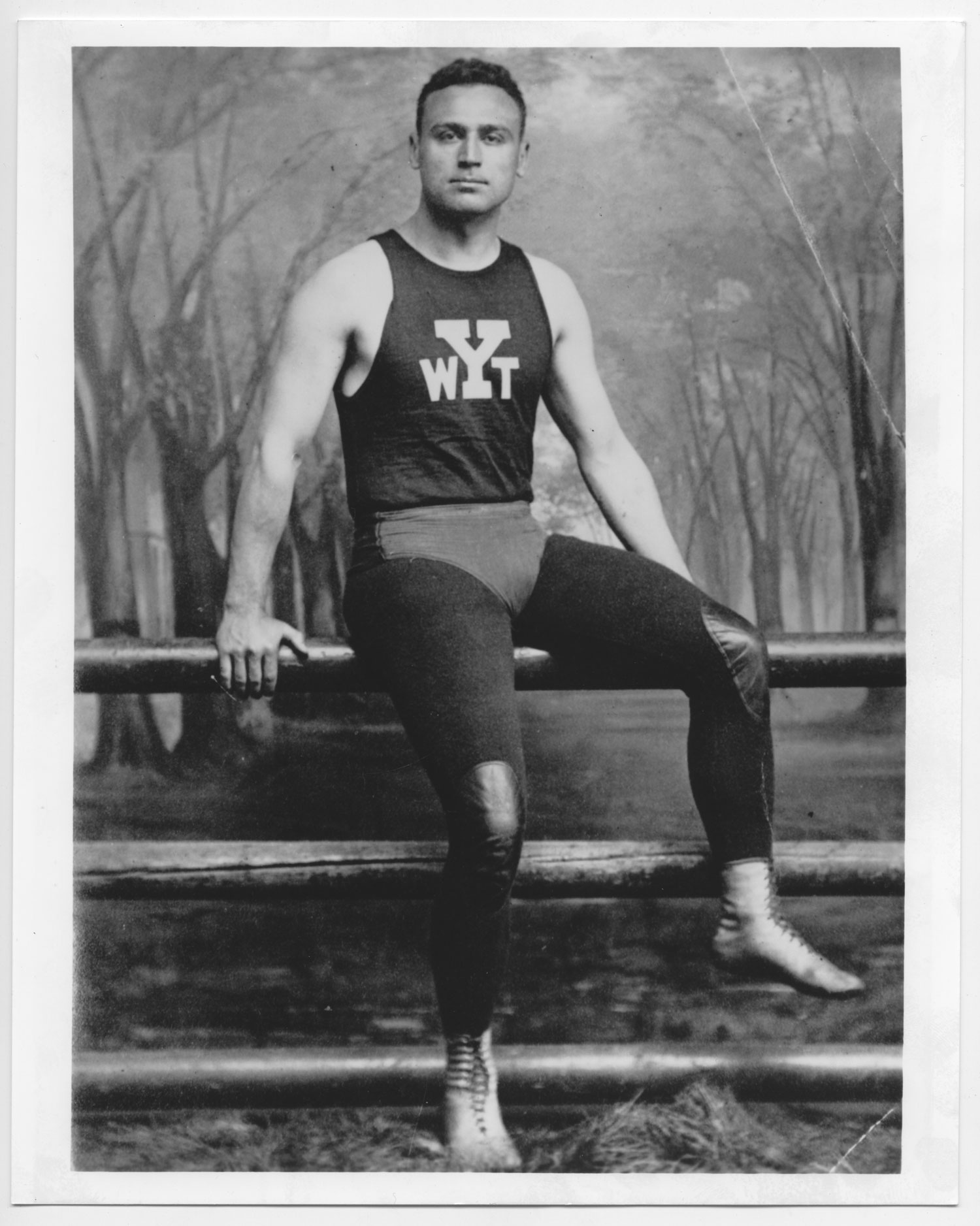
George Dole, had a collegiate record of 100 – 1, winning four national championships. His twin brother, Louis Dole, won three national collegiate titles. George was the first collegiate wrestler to accomplish that 4-year feat. He went on to win a gold medal in his weight class in the 1908 Olympics, held in London, England. George was later an instructor at Milton Academy, and the coaching of wrestling was part of his duties.
Coaches with a Yale Pedigree
And although there was a dry spell in Yale wrestling prowess from the Dole brothers, at the turn of the century to the 1970s, there were some notable coaches and champions along the way. One of the early Yale wrestlers, Walter O’Connell, was recruited to be the head coach at Cornell. O’Connell stayed for forty years (1908 to 1947), earning 12 EIWA championships crowns for Big Red over that time. Dr. Raymond Clapp, a Yale wrestler and pole-vault world record holder, was a prominent figure in the sport in the mid-west. Clapp coached wrestling at Nebraska for 15 years (1911 to 1926), becoming the head of the NCAA Rules Committee, when he retired from coaching.
While Cornell had O’Connell as its longtime coach, Yale had another Irish family, the O’Donnells, as coaches. Eddie O’Donnell and later his younger brother, John O’Donnell, wrestled and then coached the Yale teams for over three decades for a long skein of O’Donnell-style wrestling.
The international turmoil of WWII in the early 1940s gave urgency to the sport of wrestling at Yale. At the time, John O’Donnell was in the middle of his coaching tenure, and the team needed some juice. One breakout wrestler in that era was Larry Pickett, who was a product of Gilman School in Baltimore. Pickett was Yale Captain and an NCAA runner-up and All-American in the class of 1941. Pickett’s teammate, John Castles (Yale ’41), was also an All-American. The Pickett/Castles duo gave the Elis some much needed mojo in those years. Dr. Pickett later retired and refereed at the college level in New England, as recalled by the Yale wrestlers. (Despite Pickett’s impressive Bulldog credentials, Coach Waterman always gave him a rough time as a referee.)
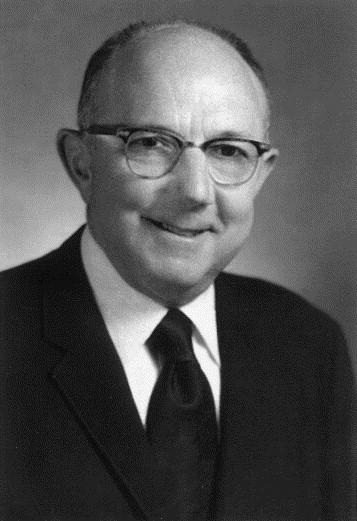
In the 1950s and 1960s Yale had several All-Americans on their squad, including George Graveson (1951), and Andrew “Andy” Fitch (1959). Fitch was one for the record books. An athletic prodogy out of the Hill School in Pennsylvania, he was coached by Frank Bissell and trained with the freestyle wrestlers at the New York Athletic Club. Fitch was a solid EIWA wrestler at 125 lbs. for four years at Yale. In his senior year at the NCAA Finals he competed at the next lower weight class, 115 pounds. Fitch defeated Dick Wilson of Toledo. With the score tied 3-3 at the end of regulation, Fitch eked out a narrow 5-4 decision in over-time to earn the title. Andy Fitch had an impressive collegiate record of 36-5 with 12 wins by pins.
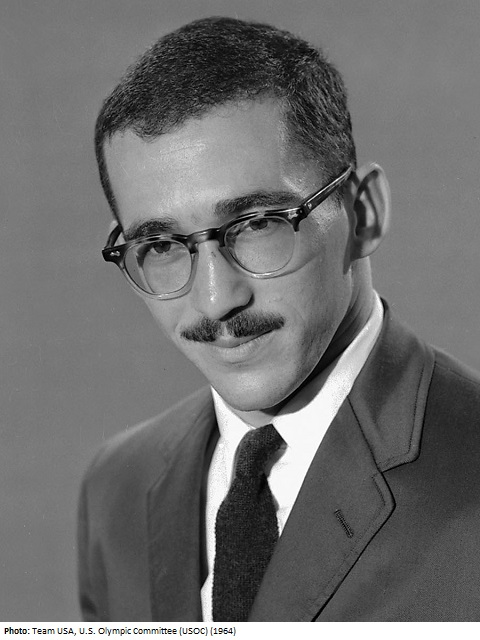
In 1963 Andy Fitch went on to win a gold medal for the US in flyweight freestyle wrestling at the Pan American Games. One year later he wrestled bantamweight (<57 kg, or 114.6 lbs to 125.7 lbs) Greco-Roman at the 1964 summer Olympics in Tokyo, Japan, but did not medal.
In the 1960s Yale claimed three NCAA All-American wrestlers: Bob Hannah (1964), Ken Haltenhoff (1965), and Tom McEwan (1968). Coach Waterman came on the scene in New Haven during that last All-American season with captain McEwan.
The Waterman Era at Yale
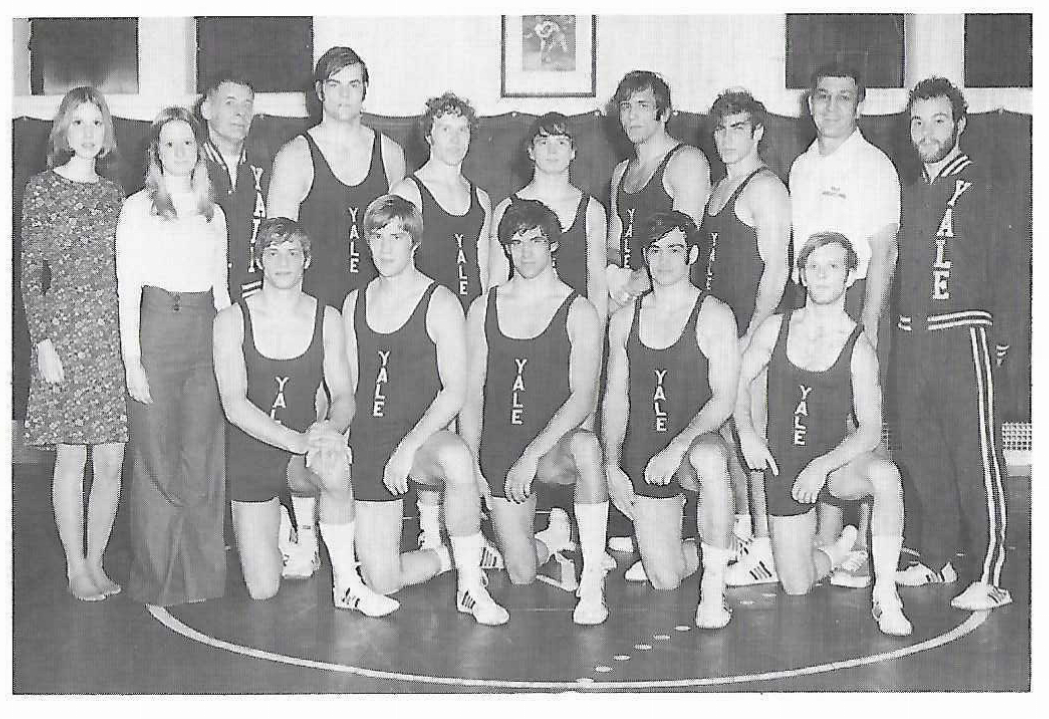
In the 1970s and 1980s Yale wrestlers, under coach Bert Waterman, hit their pinnacle. The Eli’s had All-Americans Tim Karpov (1974), Neal Brendel (1976), Jim Bennett (1975, 1976), and Colin Grissom (1982). Waterman believed that college are supposed to train the whole person, body and mind. So he was tolerated students who missed practice because of lab reports due from the biology department. He made room on his roster for athletes who were students first and foremost. Grissom, by the way, earned a degree in molecular bio-physics and bio-chemistry. As the fans at the Nationals exclaimed, “Only at YALE, would someone be an MB&B genius and not a phys ed major!”
Jim Bennett, described in depth later in this Post, earned a double major at Yale in Economics and Russian Studies. He stood atop the podium in the NCAA’s Division-I finals in 1975.
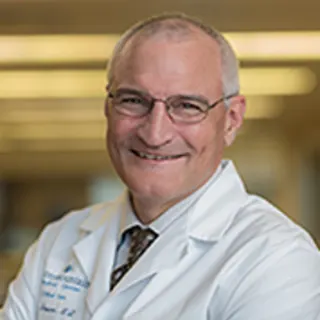
Tom McEwan, as Captain of the Yale wrestling team in 1968, said that he had given the newly appointed Coach Waterman a tough time that first year. Tom had really liked the style of the former Yale Coach, Henry “Red” Campbell, who was at the helm for five-years. Coach Waterman had succeeded Campbell that ’67-’68 season. McEwan acknowledged, “I was not happy to see Coach Red Campbell replaced, so I never really gave Waterman a chance. I quit in protest, when Campbell left.” Others on the team did not care for Campbell, who often showed up to practice and meets smelling as if he had gargled Lavoris to cover alcohol on his breath. Fortunately Tom McEwan and Coach Waterman mended fences, and he returned to the team. Coach and Captain were both quality people and hard charging athletes, who demanded the most from themselves and those around them.
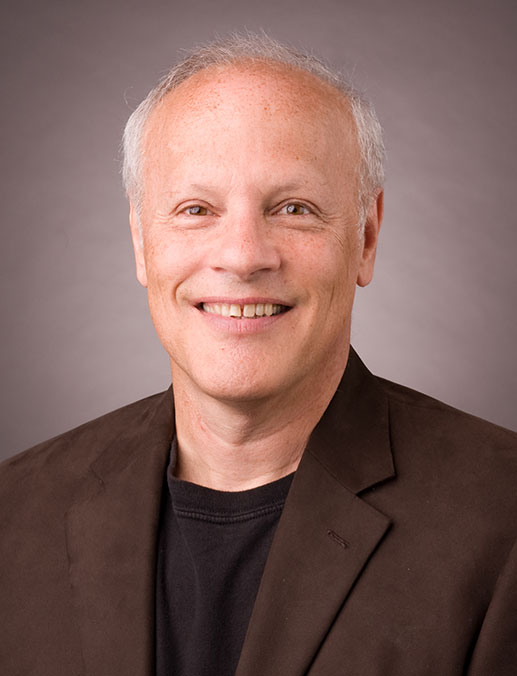
Yale Wrestling Stories from the 1970s
In those decades of NCAA Division-I competition, Yale teams placed among the top 20 wrestling programs in the country three times. In a eight year stretch, from 1968 to 1976, the Bulldogs under Waterman produced one NCAA champion — Bennett (142 lbs) — and as a team finished 20th (1968), 11th (1975) and 12th (1976) in the country.
Bert Waterman hit his coaching stride and the results from his team of wrestlers were astonishing. Notable wrestlers, who made strong contributors to the teams were: Alan Gaby, Chris Legg, Frank Kreiji, Jeff Spendelow, Tim Karpov, the McEwan brothers, Marty Schwartz and Neal Brendel, along with Jim Bennett. (Interestingly Alan Gaby, Chris Legg, Bill Gamper and Henry Rinder were all products of Gilman School in Baltimore, which coincidentally is where Larry Pickett (Yale ’41) wrestled in high school. Chris Legg returned to Baltimore after graduation and he taught English and coached wrestling at Gilman for many years.)
The Captain of the Yale Wrestling Team in 1972 – 1973 was heavyweight, Tim Karpov, an All-American with a ferocious temper and a determination for positive wrestling results. With team points coming in tournaments from many weight classes (Bill Gamper, Brian Robb, Mike Poliakoff, Ken Stewart and Kent Weichmann), Yale was perennially considered an Ivy League contender, an Eastern’s (EIWA) dark horse, and an NCAA surprise.
Waterman Shenanigans
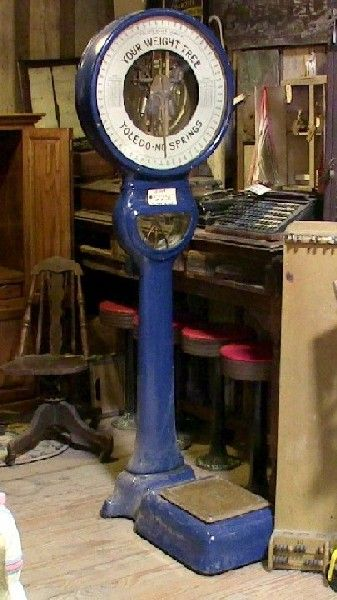
Coach Waterman was also called out for his coaching behavior. Some dubbed it off-the-mat shenanigans. He “made trouble” for the referees and other coaches, claiming evidence of fraud or malfeasance on the part of the other teams. He was notorious among the Ivy League Coaches in particular. Waterman would taunt coaches, such as Johnny Johnston at Princeton or Andy Noel at Cornell, by claiming that one of their wrestlers was ineligible due to rule infractions. For example, the Ivy League has a grade point average (or academic index) that each team must meet in order to participate in sports. Waterman would claim foul against the other team and the coach would have to research and prove that the team members met the index requirement. He also disputed weigh-in scales that he believed were improperly calibrated. Those tactics were protested by the opposing coaches, but they still had to track down the truth, nonetheless, making it difficult to prove wrestler eligibility or scale correctness in a matter of hours.
All of his antics, some true, some false, irked other coaches and kept them off balance. Waterman’s claims often surfaced within hours of the start of matches. Cornell Coach Noel lamented, “I hated Waterman, when he made those accusations, but I know in his heart, he just wanted the most for his wrestlers. And if those tactics favored HIS boys, then he felt all the better.“
McEwan Brothers & Brendel
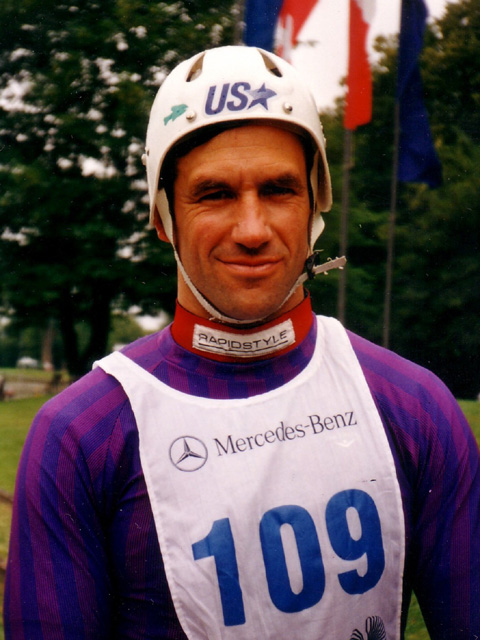
In the fall of 1972, when the class of 1976 arrived in the wrestling room, Coach Bert Waterman told the athletes that there was a good 167 pounder, Jamie McEwan, who had taken the previous year off to qualify for the Olympics in another sport – whitewater canoeing. Coach said that Jamie’s older brother, Tom McEwan, was also a canoeing star and Tom had been the captain of Waterman’s first Yale wrestling team. Must be a pretty competitive family.
The McEwan boys grew up in Olney, Maryland, and spent many waking hours paddling with the family on the Potomac River. Their father set up a canoe course near a small set of rapids on the Maryland/Virginia state line. Jamie and Tom were both multi-sport (wrestling and canoeing) scholar athletes. They attended Landon School in Bethesda, Maryland. Both McEwan boys graduated at the top of their high school classes and matriculated at Yale.
Jamie McEwan won the bronze medal in white water canoeing at the 1972 summer Olympics which were held in Munich, Germany. He did not stick around to see his fellow Yale athlete, Frank Shorter, win the marathon gold medal. McEwan also avoided the massacre of Israeli athetes. He left before the lock-down and returned to New Haven to continue his studies. Jamie was a stand out wrestler and the captain of the team during the 1974-1975 season.
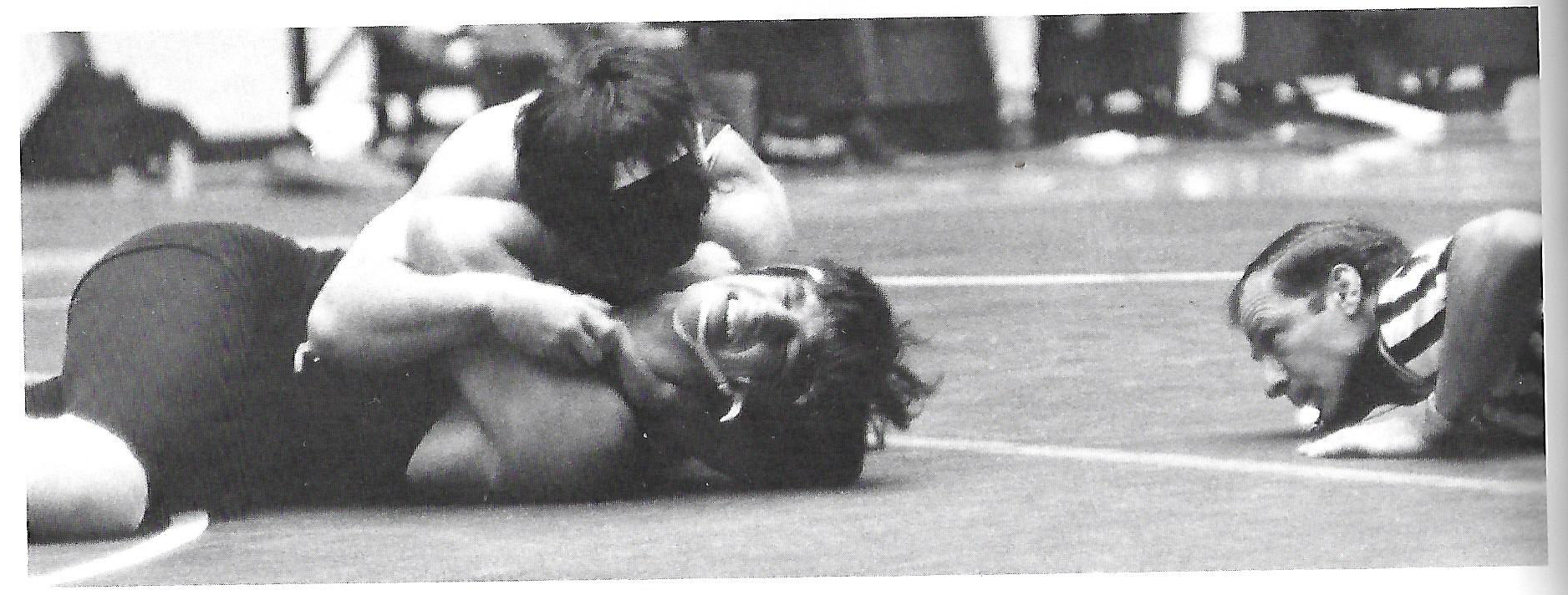
The brutalist on the team was Neal Brendel (190 lbs), who was a Pennsylvania Catholic league champion from Serra Catholic in McKeesport, PA. He often battered his wrestling opponents and practice partners, even during warm-up sessions and take-down drills. Neal had one speed: ALL OUT! Marty Schwartz and Cliff Wilson were wise enough to stake their weight class (158 lbs) as too light to wrestle with Neal. Even when they were overweight, Schwartz and Wilson did their darnedest not to partner with Brendel. That declaration helped extend their wrestling careers considerably. Screams from Neal’s side of the practice room were ignored by Coach Waterman, especially when Brendel and Karpov squared off. The shrieks from the corner mat were intense.
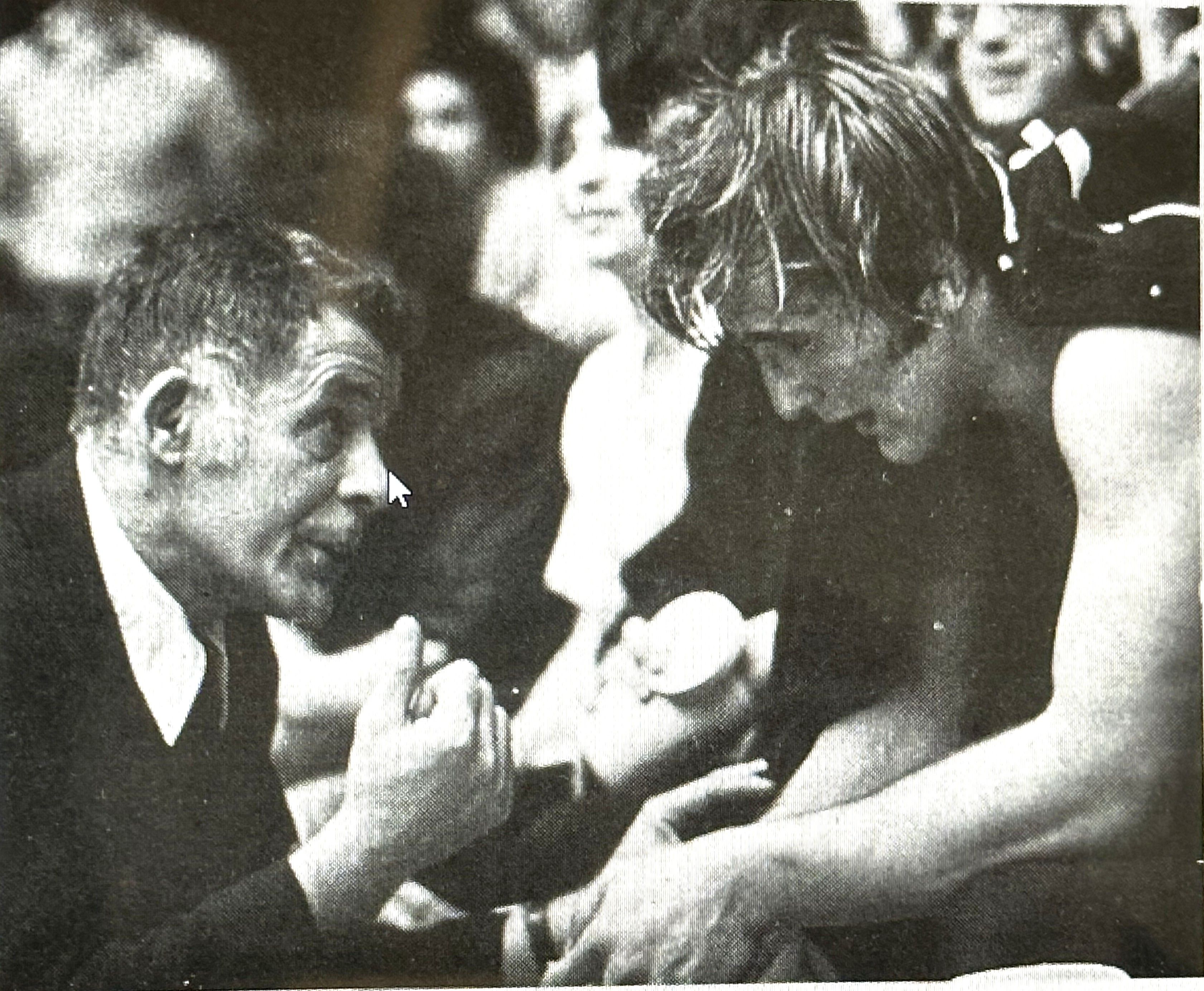
Jamie McEwan hated wrestling Neal Brendel as much as Kent Weichmann, Ken Stewart, Tim Karpov, Jim Simpson, Jack Moses, Joe Cooper, Sam Teeple, Frank Jackson, and the rest of the heavier guys did, because Jamie knew he would likely finish practice with a hyper-extended elbow, a broken nose, or flesh wounds of some kind to show for the effort. Partnering for drills with Jamie, on the other hand, was a pleasant experience, all things considered. He could crank it down a gear and go half-speed which helped us learn the move Coach Waterman was drilling. Neal never mastered that lower gear.
The Yale Wrestling Club
In 1974, Coach Waterman cobbled together the Yale Wrestling Club to attend “open tournaments.” One such opportunity was at the Montgomery County Community College in Bethesda, Maryland. Several events transpired in that Maryland gym which marked milestones for Yale Wrestling. Jamie McEwan’s older brother, Tom, joined the Yale Wrestling Club and competed with us. Jamie competed well, while Neal Brendel, Jim Bennett and Tom McEwan each won their weight classes. Tom said he was in “good paddling shape” but not great wrestling shape. He could have fooled the rest of the Yale Club team. He won his matches handily with some slick moves that defied his six years post-college.
During one of Bennett’s early round matches, Coach Waterman got so angry at the referee he stood up, lifted his seat and threw it across the gym. The metal chair went clattering across the wooden floor, as Coach berated the official’s calls. The referee soon ejected Coach from the gymnasium. Waterman kept yelling at and heckling the ref from the exit door to the locker room. They finally called security who escorted Waterman from the premises. We all esteemed Waterman for his passion and his fire, and were glad we were not the referees. He was a formidable man with a very loud voice which resonated, even from the exit doors. Bennett stated, “I have never had a coach who cared that much about me before.”
Neal Brendel had not cut his typical 30 pounds (from 220 to 190) to get to his fighting weight for the tournament, so he was wrestling Heavyweight. He made it to the finals in Bethesda. In his last match, Brendel met a 350-pound wrestler from Cleveland State who was an NCAA All-American, named Chuck Erhardt. Talking to Neal in the corner, before the match, Coach Waterman advised, “Neal, play it smart. Do an arm drag to an ankle sweep. Whatever you do, don’t get underneath this guy. He’ll crush you.” Brendel ignored Coach’s advice and on the whistle immediately dove in low for an ankle. As Erhardt tried to collapse on Brendel, Neal used an ankle freeze and a knee lock that made Erhardt topple over to his back like a felled tree. Tom McEwan shouted Boola, Boola in amazement. It sounded as if Brendel, like a lumberjack with an axe, had broken Erhardt’s leg. Neal quickly dove at Erhardt’s head, securing a half nelson. By lying on Erhardt’s face, Brendel muffled any possible shriek of pain. The ref quickly slapped the mat. Brendel had won the match by fall in less than a minute. Not sure what had happened to Erhardt, a team of eight medic supporters carted Erhardt off in a waiting gurney.
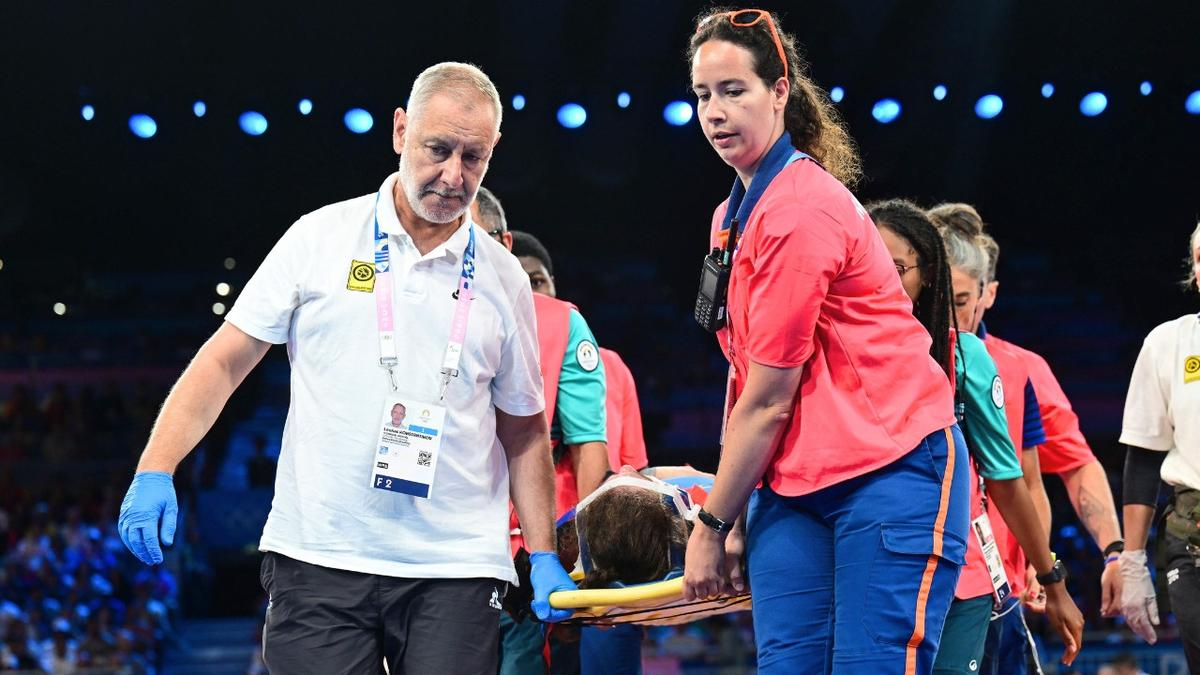
Butting heads with Neal Brendel was no joke. He split the heads of more than one opponent, who challenged him with a head-first takedown. In this case, however, Brendel was competing against an opponent who had a 130 pound weight advantage, Brendel’s first period pin over Erhardt was extraordinary.
As a senior in 1976, Neal Brendel earned All-American status by placing 4th in the NCAA Division-I consolation finals. Before graduation from Yale, Brendel was nominated by Coach Waterman and voted by the administration as winner of the William Neely Mallory Award, designated to the athlete “who best represents the highest ideals of American Sportsmanship.” The administration had obviously not consulted with Cleveland State on the award. To this day Brendel remains the only collegiate wrestler ever to have won that award. As a side note, Neal Brendel had an expansive vocabulary, which he used effectively, as proven by his recognition at graduation with the White Prize, awarded to Brendel for his academic excellence in undergraduate writing.
Neal went on to play rugby while in law school at University of Virginia. Rugby became a sport that Brendel mastered even better than wrestling. He grew to be an internationally ranked US player and later became the first national team player to serve as Chairman of the USA Rugby Football Union.
Jim Bennett: One of Waterman’s Best
Jim Bennett was a multi-sport force in his own right. A Pennsylvania High School (PIAA) wrestling champion from Corry Area High School in Erie, PA, Jim was also a track and field star. He set a high school record in the pole vault at the time and was a two time PA state pole vault champion. “I was a good wrestler those days because I was able to work out with the Carr brothers, who were all excellent matmen in the Erie area during my time.” Indeed the Carr brothers were even more prolific than the Dole twins! The Carr brothers (Jimmy, Fletcher, Joe and Nate) were all celebrated in Erie. The family was famous for their multiple Pennsylvania high school wrestling champions, NCAA All-Americans, Olympic medalists and world champions. As Bennett surmised, wrestling with the best improves your skills dramatically.
Road to the NCAA Championship
Bennett described that the “potholes” along the NCAA highway in 1975, his junior year, included a number of well-known grapplers. Bennett had beaten Dan Muthler, the defending NCAA champion at 142 lbs, from Navy in the dual meet, so he had confidence going into the tournaments; however, Bennett hit a rough patch at the EIWA’s that year, held in Annapolis at the Naval Academy. Jim lost 6-4 to Lehigh’s Pat Sculley in the finals and placed second. That finals loss and an unremarkable 5-2 record at 142 left Bennett as an unseeded wrestler going in the NCAA’s. Princeton hosted the NCAA tournament that year, but there was no Ivy League glide path to the podium. It was a rocky road to the championship round.
Two matches prior to finals were key decision matches: first, Bennett defeated John Martellucci (Brockport State), by a 6-1 score in the preliminaries. Next up he met Larry Reed (No. Colorado State) in the second round. Reed had a season record of 32-2, before pairing up with Bennett. During all of his time in the neutral position, Reed wrestled from his knees, “like a monkey; I couldn’t believe it,” later commented Bennett. In the second period, the Yalie reversed Reed and put him on his back, eventually winning by a 7-4 decision. (Interestingly Pat Sculley lost in the first round to Dean Dixon of Oregon and was eliminated from the tournament.)
Next up were the quarterfinals. Bennett faced the No. 1 seeded wrestler, Steve Randall (Oklahoma State). Randall had lost just one match in two years, and that loss was in the finals of the NCAA’s in 1974. For obvious reasons Randall was heavily favored over the unseeded Bennett. With Bennett’s solid takedown in the final 30 seconds of the first period, he drew first blood. In the second period, Randall was on top. Stan Able, the Cowboy’s coach, began yelling to Randall his defensive advice with increasing pitch: “Watch the granby, watch the Granby, WATCH THE GRANBY.” Jim earned an escape point soon after by executing the Granby roll, an aggressive forward roll move from the bottom position. Waterman commented that Randall was indeed watching the Granby, which Jim executed to perfection. Bennett quickly followed the escape with another takedown, earning him a five point lead.
Bennett rode Randall from the top position with leg rides for all but a few seconds in the third period, before Randall escaped, earning him his only point in the match. Bennett felt that winner’s edge as he was awarded an extra point for riding time. In a post-match interview, Bennett mentioned his chances in the finals. “I knew I could do it after I beat him (Randall).” Buoyed by his 6-1 margin over the top seed that Friday afternoon, Bennett added, “I’m usually a conservative, cautious wrestler. I was surprised I beat Randall so easily.“
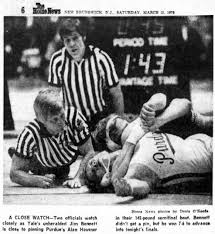
Bennett’s quarterfinal victory set the stage for a semifinal match versus Purdue’s Alan Housner on Friday night. That evening match, a win for Bennett, was not as close as the 7-6 final score indicates. Bennett was ahead by 6-2 at the end of the second period. Housner tallied four markers in the final minute of the third period, which included a stalling point against Bennett. The Bulldog grappler had the bout well locked up, plus riding time, earlier in the match, yet the score was too close for comfort.
In the finals match of the 142 pound weight class, Bennett faced the No. 3 ranked Andre Allen from Northwestern. Allen’s college record included two Big Ten Championships and a first place medal at the prestigious Midlands Tournament that year. Andre Allen had also been a Junior National freestyle champion and placed fifth in the Junior World Cup. Coach Waterman encouraged Bennett: “Jim, ignore the press clippings, just be calm and collected. You got this!” Coach knew what mattered was showing up as your best self. Bennett had a plan and was ready.
Marty Schwartz, captain of the 1975-1976 Yale team, commented, “I knew the Northwestern Coach, Ken Kraft, from my high school years in Illinois and I knew Jim could beat Andre, who went to our rival school, Lane Tech. Bennett had the whole package: his takedowns, leg rides and slick Granby roll.”
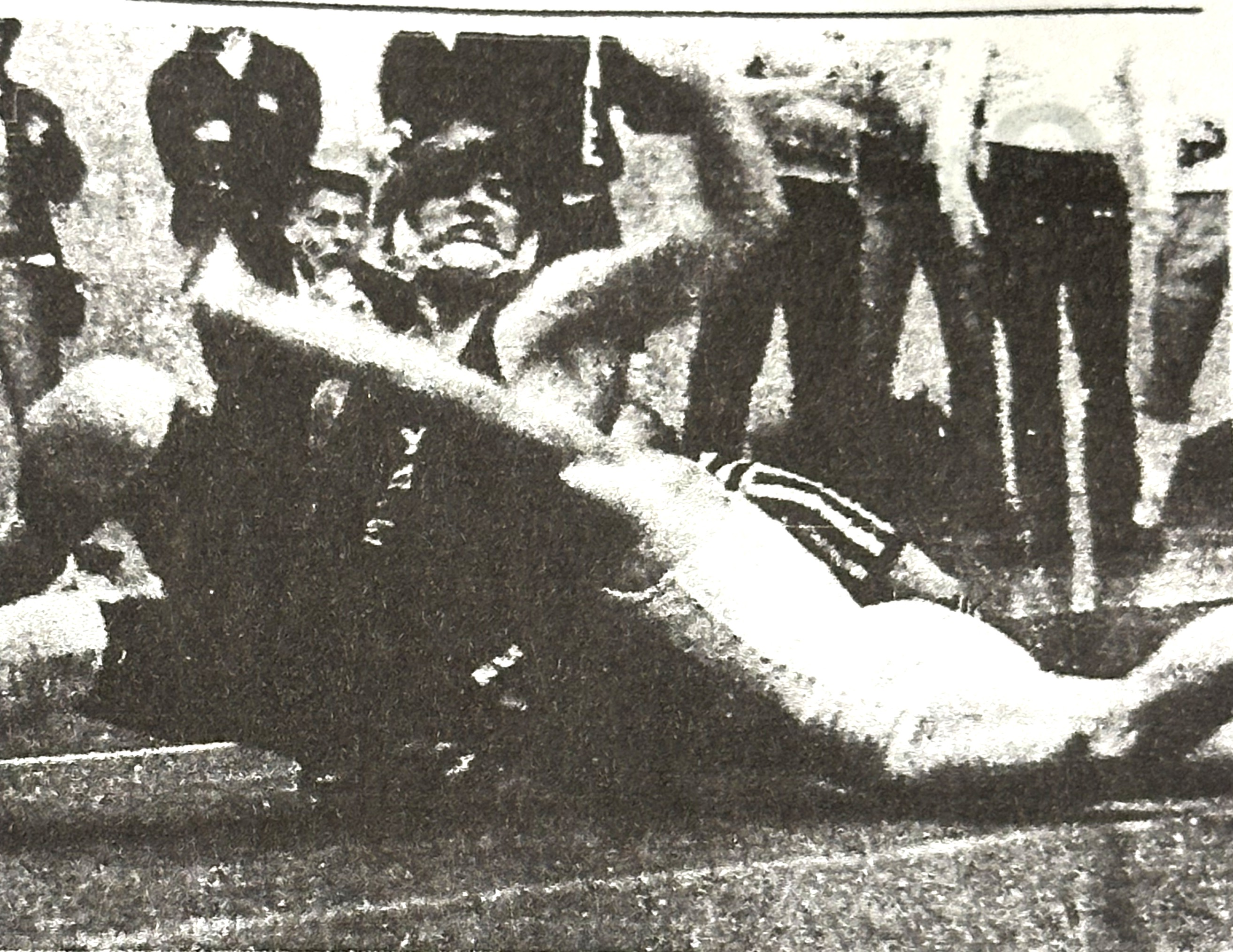
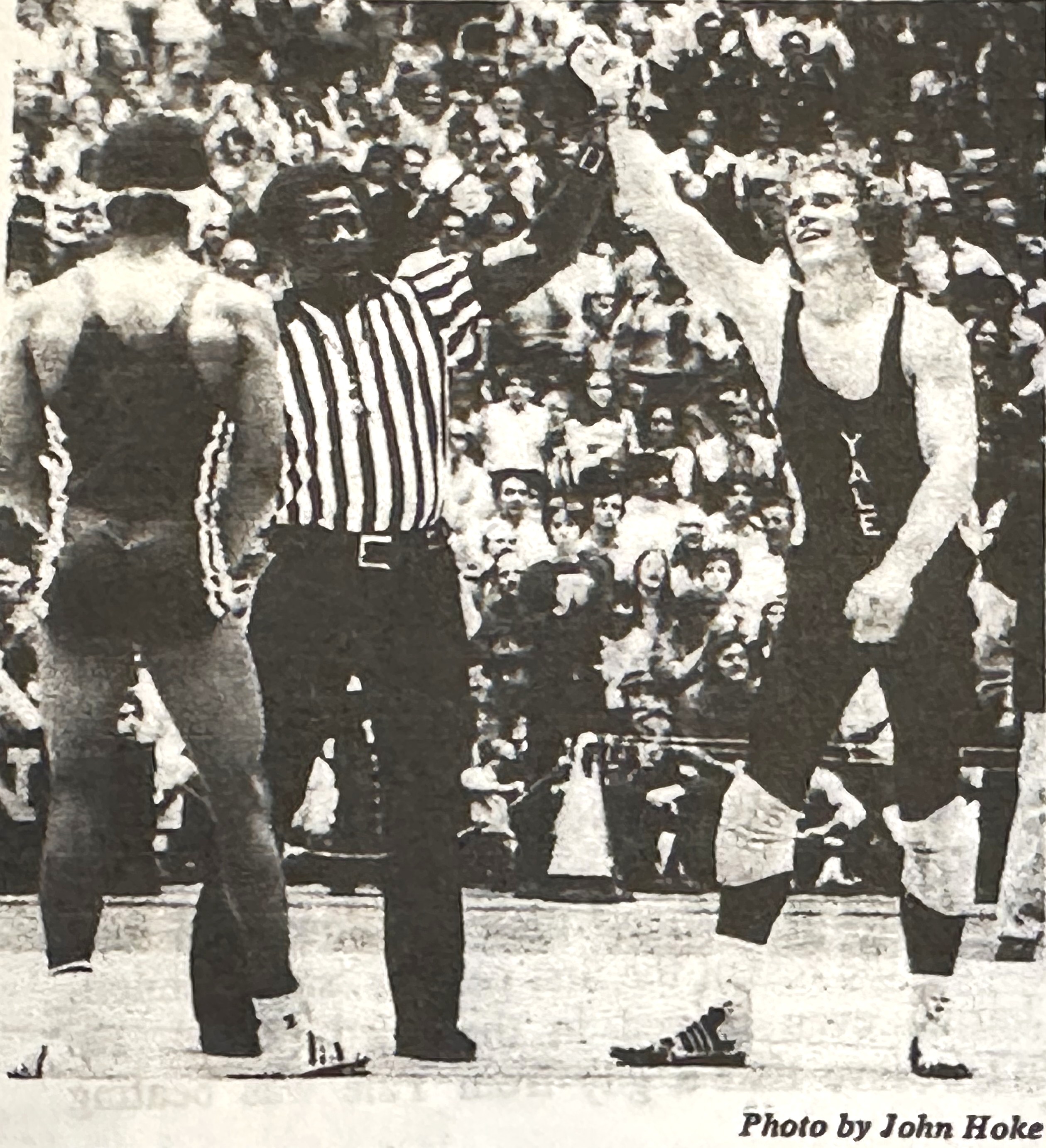
That Saturday, Bennett wrestled a smart NCAA Division-I finals match. The two wrestled cautiously from the start. And although Allen held a 2-1 advantage at the end of the second period, Bennett was prepared. He battled Allen from the bottom in the third period, quickly tying the score with an escape, followed by a solid takedown. Bennett continued his skein of strong leg-riding time on top, earning an extra point and a win in his 5-3 decision. The referee raised Bennett’s hand as the Princeton band played the Yale fight song.
Waterman on Goal Setting
Waterman felt Bennett would savor that win, yet he knew Jim was dissatified in the end. Coach Waterman explained what he knew for sure about this wrestler: “Jim was happy about being National Champion, but he was worried he didn’t do something exactly right. He felt he should have done it better … To my mind, Jim’s the ideal type of athlete. He knows what goals he wants, he knows what he has to do to get them — and does it. Jim does an awful lot of hard work. He’s always finding people to stay late and work extra with him.”
Captain Marty Schwartz chimed in, “Jim keeps to himself a lot. He’s a leader by example. During practice he’s really quiet. A real champion is someone who really hates to lose. Jim dispises losing, that’s what separates him from the rest.”[2]
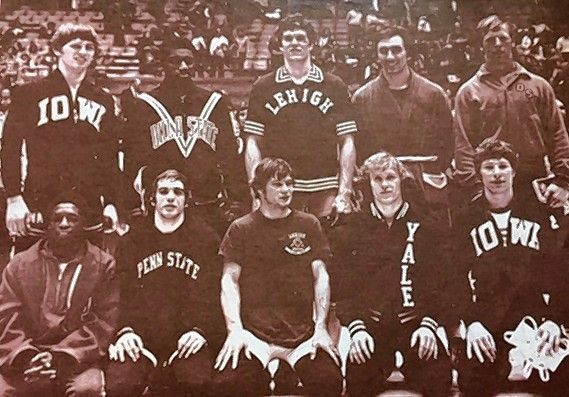
Coach Waterman opined further, “Jim Bennett will never stand still as a wrestler. He wants to be the perfect wrestler. Jim’s going to go out every match and demand of himself that he wrestle like a national champion or better.“
As a senior at Yale, Bennett moved up a weight class to 150 lbs and again achieved All-American status. He placed 4th at the NCAA tournament despite being heavily taped with a torn ligament in his knee, that he sustained during the finals of the EIWA tournament. Bennett finished his wrestling career at Yale as a National Champ and two time All-American. He notched a collegiate record of 70-13-1, with 12 wins by pins.
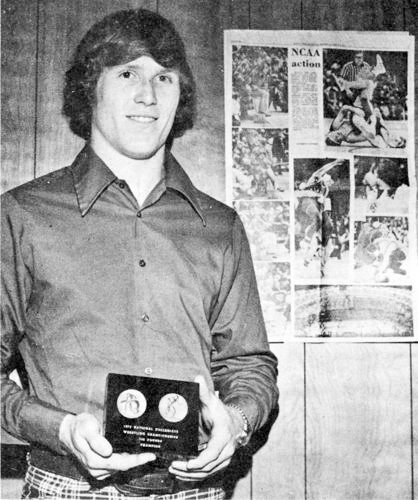
Bennett went on to be an assistant wrestling coach at Harvard, while he earned his MBA. During his coaching at Harvard, Bennett trained for the US Olympic team, finishing in the top eight at the US qualifiers in 1980. In 1984, Bennett was elected to the Pennsylvania State Wrestling Hall of Fame, and in 1998, he was elected to the Corry Sports Hall of Fame. Bennett was inducted into the EIWA Hall of Fame in 2019.
Jim and his wife, Amy, are active in athletic and educational philanthropy through the James & Amy Bennett Foundation. Bennett has stayed active in sports for many decades, spearheading the addition of Women Wrestling to the sports scene in the US. In 2016 Bennett was selected as the team leader for the USA women’s wrestling national team for the four-year cycle that ended with the 2020 Tokyo Olympics.
Waterman Earns Michigan Wrestling Hall of Fame Honors 1978
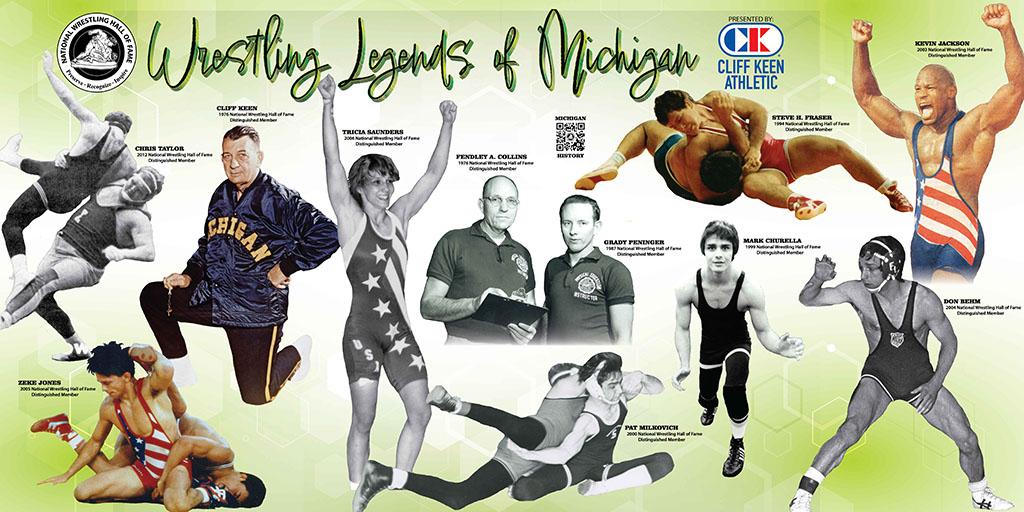
Bert Lee Waterman was a 1950 graduate of Michigan State. He was a former Spartan’s wrestler and a remarkable teacher and coach. For his lasting impact on Michigan wrestling, Waterman was elected to join the Hall of Fame’s inaugural class of 1978. Waterman was honored at the local ceremony along with Eastern’s Don Johnson, Lansing Sexton’s Iggy Konrad, Fran Hetherington from the School for the Blind and two other high school coaches. These individuals made up the charter members of the Michigan Wrestling Hall of Fame.
The Yale Wrestling Program is No Longer Intercollegiate
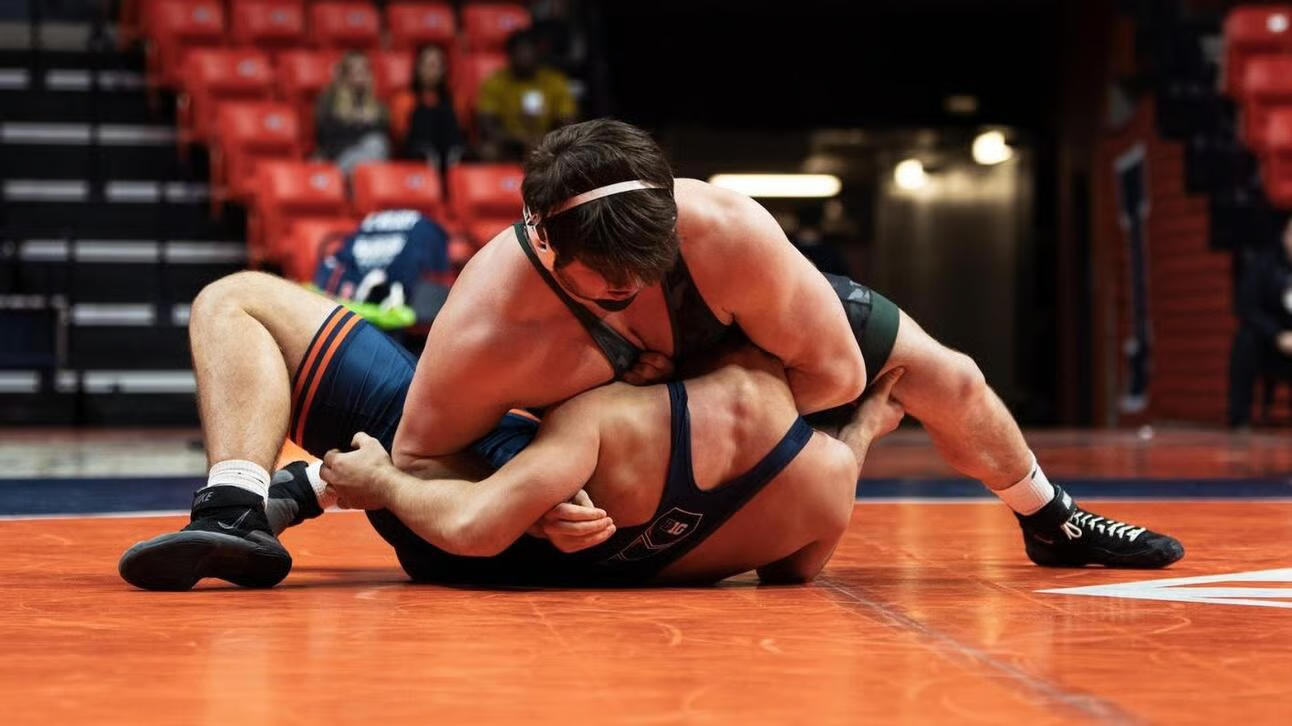
Sadly, by the early 1990s the Yale wrestling program was “hanging by a thread.” While other wrestling programs in the Ivy League flourished (Harvard, Cornell, Princeton, Brown, Penn), Yale’s program floundered. The pressures of Title IX and apathy from the administration could not be overturned, even by the legion of loyal Yale wrestling alumni, who offered to pay for the program. Finally in the spring of 1991 the varsity intercollegiate program at Yale was “deprioritized and demoted to club status.” The proud 91-year old history of Yale collegiate wrestlers was laid to rest. The program returned to intramural, where it all started.
Bert Waterman Memorials
Yale University’s message to alumni in memory of Coach Bert Waterman (1925-1999)
On Dec. 9, 1999, Bert Waterman, coach of the Yale wrestling team, died of cancer at the age of 74. Waterman, a wrestler at Michigan State, began his coaching career at Ypsilanti High School in Ypsilanti, Michigan. He was on the athletic department coaching staff from 1951 to 1967. During these 16 years, Waterman — a member of the Michigan Wrestling Hall of Fame and the National Wrestling Coaches Association — coached high schoolers in the Michigan State Finals seven times, winning the majority of his final appearances. During the eight-year period of 1956-1964, only once did his team not place higher than third. He also coached numerous individual state champions.
After leaving Ypsilanti, Waterman began coaching at Yale in 1967, where his legacy has left an extremely successful record. He led numerous Yale wrestlers to the NCAA championships, and by 1980 he had coached Yale to three top-20 finishes in the NCAAs.
Coach Waterman will be remembered in the Yale community — among other things — as coach of the Yale wrestling team for two dozen years, as well as a Yale College fellow. He was well respected by his peers and by those whom he coached, past and present. Coach Waterman is survived by his wife, Georgia, children Randy, Candace and Craig, and grandchildren. Those who knew him, loved coach Waterman for his dedication to his wrestlers and to the sport of wrestling.
Yale Wrestlers Gather in Waterman’s Honor
There was a memorial service for Bert Lee Waterman in New Haven, Connecticut, held at Yale’s Ray Thompkins House in 1999. Bert Waterman’s wife, Georgia, came to the memorial, along with their daughter, Candace. About 30 wrestlers showed up for the ceremony, including Jim Bennett, Neal Brendel, Craig Davis, Marty Schwartz, Bill Gamper, Henry Hooper, Frank Krajci, Colin Grissom, and Chris Legg.
There were a lot of other athletes and colleagues at the memorial, who had been coached by Bert Waterman, and men whom he had impacted by his mentoring along the way. I had written a letter of condolences to Georgia Waterman, but did not have much to say at the gathering. Jamie McEwan, on the other hand, had written a beautiful letter in Bert’s honor, which he read aloud. His words perfectly captured why we loved that quirky coach so much. He had personal insight: we all felt as if he could see right through us. He constantly affirmed that he wanted us to do our best — always. Waterman was a hard man to disappoint.
That memorial service was also the last time that many of us saw Jamie McEwan, who died in 2014 of lymphoma, Neal Brendel, who died of cancer in 2021, and Georgia Waterman, who died in 2025 at the age of 95.
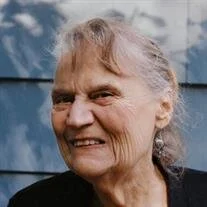
My fondest memories of Georgia Waterman was her hosting Thanksgiving dinner for the wrestling team. Bert scheduled wrestling matches for the Saturday after Thanksgiving so the wrestlers had to stay in town and couldn’t eat. Georgia would make Thanksgiving dinners after the Saturday matches. It was a massive undertaking, serving a whole team of wrestlers who had been starving themselves for the better part of a week. It really made the holiday for all of us. My deepest sympathies to the family.
— Marty Schwartz, Yale 1976
=-=-=-=-=-=-=-=-=-=-=-=-=-=-=-=-=-=-=-=-=-=-=
[1] Bert Waterman had kindly picked me to be his graduate assistant on the wrestling team for two years, when I returned to Yale’s School of Management for an MBA. The Waterman family, as a whole, accepted me as one of their own in all of my six years in New Haven.
[2] For a more complete story of Yale Wrestling (from start to finish) see the full story with THIS LINK.
[3] Marty Schwartz, from Skokie, Illinois, was a singular character in those ’72-’76 Yale wrestling years. Voted Captain of the team as a senior, he had put in his share of long runs, and grueling sessions in the weight room and on the wrestling mat with Jim Bennett.
Asked about Marty’s nicknames, he had more than his share: one of his favorites was Marty “Monster” Schwartz. He is also Marty “Chicago Cat” Schwartz, Marty “Hurricane” Schwartz, Marty “Ladies Man” Schwartz and Marty “Killer” Schwartz, depending on who you talk to.
Schwartz was also known for his prolific appetite: Marty was often spotted at Durfee Sweet Shop during late hours, having a nite time snack. Marty once lamented that all he really wanted was a simple McDonald’s meal, “yet I left the restaurant with three quarter-pounders, a fish sandwich, two large fries, and a milkshake!” Asked about his eating habits, Schwartz noted to the Yale Daily, “When the Yale lacrosse coach, Bob McHenry, called Emerson’s Restaurant (known for all-you-can-eat fare) to arrange for a team banquet last year, he was told by the manager, “No way! Last year we had the wrestling team banquet and some kid named Schwartz ate nine whole steaks, and nine baked potatoes!“
To compensate for his eating habits, Marty was renowned for his weight loss regime and grumpy moods. He would enter wrestling practice on Thursdays tipping the scales at 187 pounds. And on Friday, after practice and a sauna, he would make weight at 167. He had to maintain weight for his match the next day. As one roommate remarked, “Don’t mess with Marty on Friday nights; he’ll chew your head off!“
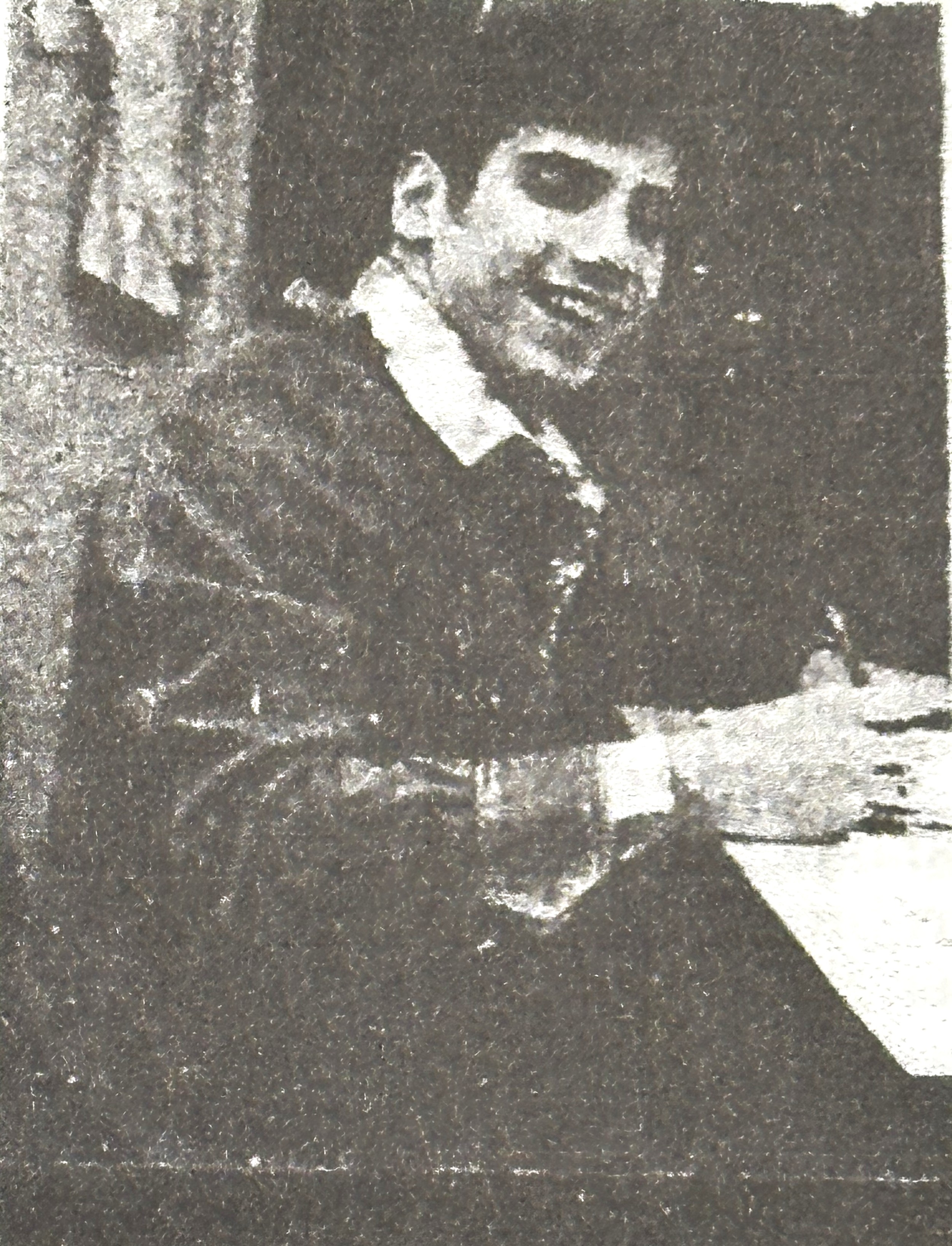
Also known for his unique style of attire, Marty’s wore those wide collared shirts, jackets with broad lapels, leather belts and loud shoes with even louder socks. His roommate, Steve Woodsum, noted “Marty’s clothes are so loud, they keep me awake at night.“
All that said, Marty was a true believer in his wrestling coach, Bert Waterman. “Coach is one of the best in the country. He really understands Yale and much more than most other coaches, that’s why he is successful. A coach needs greater rapport with Yale wrestlers than he would at Iowa… He undertands how to work with radically different wrestling styles. At Oklahoma or Iowa, there is one style: the coach’s style. At Yale, Waterman has helped all of us to develop our own techniques, our own style…He’s not only my coach, but one of my best friends. I’d do anything for him concerning wrestling or anything else, for that matter.” Even if Schwartz’s style was driving a Cadillac he won at a synagogue raffle which he shared with his dog, Fifi, Marty had a big heart, a huge stomach, and an All-American work ethic.
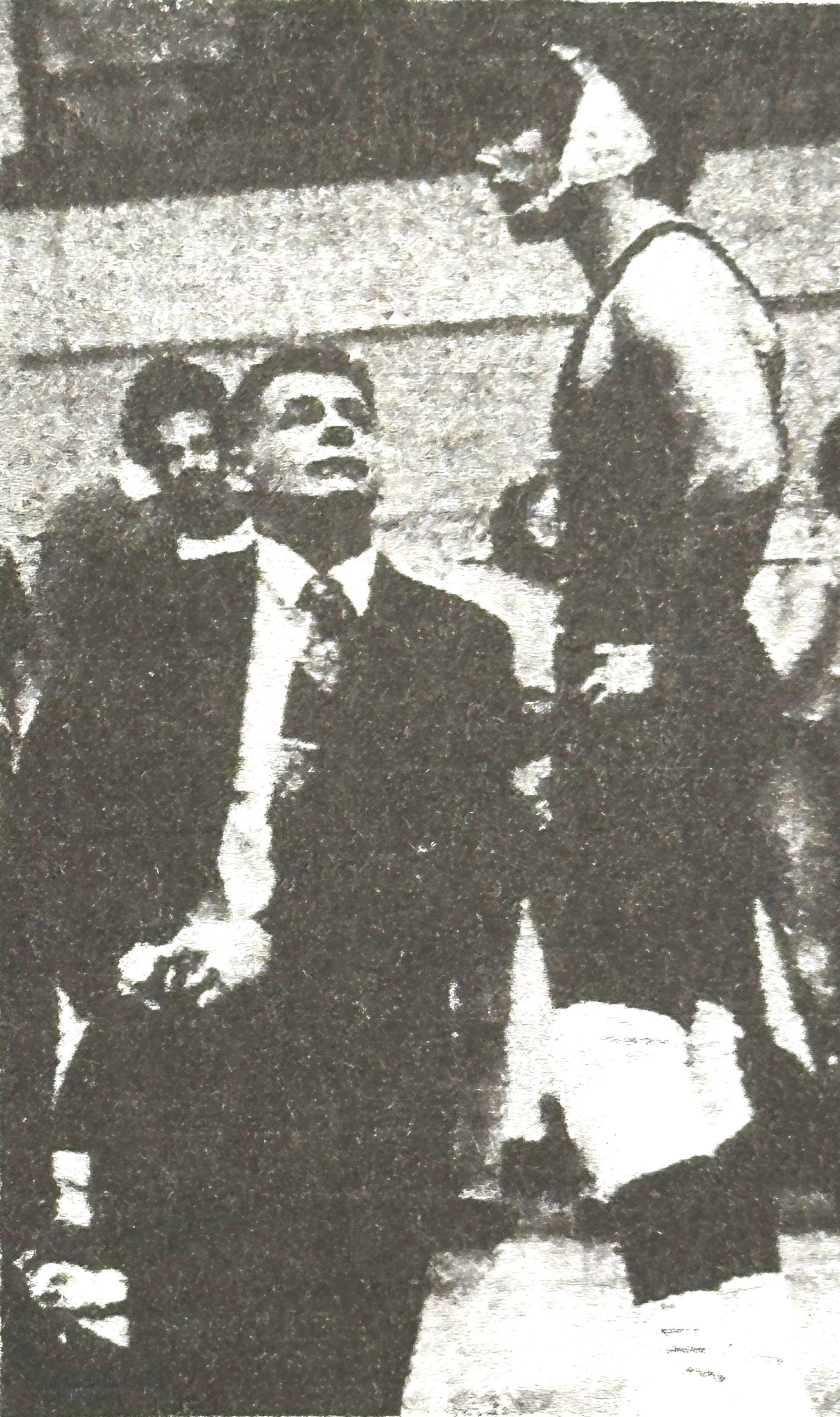
 Henry E. Hooper