
Word Smith: Palimpsest
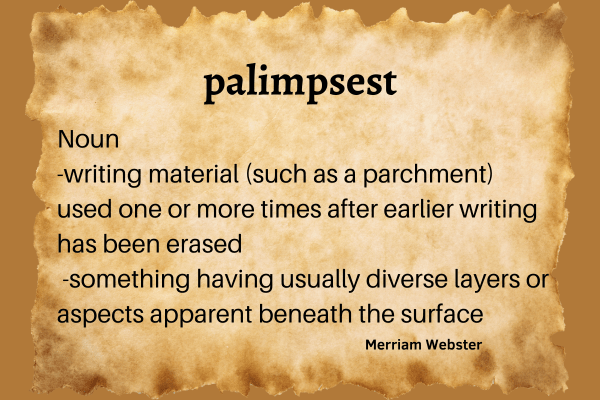
I came across this NOUN in the book, “On the Road with Saint Augustine” by James K.A. Smith. Since it was a new word for me, I had to look it up. Here is what I uncovered.
A palimpsest is a manuscript, parchment, or even an urban space where new information or layers are superimposed on older, erased content, leaving traces of the past visible beneath the new. Classic examples include medieval parchments where old texts were scraped and reused, like the Archimedes Palimpests, which contained mathematical treatises by Archimedes, written over by a prayer book. More broadly, the term applies to the architecture of an old city or the layers of memory and history that make up a culture.
Examples of Palimpsests:
- The Archimedes Palimpsest: A famous example where a 13th-century prayer book was written over a 10th-century manuscript of Archimedes’ mathematical works, which was later recovered using multispectral imaging.
- St. Catherine’s Monastery Collection: This isolated monastery in Egypt holds a large collection of palimpsests made from recycled parchment, allowing researchers to uncover ancient texts.
- Architectural Palimpsests: A city’s downtown area can be a palimpsest, with different historical styles of architecture and modern buildings layered over each other, revealing glimpses of the past.
- Urban Spaces: A city or region can be seen as an “architectural palimpsest” if its structures are continually built, destroyed, and rebuilt, leaving traces of former layouts and buildings.
- Memory and Culture: The concept extends to how human memory and entire cultures are palimpsests, as new experiences and events write over, but don’t fully erase, past ones.
How They Are “Read”
- Modern Technology: While chemical reagents once damaged palimpsests, modern methods like ultraviolet light, advanced photography, and multispectral imaging can reveal the undertexts without causing further damage.
- Visible Traces: Even without technology, faint traces of the original writing may still be visible if the scraping or washing wasn’t complete.
PALIMPSEST Definition & Meaning – Dictionary.com
NOUN * a parchment or the like from which writing has been partially or completely erased to make room for another text.
Something that has a new layer, aspect, or appearance that builds on its past and allows us to see or perceive parts of this past: Today’s towering Romanesque-Gothic structure is a palimpsest, the result of numerous additions and reconstructions. Most of what we actually see when we view any culture is a historical palimpsest, with traces of former times. Today’s towering Romanesque-Gothic structure is a palimpsest, the result of numerous additions and reconstructions. Memory is a palimpsest that is continually being written over, but never perfectly so.
If you are writing fast and hastily erase something not quite all the way and continue writing right over the smudgy bit, then you’ve created a palimpsest — which means you can see traces of the earlier writing mixed in with the new.
The noun palimpsest originally described a document, such as a page from a manuscript written on parchment, that had been rubbed smooth so it could be used again, with traces of the original writing showing through. The word still carries that meaning, but ancient manuscripts are rare these days, so you’re more likely to hear palimpsest used to describe something that has traces of early stages showing through, like “the palimpsest of an urban neighborhood” — in which hints of earlier styles and designs are still evident among the new highrises in the city.
 Henry E. Hooper