
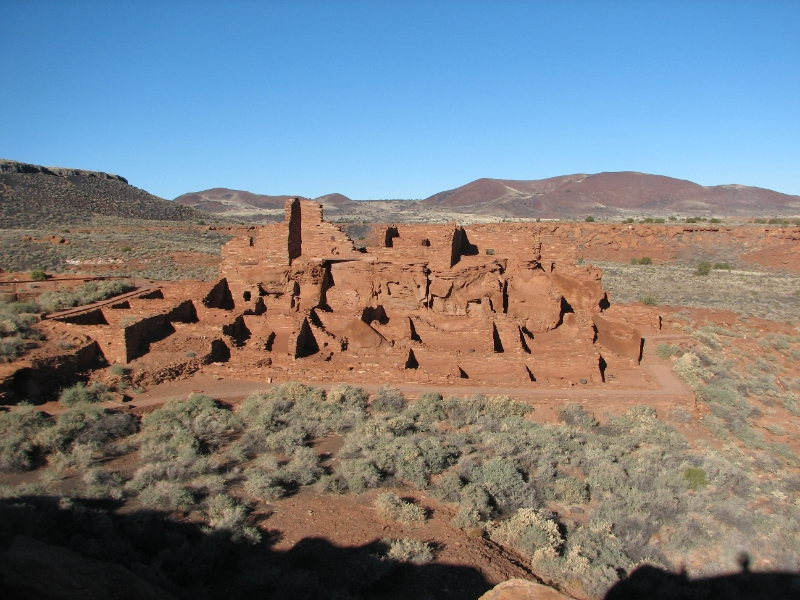
Wupatki Pueblo in Northern Arizona
Word Smith: Cohonina
AD 700. This is the approximate date that archaeologists have assigned to the native people marking when they expanded from strict hunters and gatherers to more sustainable practices. At this time, they occupied the land around the Grand Canyon. Known as Cohonina, Hopi for, “the people who live to the west”, they are also known as Yuman, Havasupai, and Walapai peoples who inhabited the area to the west of the Hopi mesas. These people were believed to be the first tribes to settle in one area to concentrate on farming as a their major enterprise and source of nutrition.
Initially, the Cohonina lived in brush structures above ground and pit houses below. The tribes moved seasonally like early foragers, gathering wild plants and animals for sustenance. They hunted deer, antelope, mountain goats, and rabbits. They also captured smaller animals like squirrels, pack rats, prairie dogs and birds. They hunted with snares as well as bows and arrows, using arrowheads carved from stones, such as obsidian, chert and flint. [1]

Cut-away view of a pithouse, American Southwest Virtual Museum
The Cohonina culture was centered west of the San Francisco Peaks, east of the Aubrey Cliffs, north of the Mogollon Rim, and south of the Grand Canyon in Arizona. Their cookware is distinguished primarily by San Francisco Mountain Gray Ware, a pottery type also common to the more eastern Sinagua and other Puebloan people.

Gradually, over the next four or five hundred years, they built more permanent structures and constructed low dams across seasonal water ways and washes, possibly to capture and control the rain runoff for farming.
About AD 900, the number of Cohonina began to expand dramatically. Archaeologists theorize that the weather moderated and the farming techniques improved to sustain more people. The weather, according to tree ring dating, brought on more rain and warmer temperatures in the region. More permanent structures such as the pueblo at Wupatki became normalized.
The Cohonina people are thought to have lived peacefully alongside the Anasazi. This is meaningful, because Anasazi is the Navajo term meaning “The Ancient Ones” or “Ancient Enemy”. All of these Puebloan peoples enjoyed a period of fertility, producing “significant” amounts of crops (primarily squash and corn) and practicality with their pottery.
Good times didn’t last forever. In approximately AD 1250, the weather conditions began to worsen dramatically. The lush fields became harder to irrigate; arid soil and hard clay became the new normal. The rains led to severe flash floods and erosion, which forced them from their homelands. Several lines of evidence led to a theory that a climate change episode caused a severe drought in the region from AD 1276 to 1299 forcing these agriculture-dependent cultures to move on. As additional clues to their departure, all archaeological evidence of the Cohonina people disappeared beyond this period in history. [2]

Puebloan Knife
[1] https://en.wikipedia.org/wiki/Cohonina
[2] https://swvirtualmuseum.nau.edu/wp/index.php/national-parks/wupatki-nm/prehistory-of-wupatki/
 Henry E. Hooper