

The Caves

What is a Cave?
In the Great Basin National Park, a cave [1] is defined as a natural opening in rock, accessible by a human and animals, which is at least 30 feet long and has a dark zone. This National Park contains 40 known caves, filled with unusual cave life and unique features.
What is Karst?
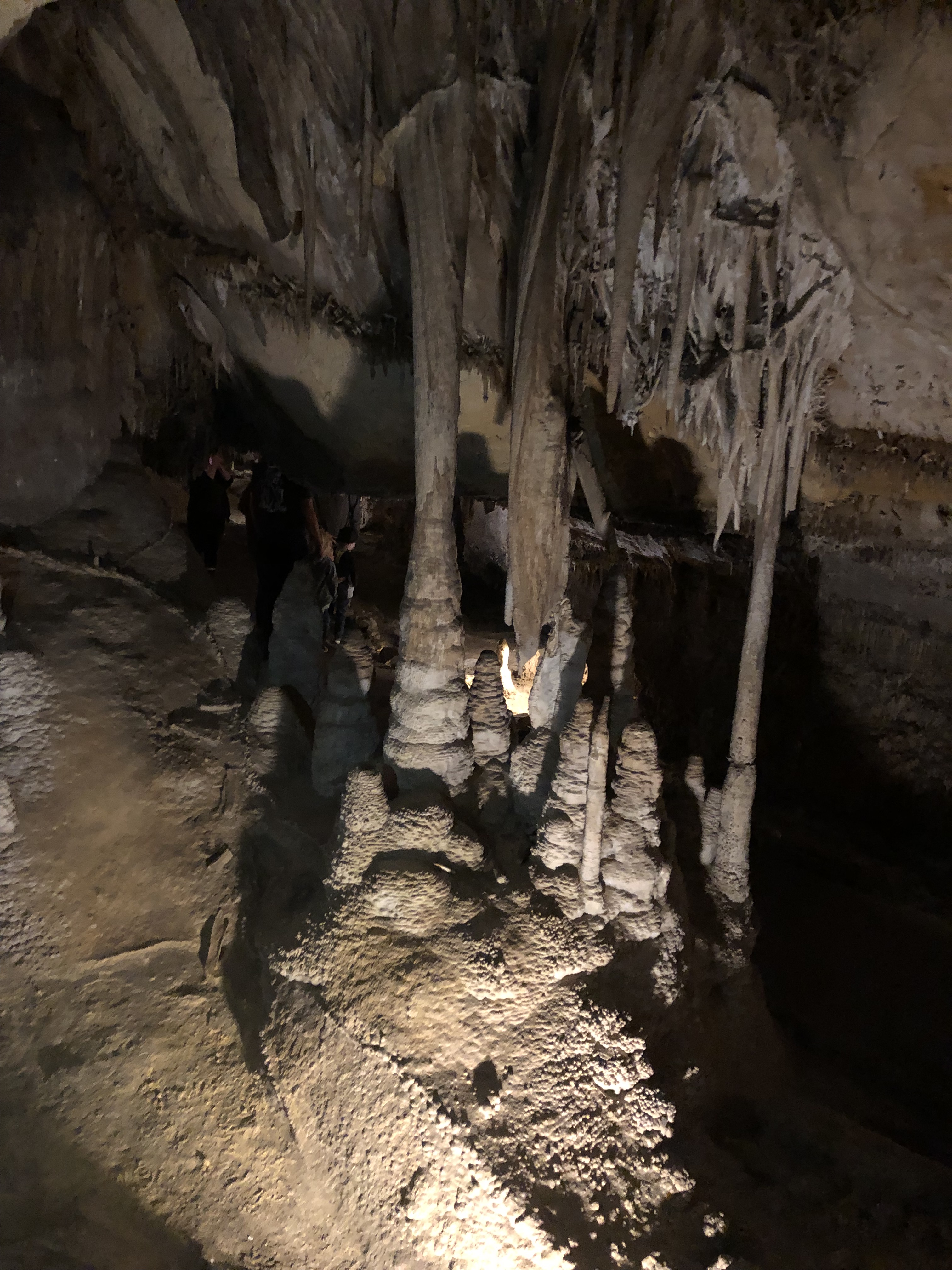
Karst is a specific landscape that is capable of supporting caves. Great Basin National Park has over 41,000 acres of karst. The most famous cave in the Park is Lehman Caves, which is open to the public via park-ranger and/or park-intern guided tours. At over two miles in length, it is also the longest cave in Nevada. Although Lehman Caves is filled with speleothems, some caves in the park have none. Some are muddy, some require ropes to enter, some have streams running through them, and some have perennial ice. A few can be visited by experienced cavers who obtain a Wild Cave Permit from the National Park Service. All other caves remain closed to protect their fragile ecosystems.
Caves are Treasure Troves of Information
As all cave enthusiasts (known as spelunkers) can attest, caves are amazing places. Protected from the sun and elements, they can preserve what is in them for thousands and even millions of years. Geologic processes occur in caves that still puzzle scientists. Endemic creatures that live nowhere else in the world are frequently found in caves. Cave climate usually has stable temperatures and high humidity, but park staff are finding it changing in some caves. In fact, management of cave resources has become more important as we learn about these special ecosystems.
Cave Life
Over the past 15 years, over 10 species new to science have been found in caves at Great Basin National Park. In addition, many species of bats use park caves. Our biggest invertebrate predator is the Great Basin Pseudoscorpion, a cool false scorpion first found in Lehman Caves and now known from additional caves, including some high elevation ones.

Encrusted drip tubes in the Gypsum Annex portion of Lehman Caves give clues about how the cave originated. NPS/Gretchen Baker
Cave Geology
The understanding of cave geology has changed rapidly over the last few years due to researchers who have seen the cave with fresh eyes and ideas. Visit your next cave with a sense of curiosity and your thoughts may add a new element to the art of discovery.
The People
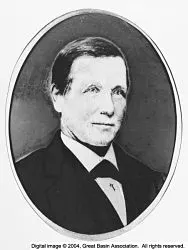

| Absalom Lehman, above & Olive Smith Lehman, Absalom’s second wife below |
Evidence of American Indian awareness of the caves goes back to as early as 1000 A.D. There are remnants of Indian bones that were discovered beneath the entrance to the cave. Whether the Indians entered the cave is difficult to say based on the bone fragments. It does appear that the site was a reverential burial plot used by the Anasazi (ancestors of the Indian tribes in the region). It seems likely that Indian contemporaries of Lehman did not know of the cave. In any case they made no claims to the site. There is also a chance that prospectors may have also found the caves in their search for silver and gold in the mid to late 1800s. If they did, they promptly forgot about or ignored it, since the cave held no precious mineral value.
Like a tall tales of Pecos Bill or Paul Bunyan, the true story of the discovery of Lehman Caves will never be known. There are over 40 widely differing accounts of this momentous event. Most accounts estimate that the likely year of the caves’ first white settler’s discovery was 1885. And the discoverer was Absalom Lehman. One version of the discovery establishes Lehman’s horse as the true discoverer.
Lehman: the man, the miner
Absalom “Ab” Lehman [2] grew up in Chambersburg, Pennsylvania. Extraordinarily adventuresome as a young man, he left the Mid-Atlantic region and spent many years mining in various basin and range locations for his fortune. By 1849 Ab Lehman, then 22, headed farther west in search of gold. After a seemingly unsuccessful venture in California, he boarded ship for Australia, hoping to strike it rich in a newly discovered gold fields there. The land down-under proved prosperous, yet heartbreaking. Lehman bought some property and found a gold mine in his backyard. He also raised sheep and established a number of wool stores. In Australia he fell for an English woman, named Mary Taylor. They were happy and prosperous, raising two daughters, Lucy and Martha. Both children were born in Victoria. Tragedy stuck, with the deaths of his wife, Mary, and youngest daughter, Martha. Shortly afterwards in 1861, Lehman and his young daughter, Lucy, returned to California. He mined there for a time with his brother, Jacob Lehman, with whom he left Lucy, when he moved on yet again.
Sometime between 1866 and 1869 Ab Lehman first settled on Weaver Creek, Nevada, a few miles north of the eponymous caves. There he “lived the first summer under a pine tree with Indians for neighbors.” Little is officially known of Ab’s operations on Weaver Creek. [Records show that Ab Lehman certified in 1887 that for the previous 28 years he had used Lehman Creek waters continuously (since 1869)]. That same year 1869 he returned to Ohio, married 21 year-old Olive Smith (he was 42). By the fall of 1870, he had moved back to Nevada with his young bride.
Ab and Olive Lehman’s first child, Laura Nevada, was born near the mining town of Hamilton, in 1871. Three years later their son, Frank, was born at Pioche, Nevada. Later in his life Frank became a Lutheran minister, but died at age 28 in Baltimore, Maryland. One other child was born to the Lehmans: Lawrence was born “near Osceola” in 1878 and died in 1880.
Not all of the Lehman offspring died young. Lucy, who was Ab’s daughter by his first marriage, and Laura Nevada were both long-lived, dying at the ages 85 and 78, respectively.
In 1875 several more families established encampments near Ab’s ranch on Lehman Creek, which became a busy place. That year the Lehmans raised 25-30 cows. Their orchard was productive and the fruit was said to be the best in the region. A large garden was set up and its produce was supplemented with wild fruits, especially strawberries. By 1880 the Lehmans hired two ranch hands, who were needed to keep the place going. Ten years later records report that the ranch consisted of “600 acres, spring pastures, orchards, cultivated fields, stables, blacksmith shop, carpenter shop, butcher shop, corrals, dairy ranch, rock milk house and churn run by water power” along the banks of Lehman Creek.
Adding to the folk legends, Ab Lehman had other interests too. He kept his hand in mining, staking a mineral claim in Osceola. He proved his political adroitness by netting a position on the “Republican County General Committee.” He was also a member of the Baker County Grand Jury.
The rugged frontier existence began to take its toll on Olive. In late 1881 she and their young children left Nevada and returned to her family home in Ohio. Ab Lehman kept the ranch operating, but left for the east when word reached him that his wife’s health took a turn for the worse. She died September 19, 1883, aged 35 years. A saddened Ab Lehman returned to Nevada, leaving the children in Ohio with relatives.
It may have been about this same sad time that Lehman found his cave. There is some indication that he discovered it just after his family moved back east to Ohio. One family recollection states he brought stalactites to his wife and children on his trip to see them in 1883, which infers that he had already visited the cave. In any event, the first extensive guided tour of the caves was in 1885, with Ab Lehman doing the guiding.
Discovery of Lehman Caves: Legends
Little mention is made of how the caves were discovered in the family records, but the oral history is rich with tall tales. [3] Among “the legends” that circulated is a claim that while Lehman was riding across the terrain, his horse broke through a thin rocky crust covering the cave’s natural entrance, horse and rider in a free-fall. Ab lassoed the nearby basalt rocks as he was falling and he hung there dangling, with the horse between his legs for an astonishing four days.
Yet another version claims that Lehman’s brother, Ben, actually discovered the cave. When passing a clump of bushes one day, Ben felt a strong, cool current of wind coming from a hole in the ground. The inspection of wind’s origin led to the cave discovery. Yet, another tall tale stated that Ab Lehman was eating lunch while tending his cows and his sandwich was stolen by a pack rat who scampered along on the terrain. Ab followed the rat until he discovered its hole which was the rocky cave entrance.
The most likely discovery scenario is that Absalom Lehman, or one of his hired ranch hands, stumbled upon the natural entrance to the cave. He then attempted to lower himself down into the cave using ropes. That person decided that further exploration was necessary and the opening up of the secret cave was assured.
Many accounts agree that the first party of white men to enter the cave included most of Snake Valley’s early citizens. These residents include Ab and Ben Lehman, William Burbank, Dan Simonsen, E.W. Clay, Ed Lake, William Atkinson, Isaac Gandy, George Robison, D.A. Gonder, and P.M. Baker. Nettie Baker, who was P.M. Baker’s wife, was probably the first white woman to see the inside of the cave.
The discovery of the cave was heralded first by the White Pine Reflex, a local newspaper out of Ely, Nevada, on April 15, 1885:
“Ab Lehman of Snake Valley, reports that he and others have struck a cave of wondrous beauty on his ranch near Jeff Davis Peak. Stalactites of extraordinary size hang from its roof and stalagmites equally large rear their heads from the floor…The cave was explored for about 200 feet when the points of the stalactites and stalagmites came so close together as to offer a bar to further progress. They will again explore the cave armed with sledgehammers and break their way into what appears to be another chamber.”
Lehman built a ranch house near the caves’ entrance, just above the orchard he had planted many years earlier. Ab constructed the main house with the idea of living there and simultaneously developing the caves into a tourist attraction. To shore up his finances, Ab sold the lower ranch along Lehman Creek in the fall of 1891. Soon thereafter, his health began to fail and he was hospitalized in Utah. Absalom Lehman passed away on October 11, 1891, at St. Mark’s Hospital in Salt Lake City. He was 64 years old.
His death was mourned by many in the region. Those who knew Lehman well remembered him as a kind man with a quick wit, who never turned a needy person away from his door. An obituary in the White Pine News read, “It was he who discovered and opened up the wonderful cave which bears his name.” Another opined, “His liberality knew no bounds; to many a wanderer, he was a benefactor. His life was indeed an eventful one, full of romance and adventure.“
REFERENCES:
[1] https://www.nps.gov/grba/learn/nature/lehman-caves-origin.htm
[2] https://www.nps.gov/grba/learn/historyculture/absalom-lehman.htm
[3] Lehman Caves: Its Human History from the Beginning Through 1965, published by the National Park Service written by Keith A. Trexler


 Henry E. Hooper