
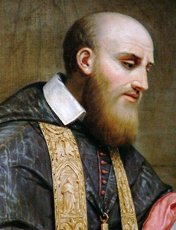
St. Francis de Sales (1567-1622)
Witness Post: de Sales
First an introduction of the Saint and then a story about a Delaware high school named in his honor!
Saint Francis de Sales
The tumultuous years in Europe after the Protestant Reformation shaped the life of St. Francis de Sales.[1] He was born on August 21, 1567, into a family of nobility of what was then the Duchy of Savoy, which bordered France, Italy, and Switzerland. He was educated at the Jesuit College of Clermont in Paris and later at the University of Padua where he received a double doctorate in civil and church law.
To the great disappointment of his father, Francis gave up a most promising civil career in favor of the priesthood. After his ordination, he was sent as a young missionary to the Chablais region of Savoy to reclaim it for the Catholic faith. While there, Francis proclaimed the Gospel in a gentle and humble way. He consistently showed respect toward everyone, and composed and distributed printed pamphlets explaining the Catholic faith to those who either were unable or refused to attend his sermons. By the end of the Chablais mission in 1598, approximately 15,000 people had been converted to the Catholic faith and Francis recognized that gentle persuasion was a key for evangelization.
Francis became Bishop of Geneva in 1602. Since Geneva was under Calvinist control and would not admit Catholics, Francis followed the tradition of previous bishops and lived 50 miles south of Geneva in the town of Annecy. As bishop, Francis spent his time preaching, teaching, and providing spiritual direction both in person and in writing. Due to his efforts, his diocese became renowned throughout Europe for its efficient organization, zealous clergy, and well-instructed laity.
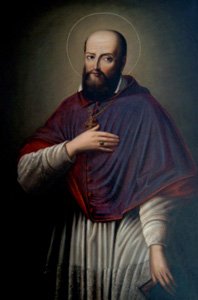
Francis de Sales, cannonized a saint 1655, doctor of the church 1877
Over time, Francis’ fame as a spiritual director and writer grew. He was urged by others to collect, organize, and expand on his many letters addressing spiritual topics, and to publish them in 1609 under the title, The Introduction to the Devout Life. In this book he taught that holiness, also called devotion, was possible for all people. He wrote: “True devotion consists in a constant, resolute, prompt, and active will to do whatever we know is pleasing to God.” In 1616 he published his masterwork, Treatise on the Love of God, which describes in more detail the nature and working of God’s love and our human response. Both works are spiritual classics and remain in print today
In 1604, while preaching for the Lenten season in Dijon, Francis de Sales met the recently widowed Jane Frances de Chantal, who desired to consecrate herself more fully to God. Francis’ friendship with Jane was one of the most important in his life, and six years later, in 1610, Francis and Jane jointly founded the Order of the Visitation of Holy Mary, a contemplative order of women dedicated to contemplation and prayer.

Jane Frances de Chantal (1572-1641)
Francis de Sales died on December 28, 1622, at the age of fifty-five. In addition to the works above, his published letters, sermons, and conferences comprise twenty-six volumes. The enduring value and popularity of his writings led to Francis’s proclamation as a Doctor of the Church in 1877 and the Patron of Writers and Journalists in 1923.
The influence of Francis’s writings is still felt today. His many works, especially Introduction to the Devout Life, continue to be used by people in all walks of life who wish to draw closer to God. Francis’s gentle and persuasive style reminds us that God desires us and patiently waits for our own response.
Salesian Spirituality
A way of living the Gospel as learned, lived, and shared by St. Francis de Sales (1567–1622) and St. Jane de Chantal (1572–1641), Salesian Spirituality is characterized by what Francis called “the little virtues” such as gentleness, patience, and humility and the idea that all people are called to holiness. This spirituality is a practical, intentional way of living a devout life by doing all through love and nothing through force.
Salesian Spirituality teaches us to engage in heart-to-heart relationships with God and others. It encourages us to embrace fully the present moment and to not look forward to the future with anxiety but to place the future in God’s loving providence.
St. Francis invites us to “live Jesus” – to place Jesus at the very center of our being and, in so doing, approach each person gently and humbly. To live Jesus is to do the ordinary, everyday activities of life with a great passion and great love for God and others. From his way of life and through his teachings, Francis, the gentleman saint, offers practical wisdom and an inspired message of common sense that Oblates love to share. This is the heart of what we do.
You will find in St. Francis a friend who understands life and offers gentle ways to live your Christian call to holiness. Oblates believe that by living each day well, we are doing God’s will and building up the Body of Christ.

Salesianum High School, Delaware
As a student athlete at Loyola Blakefield in Towson, Maryland, each year we held a football scrimmage with the football team from Salesianum High School in Delaware.[2] The school is k-12, follows the Francis de Sales Spirituality. It is an all boys education. My sophomore yearat Loyola I was selected to play varsity. For the scrimmage versus Salesianum, I was “invited” to play middle guard. In our defensive set, I was positioned head-to-head with the center of the offense. Right in front of me was the football. Hiking the ball was one of the largest boys I had ever seen. As most people know, the football is hiked to the quarterback or other players in the backfield. I came to find out that day that playing middle guard is not for wimps. Only the toughest players can take the repeated punishment dished out by the center, the fullback and the other linemen as the football gets advanced right down your throat.
During that first scrimmage, the center for Salesianum was a big guy about twice my 150 frame. I noticed that just before each play, the center kept advancing the ball forward about six inches before every snap. I thought he was cheating, so I dug in extra deep to get a fast rush to the quarterback. On one play in the first quarter, I was blocked by a guard and knocked off balance. I landed on all fours. As the center was running to block me, he stepped on my hand. His cleats tore off one finger nail and badly bruised the rest of my hand. It was a bloody mess.
The medical support of our team that year was a man we called Doc Costagna. I went over to Doc and showed him my torn nail and bloody hand and he replied, “It’s just a bruise, son. Here’s a bandage, now get a glove and jump right back in there.”

I wore hand pads every play after that and remembered to cover my nuckles on all defensive plays; there is no telling when some 250# lineman will knock you over, block you, and step on you. The boys at Salesianum may have embraced the Spirituality of their namesake, Francis de Sales, but they also quickly cast aside those gentle and persuasive virtues. When it comes to football: every man and boy for themselves!

Jane Frances de Chantal [3]
References:
[1] https://en.wikipedia.org/wiki/Francis_de_Sales
 Henry E. Hooper