

Witness Post: David Lee Bollinger
The guy just had that way with musical notes: he could play with them on the piano, make them linger a little bit longer, put extra emphasis on a beat. His style and syncopation let the audience know that he owned it. From the first time we met him at Cathedral School, David was a musician. The way he walked, slowly, with his own tempo. The way he smiled and chuckled, with glee. The way he listened, so intently.
The musical brain trust at the Catholic School in those years was bi-polar. On one side was the tone-deaf music teacher, Sister Arnold. She had been in my mother’s class at Notre Dame Prep, and showed her age. When the music classes drifted toward drudgery, which they always did, David reminded the good CCND nun that he could accompany her on the piano. Meanwhile she waved her hands and urged the cherubs to sing with the beat. On the other side of that brain was a musical genius: Mr. Robert Twynham, the recently hired musical director and choir master of the Cathedral’s men and boys choir. Twynham was an organist from Brooklyn, New York, and another character all together: deaf in one ear and blind in one eye, Mr. Twynham was a song writer, a musician and a strict task master. Having perfect pitch, Twynham could detect a sour note from a mile away. His one eye glare was all you needed after a miscue to feel inferior. Unintimidated by Twynham, David Bollinger said singing in the soprano section was “no sweat.” Music was just a matter of pitch, volume and range. David heard things the rest of us missed, as he soared above and beyond us.
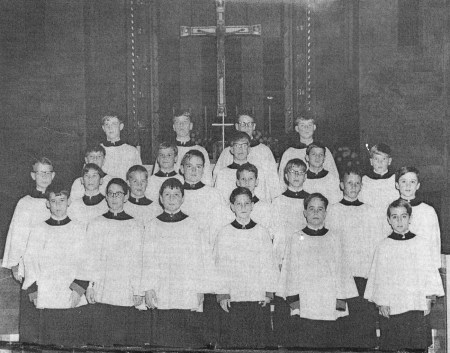
In 1966 the Cathedral Choir rehearsed with the Old St. Paul’s Choir in downtown Baltimore. Through good fortune and some lucky connections, Mr. Twynham had managed to get the Cathedral Choir invited as one of two national choirs to perform at the wedding of Luci Baines Johnson to Patrick Nugent. Luci Johnson was the daughter of President Lyndon Johnson and Lady Bird Johnson and the wedding was going to be broadcast on television.
After lots of practice and Social Security reviews, we receive FBI clearances and took the bus to the National Cathedral in Washington, DC. David was one of the soprano soloists that day, so he stood front and center. He mentioned craning his neck for a bird’s-eye-view of the President, the bride, and the pageantry. The wedding was a public affair, drawing 55 million television viewers, and pictures of the wedding were featured on the cover of Life magazine. Our parents told us that dignitaries were asked by journalists for comments as they hit the exits. Everett Dirkson, the Senate Minority Leader at the time, said to a reporter as he left the Cathedral, “The choir sounded like angels!”

The Cathedral choir boys rehearsed several times a week and practiced with the men on Thursday nights. The evening practices started in the choir room and ended in the loft at the back of the Cathedral, from which the echo of an organ chord or a random laugh lingered for seven seconds. We ended most hymns with a full descant, after which Mr. Twynham would say, “That was good, now let’s do it again.”
David’s father, Michael Bollinger Sr., would be there promptly to pick up his sons, before the boys got enmeshed in the weekly rumble on the Cathedral lawn. The choirboys claimed it helped them to “let off steam.” David, sounding like the Kinks or Michael Jackson, said that he did not participate in the rumbles because he was a lover not a fighter. He wanted to protect his hands for the keyboard. He would overcome his penchant for passivity soon enough; in a few years he was ready to roll with his fellow Dons.

The Bollinger’s were a family whose many members were exceptionally good with their hands. Michael Bollinger, Sr. founded a roofing company in Baltimore in 1936. The family business took off after the war with the housing boom of the 1950s, ’60s and ’70s. Many of the family members joined their father in the business. There were two families, the first was a marriage to Margaret Cadden. They had 6 children: three sons and three daughters. Tim Bollinger was the last child from the first marriage, before Margaret died. Tim sang in the Cathedral choir. David was the eldest child of Michael Bollinger’s second marriage. Born nine months after his dad married Cecilia Curley, David calculated, “I was conceived on my parents’ honeymoon!” There were eight siblings who arrived after him. He may have developed the hand skills from his family; however it was David by himself who would work with words, paint, ebony, ivory and notes for the rest of his life.
In elementary school David was very popular with the girls. He always seemed to have a girlfriend hanging on his arm. He said that he could easily talk with the girls because he was from a large family. As one of 15 kids, he had six sisters on whom to practice, but it may have been because their Lake Avenue home had but one kids bathroom that he became the persuasive, smooth talker that he was. In the Bollinger household those verbal qualities were a necessity, not a luxury.

David’s older brother, Tim, and younger brother, John, were close in age, so they were always around to give family support. Not that David needed it much. In high school he started dating Liz Russo, who was smart, clever and gorgeous. Her blond hair, perfect hairdo, and cute legs instilled the envy of most of Dave’s classmates. At the Loyola school dances, with the mirror ball swirling colored lights in the Creaghan Library, we could depend on Dave to be there with Liz, suggestively draped over his shoulders for the slow dances. He taught us how to slow dance. Dave had the Beatles hair cut and the Bee Gee’s suits, which made him seem extra cool and sophisticated.
Loyola classmate, Jeff Christ, recalls the dramatic academic and social upheaval in the curriculum that Fr. Leo Murray, SJ and the Board implemented in 1969-1970. It made the alumni nervous and several Board members resigned. The situation for coat and tie clad students at Blakefield was another matter. “The campus was more open … the innovation provided us a sense of freedom, and it was wonderful.” Jeff visualizes that the benches outside of Wheeler Hall became private space for a sophomore club. He claims that David and he were sharp dressers at the time. “Dave got me interested in music (Elton John, of course) and we talked endlessly about the upcoming weekend and our girlfriends … Dave’s dazzling smile, warmth, impish sense of humor and enthusiasm (he had a way of gently clapping his hands as he spoke) were magnetic.” Those club sessions also included scheming to get off campus for food. Their number one destination was Chalet Charles. The craving was for a roast beef on rye, David’s favorite.
David liked the occasional football game and he could mix up the razzle-dazzle, with emphasis on the RAZZLE. The Sunday morning games were held on a make-shift field at St. Mary’s Seminary on Roland Avenue. The usual suspects at the touch/tackle games included Bill Zorzi, Billy Rodgers, Scott Keim, Bill Birmingham, Dailey Kennedy, Scott Dunbar and David. Barbing and laughing after nearly every play, David was clearly in his element. After the games the boys would head down the block to Morgan Millard for an ice cream cone.
Yes, he could keep the beat like a metronome, but he also had an insatiable ear for new artists. Even in the sixth grade he could imitate musicians like the Beatles, Elton John and others from the British revolution. As the year’s passed, he picked up the piano chords so easily, he was the envy of many of his classmates. His singing and piano playing were precursors to his starting of the group, Tumbleweed. When we went on high school retreats to places like Wernersville, PA, David was there to lead us through the latest songs by Steve Winwood, Cat Stevens, Bread and rock musicians from Woodstock.
As David matured he became more than just a cover artist for other bands, he started writing his own words and chords in high school. Scott Dunbar recalls the prophetic lyrics to a song he sang at Steak & Ale in Towson: When I’m without you, nothing seems to go my way … ‘Cause I’ve tried it before and it just doesn’t work out right.
After high school, he eschewed college and pursued a solo singing career. He performed at the Carousel Hotel in Ocean City, Maryland, and Four Corner’s Inn in Jacksonville. David met his future wife, Karen Jankowski, while performing at the Carousel Hotel restaurant, a block off the beach.

When asked to reflect on his musical career, David often said that he never really got a break. He would sometime let you in on a “close-call with success” that he had a number of years ago. At the time David was approached by a booking agent, who had heard him, and wanted to sign him to a recording contract. On the given date, David took the train from Baltimore to New York to meet the agent and visit the record company. He was excited beyond belief, as he looked out the window and imagined what was next. When he arrived at the agency, David was surprised that the agent was not there. After a long delay and some unusual excuses, the secretary at the main desk said that the agent was no longer with the firm. He had been busted that day for possession of cocaine, and he was being finger-printed, photographed and booked at the local police station. No one else at the agency was familiar with David’s potential contract, so he shuffled back to Baltimore to start all over again. He lamented, “Isn’t it funny how fragile life can be?” In this case, it was the last straw for David’s effort to make the big leagues. Instead he resorted to playing small gigs in the Baltimore area. Familiar territory.
Bill Zorzi, a Loyola classmate, became the keeper of the David Bollinger archives. He collected over 43 audio tapes of David singing and put them on a CD, which he gave to the family members on David’s 50th birthday. There may be stray tapes with few other Bollinger originals, but they would be in boxes in Nick Bollinger’s basement for discovery at a later time.

All the while, David stayed loyal to his old friends from Loyola, even sending his children to the school. Counting David’s three children, Sam, Nick and Max, there are nearly four dozen Bollinger graduates of Loyola Blakefield. Few other families can match those numbers. Max Bollinger, David’s youngest son, was elected his class president, which helped secure a scholarship toward his future education. That financial award helped David and his family make ends meet and still have the Bollinger boys educated as Dons.
Bill Zorzi wrote for a time with the Baltimore Sun and he captured David’s style, musical acumen and marketing sense: “He was a very clever guy with words and he had an amazing sense of melody. It was odd how he could look at something and figure to fix it or figure a way to tout it.”
John Sullivan, another Loyola classmate, re-met David about four years ago (2012). They sat next to each other at a coffee shop in Towson for many days before David let John know they were Loyola classmates. Hanging around mostly with basketball players, John did not know many Don musicians. They both showed up many days a week and worked on computers or cellphones to promote their businesses. Soon Starbuck’s became their personal wifi WeWork office space. John got to know David’s slow gait, his rumpled, untucked shirt and khakis, and his ever present Martha’s Vineyard hat. He would drift outside periodically for a break and to smoke a cigarette by a dumpster in the alley.

One night last July, 2016, David was coming out of a store, when he was jumped by a guy who attempted to rob him. The good story teller that Bollinger is, several versions of that attempted robbery were told to different interested parties. Harking back to grade school at Cathedral, one story version could be called the ‘Sr. Arnold version’ and another the ‘Mr. Twynham version.’ The stories go like this:
Sr. Arnold version — “I was walking back from the Giant on York Road with a can of tomatoes, when I got jacked by this guy who jumped me from out of the shadows. The poor fella fled on foot, after I nailed his ass with a can of Muir Glen Organic Crushed Tomatoes ‘n Basil. He’ll not be eating or smooching for sometime, I suspect. I got him full swing, right on the button, teeth realigned.”
Mr. Twynham version — “I was walking home after picking up a bottle of whiskey at Well’s Liquors on York Road when a guy jumped out of the shadows, grabbed me, and slammed me against the wall. It was a classic fight or flight moment. I reached for the only weapon I had, my bottle, and slammed it into my assailant’s face. After a bit more struggling, the mugger, bloodied, ran off into the night.”
In either case David had some serious scars and bruises from the fight that night. He texted John Sullivan, saying he didn’t think he could go on stage at the Hamilton Tavern that week, looking like a bloodied bum. Sullivan, the good Irishman that he is, reported, “I texted back asking David if he thought the scars and bruises would stop Keith Richards from performing … I was there in the front row when Dave played at the Tavern that Friday night and he sounded GREAT.”
Despite advancing lung cancer, which David had hidden from his friends for years, he always had amazing vocal range, voice control and perfect pitch in his music. Sr. Arnold and Mr. Twynham are gracefully looking down on David Bollinger, no doubt.
We will miss hearing his sweet voice and encouraging laugh. We deeply mourn his loss for the void it leaves in our Loyola community and the Bollinger Family.
 Henry E. Hooper