

Cornell House ‘Telluride Treasure’ built by L.L. Nunn sold for $5,681,250 on 10/05/2020
Witness Post: Current
The House
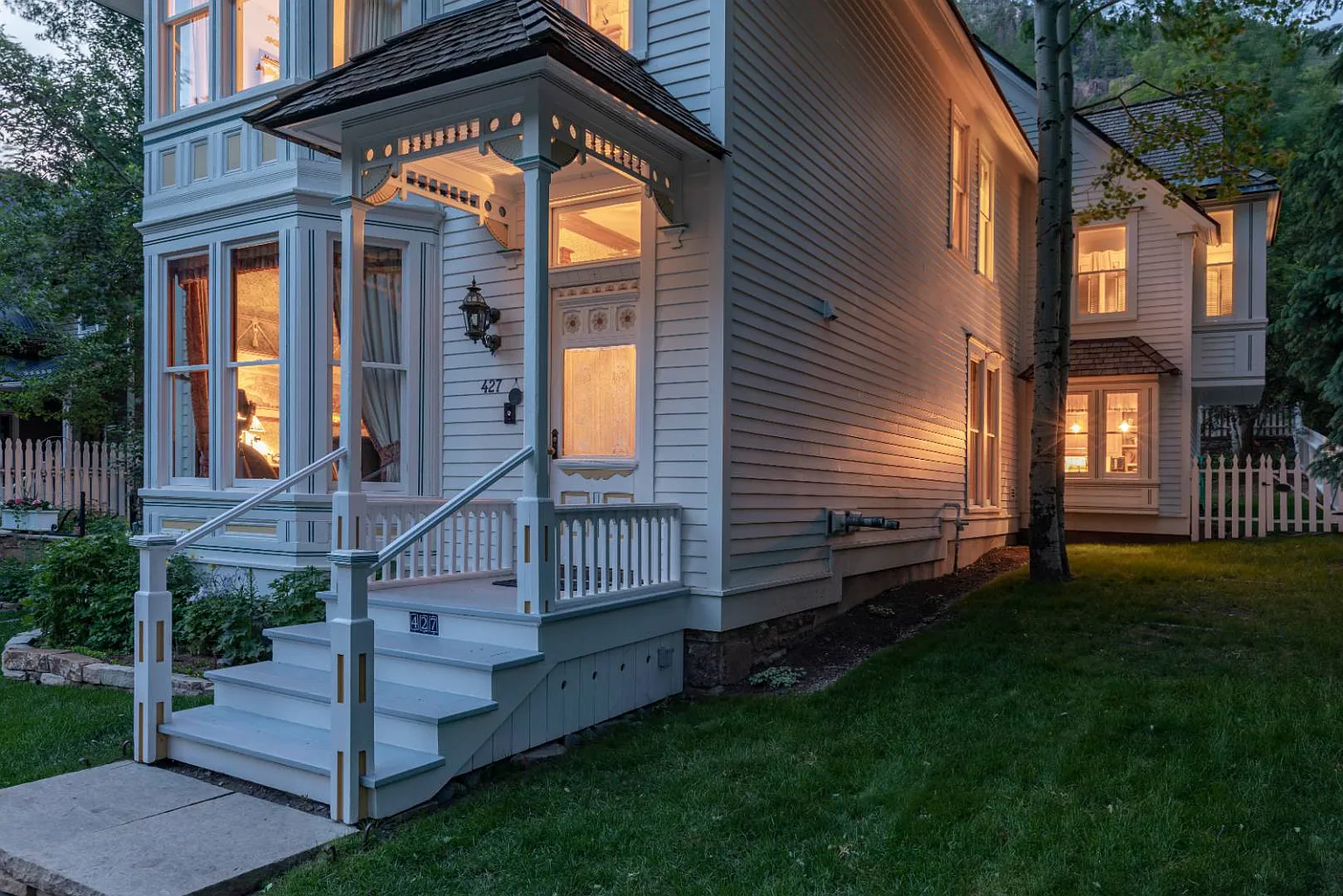
The historic Cornell House on 427 W. Columbia Avenue in Telluride, Colorado, was for sale in July 2019 for $6.1 million. Fifteen months later, the house sold for $5.7 million. The Nunn Cornell House is truly one of a kind, given its historical significance to Telluride and its use of the invention of alternating electric current.
The home, which was built in 1891 by Lucien Lucius Nunn, was one of the first homes in the country to feature alternating current, which Nikola Tesla and George Westinghouse harnessed in the 1880’s. Nunn read about alternating current and urged Tesla and Westinghouse to help him create the Ames Hydroelectric Generating Plant. In 1902, the Telluride Institute — later renamed the Pinhead Institute, which still survives today — used the name Telluride House to a building in Ithaca, NY that welcomed students from Cornell University, who were interested in electrical engineering.
“I’ve fallen in love with the Colorado house,” said realtor, George Harvey. “It’s over 120 years old. So many cool things have come out of that house.”
“As far as me being the real estate broker, I actually look at this as an incredible privilege to represent this piece of history. I’m quite smitten by it. There’s just so much richness that makes this home special to Telluride.”
The 2,154-square-foot home features four bedrooms and bathrooms, as well as an 848-square-foot detached guesthouse and one-car garage. Robert and Janet Barnhill bought the house in 1998, but it took two-plus years to fully restore the historic house. The foundation was almost non-existent and the house was liable to collapse, Janet explained. The house literally needed to be picked up and moved into the street for foundation work to be completed.
“It’s very scary to see your house moving to the middle of the street,” Janet said.
Throughout the process, which included following the town’s Historic and Architectural Review Commission guidelines, the Barnhills learned about L.L. Nunn and the history that their newfound home harbored. It seemed like fate brought them here, since Robert “Barney” Barnhill was an electrical engineer and a graduate from Cornell University.
“We found out about L.L. Nunn and fell in love with his story,” Janet said. “It became a bit of a passion.”
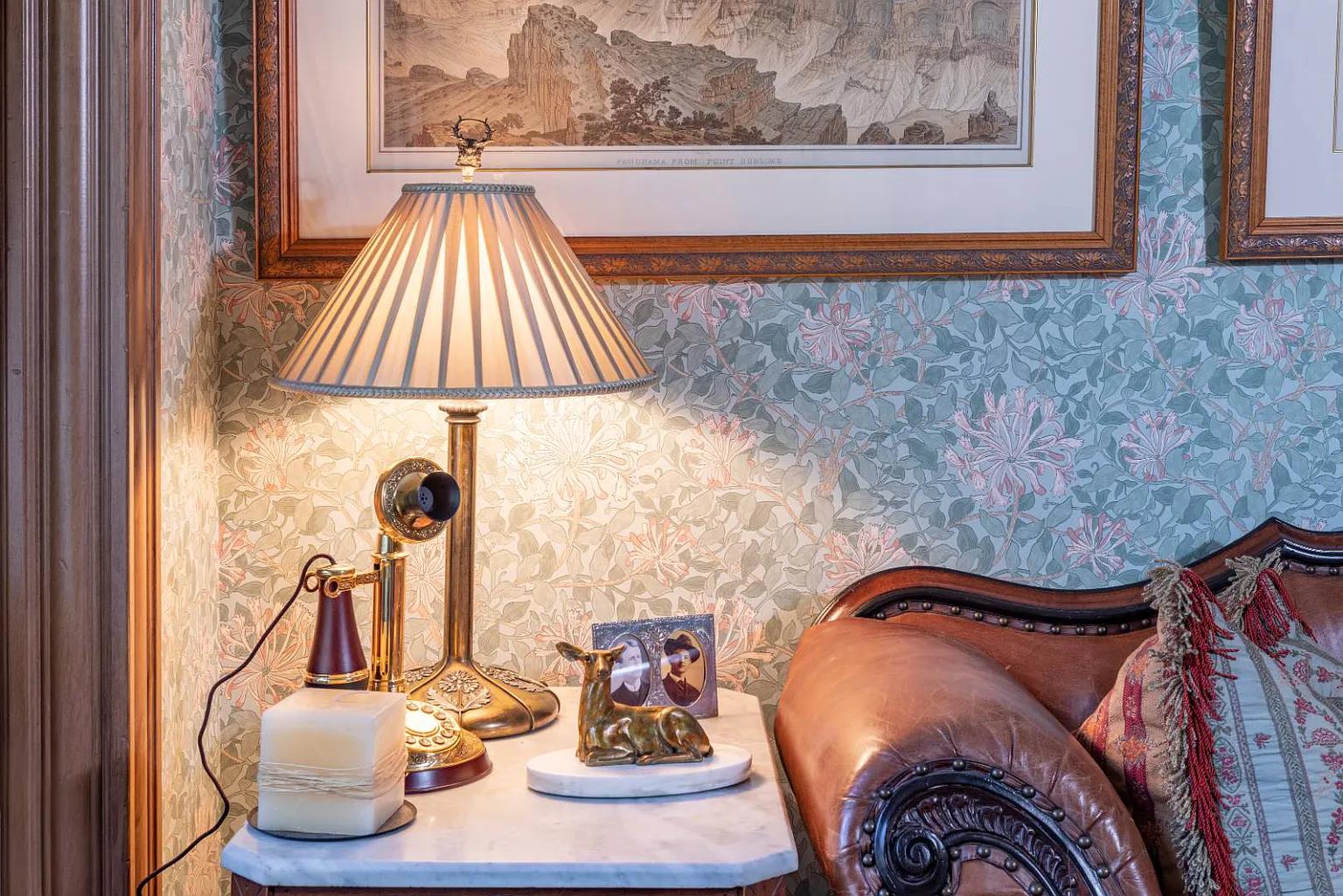
“I’m incredibly thankful that this couple committed themselves to the project. I think it’s a Telluride treasure,” Harvey said. “They’ve maintained it exceptionally well for over 20 years.”
The Cornell House is an example of Gothic Revival architecture, with the vernacular wood frame and a front gabled structure with wide overhanging eaves, according to the listing. The two-story bay tower with a hipped roof and fixed glass windows are original. The new open entry porch also contains a hipped roof with fixed glass and wood post supports, a decorative frieze, and a balustrade. The narrow double-hung windows above the front door and on the sides of the house are original. The parquet wood floors, the only historic inlaid floors in Telluride, were also restored to their original piano key pattern, Harvey explained.

“If a house could have a personality, this house has a personality,” Janet said. “I hope Nunn would be happy with what we’ve done.” Both Harvey and the Barnhills have wanted the house to go to someone who will appreciate it as much as they have.
Harvey said. “It is a treasure and it takes a special buyer. The house is extremely livable.”
Janet added, “I’m going to miss it, but it’s time for somebody else to take on taking care of this house. It’s a wonderful house.”[1]
A/C and Electric Power
Alternating Current (also known as A/C) is an electric current which periodically reverses direction and changes its magnitude continuously with time, in contrast to direct current (or D/C), which flows only in one direction. Alternating Current is the form in which electric power is delivered to businesses and residences, and it is the form of electrical energy that consumers typically use when they plug kitchen appliances, televisions, fans and electric lamps into a wall socket. A common source of D/C power is a battery cell in a flashlight. The abbreviations A/C and D/C are often used to mean simply alternating and direct, respectively, as when they modify current or voltage.

Alternating current (the green curve above). The horizontal axis measures time (it also represents zero voltage/current); the vertical, current or voltage.
The usual waveform of alternating current (A/C) in most electric power circuits is a sine wave, whose positive half-period corresponds with positive direction of the current and vice versa. In certain applications, like guitar amplifiers, different waveforms are used, such as triangular waves or square waves. Audio and radio signals carried on electrical wires are also examples of alternating current. These types of alternating current carry information such as sound (audio) or images (video) sometimes carried by modulation of an A/C carrier signal. These currents typically alternate at higher frequencies than those used in power transmission.
Electrical energy is distributed as alternating current because A/C voltage may be increased or decreased with a transformer. This allows the power to be transmitted through power lines efficiently at high voltage, which reduces the energy lost as heat due to resistance of the wire, and transformed to a lower, safer voltage for use. Use of a higher voltage leads to significantly more efficient transmission of power. The power losses (Pw) in the wire are a product of the square of the current (I) and the resistance (R) of the wire, described by the formula: Pw=I2R.
This means that when transmitting a fixed power on a given wire, if the current is halved (i.e. the voltage is doubled), the power loss due to the wire’s resistance will be reduced to one quarter. The power transmitted is equal to the product of the current and the voltage (assuming no phase difference); that is, Pt=IV.
Consequently, power transmitted at a higher voltage requires less loss-producing current than for the same power at a lower voltage. Power is often transmitted at hundreds of kilovolts, and transformed down to tens of kilovolts to be transmitted on lower level lines, and finally transformed down to 100 Volts – 240 Volts for domestic use.
Three-phase high-voltage transmission lines use alternating currents (A/C) to distribute power over long distances between electric generation plants and consumers.
High voltages have disadvantages, such as the increased insulation required, and generally increased difficulty in their safe handling. In a power plant, energy is generated at a convenient voltage for the design of a generator, and then stepped up to a high voltage for transmission. Near the loads, the transmission voltage is stepped down to the voltages used by equipment.
Consumer voltages vary somewhat depending on the country and size of load, but generally motors and lighting are built to use up to a few hundred volts between phases. The voltage delivered to equipment such as lighting and motor loads is standardized, with an allowable range of voltage over which equipment is expected to operate. Transmission with high voltage direct current was not feasible in the early days of electric power transmission, as there was then no economically viable way to step down the voltage of D/C for end user applications such as lighting incandescent bulbs.
The Entrepreneur: L.L. Nunn

Lucien Lucius Nunn (1853 – 1925)
L.L. Nunn was an American entrepreneur and educator who flourished in Telluride, Colorado, and founded the Telluride House, Telluride Association and Deep Springs College. He was born in Medina, Ohio and received his higher education at Oberlin College. He later studied law at Harvard Law School.
In 1880, Nunn moved to Telluride, where he started a law practice and dealt in real estate. By 1890 he had become involved in gold mining, journalism, and banking within the small community. His bank, the First National Bank of Telluride, was the only bank in San Miguel County at the time. In order to help his mining operations prosper, Nunn’s bank financed the world’s first A/C power plant used for industrial purposes (mining), the Ames Hydroelectric Generating Plant.

Electricians working on the Ames Power Plant in Telluride
Nunn had read about the successes of Nikola Tesla and George Westinghouse with alternating current (A/C) power and was impressed with their claims that it could be transmitted over much longer distances than Direct Current. Nunn was able to strike a deal with Tesla and Westinghouse to build the world’s first commercial grade alternating current power plant in Telluride, Colorado. The cost of the plant was $15 million. Originally named the “Ames Power Plant,” it began operation in Telluride in 1891.

This plant became part of the Nunn’s Telluride Hydroelectric Company, which would later become part of Utah Power & Light. Nunn continued investing in the power industry and he helped design the Ontario Power Plant in Niagara Falls, Ontario, Canada. To staff the power plants Nunn created a work study program called the Telluride Institute, headquartered near the Olmsted Power Plant, located in the Provo Canyon, Utah. Upon completion of the course the graduates were sent on to gain further education through the issuance of scholarships. Many of these students went on to study at Cornell University, where they resided at Telluride House, managed by Telluride Association, which Nunn founded.
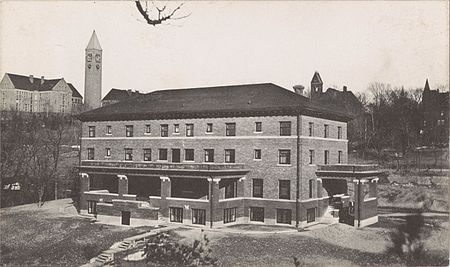
Telluride House, Cornell University, Ithaca, NY

Nunn was forced to sell his portion of Telluride Power in 1912 due to disagreements with other stockholders, which led to the closure of the Olmsted educational site and the suspension of the Telluride Institute program.

The Telluride Institute
The Telluride Institute remains in existence today. Its mission encompasses a variety of intellectually intense residential houses for college students, summer programs for high school students, scholarships, and other activities, all coeducational. In 1917 Nunn founded Deep Springs College, a highly regarded two-year college built on the “Swinging T Ranch” in the remote Deep Springs Valley, California. The college is similar in style to the Telluride Institute, in that students must work while completing their academic requirements and are engaged in a significant measure of self-governance. The New Yorker described the style of education Nunn established at Deep Springs as “a novel form of education, a mix of Christian mysticism, imperialist elitism, Boy Scout-like abstinence, and Progressive era learning-by-doing, with an emphasis on leadership training and the formation of strong character.” He financially supported American zoologist Charles Otis Whitman’s work. Whitman was married to Nunn’s sister Emily, herself a zoologist.[3]
Why This Story?
In July 1998, 107 years after the Nunn House was first built, I worked for Barney Barnhill in Hunt Valley, Maryland. Barney’s father had founded TESSCO as an electronics manufacturers’ representative and distributor. Barney had re-founded and re-branded TESSCO Technologies as a wireless communications “Total Source” distributor of wireless electronics.
And while the Barnhill family was renovating the Nunn Cornell House in Telluride, Barney was giving me a financial review. He was very excited about the mountain home and its connection with his Cornell legacy. “Before we talk about your review, look at these photos Janet just sent me.” He lay on the desk the Polaroids that his wife had just mailed. “The house we just bought has a disintegrating basement and it needs a new sill plate. To do the work we have to lift up the house and repour the basement. It will be awhile before we move in. Janet is overseeing the construction.”
At that moment I realized that it was my sweat and labor over the past 13 years at TESSCO that had bought the Barnhills vacation home in Colorado. What had I ever done for my own vacation home? Nothing. Barney saw the amount I had earned over the previous few years had declined and said, “You need a different role and title,” which was fundamentally contradictory to the titleless flat organization he had created.
Instead, Barney and I negotiated a new role which gave me a steady income for a period of time and an ability to ease out of TESSCO at the end of 1999.
Since that time our family has moved to the Pacific NW, bought our own vacation home and have visited the Cornell house in Telluride. Onward and Upward!
References:
[1] www.telluridenews.com, PO Box 2315, Telluride, CO 81435; Copyright Telluride Daily Planet, Telluride, CO.
 Henry E. Hooper