
Witness Post: Buffalo
The American Buffalos, also known as American Bison, have had their lives intertwined with humans for centuries. For generations, the native word for buffalo has been a critical word in the vocabulary of many Indigenous people. The revered herd animal is called Iinniiwa in Blackfoot, Tatanka in Lakota, Ivanbito in Navajo, and Kuts in Paiute, to name a few. Buffalos are undoubtedly the most significant animal to many American Indian nations. For thousands of years, Native American tribes on the western plains have relied heavily on buffalo for their survival and well-being. They used every part of the animal for food, clothing, shelter, tools, jewelry and in ceremonies. The Native tribes set their calendars on the migration of the buffalo for their seasonal, nomadic hunting and living.
And the name “Brother Buffalo” remains the name of choice for these animals. As a general rule, the word buffalo is used in a cultural context, while the label bison is used in a scientific context. These glorious animals have roamed the prairies for many millennia, long before humans arrived on the scene.
As the song exhorts, “Oh, give me a home where the buffalo roam and the deer and the antelope play.” That said, buffalos are not tame animals ready to graze in your backyard. They are serious, unpredictable wildlife. Humans should remember:
- Buffalo are not domesticated animals.
- Always maintain a distance of 100 feet (30 m or two bus lengths) from all buffalo.
- When buffalo are within 100 feet of the road, view them from inside a vehicle.
- Do not walk or park in the road near where buffalo are grazing.
- Many a gored and trampled pedestrian has regretted taking the danger of the buffalo too lightly.
Importance of Buffalo to Indigenous Cultures [1]
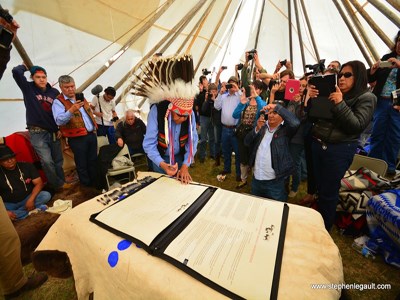
Photo by Stephen Legault.
The Brink of Extinction
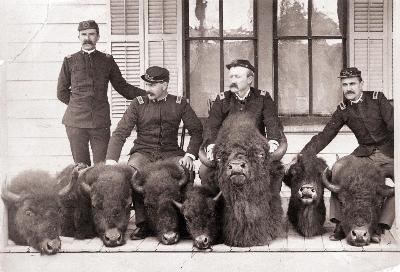
The decimation of millions of buffalo in the 1800s was pivotal in the tragic devastation of Indian people and society. Today, buffalo are central to many American Indian traditions, spiritual rituals and healthy diets, and more than 60 tribes are bringing their sacred “Brother Buffalo” back to their families, lands and ways of life.
The westward expansion of European settlers across the continent in the 19th century was the primary driver in the rapid decline of bison in North America. Railways, rifles, and an international market for buffalo hides led to “the Great Slaughter” from about 1820 to 1880. Some estimate that there were over 60,000,000 buffalo alive in North America in the early 1800s. With the Great Slaughter the bison population plummeted from 30-60 million (estimates vary) to fewer than 1,000 animals by the 1890s. That is a reduction by 99.998%.
The Slaughter was not the only factor creating problems for bison survival. Other factors including 1) the military’s directive to destroy buffalo as a way to control American Indians, 2) the introduction of diseases from cattle, 3) periods of extensive drought, and 4) competition from graze land with domestic livestock (horses, cattle, sheep), all of which contributed to the speed of reduction in bison numbers. At their lowest numbers, some estimated that there were only 300 bison that survived the Slaughter, bringing the once mighty species to the brink of extinction.

Saving the Last of the Buffalo
As bison were notably vanishing by the 1860s, public outcry prompted some states to pass laws to protect bison, but enforcement was lacking and the massacre continued. The earliest efforts to rescue bison began in the late 1860s when a handful of private citizens independently began to capture and shelter bison, saving the species from extinction. These bison served as the foundation stock for most modern public and private bison herds today.
In the 1870s and 1880s, hundreds of bison occupied Yellowstone National Park. The presence of the first U.S. Cavalry soldiers in the national park, whose mission was, in part, to protect wildlife, did not stop the slaughter. Poaching of mountain goats, antelope, moose, elk and bison continued until Congress passed the Lacey Act in 1894. This legislation authorized the cavalry soldiers and park rangers in Yellowstone to prosecute people who were killing or removing wildlife from the park.

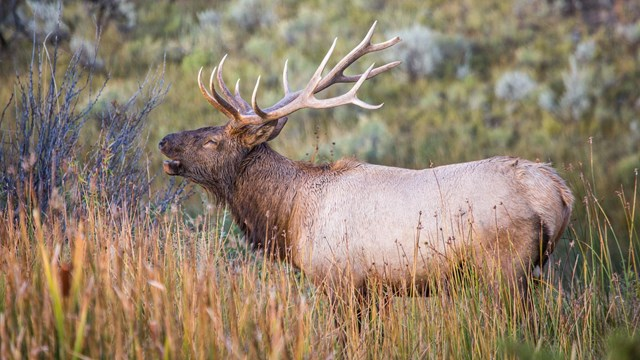
Pronghorn Antelope and Elk in Yellowstone National Park [2]
In 1905, the American Bison Society (ABS) was formed to support bison recovery efforts, compelling Congress to establish several public bison herds at Wichita Mountains National Wildlife Refuge, the National Bison Range, Sully’s Hill National Game Preserve, Fort Niobrara National Wildlife Refuge, and Wind Cave National Park. Congress gave President Theodore Roosevelt funds to establish the Grand Canyon Game Preserve. These efforts helped save bison from extinction. The ABS disbanded in the early 1900s, having accomplished their mission; however, in 2005 the ABS was once again reestablished to help advance the ongoing restoration of bison to our lands and our native cultures.

Silhouette of Buffalo by Art Wolfe
Wild and Domestic Bison
Today, about 360,000 plains buffalo are privately owned as domestic livestock, while about 31,000 bison are stewarded as wildlife in publicly owned herds in the United States and Canada. The Department of the Interior manages about 10,300 bison as wildlife, including approximately 8,000 bison in ten national park units; 1,600 bison in seven National Wildlife Refuges; and 700 bison on Bureau of Land Management Lands in Utah.
Our National Mammal
In 2016, the North American bison was declared the national mammal of the United States. National Bison Day has been observed annually on the first Saturday in November since 2012.
————————————————————————————-
[1] Most of this post is courtesy the National Park Service, which has memorialized the life, near death, and revival of the American Buffalo. https://www.nps.gov/subjects/bison/about.htm
 Henry E. Hooper