
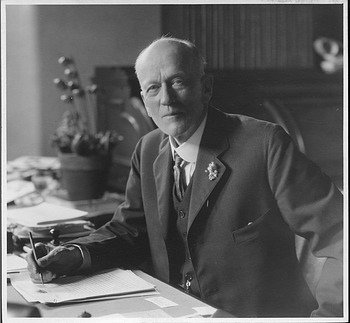
Powell’s Pals: Charles D. Walcott, Jr.
Charles Doolittle Walcott, Jr. was a renowned American geologist and paleontologist, who is best known for his 1909 discovery of the Burgess Shale in the Canadian Rockies. His discoveries, which included an unprecedented diversity of ancient life forms, required extensive work excavating, documenting and cataloging of the Cambrian fossil record which was preserved in those shale deposits. In his lifetime Walcott held significant administrative positions, including as the fourth Secretary of the Smithsonian Institution and as the Director of the U.S. Geological Survey, following Capt. John Wesley Powell. Walcott’s career was marked by numerous field expeditions and a lifelong dedication to studying ancient life on earth as captured in geological history. [1][4]
There was also a major controversy in Walcott’s later aeronautical life, which raised questions of his loyalties and adherence to “the truth,” as we know it.
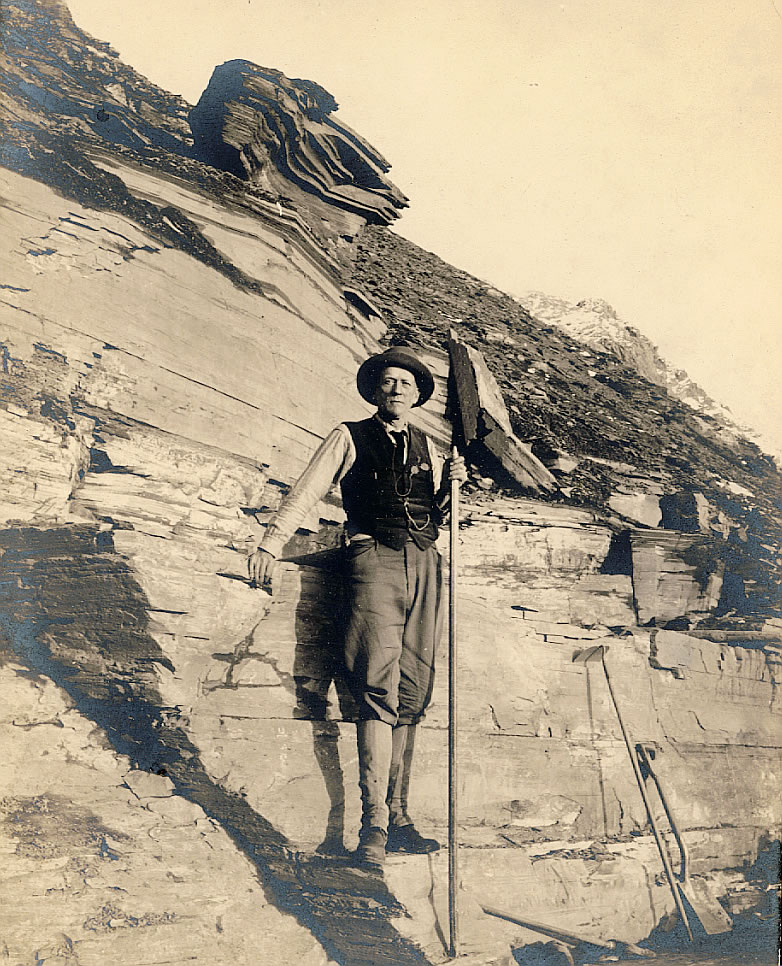
Charles Doolittle Walcott, Jr.
Charles Walcott, Jr. was born on March 31, 1850, in New York Mills, New York. His grandfather, Benjamin S. Walcott, moved from Rhode Island to New York in 1822. His father, Charles Doolittle Walcott, died when Charles, Jr. was only two. Charles Walcott was the youngest of four children. He was interested in nature from an early age, collecting minerals and birds eggs and, eventually, fossils. He attended various schools in Utica, New York, but he abandoned formal education at the age of eighteen, before he completed high school. His interest in fossils solidified and he became curious about living as a commercial fossil collector.
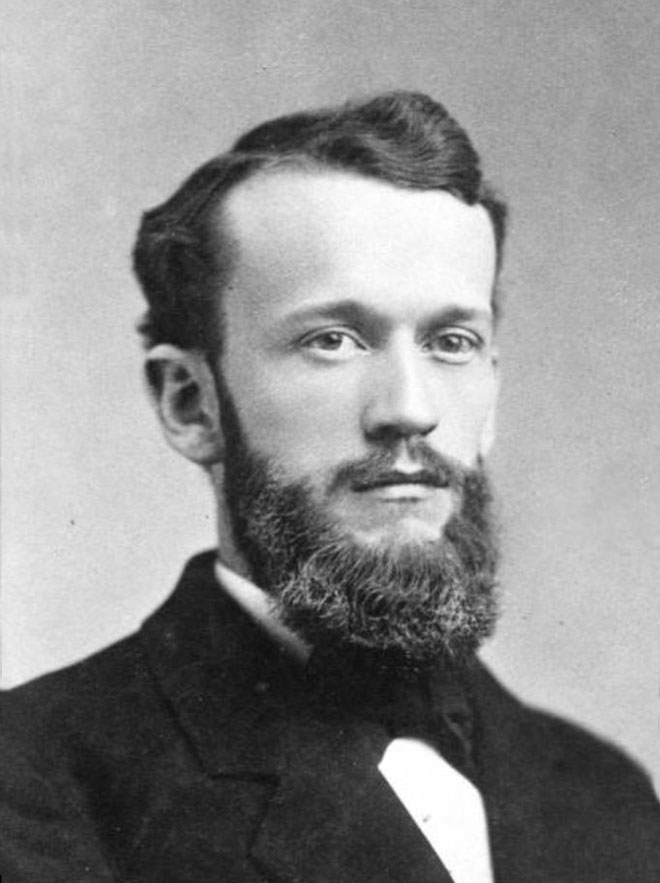
On January 9, 1872, Walcott married Lura Ann Rust, daughter of the owner of a farm in New York where Walcott made one of his most important trilobite discoveries. His early discoveries were local, such as the Rust property in upstate New York, and the Georgia Plane trilobite beds in Vermont. Walcott soon realized the value of his fossil finds, when he sold his prized specimen to the Peabody Museum at Yale University. [2] Walcott’s discovery led to a keen interest in developing a professional paleontology career.

Suddenly, in January of 1876, four years into their marriage, Lura Walcott died from unspecified causes. Only after a dozen years of mourning and searching did Walcott regain his interest and desire of some personal family connections.
Walcott’s fascination with fossils, meanwhile, led to his acquaintance with Louis Agassiz, a professor of geology at Harvard University. Agassiz encouraged Walcott to supplement his lack of formal education with “work in the field of paleontology.” Later that year, 1876, Walcott secured work as an assistant to New York state paleontologist, James Hall. Walcott lost that job after two years, but in 1878 was soon recruited to the newly formed US Geological Survey as a geological assistant. He got to know Maj. John Wesley Powell over the years, who respected his mental acumen and scientific rigor. With applied skills and sheer diligence Walcott rose to become chief paleologist of the USGS in 1893 and ultimately director and Powell’s replacement in 1894.
In 1888 Walcott married Helena Breese Stevens. Together they had four children between 1889 and 1896: Charles Doolittle Walcott III, Sydney Stevens Walcott, Helena Breese Walcott, and Benjamin Stuart Walcott.

As Wikipedia amply outlines, Walcott was highly decorated and sought after by both individuals and organizations specializing in the arts and the sciences. Walcott was elected to the National Academy of Sciences in 1896, the American Philosophical Society in 1897, and the American Academy of Art and Sciences in 1899. In 1901, he served both as president of the Geological Society of America and the Philosophical Society of Washington.
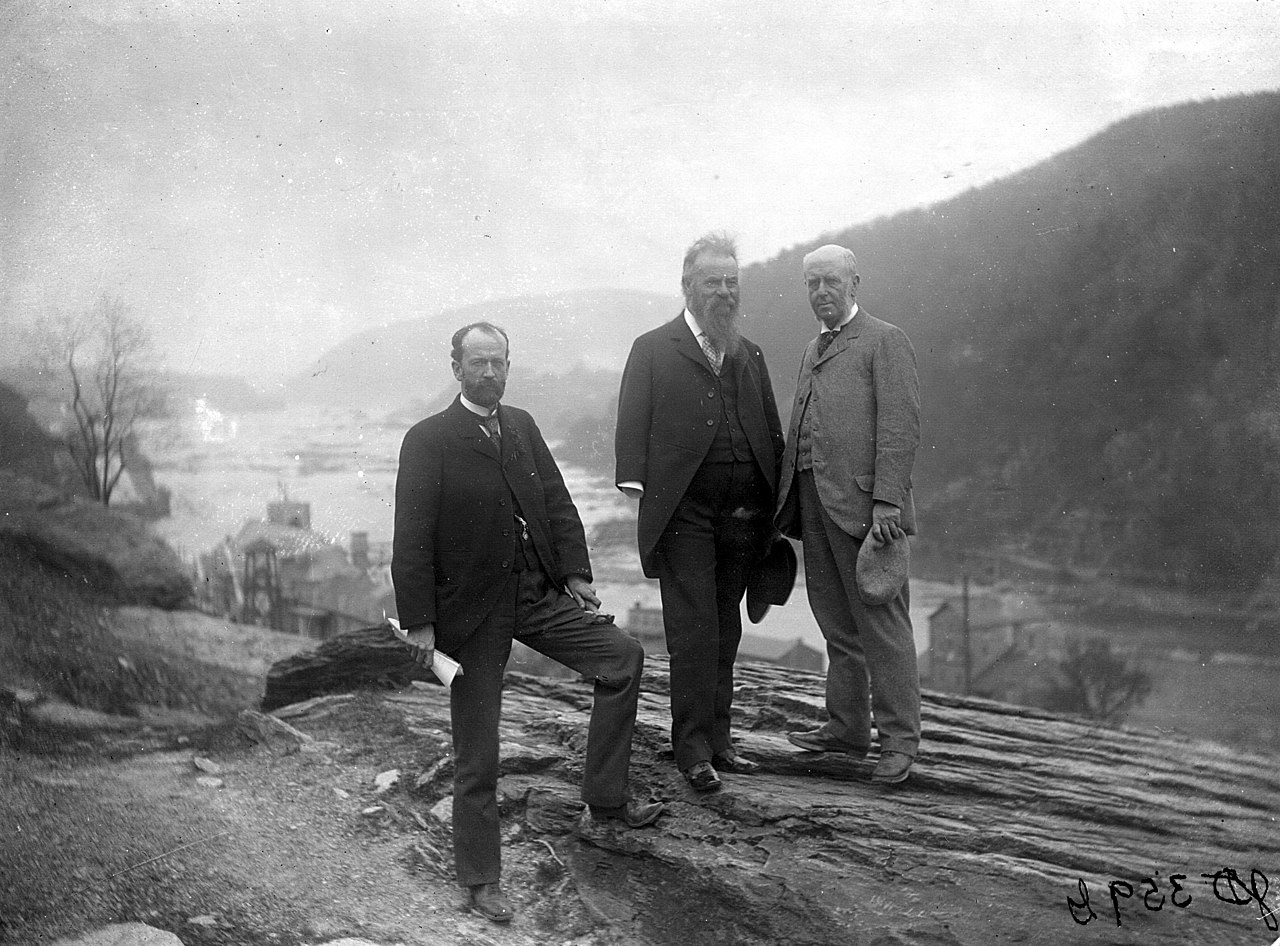
Walcott had been an important paleontologist in Powell’s administration. Powell believed that when it was time to turn over the reins of the USGS in 1894, it had to be to someone who could bear up under the pressure and wear and tear of currying favor with the current administration and fighting the bureau’s battles in Congress. Walcott was his choice and he spearheaded the U.S. Geological Survey under three adminstrations: Presidents Grover Cleveland, William McKinley and Theodore Roosevelt. He remained director until 1907, when, after the death of Samuel Pierpont Langley, Walcott was appointed Secretary of the Smithsonian Institution. [1]
In 1902, Walcott met with Andrew Carnegie and became one of the founders and incorporators of the Carnegie Institution of Washington. He served in various administrative and research positions in that organization. In 1921 Walcott was awarded the inaugural Mary Clark Thompson Medal from the National Academy of Sciences. [1]
He served as president of the American Association for the Advancement of Science in 1923.
The Burgess Shale

In 1910, the year after his discovery of 508 million year old (middle Cambrian) fossils in the Burgess shale, Walcott returned to the area accompanied by his sons Stuart and Sidney. Together they examined all the layers on the ridge above the point where the fossil-laden rock had been found, eventually finding the fossiliferous band. Between 1910 and 1924, Walcott returned repeatedly to collect more than 65,000 specimens from what is now known as Fossil Ridge at Walcott Quarry, named after him. The find includes exceptional preservation of the soft parts of its fossils, one of the oldest fossil beds containing soft-part imprints.
Walcott’s wife, Helena, died in a train crash in Connecticut in 1911. In 1914, Walcott married his third wife, Mary Morris Vaux, who was an amateur artist and avid naturalist. She accompanied him on his expeditions, enjoying the study of nature. She made watercolor illustrations of wildflowers as she traveled with him in Canada.
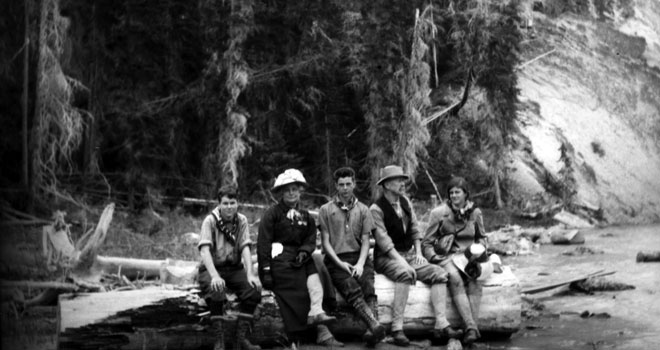
Although Walcott spent a considerable amount of time at the Burgess Shale quarry, he also traveled widely in other areas of the Canadian Rockies with his family. Some of his numerous scientific publications feature spectacular panoramic photographs of the mountains taken from high passes or high on mountain slopes with waterfalls in the background.
The NACA (National Advisory Committee for Aeronoutics)

In 1914 Walcott convened a conference in Washington, D.C. for the purpose of stimulating interest in aeronautic science, and its relation to the U.S. government. The conference led to an act of congress to organize a National Advisory Committee for Aeronautics whose charter was “to supervise and direct the scientific study of the problems of flight with a view to their practical solution.“
This committee had twelve members: two each from the Army and Navy, one each representing the Smithsonian Institution, the Weather Bureau, and the National Bureau of Standards. Five additional members were selected as those “who shall be acquainted with the needs of aeronautical science, either civil or military, or skilled in aeronautical engineering or its allied sciences.” Brig. Gen. George P. Scriven, Chief Signal Officer of the Army, was chairman of the committee. William F. Durand, pioneer naval and aeronautical engineer, was one of the civilian members of the Committee. Charles Walcott was elected chairman of the Executive Committee.
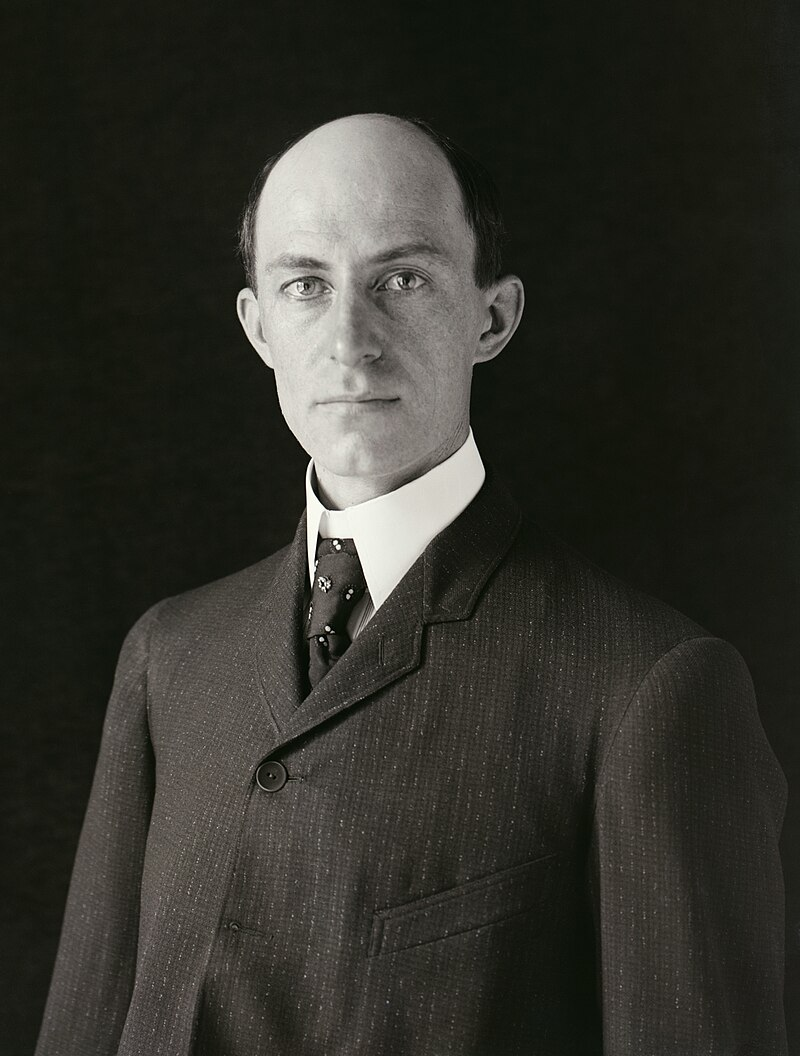


Orville Wright (top), Wilbur Wright, and Glenn Curtiss (bottom)
The Wright Brothers Controversy
Orville and Wilbur Wright are widely credited with inventing and building the world’s first flyable airplane and making the first controlled, powered and sustained human flight. The date of this important breakthrough was on December 17, 1903, at Kill Devil Hills, North Carolina. Their design was awarded a patent in 1906; soon thereafter patent challenges arose from various airplane enthusiasts around the country. The Patent Wars were on!
In 1914, in light of the Wright brothers patent wars and to discredit the Wright brothers, Glenn Curtiss helped Charles Walcott secretly make major modifications to a failed aerodrome built in 1903 by Professor Samuel Langley to make it appear able to fly. After the flight demonstrations, Walcott ordered that the Langley machine be restored to its 1903 condition, to cover-up the deception, before it was put on display.
Why Walcott inserted himself or became enmeshed in the airplane controvery and patent wars is a mystery, as the issue seemed far afield of his area of expertise; however, he did indeed insert himself.
Orville and Wilbur Wright lost millions of royalty dollars in the battles that followed. With much political and legal/patent wrangling in its way, it took twenty-five years, until 1928, for the Smithsonian Board of Regents to pass a resolution acknowledging that Orville and Wilbur Wright were officially credited with “the first successful flight with a power-propelled heavier-than-air machine carrying a man.” By that year Orville Wright had died and the patents were long since sold to other airplane operators.
Walcott’s Death and Legacy

After Walcott’s death in Washington, D.C., his fossil samples, photographs and notes remained in storage until their rediscovery by a new generation of paleontologists in the late 1960s. Since then, many of his interpretations have been revised. Walcott would be little known today if he had not been brought to attention by Stephen Jay Gould’s book Wonderful Life (1989). In this book, Gould put forth his opinion that Walcott failed to see the differences among the Burgess Shale species and “shoehorned” most of these fossils into existing phyla. Many paleontologists would now take a much less negative view of Walcott’s descriptions and of the theoretical perspective that shaped them.
Walcott’s work on Ordovician trilobites of New York also tended to be overlooked until, in the early 1990s, Rochester-based amateur paleontologist Thomas Whiteley revived Walcott’s research and re-opened the Walcott–Rust quarry near Russia, New York. This localized stratum has some of the best preserved Laurentian trilobites ever found, including enrolled specimens with soft body parts.
Walcott is remembered with geographic landmarks, such as Walcott Peak in the Burgess Shale of Canada and the nearby Walcott Quarry. In his honor the Charles Doolittle Walcott Medal is awarded every five years by the National Academy of Sciences for outstanding work in the field of Precambrian and Cambrian life and history.
The World War II Liberty Ship SS Charles D. Walcott was named in his honor.
References:
[1] The vast majority of the research of Charles Walcott was confined to Wikipedia, which holds a treasure trove of details that I have glossed over in this Powell’s Pals post. The more complete work, as well as invaluable primary sources, can be found in the Wikipedia listing entitled: https://en.wikipedia.org/wiki/Charles_Doolittle_Walcott
[2] The property where the trilobites were discovered and extracted became known as the Walcott-Rust quarry. Walcott’s discovery led to a keen interest in a professional paleontology career. It is worth noting that Othniel C. Marsh, the head of the Peabody Museum at Yale University, often paid amateur paleontologists for their fossil finds, bringing them into the vast collection of dinosaurers and fossilized animals and plants that the museum amassed over the years.
[3] There are many pictures from private collections in the internet sources for this post, many of them are included in the collections assembled and copywritten by © Erin Younger family collection. Since there is no monitary value to this post, the author hopes to be allowed to include these family images can be included with the written text.
[4] Charles D. Walcott was one of the men with whom John Wesley Powell found some of his strongest kinship. The exploration of the relationship is outlined and discussed in another Powell’s Pals post on Walcott and eight other scientists and explorers from the Powell era.
 Henry E. Hooper