
Moths: Orgyia
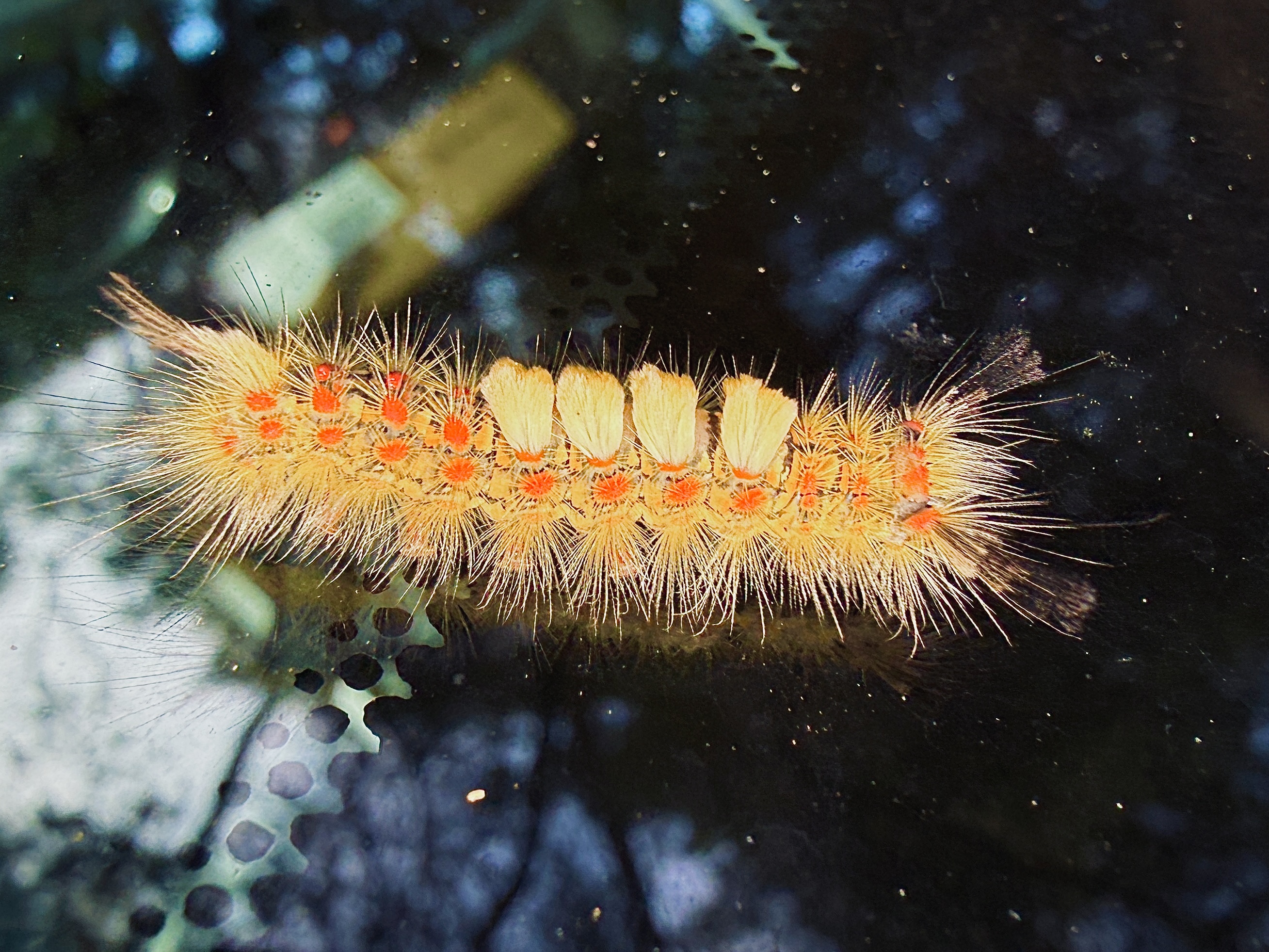
Our nephew, Dave White, who lives in Atherton. CA, described these caterpillars as an invasive species. “They remind me of the cicadas of Maryland. The locusts arrive on cue every 17-years emerging from the earth to infiltrate the Northeastern parts of this country. These caterpillars munch on leaves of our our live oak trees, chomping the debris all over the yard. Then they drop down on silk threads and land on the ground. They climb back up the trunk of the tree and create cocoons in the folds in the bark of the oaks. We will see a massive flight of these guys, when they leave the chrysalis and morph into moths, to the delight of the birds in the neighbourhood.” He went on to describe the appearance of the invading insects, “These caterpillars appear to have been given a mohawk hair cut, but the local barber,” with the four light colored spikes in the middle and several longer hairs on the head and tail.
Dave also found that he felt an allergic reaction while he stood under the trees, as if he were injected by something poisonous from the caterpillars.
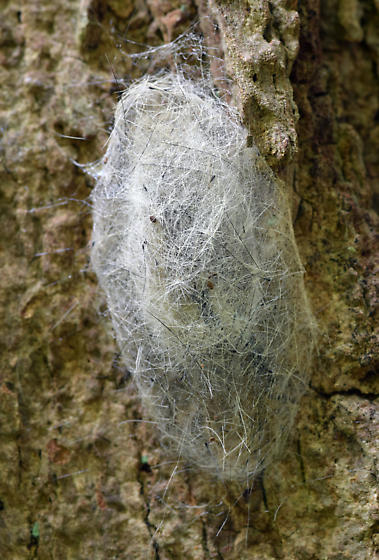
Tussock moth cocoons have their own unique qualities. The are a brownish-gray color, with fuzzy, spindle-shaped outer casings. They can be found on trees, fences, leaves, walls, (inside doors of cars, left out in the elements) and in various other obscure places. The are spun by caterpillars using silk threads that are mixed with urticating hairs that prove irritating and toxic to the human touch. These cocoons, as noted by our nephew, Dave White, are highly irritating to skin, often causing allergic reactions. Lepidoptrists recommend that these cocoons should be handled with gloves or removed with tools like tweezers or a broom.
Orgyia is a genus of tussock moths of the family Erebidae. The genus was described by Ochsenheimer in 1810. The species are cosmopolitan, except for the Neotropical realm, according to Wikipedia.[1]
Moth Description
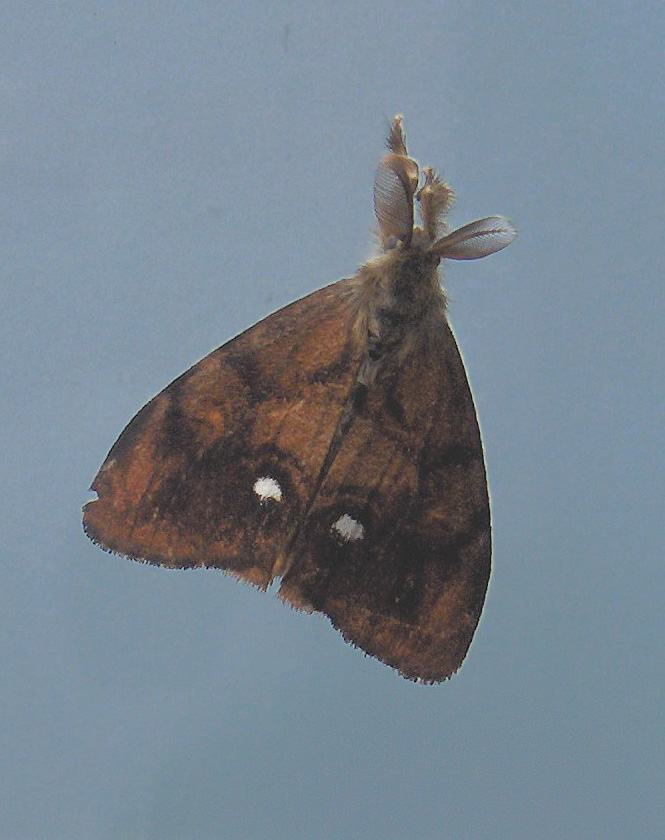
The male flies during the day. Its palpi are short, porrect (extending forward), and heavily fringed with hair. The antennae have long branches and long spines at the extremities. The legs are heavily hairy. The abdomen has a dorsal tuft on its second segment. The forewing has vein 9 arising from vein 10 and anastomosing with vein 8 to form an areole. The hindwing has veins 3 and 4 from angle of cell, vein 5 from just above angle, and vein 6 and 7 stalked.
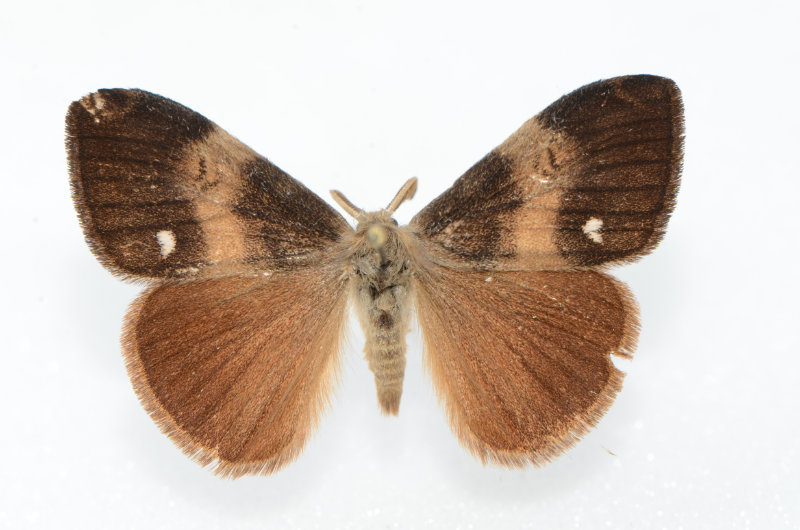
In the female, the palpi and legs are less hairy. The antennae are serrate. The wings are aborted, scale-like and covered with hair. The abdomen is covered with hair and immensely dilated when full of eggs.
Many Species
There are over 27 species of Orgyia, as catalogued by insect lovers:
- Orgyia albofasciata (Schintlmeister, 1994)
- Orgyia amphideta (Turner, 1902)
- Orgyia antiqua (Linnaeus, 1758) – rusty tussock moth, vapourer moth
- Orgyia araea (Collenette, 1932)
- Orgyia ariadne (Schintlmeister, 1994)
- Orgyia australis (Walker, 1855)
- Orgyia basinigra (Heylaerts, 1892)
- Orgyia cana (H. Edwards, 1881)
- Orgyia chionitis (Turner, 1902)
- Orgyia definita (Packard, [1865]) – definite tussock moth
- Orgyia detrita (Guérin-Méneville, [1832]) – fir tussock moth
- Orgyia dewara (Swinhoe, 1903)
- Orgyia falcata (Schaus, 1896)
- Orgyia fulviceps (Walker, 1855)
- Orgyia leptotypa (Turner, 1904)
- Orgyia leucostigma (Smith, 1797) – white-marked tussock moth
- Orgyia leuschneri (Riotte, 1972)
- Orgyia magna (Ferguson, 1978)
- Orgyia osseana (Walker, 1862)
- Orgyia papuana (Riotte, 1976)
- Orgyia pelodes (Lower, 1893)
- Orgyia postica (Walker, 1855)
- Orgyia pseudotsugata (McDunnough, 1921) – Douglas-fir tussock moth
- Orgyia semiochrea (Herrich-Schäffer, [1855])
- Orgyia thyellina (Butler, 1881)
- Orgyia vetusta (Boisduval, 1852) – western tussock moth
- Orgyia viridescens (Walker, 1855)
=================================
References:
 Henry E. Hooper