

Kachina: Momo Bee
Standing on its honeycomb, the Bee Kachina, known to the Hopi, Zuni and Laguna people, is a tall, skinny presence in any ceremonial dance. Because of its height (17.75″), our specific Kachina does not fit on the shelf we have for other katsinas, so it stands apart, as any good bee would do.
“Momo, the Bee Kachina of the Hopi, carries a tiny bow and arrows. In the dance he imitates the hum of the bee and goes from one spectator to another, shooting blunt arrows at them. The children become frightened, so to calm their crying, Momo Kachina squirts a little water on the supposed wound.”
“The Zuni Indians mix honey with the black paint they use on the Kachina masks to make it shiny. They believe that the bees, flying in all directions, will bring the winds from each direction which will bring the rain. They use the honey because the bees come on beautiful days and the children like to catch them. So they pray with the bees’ honey. The Indians also used honey as medicine to quiet crying children, and they gave it to babies when they were teething.”
At the time of the writing by Walter Fewkes (1900) European honey bees (Apis mellifera) had been in the “new” world for nearly 400 years, and the bees went feral quickly and successfully. Mormons brought them to Utah in the 1800s. However, some 4,000 species of bees are native to North America. Honey was collected from bumble bee hives by some Native American tribes. Also native in the region are honey producing wasps, and not much farther south native stingless honey bees. The honey part of the ceremonies, if collected from Apis mellifera, must have developed sometime from the early 1600s. [2]
Gene Hodge [1]
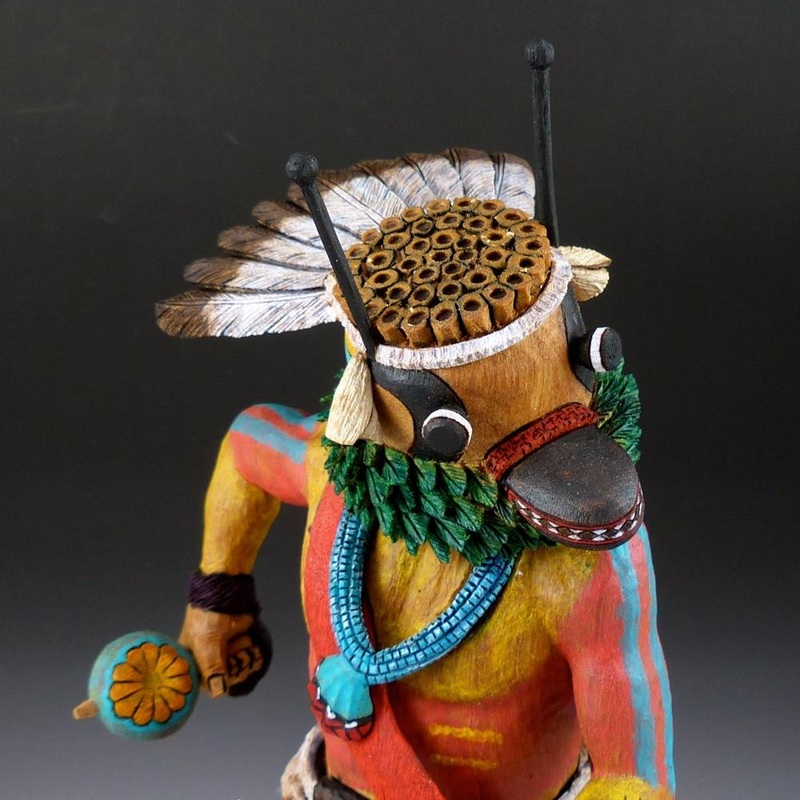
The Momo Kachina Ceremonial Dress
On the yellow mask of the Momo Kachina are black bands in a “U” shaped design over the cheeks and under the large pop-out eyes, which resemble the markings on a bumblebee. A shelf of feathers hang from the back of the mask and he has a snout with teeth. Horizontal green or blue stripes are painted on the back of the mask. The top of the mask is covered with cup-like cones representing wax honey cups. He has an antenna sticking up from each side of his head and many Momo Kachina have two corn husk cones hanging from the bases of each antenna. A fringe of fluff feathers surround the top of the mask. His ruff is either Douglas Fir or fox hide. His body is painted red or pink and yellow and he wears a turquoise necklace and a kato. His clothes are a kilt, sash, belt, breechcloth and fox hide. He has a hank of yarn around one wrist and one knee and a band of sleigh bells around the other. He wears ceremonial moccasins and carries a rattle and a small bow. During dances Momo carries the bow with an arrow in place, to be used like the sting of a bumblebee [3]
The Momo Kachina would come out during the Water Serpent Ceremony, held when the sun rises over the Munyâ’ovi cliffs. In the dance, the Bee Kachina of the Hopi imitates the hum of the bee and goes from one spectator to another, shooting play arrows at them. For the children, if they get “shot,” the Bee Kachina squirts water on their “stinging wound,” and gives them honey. By performing this ceremony, the Hopi (Leguna and Zuni) believe that the bees will bring the winds, carrying rain from each direction, because they fly in all directions. The honey is also used in some prayers, and because honey is thick, they want the rain to be thick to deeply water the roots of their crops to have a good harvest. [4]
The Pantheon of Spirits
In impersonating kachinas, or katsinas, the Hopi and other tribes honor many living beings and neglect few in their environment. Insects and reptiles occupy as important a position in the pantheon of spirits, as others that might be presumed to be more important than bugs, like deer, owls, and antelope for example. Each living being, however, has a position and some power or attribute associated with it that makes it an essential kachina. [5]
References:
[1] Quotations from The Kachinas are Coming: Pueblo Indian Kachina Dolls with Related Folk Tales. 1967. Gene M. Hodge
[2] The Bee Kachina, Momo, of the Hopi People
See ‘Hopi Kachina Ceremonies‘, 1900 by J. Walter Fewkes and see “Hopi Kachinas Drawn by Native Artists, Bureau of American Ethnology” AR 21, Washington, D. C., 1903 pls. II-LIII, by J. Walter Fewkes.
[3] Brandson, 1992:43
[4] https://beekachina.weebly.com/
[5] Wright, 1977:116
 Henry E. Hooper