
Friday Finance: Who owns the U.S. Federal Debt?
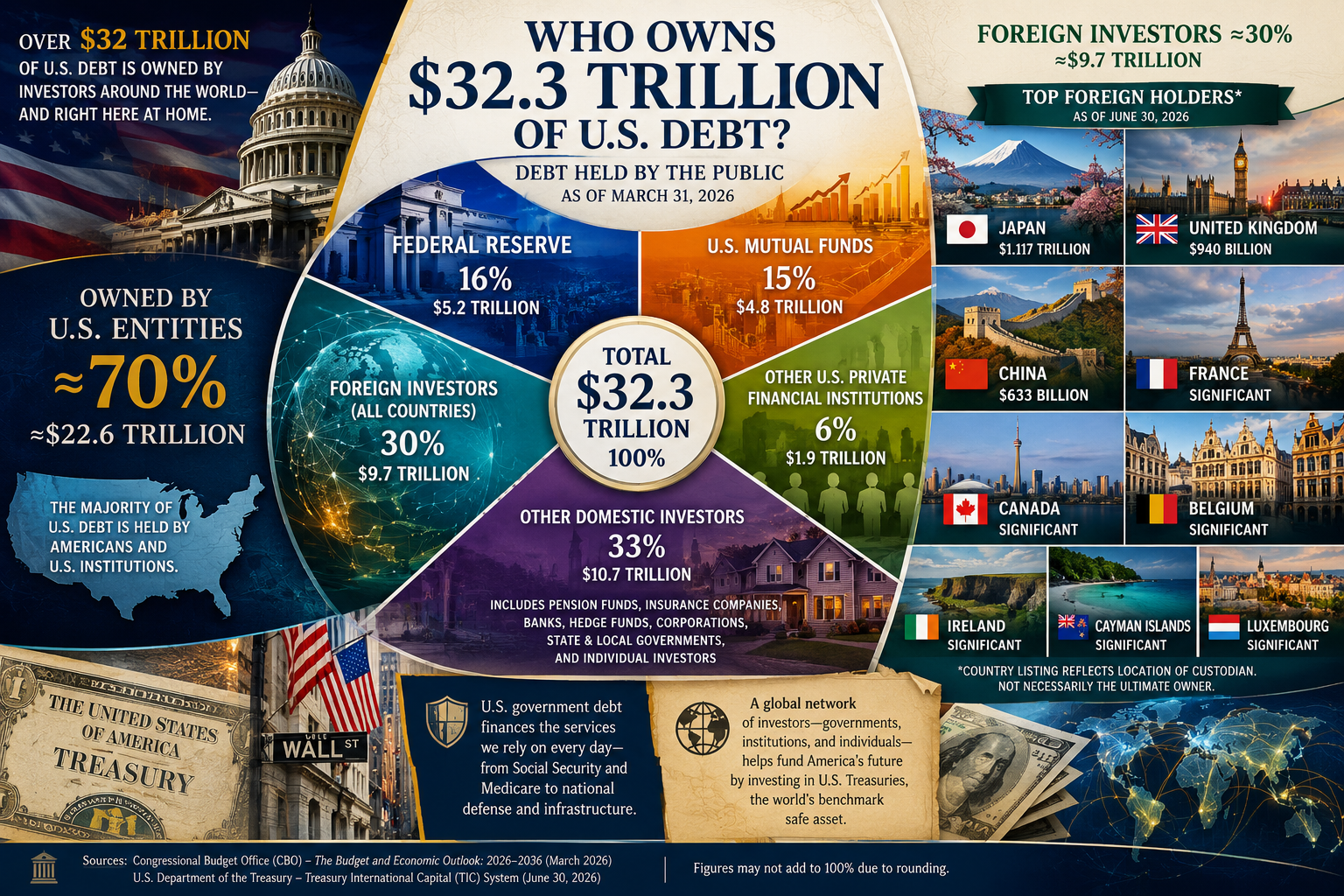
As of the latest data, the United States has more than $40 trillion of gross federal debt, but about $32.3 trillion is debt held by the public. The rest is largely money the government owes to other government accounts, such as Social Security and federal retirement funds. [It is important to register that $1 trillion had 12 zeros after it. That is $40,000,000,000,000+ in 2026 US debt.]
The Big Picture
The Congressional Budget Office’s (CBO) latest ownership breakdown is particularly useful. See the table below:
| Owner | Approx. share of debt held by public |
|---|---|
| 🇺🇸 U.S. Federal Reserve | 16% |
| U.S. mutual funds | 15% |
| Other U.S. private financial institutions | 6% |
| Other domestic investors | ~33% |
| 🌎 Foreign investors, all countries | ~30% |
| TOTAL | 100% |
So roughly 70% of publicly held U.S. debt is owned by red-blooded Americans or American institutions, not China, Russia or Japan.
That is the first important point.
Who are these foreign owners?
The latest Treasury data, for June 2026, show:
| Country | Treasury holdings |
|---|---|
| 🇯🇵 Japan | $1.117 trillion |
| 🇬🇧 United Kingdom | $940 billion |
| 🇨🇳 China | $633 billion |
| 🇫🇷 France | substantial |
| 🇨🇦 Canada | substantial |
| 🇧🇪 Belgium | substantial |
| 🇮🇪 Ireland | substantial |
| 🇰🇾 Cayman Islands | substantial |
| 🇱🇺 Luxembourg | substantial |
Japan is now clearly the largest foreign holder.
China, on the other hand, used to be one of the top two foreign US debt holders; however, it has fallen dramatically — its $633 billion bond holdings is its lowest level since 2008 and is down more than 13% from a year earlier.
And here’s an interesting wrinkle: the United Kingdom is now the second-largest reported holder, ahead of China.
But don’t assume “UK” means the British government
This is one of the most misleading aspects of the Treasury statistics. The Treasury records securities according to the custodian/location through which they are held, not necessarily the ultimate owner. So Treasuries recorded as being held in the Cayman Islands, Belgium, Luxembourg, Ireland or the UK can belong to:
- investment funds
- hedge funds
- banks
- pension funds
- corporations
- wealthy individuals
- sovereign wealth funds
- foreign governments
That’s why the country figures shouldn’t be interpreted as “Japan’s government owns $1.1 trillion” or “Britain owns $940 billion.”
And here’s the interesting part: the Funds
The U.S. Treasury market is increasingly an institutional market, not primarily a foreign-government market.
The Federal Reserve’s data show major categories including:
Federal Reserve
The Fed itself owns a huge Treasury portfolio. It became an enormous buyer during the financial crisis and especially COVID. Its holdings have subsequently declined as quantitative tightening reduced its balance sheet.
Mutual funds
These are enormous Treasury holders—about 15% of debt held by the public according to CBO.
Think:
- money-market funds
- bond funds
- index funds
- short-term Treasury funds
Banks and broker-dealers
Banks need Treasuries for liquidity, regulatory purposes and collateral.
Pension funds and insurance companies
These institutions have enormous long-term liabilities, so Treasuries are natural assets.
Households
Americans indirectly own Treasuries through:
- retirement accounts
- brokerage accounts
- money-market funds
- mutual funds
- ETFs
- savings bonds
- bank deposits
Hedge funds
This is a particularly important—and relatively recent—story. A Financial Times analysis estimates hedge funds controlled approximately 8.5% of U.S. Treasuries in 2025, more than China, Japan, or the U.S. mutual-fund or banking sectors individually.
That’s a remarkable change.
So who is actually financing America?
I’d boil it down this way: The U.S. government is borrowing primarily from the American financial system, with a very large—and still important—foreign investor base.
And that foreign base is changing.
In 2006, official investors such as foreign central banks and the Federal Reserve were much more dominant. Today, private investors—mutual funds, banks, households, hedge funds and foreign private investors—play a much larger role. The private-investor share of marketable Treasuries has risen from roughly 50% in 2006 to about 73% today.
That is arguably more important than the China story.
The $1 trillion question
The question I would keep asking isn’t simply: “Will China stop buying Treasuries?”
China already has been reducing its holdings for years.
The bigger question is: Who will absorb the next $1–2 trillion of Treasury issuance every year as the U.S. continues running very large deficits?
That’s where the current debate about Treasury yields gets much more interesting. The buyer increasingly has to be American households, pension funds, mutual funds, banks, hedge funds, corporations and foreign private investors—and those investors generally demand a sufficiently attractive interest rate.
That’s one reason the ownership story connects directly to the recent concern about higher Treasury yields and the cost of servicing the national debt. The latest reporting notes that foreign demand has weakened while private investors have become increasingly important.
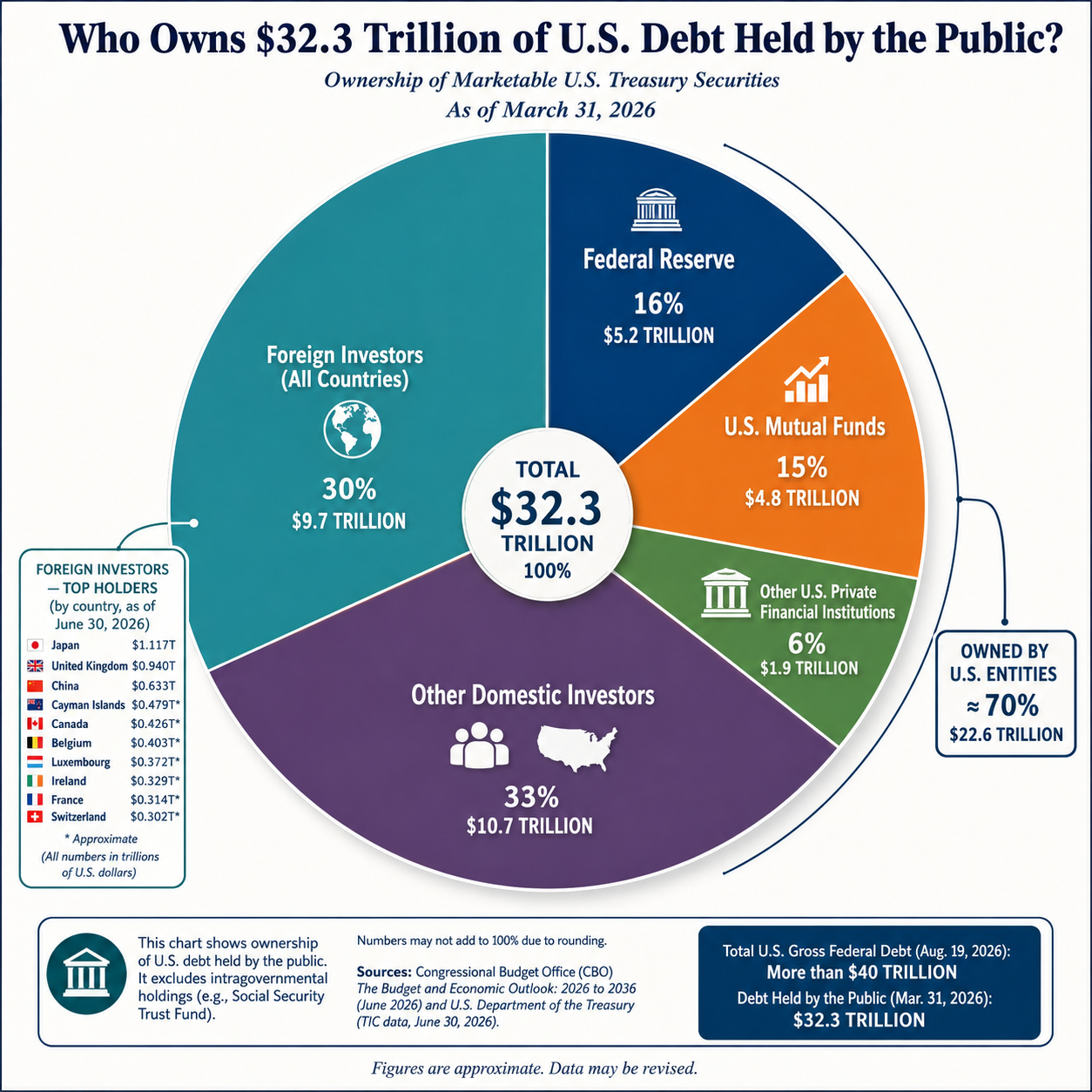
While you’re thinking about these questions, with the Friday Finance: Invisible Markets lessons at work, there is a very good graphic hiding here: a $32 trillion pie showing exactly who owns America’s publicly held debt, with the Fed, mutual funds, pensions, banks, households, foreign governments and foreign private investors sized proportionally. It would make the “China owns America’s debt” misconception disappear immediately.
References:
The graph above is the record version, dated March 31, 2026, using approximately $32.3 trillion of U.S. debt held by the public. The country-level foreign holdings are shown separately as of June 30, 2026.
One important distinction: this is debt held by the public, not the roughly $40+ trillion of total gross federal debt. The latter includes about $7 trillion of intra-governmental holdings.

