
Friday Finance: Short
Long vs. short: the risk profiles
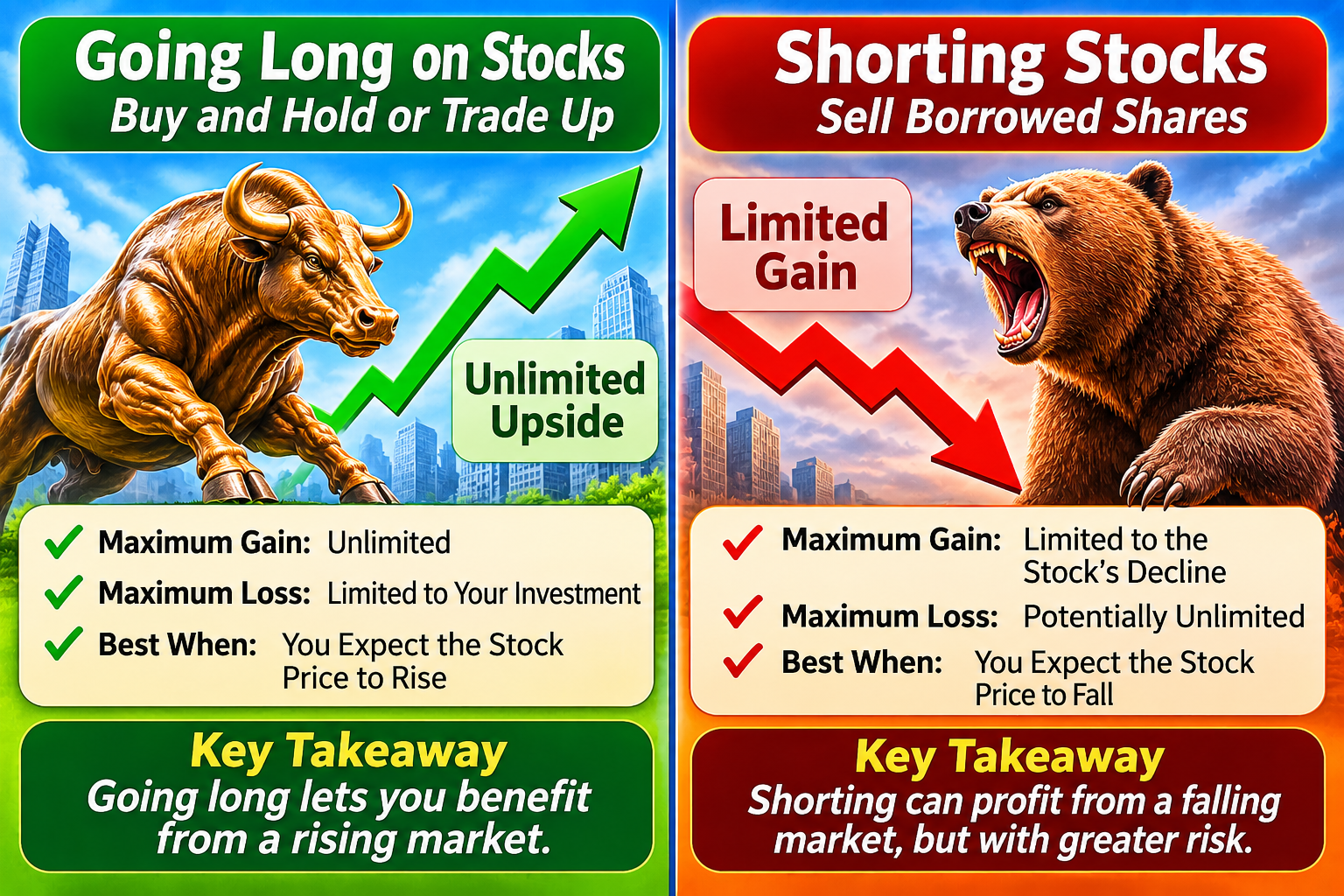
The core difference between these two stock investment strategies is the asymmetry to the possible gains and losses for the investor. Please consider the following two statements carefully:
- A long position has capped downside and uncapped upside.
- A short position flips that arrangement: capped upside and uncapped downside.
| Gains/Losses/Dividends/Risk | Going long (buy) | Going short (sell borrowed shares) |
|---|---|---|
| Maximum gain | Unlimited, since price can rise indefinitely | 100% of the sale proceeds, reached only if the stock goes to $0 |
| Maximum loss | 100% of what you paid, if the stock goes to $0 | Theoretically unlimited, since there’s no ceiling on price |
| Ongoing costs | Usually none, unless you buy on margin | Borrow fees, margin interest, and any dividends paid to the lender |
| Dividends | You receive them | You pay them |
| Time / market drift | Works for you, since stocks have historically trended up | Works against you |
| Forced exit risk | Low, unless leveraged | Margin calls, short squeezes, lender recalling the shares |
A working example (100 shares at $50 each)
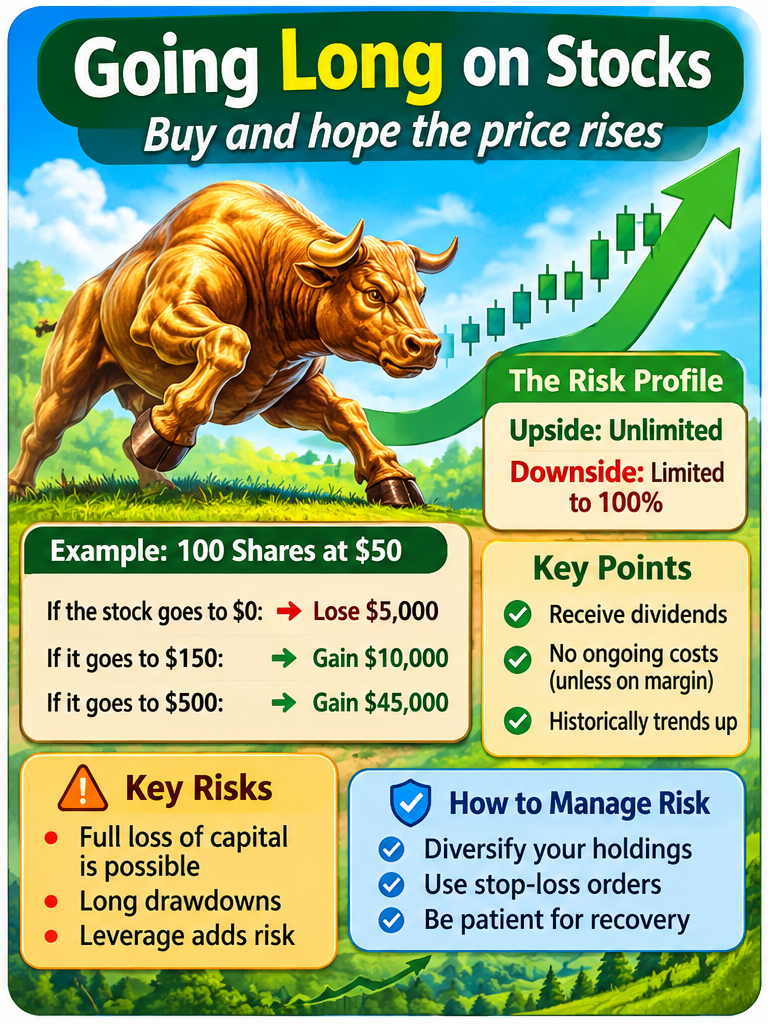
Going Long on stocks means buying shares of a company because you believe its stock price will increase over time. You invest your money upfront, become a shareholder, and hope the company grows, becomes more profitable, or attracts greater investor interest, causing its stock price to rise. You make money when you sell your shares for more than you paid. If the stock price falls, you lose money. Your potential gain is unlimited because a stock price can theoretically continue rising, while your maximum loss is limited to the amount you invested if the stock becomes worthless.
The fundamental distinction is that going long is investing in the expectation that a company will become more valuable, while shorting is speculating that its stock price will decline. Going long is the traditional approach to stock ownership and long-term investing. Shorting is a more sophisticated and potentially much riskier strategy, often used by professional investors, hedge funds, and traders seeking to profit from an anticipated decline in a company’s stock price.
EXAMPLE — Going Long: You pay $5,000.
- If the Stock goes to $0: you lose $5,000, and that’s the worst case scenario.
- If the Stock stays at $50: you have the money in stock and can cash it out for $5,000.
- If the Stock goes to $150: you gain $10,000.
- If the Stock goes to $500, you gain $45,000.
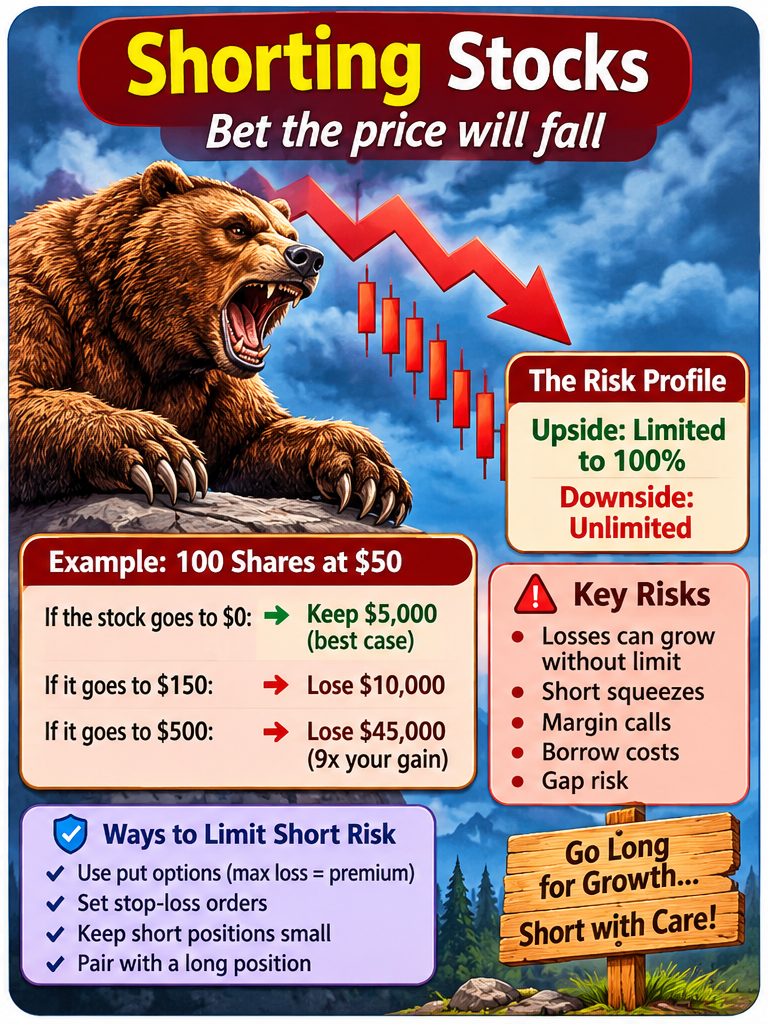
Shorting Stocks means betting that a company’s stock price will decline. Instead of buying shares and waiting for them to appreciate, you borrow shares from a brokerage, sell them at the current market price, and hope to buy them back later at a lower price. You then return the borrowed shares and keep the difference between what you received when selling and what you paid to buy them back, less borrowing costs and fees. If the stock price rises instead of falls, you lose money because you must buy back the borrowed shares at a higher price. Unlike going long, your potential loss is theoretically unlimited because there is no ceiling on how high a stock price can rise.
Another working example (short 100 shares at $50 each)
EXAMPLE — Shorting a Stock: You receive $5,000 from selling borrowed shares.
- If the Stock goes to $0: you keep $5,000, and that’s the best case scenario.
- If the Stock stays at $50: you give back the $5,000.
- If the Stock goes to $150: you lose $10,000.
- If the Stock goes to $500: you lose $45,000, which is nine times your maximum possible gain.
Risks specific to shorting
- Losses compound. When a long position falls, it shrinks as a share of your portfolio. When a short position goes against you, it grows, so the damage accelerates.
- Short squeezes. When a heavily shorted stock rises, shorts buying to cover push the price higher still. GameStop in January 2021 and Volkswagen in 2008 both caused enormous short losses in days.
- Margin calls. Shorting requires a margin account. Under Reg T, the initial requirement is 150% of the position’s value. Brokers then set maintenance requirements, often 30% or more. If the stock rises, you may have to add cash or be bought out at a bad price, possibly without notice.
- Borrow costs and recall. Popular shorts can be “hard to borrow,” with annual fees that can run from a fraction of a percent to well over 100%. The lender can also recall the shares, forcing you to close.
- Gap risk. Takeover announcements or surprise good news can make a stock jump overnight, past any stop-loss order you set.
- Being right too early. Even if your thesis is correct, carrying costs and margin pressure can force you out before the decline happens.
Risks specific to going long
- Full loss of capital is possible if the company fails.
- Opportunity cost and long drawdowns. Some stocks take years to recover, or never do.
- Leverage changes the picture. Buying on margin introduces margin calls and losses beyond your original cash.
Ways people limit their risk and short
Common approaches include buying put options instead of shorting, where the maximum loss is the premium paid. Others use stop-loss orders, though these can’t protect against gaps. Many keep short positions small, or pair a short with a related long position to hedge market moves.
I’m not a financial advisor, so this is general information on going long or shorting a stock. Do not treat this information as a recommendation. If you’re considering shorting, it’s worth reading your broker’s specific margin and borrow terms first, and seek the advice of a certified financial advisor (CFA) in the process.

