

Friday Finance: Oil
The price of oil is determined, as most commodities are, by supply and demand, right? Well, sort of…. Mostly the price of oil and its refined gasoline are determined by the production mandates of an international cartel. That’s right — a cartel. Not a drug cartel, but an organization more out in the open. Known as the Organization of the Petroleum Exporting Countries (or OPEC for short), the cartel member countries determine what the production levels will be (in barrels per day), over the upcoming period (weeks/months). The lower the expected production, the higher the price of a barrel of oil, and the higher the rate of production, the lower the price of that barrel.

First, let’s get some of the language and metrics straight with a Q&A session:
- Q: Why is this commodity quoted in Barrels? A: Barrels are commonly used for storage and transportation in the oil industry, so the unit of measure was exacted at a barrel.
- Q: So how much oil is in a barrel? A: a standard oil barrel holds 42 US gallons, which is approximately equal to 159 liters.
- Q: How much gasoline can we get from that barrel? A: One barrel of crude oil can yield about 19 to 20 gallons of gasoline, the rest goes into other distillates and plastics.
- Q: And how much does a full barrel weigh? A: The weight of a barrel of crude oil is roughly 300 pounds (136 kg). Different types of oil may have varying densities, affecting the total weight.
- Q: While you are at it, what currency is used for oil if the OPEC members are from three other continents? A: Most barrels are presently denominated in US Dollars ($$$) because of the relative stability of the USD compared to other native currencies. U.S. sanctions against countries like Iran and Russia have incentivized these countries to find non-dollar payment methods to circumvent the U.S. financial system. Saudi Arabia has also indicated a willingness to accept payments in currencies other than the dollar. In 2023, reports showed that at least 20% of the world’s oil trade was settled in non-dollar currencies.
- Q: What does a barrel of oil cost in USD these days? A: As of October 2025, West Texas Intermediate (WTI) crude oil costs about $58.30 to $58.80 per barrel, while Brent crude is around $62.00 to $62.40 per barrel. Prices fluctuate daily based on market conditions, with factors like US-China trade tensions and global supply concerns impacting the cost. (Note: in 2022, the average spiked to about $100.93 for Brent crude and $94.90 for WTI.)
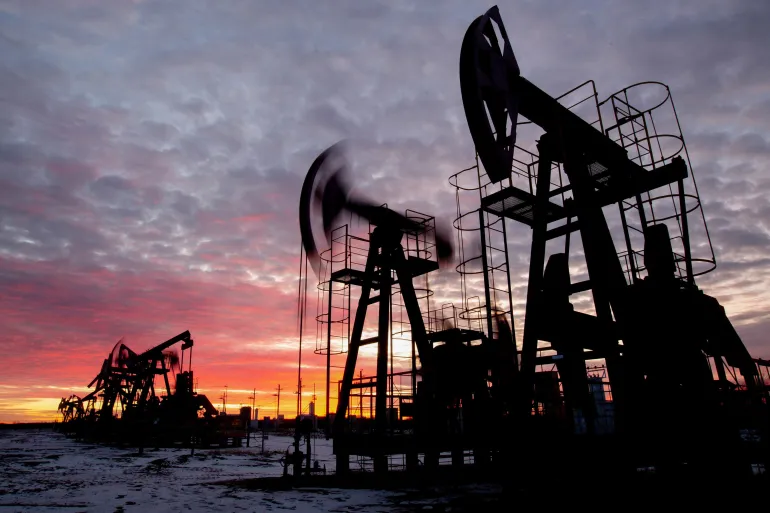
As of October 2025, the Organization of the Petroleum Exporting Countries (OPEC) has 12 member countries. These member countries are primarily located in the Middle East (5) and Africa (6), and South America (1). The five founding members established the organization in Baghdad, Iraq, in 1960. There are countries that along with OPEC constitute added members in what is known as OPEC+ (described below).
Current OPEC Member Countries:
| Region | Member Country | Founding Member (1960) |
|---|---|---|
| Middle East | Iran | Yes |
| Iraq | Yes | |
| Kuwait | Yes | |
| Saudi Arabia | Yes | |
| United Arab Emirates | No | |
| Africa | Algeria | No |
| Republic of the Congo | No | |
| Equatorial Guinea | No | |
| Gabon | No | |
| Libya | No | |
| Nigeria | No | |
| South America | Venezuela | Yes |
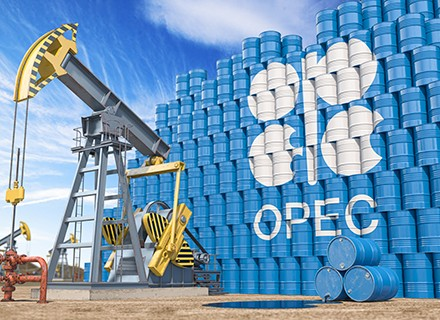
Key Facts About OPEC:
- Formation: OPEC was founded in Baghdad, Iraq, in September 1960 by Iran, Iraq, Kuwait, Saudi Arabia, and Venezuela to coordinate and unify petroleum policies among member countries.
- Headquarters: The headquarters of OPEC have been in Vienna, Austria, since 1965.
- Mission: OPEC aims to stabilize oil markets to secure an efficient, economic, and regular supply of petroleum to consumers, a steady income to producers, and a fair return on capital for investors.
- OPEC+: In 2016, OPEC formed an alliance with several non-OPEC oil-producing countries, including Russia, Mexico and Kazakhstan, creating a larger group known as OPEC+ to more effectively influence global oil prices and supply.
- Former Members: Countries that were once members but have since withdrawn include Qatar, Indonesia, Ecuador and Angola. The United States, now the largest global producer of oil, is NOT and has NEVER been a member of OPEC.
So how does supply and demand come into play?
The answer here is more nuanced and complicated. The major contraint is refineries, which adds complexity beyond simple market (supply/demand) principles. The supply chain is not a straight line from oil well to gas tank; rather, it passes through specialized, high-cost and inflexible industrial facilities.

How do refineries constrain the supply of fuel?
Here is where capacity, geography, oil types, pipelines, and profit margins come into play. (Hang in there with this, for although the economics jargon is heavy, they all play a part in determining the cost you pay AT THE PUMP, which is what most people care about.
- Refining capacity is finite: The US has lost refining capacity due to closures, some of which occurred when demand plummeted during the COVID-19 pandemic. Other facilities have closed due to environmental regulations or accidents. With limited capacity, it is nearly impossible to increase fuel supply quickly, even if crude oil is abundant. Capacity cannot be turned ON or OFF easily, which has a major impact on the cost of a gallon.
- Geographic mismatches: Refinery closures in one part of the country — such as the recent closures in California — do not simply get absorbed by expansions elsewhere. Transportation costs and logistical constraints, like pipeline capacity, mean a regional supply loss cannot be easily met from another area, leading to higher local prices and price swings from one region to another. Another factor is Oil Hubs, which are outlined in another Word Press.
- Crude oil type: Refineries are built to process specific types of crude oil, which vary in quality and density (you have probably heard of oil referred to as “light” or “heavy”) and sulfur content (which is referred to as “sweet” – low sulfur or “sour” – high sulfur). A refinery cannot easily switch the type of crude it processes, meaning an abundant supply of one type of crude cannot always meet the demand for products that may require a different type.
- Limited output adjustment: While a refinery can slightly adjust its product yield in response to market signals, its overall output of gasoline, diesel, and jet fuel is determined by its physical equipment. It cannot instantly produce more of one type of fuel without impacting the others. In a 2020 example, refineries operated their gasoline-producing units less due to low demand, while demand for other products also fell.
- Profit margins over volume: Refineries are businesses that operate on the margin between the cost of crude oil and the selling price of refined products. If this “crack spread” is low, they have little incentive to increase production. If it turns negative for too long, they may cut production or shut down. This means they will not necessarily increase supply just because crude oil is cheap.

How is demand influenced by refining constraints?
- Inelastic short-term demand: For many consumers, gasoline demand is relatively inelastic in the short term, meaning they will continue to purchase fuel even as prices increase (they have no substitutes or alternatives to turn to). While consumers cannot quickly switch to more fuel-efficient vehicles or move closer to work, their demand is not infinite. Higher prices do eventually reduce demand, but only to a small degree.
- Price volatility from disruptions: Because refineries operate near capacity and can’t quickly increase output, a sudden disruption has an outsized effect on prices. A refinery fire, for example, or an unplanned maintenance shutdown can cause gasoline prices to spike in a region, especially if it is isolated from other markets.
- Seasonal fluctuations: Demand for gasoline is subject to predictable seasonal fluctuations, with demand increasing during summer travel season and decreasing afterward. Refineries plan for this, but unforeseen shifts in demand, such as the pandemic-related drop in 2020, can lead to production cuts or closures that permanently reduce capacity.
- Regional price differences: Due to pipeline and shipping constraints, the price of gasoline can vary significantly by region. An incident that affects a refinery on the West Coast, which is relatively isolated from the larger Gulf Coast refining centers, can cause a more severe local price increase.
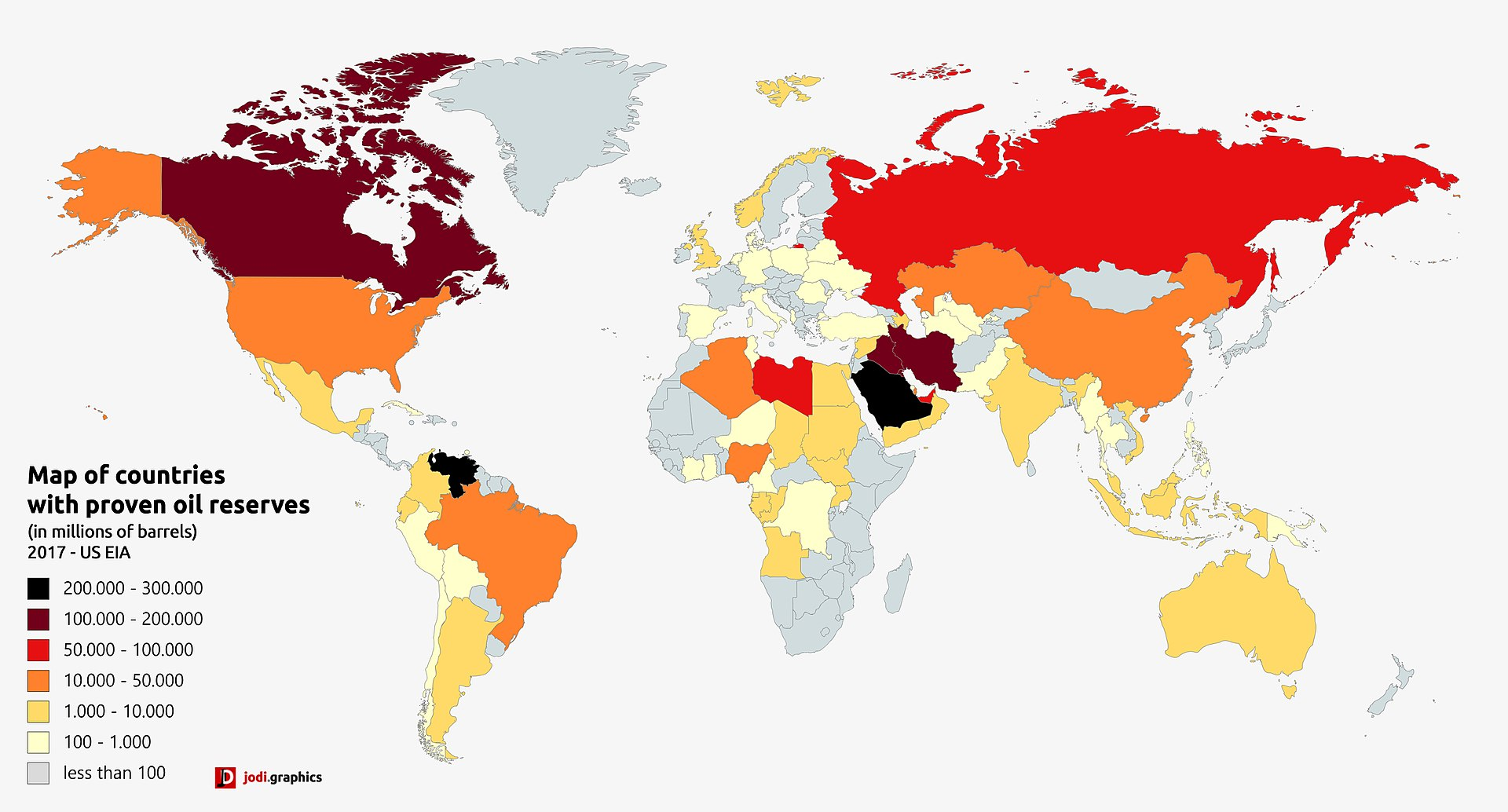
What countries have the largest oil reserves and the greatest oil production as of 2025?
As of 2025, Venezuela holds the world’s largest oil reserves, while the United States is the top producer of crude oil globally. Please Note: a country’s reserves and its production output are distinct and discrete from one another. While supply and production are not the only factors in the “who has the Upper Hand” discussions, the quantity of oil reserves (with ease of extraction) and production success are key to having leverage on a global scale. See the lists below:
Largest oil reserves
Oil reserves are the estimated quantity of crude oil that is technically and economically feasible to extract from their territories and owned wells (both on-shore and off-shore). Data from sources like OPEC consistently rank the same nations in the top five.
- Venezuela: Holds the largest proven oil reserves, estimated at over 300 billion barrels. Much of this is heavy crude in the Orinoco Belt, which is more difficult and costly to extract, limiting its production and output.
- Saudi Arabia: Possesses the second-largest reserves, with oil from the Ghawar Field (world’s largest conventional onshore oil field) and the Safaniya Field (offshore fields) that are relatively easy and cheap to extract.
- Iran: Has the third-largest oil reserves, but it faces production limits, due to current international sanctions.
- Canada: Holds the fourth-largest reserves, primarily in the Oil Sands of Alberta, which are more expensive and difficult to extract from the sands and develop/refine into usable oil.
- Iraq: Ranks fifth with a large volume of easily extractable reserves.
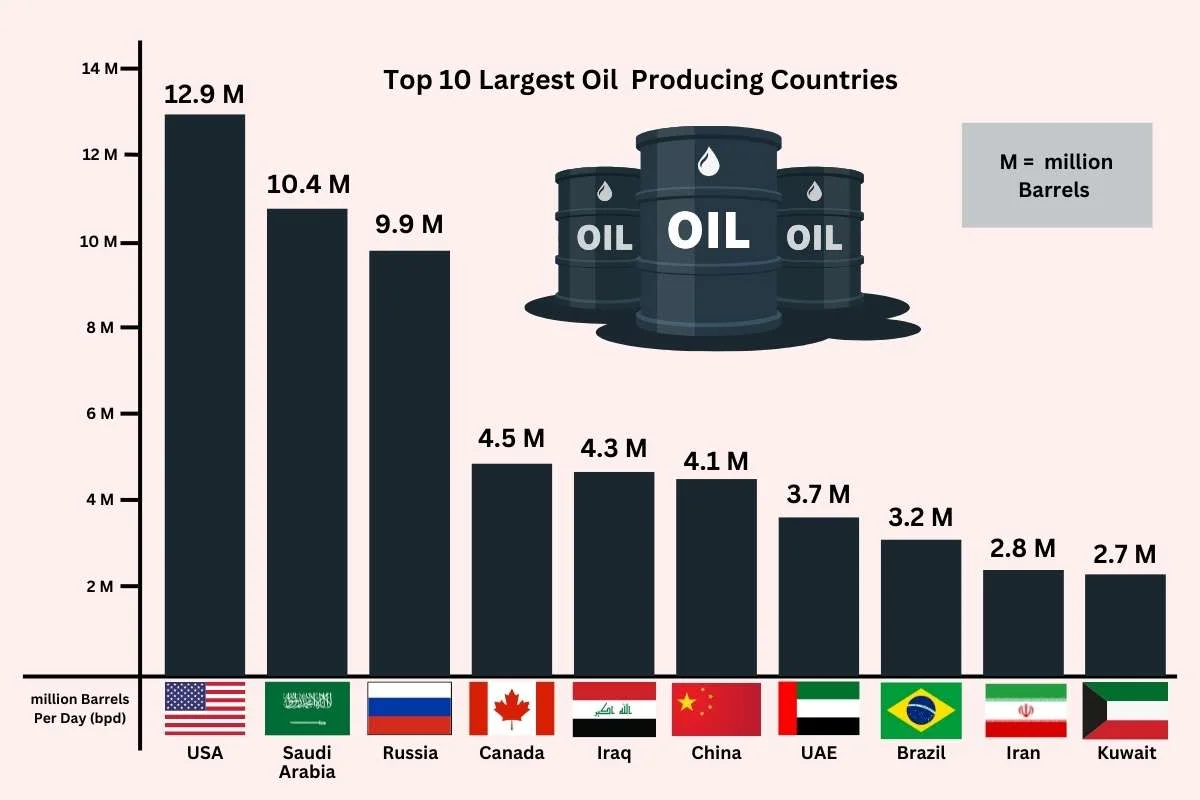
Top oil producers
The countries leading in oil production have the capacity and technology to extract the most oil daily.
- United States: Has been the world’s largest crude oil producer since 2017, largely due to its advanced shale oil extraction methods. The country’s production capacity reached approximately 13.2 million barrels per day in 2024.
- Saudi Arabia: Is a consistent top producer, leveraging its large, easily accessible reserves and its influence within OPEC to manage output.
- Russia: Is also a major producer, though sanctions following its invasion of Ukraine have forced it to reorient its energy exports toward Asian markets. It is an OPEC+ member.
- Canada: While fourth in reserves, it is a leading producer that sends most of its output to the U.S.
- China: Interestingly, it ranks among the top five producers despite having much smaller oil reserves than countries like Venezuela, Saudi Arabia, Iran, Canada or Iraq. (The ranking of Iraq above China in the chart above helps prove that supply of oil can vary greatly from year to year.)
What about our US Oil Reserves?
Oil Reserves are often a buried part of the discussions on oil and gasoline. They are encapsulated in the following question and answer:
Q: What and where are the US Strategic Oil Reserves? A: The Federal Government has set aside strategic natural resource reserves in times of trouble abroad. The 700 million+ barrel reserves are stored in previously exhausted wells (salt caverns) around the US Gulf Coast in the oil rich states, such as Louisiana and Texas. Also known as the US Strategic Petroleum Reserve (SPR), it is the world’s largest emergency oil supply, storing federally-owned oil. Established in 1975 after the 1973–1974 oil embargo, the SPR’s capacity is both a deterrent to oil import disruptions and a foreign policy tool. The SPR has only been sold from three times, most recently in 2011, when it was used to offset supply disruptions during Libyan unrest.
So finally, back to the question: What is happening AT THE PUMP with gasoline these days?

The national average price of gasoline fell 6.4 cents in October, 2025 to $3.02 per gallon, according to GasBuddy data. In seems to be rising in the Pacific Northwest, but that is not the national trend. The average is 13.7 cents lower than a month ago and 14.4 cents cheaper than a year ago. Diesel prices have declined 3.5 cents, bringing the national average to $3.63 per gallon. All together, for the first time in years, U.S. motorists may soon see the national average gas price dip below $3 per gallon.
What happens with OPEC, OPEC+, the refineries and the oil hubs will be the inputs that modify the prices of gasoline in 2026 and beyond. Yes supply and demand are part of the mix, but so are production, constraints, war, reserves, and access.
Happy Driving on the road ahead!

 Henry E. Hooper