

Friday Finance: Investment Strategies
Below are some of the most discussed stock purchasing strategies among investors in the market today. It is important to realize there are also stock selling strategies, as selling is a whole other discipline. These are very brief outlines of 20 strategies. They are not the ONLY investment strategies out there, simply the most common. If you want to try one of these strategies, or another one you have heard about, research it deeply and thoroughly. Make sure you understand the mechanics of your strategy, and that the returns (and/or losses) match your appetite for market risk. [See the Risk Assessment by the Univ. of Missouri in the footnotes below.]
Starting Assumptions: diversification is still key; there are both domestic and international versions of these strategies. I have outlined the following strategies with some consistent tools: First, a Definition, then with a few words on Why It Works and an accompanying Story, with specific examples of the strategy or the market champions of that strategy in practice.

IMPORTANT NOTES: (1) As an important disclaimer, I am not an investment professional or CFP. I am a life-long investor with over 50 years in the stock market. (2) Please note: there is no strategy that works all the time. (3) Be sure to match the strategy you choose with your risk tolerance (see tool to measure yours below). (4) Pay attention to what is going on in the real world, which is in constant flux.
And finally …
REMEMBER: your investments are not your only holdings. Your personal balance sheet will also include your possessions: including your home, auto, valuables, clothes and the like. Think carefully about what percentage of your holdings you want to expose to the stock market. Start with your retirement plans (Roth IRA or 401(k)) and build from there. The basic rule that your grandfather used to recite is still true today: “Only put at risk in the market, amounts that you are willing to lose.”
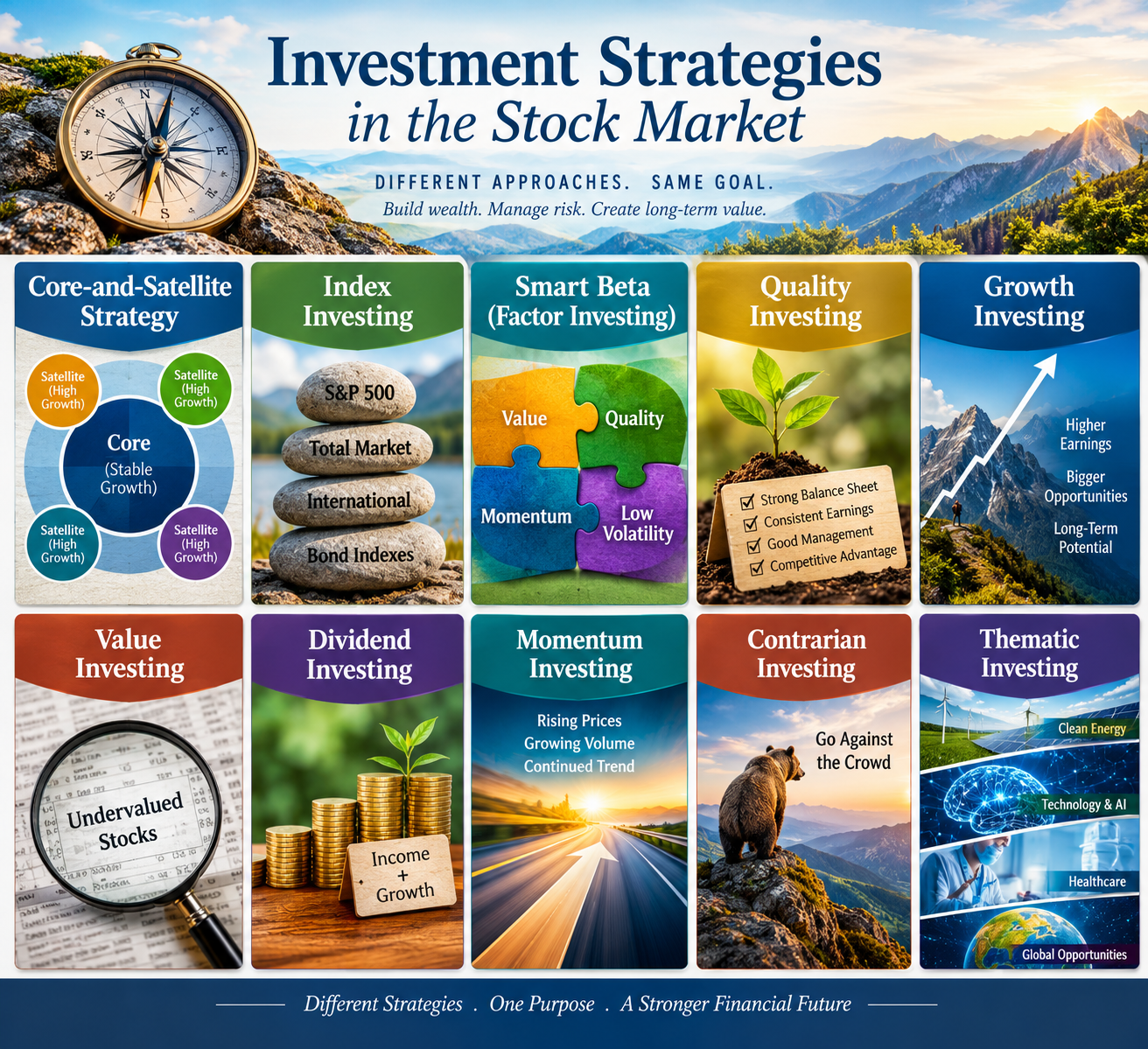
1. Core-and-Satellite Strategy
- What it means: Keep most of your portfolio (“the core”) in safe, diversified funds—like a total market or S&P 500 fund. Meanwhile you use a smaller “satellite” portion for more adventuresome picks (specific sectors, trends, or single stocks that match your risk appetite).
- Why it works: Gives you steady portfolio growth, while allowing room for higher-return opportunities you may notice in your research.
- Story: Many professional advisors use this core holdings method as their base model—it keeps emotions out of your portfolio and discipline and structure in.
2. Index Investing
- What it means: Buy index funds that mirror the entire market.
- Why it works: It’s low-cost, simple, and historically beats most active managers over time who experience “regression to the mean.”
- Father figure: Popularized by John Bogle, founder of Vanguard, who believed most investors should “own the market and hold it.” Famous Yale Endowment guru, David Swenson, recommended this approach along with Bogle.
- Example: The average S&P 500 index fund has outperformed about 85% of the actively managed mutual funds over the past decade. This strategy is the most frequently used benchmark for all other returns percentages.
3. Smart Beta (Factor Investing)
- What it means: Invest in funds that tilt toward certain characteristics—like undervalued (“value”) or steady (“low volatility”) stocks.
- Why it works: These factors have shown long-term patterns of outperformance.
- Note: It’s a bridge that fills the gap between pure index investing and active management—rules-based investing, but with a purpose.
4. Quality Investing
- What it means: Focus on strong, stable, blue chip companies with low debt and reliable profits.
- Why it works: These firms survive tough market conditions and compound wealth slowly but steadily over many years.
- Example: Think Johnson & Johnson, Coca-Cola, or Microsoft—companies that weather financial storms and continue to pay consistent dividends.
5. Growth Investing
- What it means: Invest in companies that are expanding fast—tech, innovation, or new markets.
- Why it works: When growth continues, share prices can soar.
- Famous name: Philip Fisher, author of Common Stocks and Uncommon Profits, encouraged buying “wonderful companies at fair prices.”
- Example: Early investors in Apple, Amazon, or NVIDIA saw enormous gains by holding stocks for decades.
6. Value Investing
- What it means: Buy stocks that appear cheaper than they should be based on their real worth.
- Why it works: Markets often misprice companies, and patience pays off.
- Father of the idea: Benjamin Graham, author of The Intelligent Investor and mentor to Warren Buffett, the Sage of Omaha, is considered the “father of value investing.”
- Example: Buffett’s purchase of Coca-Cola in 1988 is a classic value success—and it is still paying off decades later.
7. Dividend Investing
- What it means: Focus on companies that pay regular and growing dividends.
- Why it works: You earn income even when the market is flat.
- Story: Many retirees and conservative investors use this approach for reliable cash flow.
- Example: Long-term holders of Procter & Gamble or PepsiCo enjoy dividends that have risen for over 40 years.
8. Momentum Investing
- What it means: Buy what’s going up and ride the trend—sell before it fades.
- Why it works: Strong-performing stocks often keep rising for a while.
- Example: readers of the periodical – Investors Business Daily. The IBD is designed to provide statistics and strategies for momentum investing.
- Historical note: Academics first documented this effect in the 1990s, and many quantitative funds now use it systematically.
9. Contrarian Investing
- What it means: Go against the crowd—buy when others are fearful, sell when others are euphoric.
- Why it works: Panic and greed often cause prices to swing too far. Fear of a poor result can work for you, and against you. Evaluate your ability and durability to push against the current trends.
- Example: Sir John Templeton built his fortune buying stocks others had given up on—famously buying hundreds of “wartime losers” during World War II that later multiplied in value.
10. Thematic Investing
- What it means: Invest in big, long-term trends like clean energy, artificial intelligence, or healthcare innovation.
- Why it works: You can ride major changes in the world economy.
- Example: Early investors in renewable energy or tech infrastructure have seen strong multi-year returns—but timing and quality still matter. Today it may be in AI, or Quantum Computing, but be conscious of where we are in that strategy’s growth curve.
- Beware: Those investors who were early on cannabis growers, wireless tele-com, Dot-Com, Sub-prime mortgages, SPACs, or Fiber-Optic plays may have come out whole, but many others lost their shirts and a “boat load of money” as well.
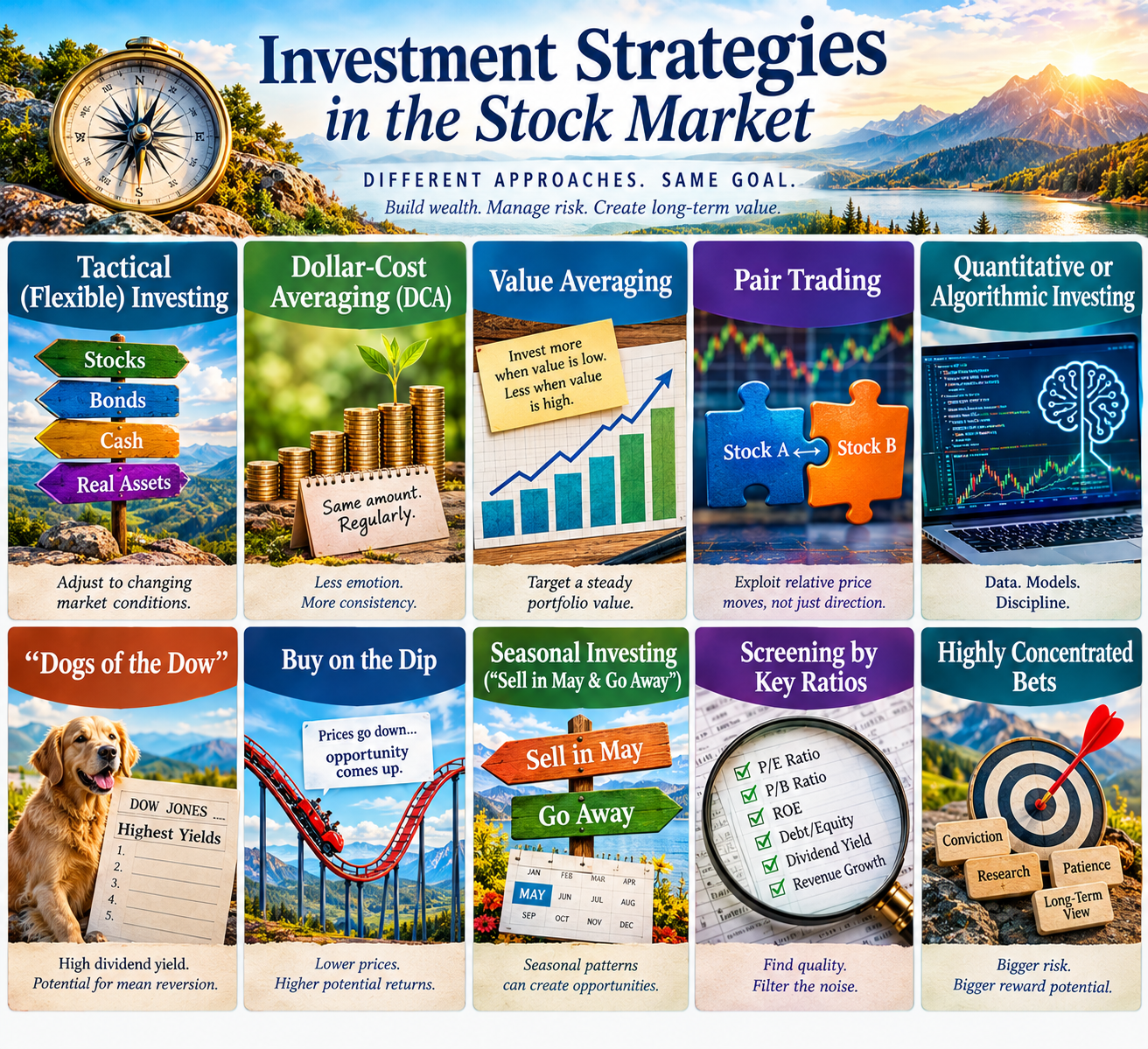
11. Tactical (Flexible) Investing
- What it means: Adjust between stocks, bonds, and cash based on market outlook.
- Why it works: Allows defense during downturns and aggression during upswings.
- Note: Many professional wealth managers use a mild version of this to reduce volatility.
12. Dollar-Cost Averaging (DCA)
- What it means: Invest a set amount of money regularly (like monthly or quarterly), no matter what the market is doing. Most pension funds do just that DCA magic for you.
- Why it works: Strategy smooths out market ups and downs and takes the emotion out of investing.
- Example: A worker investing $500 monthly in an S&P 500 fund over 20 years would have seen consistent growth through booms and busts alike.
13. Value Averaging
- What it means: Adjust how much you invest based on whether your portfolio is above or below a target.
- Why it works: You invest more when prices are low and less when they’re high.
- Note: More complex than Dollar-Cost Averaging (DCA), but powerful strategy for disciplined investors.
14. Pair Trading
- What it means: Buy one stock you think is cheap and sell another that’s expensive within the same industry.
- Why it works: Profits from the difference between the two closing over time.
- Example: Hedge funds often use this technique to stay “market neutral” and leverage the downside risk with the upside potential.
15. Quantitative or Algorithmic Investing
- What it means: Use computer models and data analysis to pick investments automatically.
- Why it works: Removes emotion and applies math to markets.
- Famous example: Renaissance Technologies, led by mathematician Jim Simons, has one of the best long-term track records in history using this investment style.
16. “Dogs of the Dow”
- What it means: Each year, buy the 10 highest-dividend stocks in the Dow Jones Index (30 industrial stocks).
- Why it works: These are often strong companies that have temporarily fallen out of favor. To win with this strategy, the market must move back to favor these 10 stocks.
- Example: This simple strategy has worked surprisingly well over decades, though it’s not foolproof and some short-term investors have abandoned the strategy.
17. Buy on the Dip
- What it means: Add to your holdings when the prices fall temporarily and precipitously below what you consider a fair value for a stock.
- Why it works: You get more shares at lower prices, assuming the stock soon recovers from the dip.
- Examples: Sometimes bad news on one stock can influence and hammer down the price of a company in the same industry or sector, yet it had no bad news to report. These drops are typically short-term in nature; so be ready for the dip. For long-term investors, who bought stocks during the COVID-19 crash of 2020, they saw big gains a few years later, when the pandemic eased (2023). You must be patient and have confidence that the market for your stocks will turn back in your favor.
18. Seasonal Investing (“Sell in May & Go Away”)
- What it means: Some investors leave the market during summer for vacations and travel and return in the fall.
- Why it works: Markets have shown seasonal patterns historically—but not always.
- Note: This strategy may be fun to know what it is (catchy name) and how it works (seasonal stock changes), but it is best used as a light overlay to your stock investing strategy, and not a core investing strategy.
19. Screening by Ratios
- What it means: Use simple measurements like price-to-earnings (PE), return ratios (ROI) or debt ratios (D/E) to find good stocks at reasonable or bargain prices.
- Why it works: Helps sort through thousands of companies efficiently, picking the ones that match your risk appetite and investment profile.
- Tip: Combine several ratios that measure key stock valuations—no single ratio tells the full story of any single company.
20. Concentrated Bets
- What it means: Put a lot of money into just a few companies you really believe in because of its strategy, market, management or momentum.
- Why it works: Big winners can change your life.
- Famous example: Warren Buffett’s early focus on American Express, Coca-Cola, and GEICO turned modest sums into billions.
- Caution: This approach takes deep research and a very strong stomach—one mistake can hurt badly and give you a belly ache.
Footnotes:
How to Build a Balanced Investment Plan
- FIRST: take a risk assessment, to determine your propensity for risk taking or risk aversion. A good one can be found at: University of Missouri Risk Assessment.
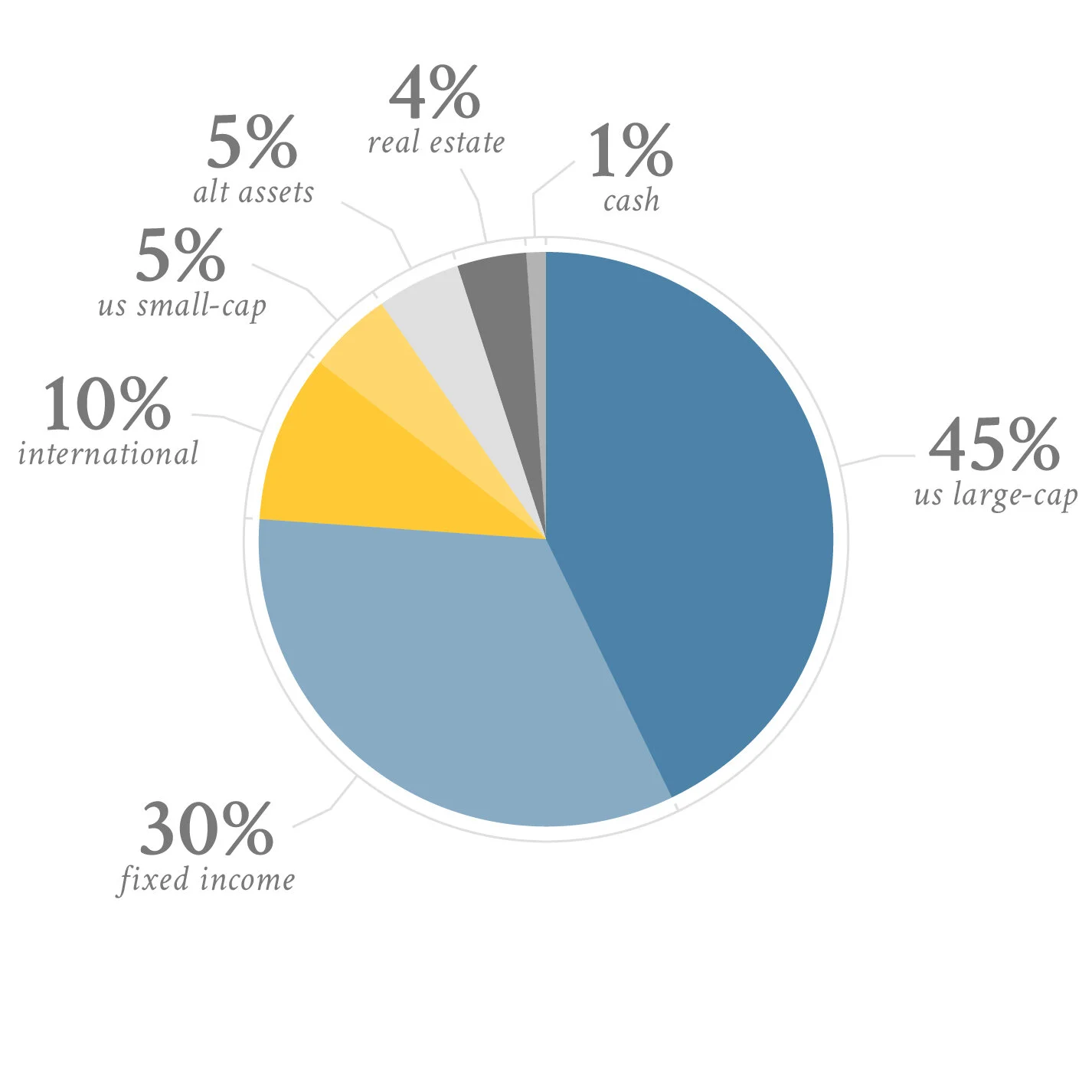
- The strategies above are for that portion of your balance sheet that you expose to THE STOCK MARKET, i.e. small cap, large cap, and international stocks. As the Investment Portfolio by Ferguson Wellman Capital notes in the graphic above, you will also have fixed income (bonds), real estate, alternative investments and, of course, Cash!
- Stay disciplined, review your holdings regularly (quarterly or yearly), and let time do the heavy lifting. Dividends can help with the compounding function of long-term growth.
- Use Indexing, Quality, and Dividend strategies for your foundation and branch out from there, with smaller sums in alternative strategies.
- Add Growth, Thematic, or Value for extra upside, when you have market confidence in your strategies and holdings.
- Sprinkle in Momentum or Contrarian or Value Investing plays carefully, as they can sink your ship in a hurry, if you guess wrong.

