

Friday Finance: House or Stocks?
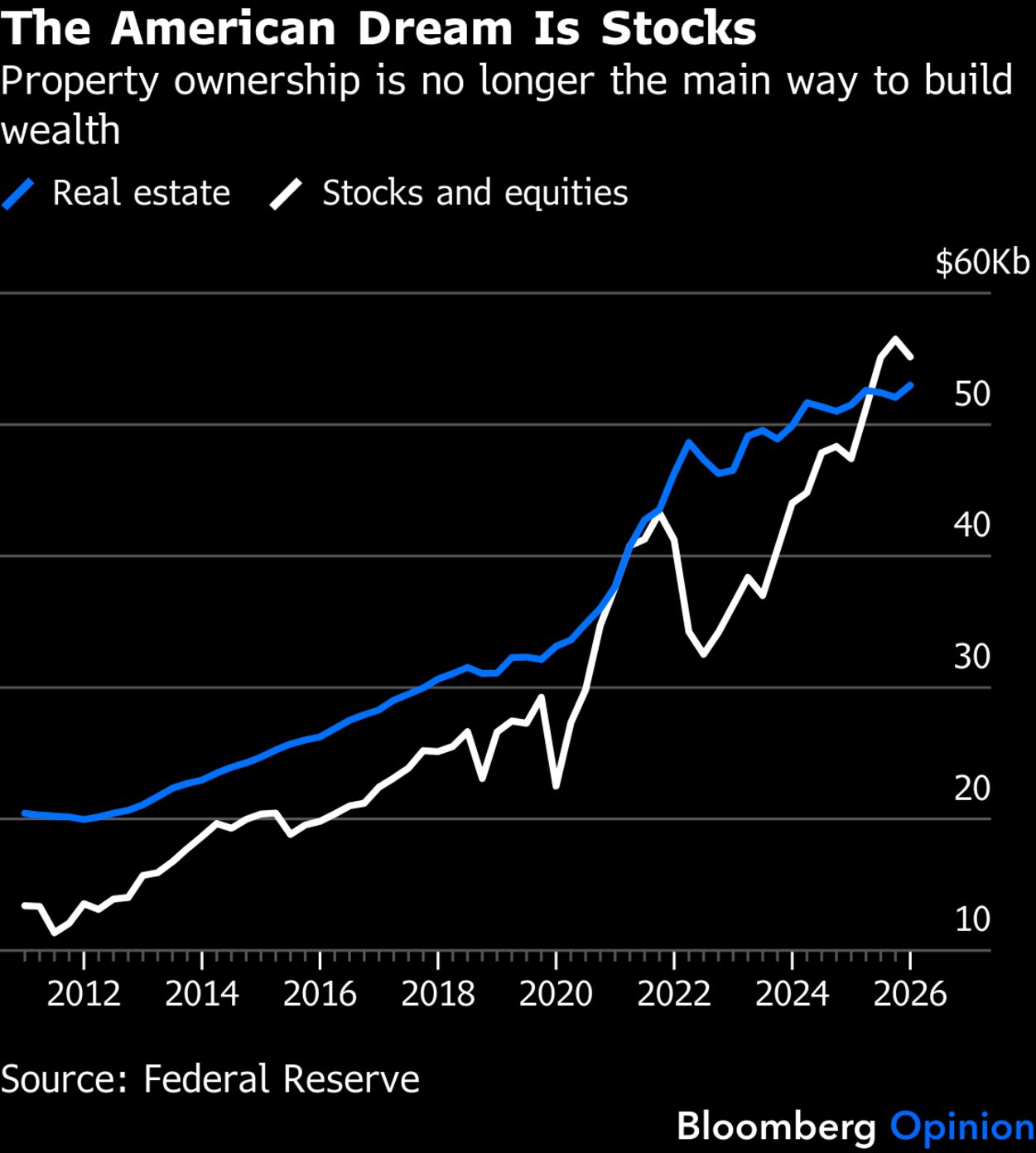
The other day a retired anaesthesiologist in our neighborhood, who is an avid follower, asked if I had any second thoughts on my Friday Finance piece touting mortgages and owning your own home. My posts insisted that home ownership was the best way to accumulate wealth in middle-class America. His observations were that the housing market was faltering, adjustable rate mortgages were rolling off (shooting skyward) and residential real estate prices in desirable cities were out of reach for the next generation. Meanwhile, he noted that the stock market was compounding, the investment business was booming and growth was steady. My knee-jerk reaction was immediate: I quickly dismissed the idea of relegating our adult children to a financial life as renters.
A short time later there appeared an article in the Wall Street Journal by Derek Horstmeyer. (Importantly, the article assumes the client already owns a house and is looking at buying a bigger house or not. Either way, the underlying question is what is the best place to put your next big investment.) Dr. Horstmeyer, a finance professor at George Mason University (GMU), simplified the question as: house vs stocks, which investment has performed the best over the last four decades? The research pointed to facts that undermined my argument and affirmed the wise anaesthesiologist
Here is the GMU finance professor’s argument:
The S&P 500’s annualized returns over the past 40 years top housing-price returns in every state and local market, research finds[1]
By Derek Horstmeyer Nov. 5, 2026

Quick Summary
- Research shows S&P 500 annualized returns over the past 40 years beat housing-price returns in every state and local market on a post-tax basis. View more
Is it better to put more money down to buy a bigger house or invest in the stock market?
That is the question my research assistants (Nandishwar Babu, Ana Manuel and Colby Rood) and I asked ourselves after a multi-decade run-up in both stock and home prices. And we found that even in the best-performing state and local markets over the past 40 years, it would have been better on a post-tax basis to allocate any extra dollars into the stock market and just sit on it instead of buying a larger home.
Our Methodology
To study this issue, we pulled average housing-price data at the state and metropolitan-area levels going back to 1985 from the Federal Housing Finance Agency. From this database we looked at most states and the top 30 metropolitan areas. (We excluded Connecticut, Delaware, Hawaii, Massachusetts, New Jersey and Rhode Island from the state-level research, as these states lacked consistent or sufficient data over the period.)
Next, we considered a hypothetical home buyer in 1985 who was planning to purchase a $100,000 house but had some extra money to spend and was debating whether to buy a more expensive home or put it in the S&P 500. We assumed that the individual put 20% down and financed the rest of the home purchase with a variable-rate mortgage 2 percentage points above the Treasury bill rate, updated monthly. We then calculated the returns this home buyer would have received after accounting for federal, state and local taxes in both options.
To make the comparison fair, all interest paid on the mortgage is subtracted from home-price returns. And all appropriate state and local taxes are applied to the house and mortgage-related expenses. All dividends from the S&P 500 holdings are taxed at the state and federal level according to tax rates at the time. Also, we assume at the end of the study on Dec. 31, 2025, that the home and the S&P fund are sold and then federal long-term capital-gains tax is applied (assuming the highest rate).

One point of NOTE: This research doesn’t reflect the returns an investor-buyer would have received if he or she had used the extra money to buy a home and rent it out as a business.
Horstmeyer’s Teams’ Findings
The top five metropolitan areas in the US over the past 40 years in terms of a post-tax and post-liquidation average annual returns have been Seattle (6.22%), San Diego (6.05%), Los Angeles (5.98%), Miami (5.91%) and San Francisco (5.80%).
Yet, all of these areas have still underperformed the S&P 500, according to our parameters, with an average annual return of 7.57%.
That said, although the S&P 500 did come in with greater average returns, it did demonstrate higher volatility over the period — 16.5% a year versus 9% a year for the average housing return.
On the opposite end of the scale, the five worst-performing metropolitan areas were St. Louis (3.88%), Houston (4.04%), Dallas (4.22%), Cincinnati (4.22%) and Chicago (4.22%).
At the state level, the top five performers were Idaho (5.90%), Arizona (5.89%), Oregon (5.79%), South Dakota (5.50%) and Utah (5.33%). The five worst-performing states were Illinois (2.36%), Kansas (3.13%), Iowa (3.27%), Nebraska (3.31%) and Ohio (3.69%).

Ultimately, the value of a home goes beyond the bottom-line price appreciation in that you have a place to live and make memories. And sometimes there isn’t much choice, say, when you have to relocate for work or buy a bigger home for a growing family. But the results highlight that home-price returns in even the hottest metro areas across the U.S. couldn’t match the stock market over the long run.
Summary: Home vs. Stocks
It is hard to abandon the thought of buying a house (a brick house with a white picket fence, as part of the American dream) and resorting to a lifetime of renting. Yet the facts and the returns reported by the Horstmeyer Team seem indisputable. Another sacred cow (my home is my castle) gored in my lifetime.
$-$-$-$-$-$-$-$-$-$-$-$-$-$-$-$-$
References:
[1] https://www.wsj.com/finance/investing/home-vs-stock-market-investment-6783607f

