
Friday Finance: H-1B Visas, Revisited
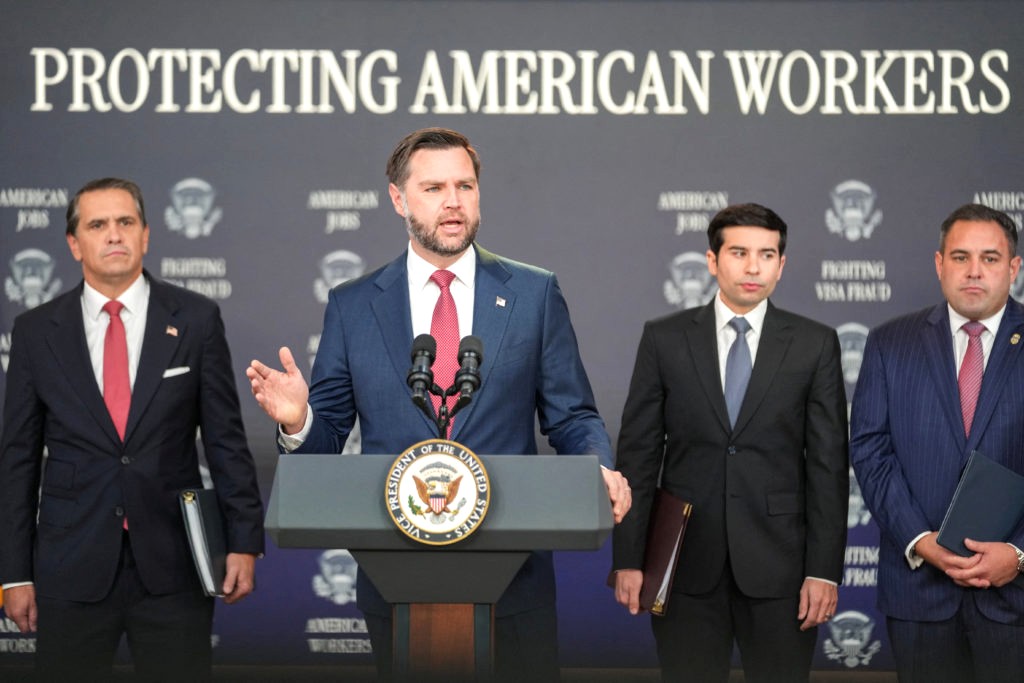
Six years ago I wrote in this space about President Trump’s June 2020 proclamation suspending H-1B, H-2B, H-4, J-1 and L-1 visas in the middle of a pandemic. I called it ludicrous then. I wish I could report that the issue has since been settled. It hasn’t. In his second term the President has gone considerably further, and America’s ability to attract the most talented people in the world is being tested over and over again.[1]
The biggest move came in September 2025, when a presidential proclamation added a $100,000 payment to every new H-1B petition. Until then, sponsoring a worker typically cost an employer a few thousand dollars. The courts have split: A federal judge in Washington upheld the fee in a challenge brought by the U.S. Chamber of Commerce and the Association of American Universities. In June 2026, a federal judge in Boston struck it down as a tax Congress never authorized, and the appeals court there declined to reinstate it. For now the fee is blocked while appeals continue. The administration isn’t waiting for the outcome. It has proposed a separate, permanent fee of $103,265 per petition through the regulatory process.
It’s More Than About Fees
The fee per petition is only part of the story. The random lottery that once handed out the 85,000 annual H-1B slots has been replaced by a weighted system that favors higher salaries. The Labor Department has proposed sharply raising the minimum wages sponsors must pay. A September 2026, Trump’s executive order requires agencies to consider whether a sponsoring employer has recently laid-off American workers. Homeland Security has proposed ending the 60-day grace period that lets a laid-off H-1B worker find a new job, before having to leave the country. It has also stopped automatically extending work permits for H-1B spouses and is weighing whether to take away their right to work altogether.
The effects are already showing. The Congressional Research Service found that in the eight months after the $100,000 fee took effect, new H-1B petitions from cap-exempt employers for workers abroad fell by 91.2% from the year before. Cap-exempt employers are universities, research institutions and nonprofit hospitals. They are not the outsourcing firms these policies were supposedly aimed at.[2] On the other side of the equation, it should be noted that the new Visa costs have added an estimated $70 million to the Homeland Security budget in the last year.[3]
In fairness, the program’s critics have raised real problems. A few large outsourcing firms have long flooded the lottery with registrations, and some employers have used entry-level wages to undercut American workers. Favoring higher-skilled, higher-paid roles and cracking down on fraud are reasonable goals, and some of the reforms do serve them. If the administration had stopped there, I might be writing a different column. Support for skilled immigration has never belonged to one party. Business leaders on both sides of the aisle, including some of President Trump’s own allies, have defended the H-1B program as essential to American competitiveness.
But a six-figure fee and a growing pile of new hurdles can’t tell the difference between a staffing mill and a cancer research lab. They make it harder for a rural hospital to hire a physician, for a school district to fill a math or science classroom, and for a startup to hire the engineer who will go on to create the next hundred American jobs. Other countries are glad to welcome the talent we turn away, and when those people build companies, publish breakthroughs and pay taxes, they will do it somewhere else.
My frustration here comes partly from experience. In 2006, one of the country’s top immigration law firms helped us secure a visa so we could recruit a gifted academic from Oxford University to join our firm in the Northwest. To call him anything less than remarkable would be a mistake. Even so, getting him into the country to work was extraordinarily difficult, and that was under rules far friendlier than today’s. His name is Peter Johnson. Few people on the planet have more experience in his field, and he holds three master’s degrees and a doctorate from Oxford and Stanford. His full pre-hire bio is below. I often wonder how many Peters we are losing right now because the major shifts in policy.
Join the business leaders, universities, hospitals, teachers and state attorneys general who are pushing back. We need diversity, global understanding and the best minds the world has to offer more than ever. Lend your voice to this cause.
[2] The 91% decline in petitions comes from the Homeland Security statistics from Sept. 21, 2025, through May 24, 2026, compared to the same period the previous year. From 13,823 petitions last year, fell to 1,212 this year, a drop of 91.2%.[3] The proclamation dates from September 19, 2025, and a coalition of 20 states filed suit against it. In December 2025, a federal district court in Washington, D.C., upheld the fee requirement in a lawsuit brought by the U.S. Chamber of Commerce and the Association of American Universities. Judge Leo Sorokin later struck down the fee imposed on new H-1B visa petitions, ruling it was an unauthorized tax that Congress never approved, and a federal appeals court in Boston declined to overturn that ruling. As of November 1, the $100,000 fee is still blocked and not collected, with three appeals pending. The earlier cost of sponsorship was $2,000-$5,000. The weighted lottery, the wage proposal, the September 2026 executive order, the grace-period proposal, the changes for spouses and the 91% drop in petitions all come from the Congressional Research Service’s October 2026 summary. federal court invalidates 100k h 1b fee +6
[3] First things first, it must be noted that 1,212 is the number of petitions employers filed. However, not all of the people who petitioned actually entered the country. Some petitions were denied, withdrawn, or never led to someone arriving. Second, not every filer paid the $100K fee. Some petitions qualified for exceptions, and the fee has been blocked by the courts since June. The best figure on actual payments comes from the administration. Its September 2026 proclamation says that since September 21, 2025, “the $100,000 payment has been made for over 700 petitions.” That puts actual collections at a little over $70 million, not $121 million. regulations
As a share of the Homeland Security budget, the fee money is tiny either way. It depends which budget figure you use:
- Regular annual funding: the Fiscal Year 2026 Homeland Security Appropriations Act provides $64.4 billion in total discretionary funding. senate
- $70 million would be about 0.11%.
- Total budget, including mandatory and disaster money: the latest full figure I found is the administration’s FY2027 request, $118.39 billion in total budget authority for the Department of Homeland Security. everycrsreport
- $70 million would be about 0.06%.
Both figures leave out the much larger multi-year funding Congress passed in 2025, which included $178 billion in funding for DHS. Counting that would make the percentages even smaller. congress
So the fee collected roughly one or two tenths of one percent of the department’s annual funding, while new petitions for workers abroad dropped by 91.2%.

