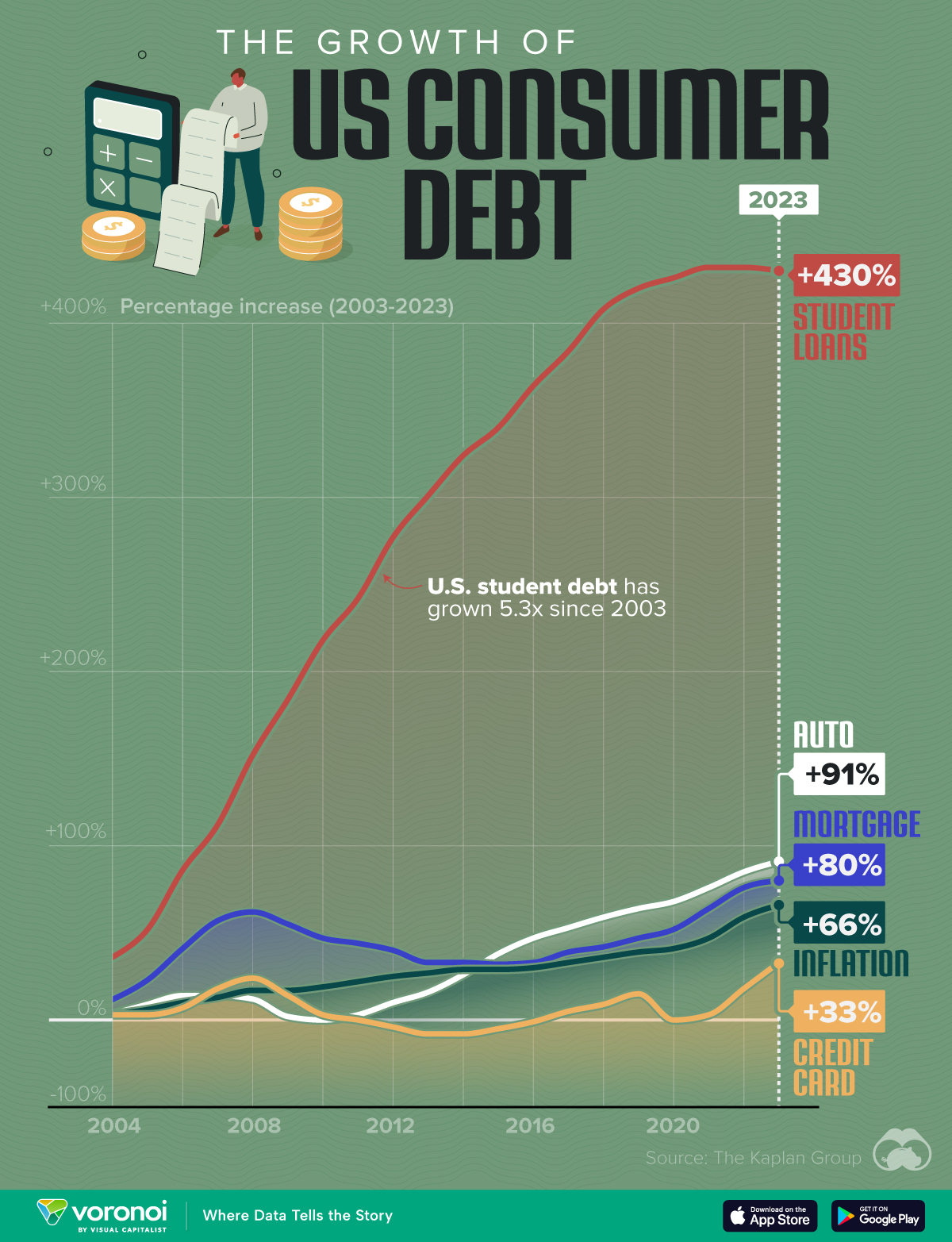
Using the latest available household-debt data, the top five largest U.S. household debt categories are: Home mortgages, Auto loans, Student loans, Credit Cards, and “Other” consumer debt. The approximate balances in these consumer categories are listed on the table below. Overall, the Federal Reserve’s household-credit data puts household debt at roughly $18.8 trillion, with the four separately identified categories below accounting for the overwhelming majority and “Other consumer debt” finishing a smaller fifth place (with about 0.3%) in the debt category.
The outstanding balances listed below, are approximate figures, as of March 31, 2026. Household state and federal taxes and unpaid medical debts are certainly part of the consumer debt picture; however, they are not all strictly comparable categories — their sums are tracked differently from the major Federal Reserve household-credit categories.
The ranking
Rank
Category
Approx. balance
What it represents
1
Mortgages
$13.2T (~70.2%)
Home financing
2
Auto loans
$1.7T (~9%)
Vehicle financing
3
Student loans
$1.7T (~9%)
Education financing
4
Credit cards
$1.25T (~6.7%)
Revolving consumer debt
5
Other consumer debt
~$0.56T (0.3%)
Retail credit, personal / consumer finance loans and other debt categories
But here’s the really interesting part for the Friday Finance piece
I wouldn’t actually call “other consumer debt” the fifth category in the article. I’d use the fifth slot to introduce the idea that the Federal Reserve’s neat categories don’t capture the way people actually experience debt.
For example, medical debt is enormous in human terms, but that category doesn’t have a clean Fed household-debt bucket comparable to mortgage loans or auto loans. The CFPB estimates roughly $88 billion of medical bills are currently in collections, while newer research finds that 36% of U.S. households had some medical debt in 2024.
And then there are tax debts, personal loans, BNPL (Buy Now Pay Later loans), payday loans, family loans, legal judgments, alimony and child support. These forms of debt can be financially lethal, and none of them fit neatly into that top-four Federal Reserve framework.
And I’d make taxes a special case, rather than a fifth category. Excluding state and municipality taxes, the IRS reported collecting $117.5 billion in unpaid Federal assessments in FY2025, but that’s collections during a year, not the total amount of household tax debt outstanding, so it would be misleading to put a “$117.5 billion tax-debt” slice next to the other balances.
In general, consumers have four giant debt mountains: mortgage loans, auto loans, student loans and credit card debt.
And then a landscape of smaller hills that can sometimes be more dangerous: medical bills, taxes, payday loans, personal loans, BNPL, divorce obligations and other debts. Even with some payday loans gouging customers for up to 400% interest, there are not as many using that category as I first imagined. And don’t forget about inflation, and interest charges…they can eat away at any nest egg in a hurry.
The surprising lesson is that the biggest debt isn’t necessarily the debt you should pay off first. Pay off the highest interest rate debt first and then go down the line to the next highest interest rate. In the process develop a plan of paying off the next “most painful” debts (like past due taxes), which have interest charges and penalties that can eat you up and cause you to lose sleep.
Start a solid plan and get that well-earned sleep you deserve!