

Bitterroot (Lewisia rediviva) in bloom
Flowers: Bitterroot (Lewisia rediviva)
Hiking the south facing slopes of the Columbia Gorge in southwest Washington, we came upon some remarkably beautiful flowers. The sign nearby indicated that the stark basalt cliffs were populated with bitterroot. It was May along the Columbia River that 2024 Mother’s Day and the sun shone with particular intensity.
The hike to Catherine Creek was just what the doctor ordered: with the sound of Western Meadowlarks among the trees, we walked up the rocky trail and headed north to get a vantage point back south of the Columbia River toward Mount Hood, snow covered on the horizon. We felt it was time to look into this small white flower that was captivating our attention.

Western Meadow Lark, state bird of Oregon (Sturnella neglecta)
Wander the high country of Montana in late May or early June and you may see a striking pale pink flower. Few plants can rival the lovely bloom of this low growing plant, a blossom that ranges from deep rose to almost white. In 1895, inspired by its beauty, the people of Montana named this plant as their state flower.

The bitterroot seems to grow right out of the rocks
Ninety years earlier than the Montana moniker, the Lewis & Clark Expedition first encountered the bitterroot plant. At that time, in late August of 1805, instead of admiring the flower, Meriwether Lewis spotted the plant and tasted the root. Writing in his famous journal, Lewis described the root as “cilindric and as white as snow throughout, except some small parts of the hard black rind which they had not seperated in the preperation… [the roots] became perfectly soft by boiling, but had a very bitter taste, which was naucious to my pallate, and [I] transfered them to the Indians who had eat them heartily.” Given this description, Lewis might have vigorously endorsed the common name of this plant: bitterroot.
Although Meriwether Lewis little relished it, the Shoshone, his hosts in August of 1805, thoroughly enjoyed the boiled root of this flower. Each year, before the plant flowered, American Indians collected this important food source, which grows from California to Montana, and from British Columbia to Arizona. Along the trail, the Northern Shoshone, Flathead, and Nez Perce Native Tribes harvested the bitterroot. Many other tribes throughout the bitterroot’s range also collected and traded this highly valued plant.
Despite the powerful effect it had on Lewis’s tastebuds, the bitterroot received very little attention in the Expedition journals. Nearly a year after his first taste of bitterroot, Lewis again encountered the plant. In early July of 1806, at Traveler’s Rest in western Montana, Lewis collected a bitterroot plant, and three other species of plants. He added the plants to the collection he would present to President Thomas Jefferson. His only record of this encounter with the bitterroot notes that, “I found several other uncommon plants specemines of which I preserved.”

Mount Hood (also known as Wy’east) framed by pine trees and oaks
Upon the Expedition’s return to the East Coast, the bitterroot became one of 134 plant specimens presented to Frederick Pursh [1] for analysis and identification. Pursh catalogued the plants and gave the flowering root its scientific name, Lewisia rediviva. The name commemorates Meriwether Lewis’s role in bringing the plant to the attention of western science and describing the plant’s apparent ability to return to life, as if reviving from the dead. In his Flora Americae Septentrionalis, Pursh noted that the specimen Lewis carried from Montana, deprived of water and soil for several years, had been planted. Although no flower blossomed, Lewis’s bitterroot had “vegetated for more than one year.” Rediviva, a Latin word, translates to “brought back to life.”
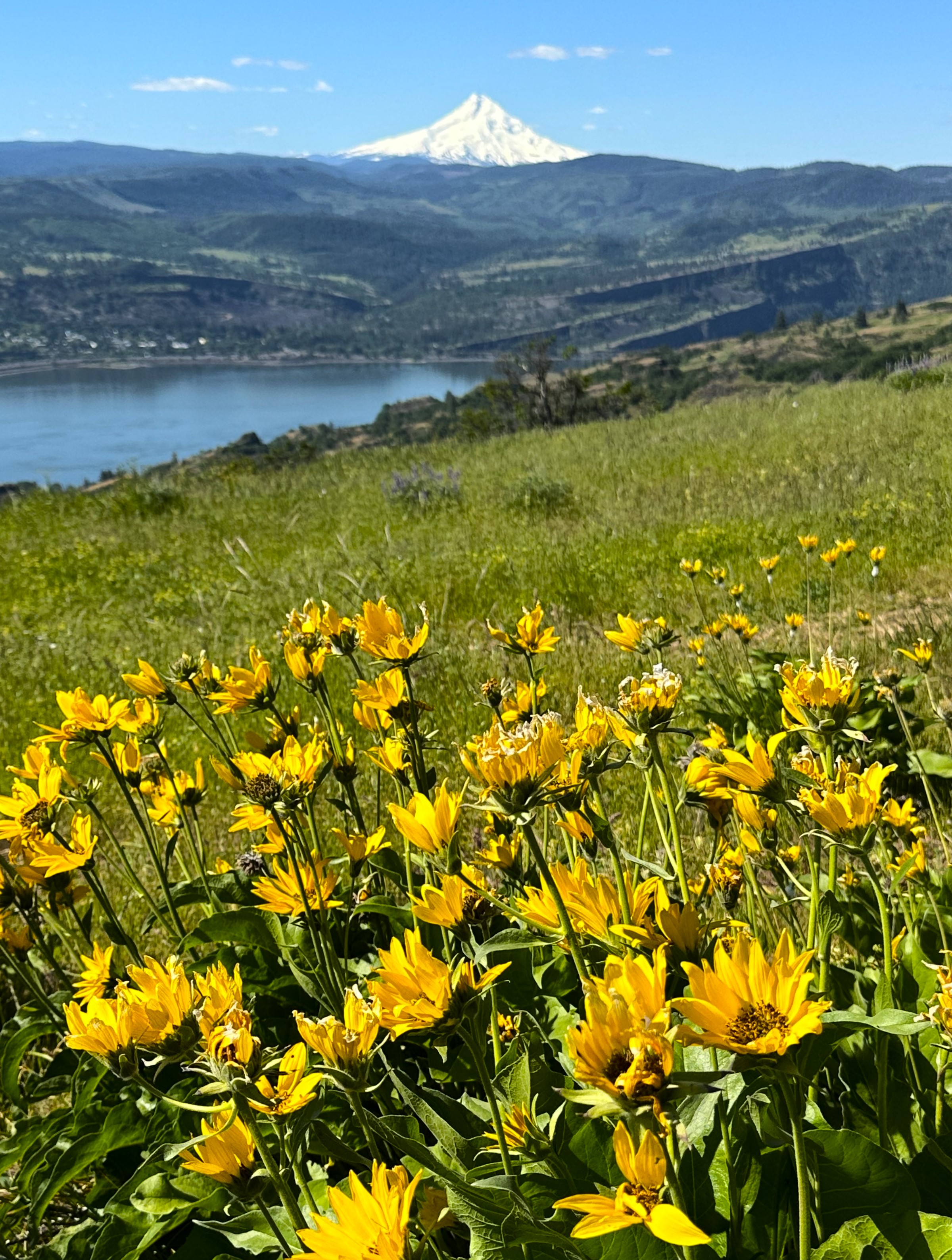
Balsam Root blooms below picture of Wy’east
Also named after this small flowering plant are the Bitterroot Mountains, the Bitterroot River and the Valley it carves. The Northern and Central Bitterroot Range, collectively the Bitterroot Mountains (Salish: čkʷlkʷqin), is the largest portion of the Bitterroot Range, part of the Rocky Mountains and Idaho Batholith, located in the panhandle of Idaho and westernmost Montana in the northwestern United States. The mountains encompass an area of 4,862 square miles (12,593 km2). [2]
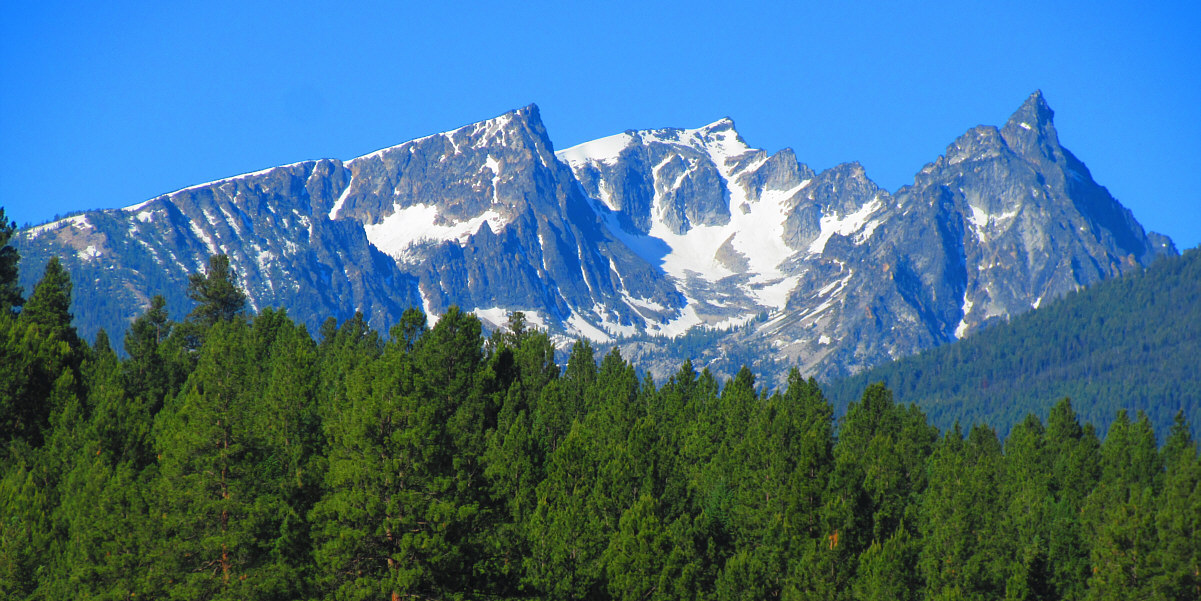
Trapper Peak Montana (10,157 feet)
The Bitterroot Mountains are bordered on the north by Lolo Creek, to the northeast by the Clark Fork, named for William Clark, on the south by the Salmon River, on the east by the Bitterroot River and Valley, and on the west by the Selway and Lochsa Rivers. Its highest summit in the mountains is Trapper Peak, at 10,157 feet (3,096 meters).[2]
References:
[1] Meriwether Lewis and Frederick Pursh (1774-1820) met in Philadelphia by mid-April of 1807 and Pursh was employed to prepare a catalogue of the expedition’s plants. Receiving $60 from Lewis to begin the work, apparently Pursh first did a series of drawings with Lewis reviewing the results. Clearly the two men talked about the overall aspect of some of the species, but Lewis’s time was limited and Pursh was scheduled to leave at the end of April on his second collecting trip under Barton’s patronage. Only limited progress on the plants was made at that time.
During the winter of 1807-1808, Pursh lived in Philadelphia. He worked on the drawings and descriptions of Lewis’s western plants. By the end of May 1808, Pursh had completed the initial work and was anxious to see his report—or at least the new species—published. Pursh was also anxious to be paid for his labors.
The death of Lewis on October 18, 1809, was soon made known to Pursh. There is indirect evidence that, by this date, Pursh had completed his study of whole of the Lewis and Clark plant collection. Due to Pursh’s work, there are now 19 species in the genus Lewisia.
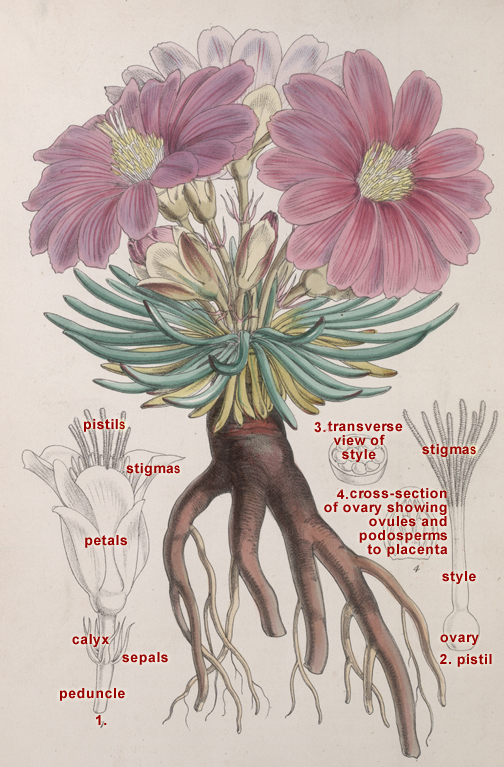
Bitterroot from Missouri Botanical Garden, P. H. Raven Library, via Biodiversity Heritage Library
 Henry E. Hooper