
Final Lecture: Economics of Abundance[1]
Teachers? How many times have we heard a parent say, “Thank you for caring for my son….You helped my child love coming to school….You’re the best teacher my daughter has ever had.”
And, how often have you looked at your paycheck and thought, “Wow, that’s not enough money for all of those the lesson plans I created, the patience I needed, and the constant grading I put in on weekends.”
So, what can we do about it? Complain? Get an advanced degree? Become a master teacher? Find a new career?
No! Instead, let’s exploit an Ancient Economics Lesson to level the tilted financial playing field.
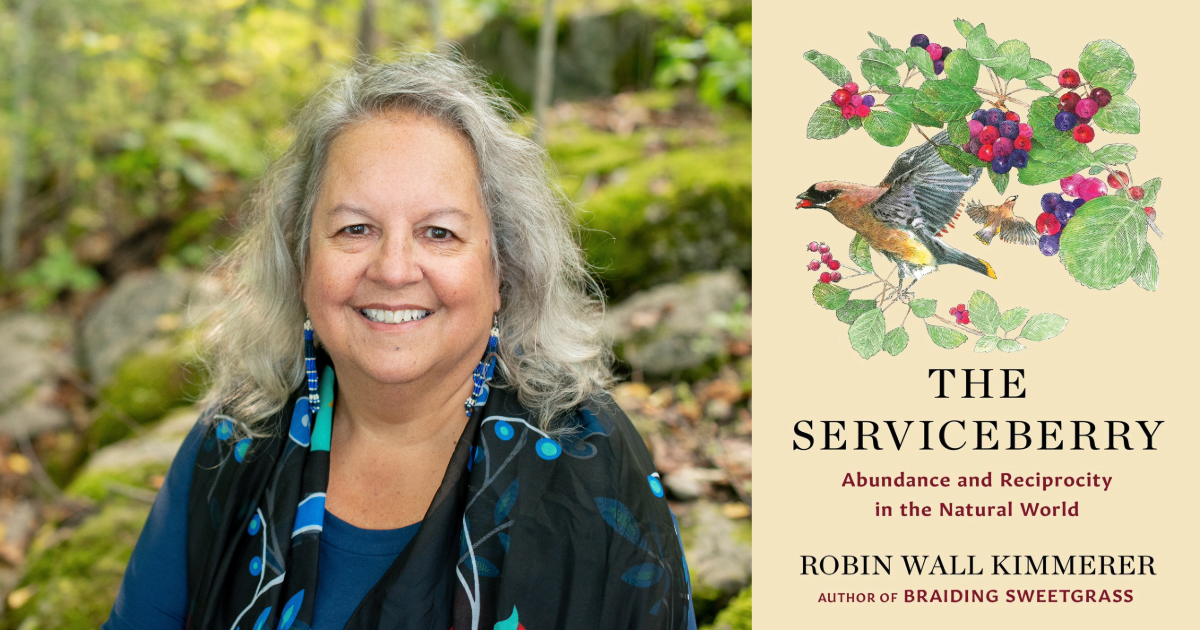
Lori Lieberman loaned me a book from our Library called The Serviceberry by Robin Wall Kimmerer. It ruminates about “service economies.” The prescient subtitle is Lessons about Abundance and Reciprocity in the Natural World. Most of these Kimmerer lessons originate from Native American cultures in the U.S and Canada. Kimmerer also wrote the book, Braiding Sweetgrass, which I loved. So a few Sundays ago, I read the pocket-sized Serviceberry book. And I started thinking…
Yes, the “Rule of the Commons” led directly to the “Tragedy of the Commons” and the arrival of “cut-throat Capitalism” in America: The greedy farmer allowed his goats to graze on “The Commons” because it was public property, after all. However, his goats ate the grass and shrubs so close to the ground, it was not able to sustain any more grass or plants. As a result, The Commons turned to a mud pit, unfit for everyone.
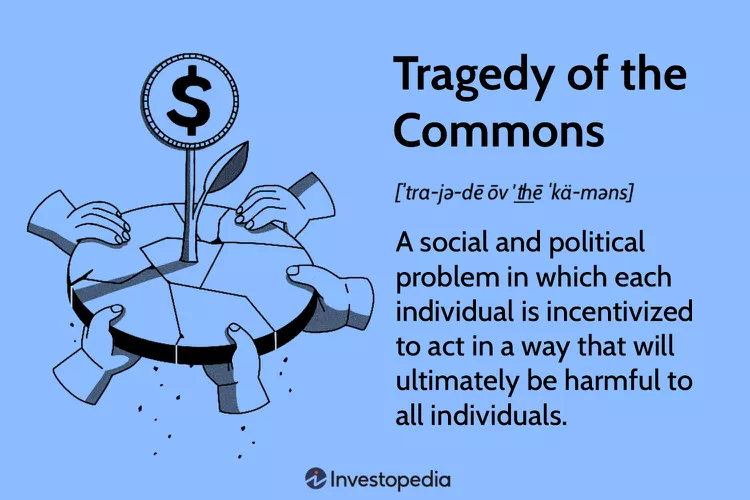
Obviously, the solution was to replace public squares with private property to prevent such bad behavior in the future. Right?
In the U.S., we ended up with a “mixed economy – a little “voluntary capitalism”; a little “socialism”, and a lot of “greed.”
For Americans, our “average” tax rate is just under 25%. But, we are really better off than most economies in the world, aren’t we?
There are many “social democracies” out there. Finland, for example, has a tax rate of 43% – carving out nearly half of everyone’s take home pay.

The Finnish economy includes:
- free universal health care,
- free education for all,
- elder care,
- family support
- and government investments in stability.
Six years ago, Fred Fox, David Valenzuela, Jason Trembley, Peyton Chapman, Hanisi Accetta, Jo Anne Wadkins, six Lincoln students and I spent our spring break in Helsinki, Finland as we dreamed and planned for the new design of Lincoln High School and other PPS buildings. Our LHS building professionals from Bora Architects traveled with us, too.
We wanted to discover the secrets of Finland. Here are three headlines worth contemplating:
- Finland is among the happiest countries on the planet
- With one of the coldest climates
- And it has among the highest PISA test scores in the world — (while the U.S. lags legions behind)

As a political region, Finland seemed more socialist than capitalist… yet they embraced what Americans called “cuddly capitalism” with socialist leanings. That trip to Finland was a revelation to all of us:
- We met happy teachers
- Highly capable administrators
- And extraordinary students, who spoke three languages fluently and controlled learning at their own pace.
At lunch one day, Alexi Halco, a Finnish business teacher, sat with me in the lunchroom to talk about the country and the school system. Meanwhile, students had cooked and served our hot meal, cleared and wiped the tables, washed the utensils and dishes and then headed to class. Alexi told me, “I’m 6 months away from retirement and, financially, I’m set for life … it’s been a great run!” Then, matter-of-factly, he said, “I’ve got to go. For the last 20 minutes, my marketing class has been working on a group project in my classroom.”
I looked at Alexi in shock: “By now, without you in the classroom, don’t you think they’ve all skipped out?”
“Heavens NO,” he assured me. “They know what they are doing: they’re fine on their own.”
I wondered, “Could we ever do THAT at Lincoln?”
The Finnish schools seemed drawn together by the shared desire to be better citizens with enormous curiosity. No matter what the weather! (By the way, the temperature outside, during our week-long visit, in late March, never got above freezing.)
Capitalism, it seems, is not the only way out of America’s “teachers-making-barely-enough” problem.

Economist Elinor Ostrom, the Nobel laureate, writes about the “socialist” view of property, water and food as common sources of abundance. In the economy around The Great Lakes region, for example, everyone has shared access to resources and the quantities they receive meet their needs. It’s not a free-for-all, but a sharing with mutually agreed upon obligations and agreements.
The lands around The Great Lakes, both in the U.S. and Canada, have ample hunting grounds, fish resources, and clean water for all: individuals and nations. Called “The Dish with One Spoon Treaty,” Ostrom points to the treaty as a hallmark of the agreements with disparate players and mutual care resulting in “superior” outcomes (no pun intended)!

What does that Treaty have to do with us here today? You may say, “As Oregonians, we don’t have international waterways nor any confounding water rights to navigate; however, we do have concerns for our planet, our waterways, our snowmelt, our ocean, our tsunami zones, our shorelines. And, more immediately, concerns about inflation and tariffs.
Canadian, European, and Mexican tariffs are making grocery shopping and every other consumable, increasingly expensive. Complaining doesn’t help. However, WE HAVE AGENCY: we can take other steps to withstand the tariffs and keep going. If we keep our goals modest, attach appropriate guardrails, and win: we can make a financial difference in our own community of teachers and staff.
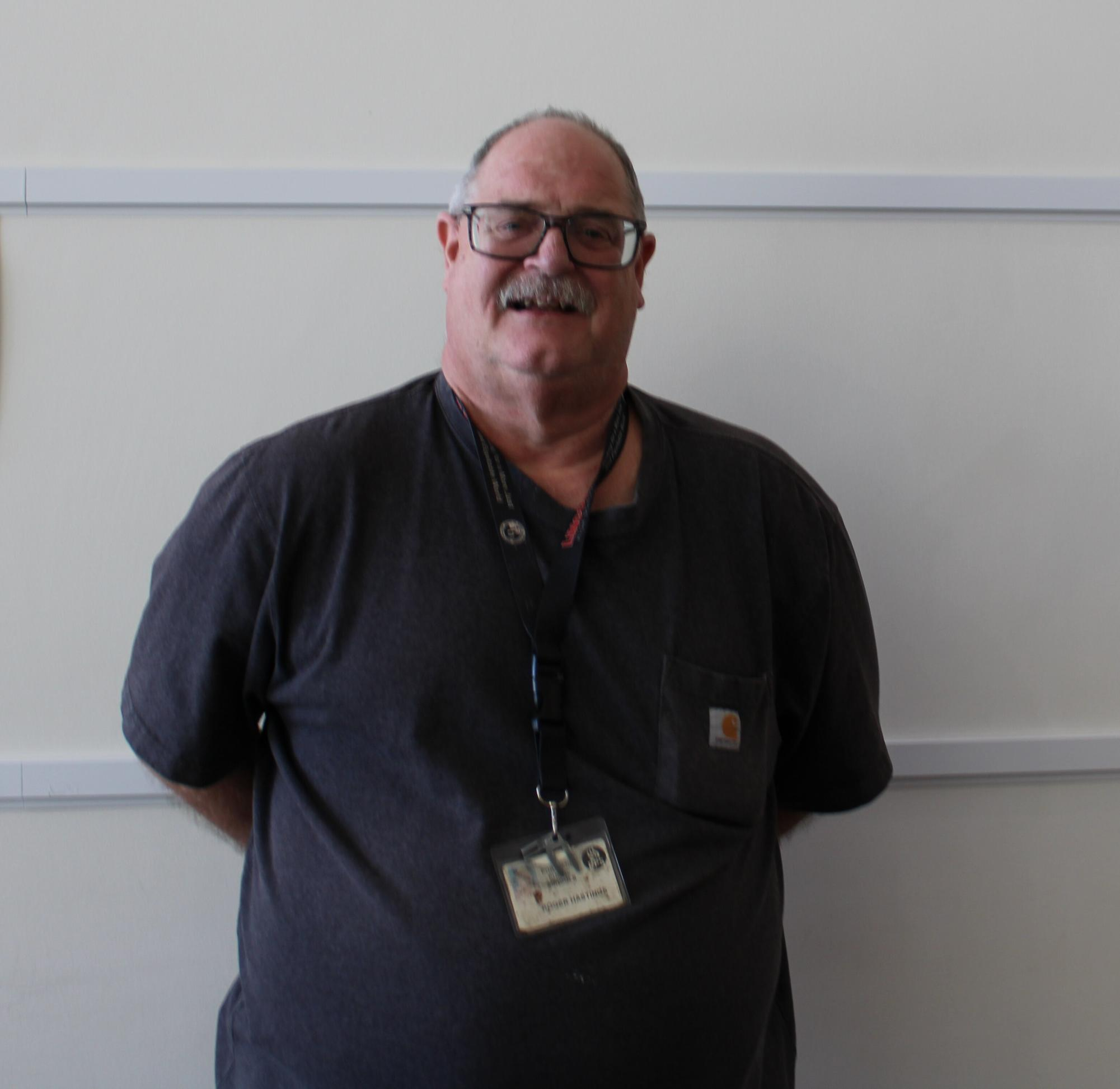
Roger Hastings, our Lincoln Custodial Leader, is part of the “sharing economy.” Last fall, he brought in an overflowing box of squash, potatoes, carrots, and basil. Any teacher, any staff, any admin could take what they wanted, because Roger had an ample supply. He and his wife generously shared their riches with us, before the vegetables spoiled.
Lauren Boubel sends messages about extra loaves of her homemade challah bread. She leaves them in the Staff Lounge for us.
Chef Hammer has some extra Caesar salads that she wants collected from her refrigerator.
Do you see it?

Lori Lieberman hands out free books for the teachers. Romance novels, dystopian fiction, text books. They’re all yours.
About five years ago, Steve Runyon gave away his ties (He gifted me 8 of his worst…I mean 8 of his best!), because he said, “I won’t need them in retirement.”
Ron Waugh gathered all of the Wall Street Journals for Addy Kessler to mold into plaster a-paris for art projects.
Imagine some other small economies that could spring up:
Patrick McGee-Jenks makes a belt from his leather shop and gives it to a student without one.
Jim Peerenboom hands out extra flowers from his garden on display for the taking.
Peyton Chapman offers fresh eggs laid in her chicken coop for your favorite omelet.

Do you hear it?
Frank Petrik and his guitar & brass players perform jazz for us in The Commons.
Mary Rechner writes us a love story that she reads to us at Powell’s Books with her loyal Lincoln friends cheering her on and Emily Hensley offers a kind critique.
Jordan Suderman holds a silent movie night, with subtitles and lots of mystery.
Lisa Riffel conducts her a cappella choir as they sing in our hallways and it sounds beautiful and incredibly resonant.

Can you taste it?
Helen Yoon brings in some surplus zucchini from her garden and Dardn Thomsen shares her sweet cherry tomatoes, because, you know, a NW harvest produces pounds of extra zucchini and too-many tomatoes!
Jill Ross brings over bottles of her “big reds” from Rossini Winery in SE Portland to celebrate our “sharing economy.”
So that NO ONE feels left out, what would YOU bring to the harvest?
We are part of a unique community. The rules of scarcity and privatization do not need to apply here at Lincoln.
We can live in a world of abundance. We have it right here at Lincoln High School.
I invite you to think of our Lincoln community, and other small, caring communities, as “incubators.” The rules on generosity are not dictated to us.
We can set them up as we see fit.

Consider the following examples of our own Shared Economy:
- Writing Seminars with Jordan Gutlerner and AJ Elliott
- Language Lessons with Trevor Todd, Ruqayya Jarad, and Doug Segal
- Cooking Classes with Chef Melanie Hammerickson and Dr. Rion Roberts
- Pottery & Visual Art Lessons with Coren Rau and Hope Ferns
- Biking Lessons with Mark Halpern and Andy Duggan
- Swimming Lessons with Kara Wendel and CJ Watson
- Technology Tips with Nathan Watson and Erin Mahoney
- Parenting Advice from Chris Brida and Ellie Voulevet
- Finance Lessons with Kim Worsham and Chuck Slusher
- Science Lessons with Maggie Raczek, Laura Lisensky and Angie McVey
- Photography & Instagram Posting Lessons with Beth Bundy and Peyton Chapman
- Running Tips with Maureen Kenny and Ken ¨Old Growth¨ Weinberg
- History Lessons with Dr. Rebecca Eisenberg and Chris Buehler
- First Aid & Yoga Instruction with Steve Scoville and Erin Burke
- Negotiation Tips with Steve Lancaster and Joe Sneed
- Dance Lessons with Tracie & Frank Talerico.
Your talents are endless. Just look at the unique skills of you, our teachers, administrators, and staff. So…. where do we start?
Returning to the importance of food for our bodies, let’s start there.
In many ways, it comes down to what the Native American tribes call the Honorable Harvest.
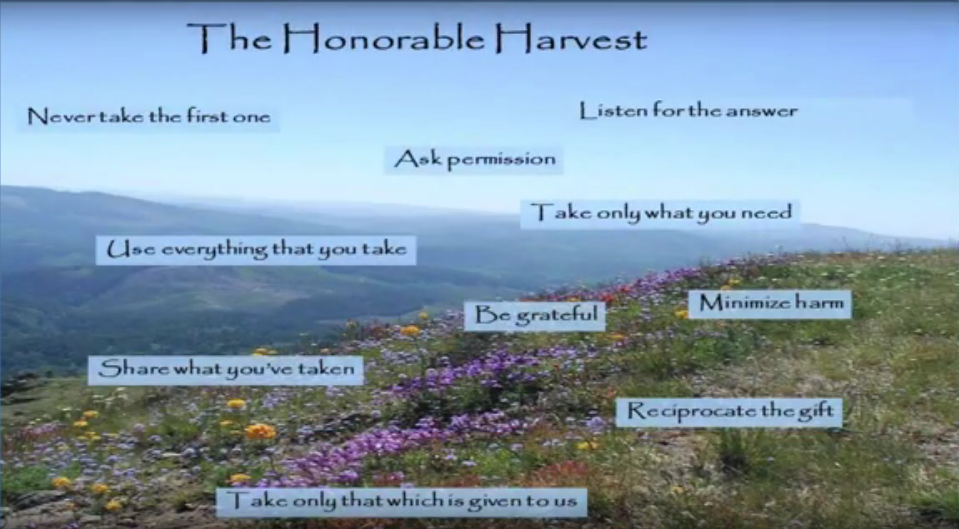
This is a harvest where humans agree to share the gift of their lives to sustain the lives of others.
In return, the people agree to protocols of restraint, respect and reciprocity.
Here are The guidelines of the Honorable Harvest. In a hand-out are offered at each table today.
The Honorable Harvest sets up ways to celebrate every mouthful.
DO use technology that minimizes harm.
DO take what is given. The philosophy of the sharing economy guides us, not only, our taking & giving of food, but also, taking & giving the gifts of the planet: air, water, and the literal body of the earth: the rocks, the soil, the fossil fuels, the energy that lies within our grasp.
Those economic lessons can last a lifetime and beyond.
In closing, I am deeply grateful to the Custodial professionals (Carl Miller, Wednesday, Charles, Roger Hastings, Samer, Brandon, Sabrina, Destiny, Deanna and Rebecca) for your actions to keep our school & campus clean.
I applaud the Campus Security team (Laura Farnsworth, Von, Lilly and Shalako) for your vigilant help with the troubled students.
Letś recognize the Para-Professionals (Andrew Porter, Jack, Jacob, Crystal, Alexis, Araxi Sevan, Taylor, Kelsi and Sabrina) for all you do for the “special needs “ students.
And the Guidance counselors (Shannan Fasold and Aliera, Daniella, Teresa, Edwina, Nadia, Judy, Siri, Dr. Mel, Alex, Greg, Linnea, Claire, Meredith, Audrey, and Cathy) for your vital commitments to our Cardinal students and families.
We include the always-helpful Support staff (Helen Yoon, Anita, Sue Denton, Julie, Rachel, Rainey, and Elizabeth) who are perpetually positive & welcoming to all who enter our school, and to Nurses Mary and Jennifer, for taking care of our vulnerable immediate need students.
And finally the Administrative team: (Kim Bliss, Emily, Travis, Maude, Steve, Matt Wiles, Jill Ross and of course, my “best boss ever,” Peyton Chapman) for your support of the rest of us at Lincoln.
THANK YOU!
I have a collection of Steve Runyonś and my best and worst ties on a table over there for anyone who wants one or two as souvenirs and mementoes of our shared economy. (Several teachers picked them up and mentioned they would make good lanyards. Great idea!)
Sources:
[1] This Final Economics Lecture was delivered by Henry Hooper to the faculty and staff at Lincoln High School, Portland, Oregon on Friday June 13, 2025.
 Henry E. Hooper