
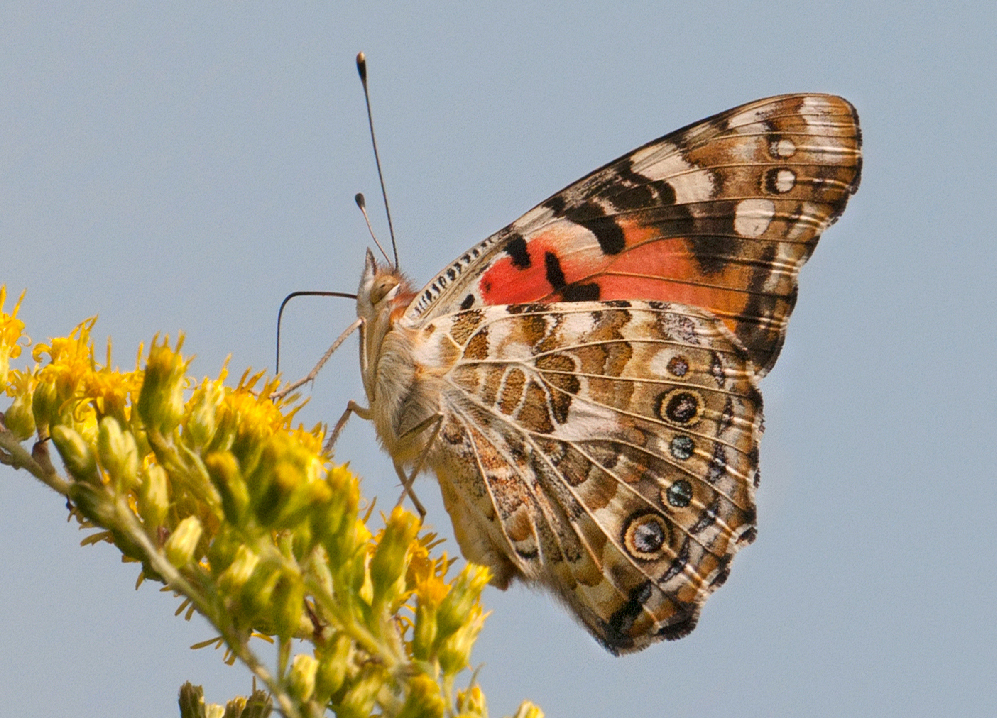
Butterflies: Painted Lady
Indentifying this beautiful butterfly in our garden made all of the flower planting and weed pulling worth the time and back aches it demanded. The real point of course is that we grow these gardens not only for ourselves, but also for the birds, butterflies, bees and other creatures who need these oases. The flowering gardens allow them to thrive, when they arrive in our yards. We rarely take note of the challenges that these flying animals and insects may have undertaken to get to our neighborhoods.
Most of us nature lovers are familiar with the migration feats of the Monarch butterflies (Danaus plexippus). They are well documented in the forests of South America and in the US. As a point of note about insects in the order Lepidoptera, the monarch is not the only butterfly that migrates great distances. There is another butterfly, the Painted Lady (Vanessa cardui), that boasts the world’s farthest migratory route, undertaking a phenomenal 9,000 mile (10,000 km) round trip from tropical Africa to the Arctic Circle and back.[1] NOTE: this Butterfly Post leans heavily on the research and findings on ButterflyLady.com.
One of the interesting Painted Lady butterfly facts is that it can reach a flight speed of up to 30 miles per hour, allowing it to travel up to 100 miles per day during its migration.

The Painted Lady is found on every continent except Antarctica and Australia, making it one of the most cosmopolitan insect species in the world. Some of the reasons for its widespread distribution include a wide variety of plants it feeds and lays eggs on, the ability to migrate to avoid winter, and its capacity for continuously reproducing.

Painted Lady larvae feed on an incredibly wide variety of host plants. These plants vary from different families, including thistles (Cirsium spp.), borage (Borago officinalis), hollyhock (Alcea rosea), mallow (Malva spp.), sunflower (Helianthus spp.), Plantain (Plantago spp.), and a few legumes including soybeans (Glycine max (L.) Merr.).

The Painted Lady is also known for its migratory behavior right here in the United States. The butterflies will set off from their wintering grounds in the Mojave Desert, the Colorado Plateau, and southeastern California as winter gives way to spring. They travel roughly the same path every year, flying northwest to Sacramento in route to Oregon, Washington and beyond. (They came in for a landing in our Portland, Oregon, front garden in mid-July 2026). On their North American tour they have been spotted as far north as Alaska. These epic migrations appear to be partially initiated by heavy winter rains in the deserts of the Southwest where rainfall controls the growth of larval food plants.
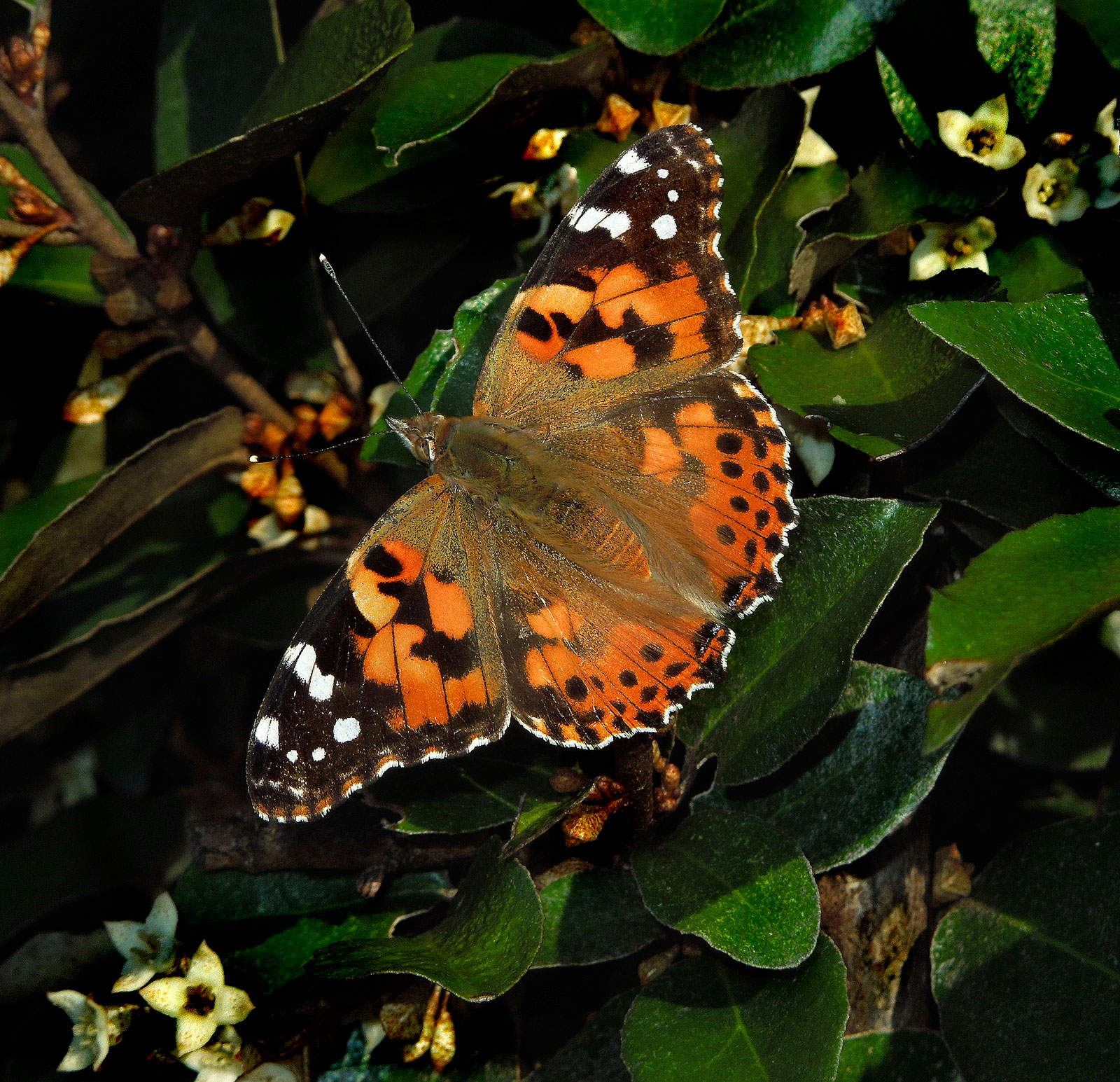
In March 2019, after heavy rain produced an abundance of vegetation in the deserts, Southern California saw these butterflies migrating by the millions across the state.
Research on the Painted Ladies in North America is limited, but scientists believe they migrate to the southwestern United States and northwestern Mexico in the fall. They arrive in the desert in late fall and the cycle begins again.

Some insect lovers confuse these butterflies with the Monarch (Danaus plexippus). While their color scheme may be similar to Monarch butterflies, Painted Ladies have eyespots on the underside their wings in addition to brown coloring on both sides. Painted Ladies lack the vein pattern that Monarchs are best known for. Painted Ladies are also smaller than Monarchs, with a wingspan measuring less than 3 inches.

The Painted Lady butterfly breeds throughout the year. The female lays eggs during its migration, contributing to its global distribution. The butterfly undergoes metamorphosis as part of its life cycle that ranges from 1 month in subtropical areas to 2 months in the temperature zones.
Eggs are laid singly on plant leaves and develop over the course of 5 days, before the caterpillar hatches. Five larval stages, also known as instars, span over 25 days where the caterpillar feeds continuously and grows extensively, followed by a pupation stage when metamorphosis takes place. The adult butterfly emerges from the pupa after a week and finds a mate before settling on a leaf to lay eggs and start the cycle again.

For butterfly admirers and insect lovers, Painted Ladies are one of the easiest butterflies to raise. That is because not only will the young larvae feed on so many different host plants, they will also feed on a specially formulated artificial diet. This artificial diet makes it possible for the larvae to be sold in butterfly rearing kits and are often raised and studied in classrooms by elementary students.
So inform your kids science teachers: they and their students can help incubate, propogate and initiate one of the world’s greatest travelers right in their classroom terrariums!
————————————————
[1] https://butterfly-lady.com/the-incredible-migrating-painted-lady/

