

Birds of Wilson
What do you call that bright yellow bird with the olive back, black-black eyes, and black hat? A Yellow Warbler, right? Not exactly. It sure is cute as it sings and eats tiny insects right in front of your eyes.
There are lots of yellow warblers and they all look a little different. With over 35 sub-species of yellow warblers, they are ubiquitous, even one species dancing in the holly outside my office window. They are called by separate names: Hooded, Wilson’s, Yellow, Golden, Mangrove, etc. They live all over North American, Central America, the Caribbean, and South America. I have some particular favorites. What are yours?
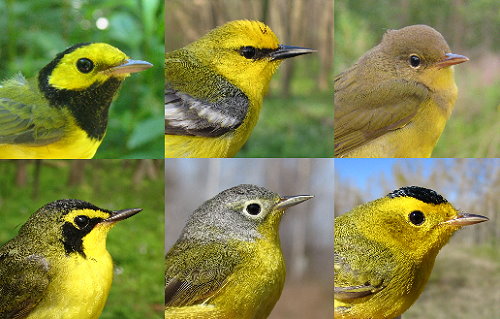
The Wilson’s Warbler (Cardellina pusilla) is a small North American songbird. It is fun to watch in the trees and willow bushes at it eats its way through the day, pecking bugs from leaves and branches. It can also be spotted feeding on the ground.
Wilson? Who is Wilson?
So who is this guy Wilson, anyway? There are a few birds with his name out there, so he must have discovered a few. The name of the warbler species has remained “Wilson’s” and it is named after Alexander Wilson, who was a noted ornithologist. However, over the years the genus has changed from Wilsonia to Cardellina to Sylvania, before moving it back to Cardellina.

Alexander Wilson
After some research I found out that Alexander Wilson (1766-1813) was a man of many talents. He is heralded as a Scottish-American poet, naturalist, illustrator and ornithologist. He had been dubbed the ‘Father of American Ornithology’ by George Ord, for all of his great work on native American birds. [1]

Wilson left his native Scotland in 1794, sailed to America to “change his fortunes,” and landed in Philadelphia. He was 27 years old. Apprenticed as a weaver in Scotland many years before, Wilson found a job teaching school at Milestown in Pennsylvania. He soon met William Bartram, who got him interested in three endeavors: bird watching, drawing and writing. [2]
After many birdwatching outings with Bertram and countless sketch sessions, Wilson made up his mind to boldly publish a book illustrating all the birds of North American. He traveled widely, observing and painting birds, and gathering subscribers for his book, or rather “books.” Wilson’s nine-volume work, American Ornithology was published between 1808-1814. This massive undertaking illustrated 268 bird species, including descriptions of 26 new species. [3]
Wilson also conducted the first breeding bird census in the US, in William Bartram’s backyard garden. The careful observation corrected earlier errors of taxonomy, and published many observations of bird and environmental natural history. [4]
JJ Audubon Connection
We often think of Audubon as the father of American ornithology, but that is not necessarily so. It is believed that Wilson’s 1810 meeting with John J. Audubon probably inspired the young Audubon (25 at the time) to publish his own book on birds. Wilson’s published works and lectures influenced many artists and encouraged budding ornithologists to expand their work.
Few bird lovers had a greater impact on ornithology, however, than John J. Audubon (1785-1851). After Wilson died (in 1813 at the age of 47), Audubon soon soaked up all of the accolades. Audubon was 28. He went on a writing and drawing spree that left a large swath of artwork and bird studies named for him. Audubon had a massive portfolio of drawings. For the next many decades the expertise of the bird world was widely attributed to Audubon. It is interesting to note that he was more likely to shoot a bird in order to study it than to count it and sketch it in his back yard. Thus Audubon’s tactics for drawing and painting were very different from Wilson’s approach.
We rarely hear about Wilson today, but his legacy is impressive. [5]

Wilson’s Legacy
Wilson discovered several important species of American birds which bare his name: Wilson’s Storm Petrel, Wilson’s Plover, Wilson’s Phalarope [6], Wilson’s Snipe, and of course Wilson’s Warbler.

Wilson’s Warbler Country

Wilson’s Warbler, male
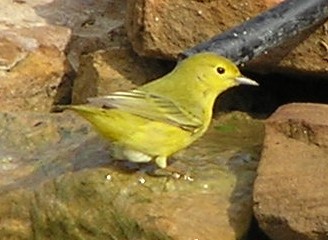
Wilson’s Warbler, female

Wilson’s Storm Petrel

Wilson’s Plover

Wilson’s Phalarope [6]

Wilson’s Snipe

==================================================
Footnotes to the Wilson’s Warbler story:
[1] http://www.wilsonsociety.org/society/awilsoninfo.html
[2] Ibid.
[3] Ibid.
[4] Ibid.
[5] Ibid.
[6] Two amateur ornithologists at the Cottonwood Gulch Expeditions, Brian Malcolm and Tim Lord, discovered a nest of Wilson’s Phalarope chicks in the marshes of Blue Water Lake in Northwestern New Mexico, outside of Thoreau. Their positive identification of the male, female and nesting site moved the breeding lines of this species hundreds of miles furthest west beyond its known nesting sites. Resident Ornithologist, Arch McCallum, authenticated the siting and the nesting pair and helped the boys write up their findings. They published a small article in American Birds Magazine. Brian and Tim were ‘over the moon’ with excitement. Two more avid birders were thus added to the flock of human avian followers.
Ending Note: Keep those binoculars ready. You never know what might show up outside your door and in your neighborhood!
 Henry E. Hooper