

Rock Ptarmigan (Lagopus muta)
Birds: Ptarmigan or Grouse
There are many species of birds that are hard to spot in the wild, for various reasons. Some of the most compelling reasons are family protection. The female ptarmigan, for example, is disguised in plain sight, because they lay their eggs on the ground. They are often sited for their natural camouflage and are not spotted until they flush from their nesting areas. These birds are prized for their meat and therefore are often target practice for small game hunters. One of the most common landscape disguise experts is the Ptarmigan, a medium-sized game bird in the grouse family. There are three species in North America: the Rock Ptarmigan, the Willow Ptarmigan and the White-Tailed Ptarmigan.
The Rock Ptarmigan, pictured above, happens to be the official bird of the Canadian province of Nunavut, and the official game bird of both Newfoundland and Labrador. Clay pigeons, anyone?
The Rock Ptarmigan is a stocky, chicken-like bird with a short bill and tail. It has finely-barred, dark brown plumage, or is completely brown except for white wings. In the winter, both sexes are white with black outer tail feathers.
Sooty Grouse spotted??
When we were hiking in Olympic National Park in August, 2024. A bird about the same size of a small chicken, came flying by me at tremendous speed. It’s sound trail zipped by my head as the bird barreled into a wooded area near Hurricane Ridge. I was not sure what it was exactly, so I asked a local Park Ranger if there were ptarmigan in the area and he confidently stated, that what I saw was probably a Sooty Grouse (Dendragapus fuliginosus). Another birder had identified some of these grouse in the area, earlier in the summer.
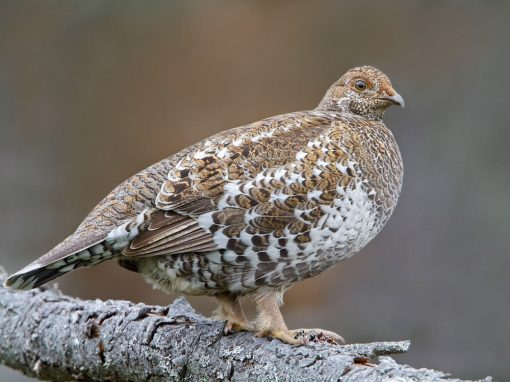
Female Sooty Grouse (Dendragapus fuliginosus)
Doing some addition digging on my own, it could have been either a female sooty grouse or a ptarmigan. The male sooty grouse is quite flamboyant in breeding season, and the small grey bird I saw was not so well dressed. I did not have time to get back to the location, though I scoured the trails near the ridge, so I had to take this as a UFB (unidentified flying bird). So marked in my bird book.
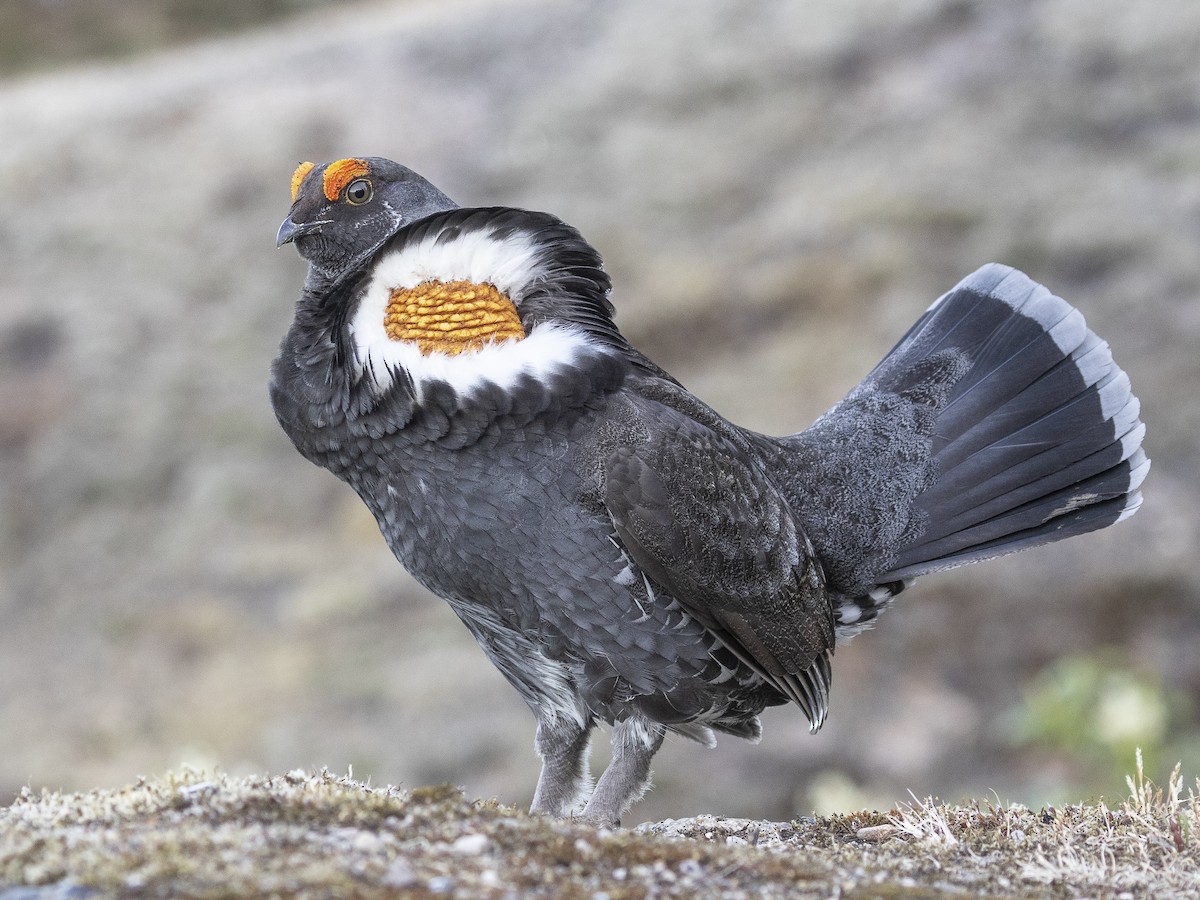
Male Sooty Grouse (Dendragapus fuliginosus)
White-Tailed Ptarmigan

White-tailed Ptarmigan (Lagopus leucura)
White-tailed Ptarmigan (Lagopus leucura) are small, tubby grouse, snow-white in winter and twig-brown in summer. They’re famous for being virtually invisible, when they stand still against the windswept rocks, low shrubs, and snowbanks of their high-mountain habitat. They nest above timberline in the alpine tundra of western mountains, and are the only birds in North America that spend their entire life cycle in these very high elevations. Their feathered feet and dense plumage enable them to walk on top of snow and even roost inside snowbanks.
- Cool Facts
- The White-tailed Ptarmigan leads a sedentary lifestyle in winter, conserving precious energy by avoiding flight and often roosting in snowbanks.
- White-tailed Ptarmigan are so well adapted to the cold that warm weather can stress them out. When the temperature tops 70°F (21°C) they may cool off by bathing in snow.
- In parts of the Yukon, Canada, White-tailed Ptarmigan share habitat with the larger Rock Ptarmigan. Surprisingly, the smaller male White-taileds are dominant over male Rock Ptarmigan, chasing them from their territories.
- The plural of ptarmigan, originally a Scottish Gaelic word, is ptarmigan.
- The longevity record for a White-tailed Ptarmigan is 15 years. [2]

Willow Ptarmigan (Lagopus lagopus)
Willow Ptarmigan
Another master of camouflage, the Willow Ptarmigan is snowy white in winter and an intricate mix of reds and browns in summer. This rotund grouse of subarctic tundra lives year-round in areas where most bird species can survive only during the warmer months. Ptarmigan are well suited to brutally cold winters, using heavily feathered feet to walk over deep snow, and excavating snow burrows in which they take shelter from the elements. The Latin name, Lagopus lagopus, is derived from the Greek words lagos (λαγως) for ‘hare’ + pous (πους) for ‘foot’, because of the bird’s feathered feet. The padding and extra sharp talons allow it to negotiate frozen ground. Perhaps their camouflage is too good, and/or they are over-confident: wild ptarmigan often act tame and unafraid of people, many of whom are more than happy to shoot them for dinner.
Willow Ptarmigan are usually easiest to find in spring, when the birds (especially males) perch in bushes and on fence posts or walk almost defiantly along roads, tolerating close approach. They are harder to find in summer, when their camouflage makes them hard to pick out against the tundra. But because they are relatively common, careful scanning through appropriate habitat should turn up a few. In winter, look for flocks where patches of willow protrude above the snow—but remember that they can be hidden inside snow burrows.
- Cool Facts
- Willow Ptarmigan form flocks in winter, and where food is plentiful these flocks can be as large as 2,200 birds! In eastern Canada, migratory flocks of the species have even turned up offshore, landing on oil-drilling platforms or ships well out to sea.
- The word ptarmigan is from the Scottish Gaelic “tàrmachan,” the old name for Willow Ptarmigan in the northern British Isles. The “p” was added to the name because early ornithologists thought that the word was Greek in origin. The genus and species name for Willow Ptarmigan, Lagopus, means “hare-footed” in Greek, a reference to the heavily feathered feet and toes.
- Willow Ptarmigan tend to play with one another when in groups. One bird often starts the play by extending and bobbing the head, then jumping around willy-nilly, flapping the wings alternately. Other birds join in, doing similar antics, which may sharpen motor skills or increase cohesion of the social group, as it does in some mammals.

- The subspecies of Willow Ptarmigan living in Great Britain (scoticus) is known as the Red Grouse. It does molt but does not change its plumage colors in the winter, instead remaining reddish brown throughout the year. The subspecies in western Norway (variegatus) and the one in the Kazakh Steppe (maior) also stay brown all year.
- The Willow Ptarmigan is the only grouse in the world in which the male regularly helps raise the young. Pairs remain together from the beginning of the breeding season until their chicks are independent, a period of up to 7 months.[1]

Can you see the three ptarmigan in the photo above? Look closely.
[1] https://www.nps.gov/dena/learn/nature/ptarmigan.htm
[2] https://www.allaboutbirds.org/guide/White-tailed_Ptarmigan/overview
 Henry E. Hooper