

Eastern Bluebird (Sialia sialis)
Birds of Blue
The concept of color is a trick of the human eye. Blue, for example, as we can see in the wings and body of a bird, is not color as we know it. It is the structured reflection of the color blue. In other words the wing feather’s microscopic structure reflects the blue light at a certain angle. Since there is no pigment of that primary color, blue, in birds, our eyes are guided by the light refraction to see it as blue. The physical principal of iridescence come into play here: coherent scattering of the light reinforces some wavelengths and diminishes others. Blue is emphasized and other colors fade out.

Blue Jay (Cyanocitta cristata)
According to David Sibley, the celebrated author and artist about birds, these flying creatures are able to see about five times more detail than we do (having an ‘eagle eye’ is a real thing) and 16 times more color. Sibley notes that birds have five times more light-sensing cells in their eyes than we do, which allows for five times as many dots per inch — so they can see a lot more detail. And almost all of those cells (80%) are cones (as in rods & cones in human eyes) that see color. Many birds, chickadees for example, can see ultraviolet wavelengths. They have evolved ultraviolet plumage markings, and thus wavelengths, which human’s cannot see.[1]

Black-Capped Chickadee (Poecile atricapillus)
Interestingly, there is also no green pigment in birds. So when we see the green on a hummingbird’s back or parrot’s head, it is actually a visual combination of two colors: 1) yellow pigment and 2) the structured blue, which the human eye sees as green (combination of those two primary colors).
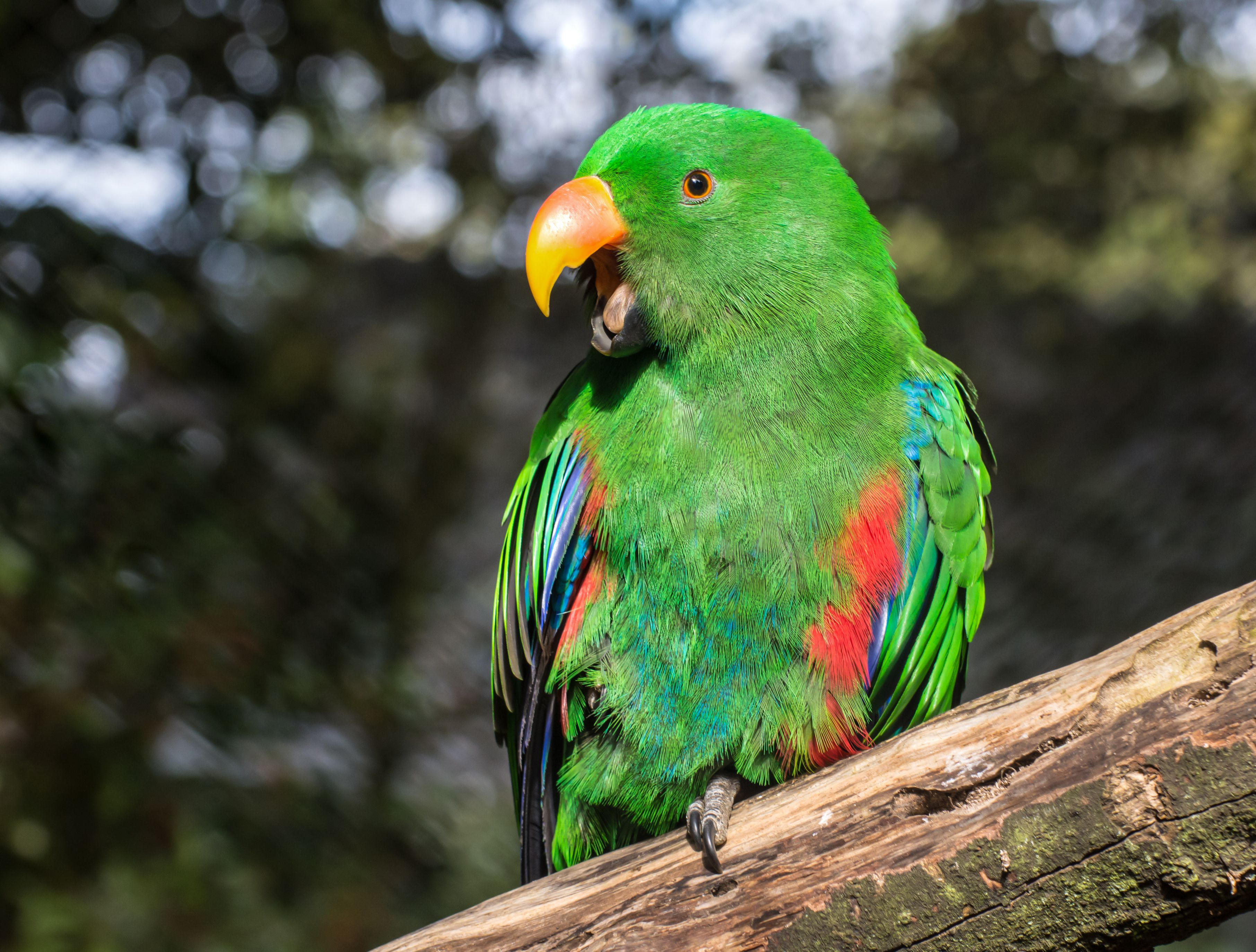
Eclectus Parrot (Eclectus polychloros)

African Blue Flycatcher (Elminia longicauda)
Bottom line? There is no blue pigment in birds.
[1] Sibley, David Allen, What it’s like to be a bird, Alfred Knopf, New York, 2020, page 57.
 Henry E. Hooper