
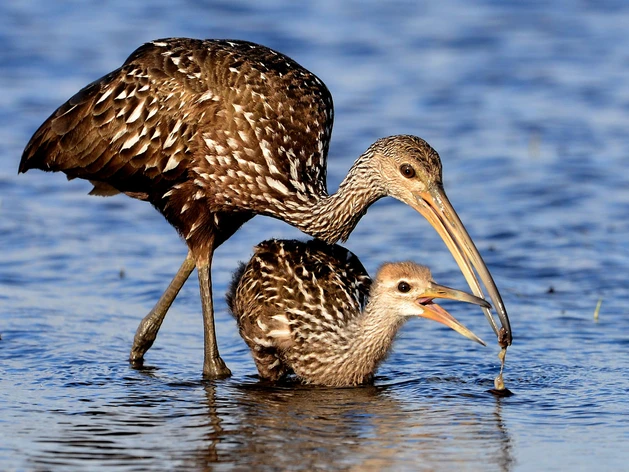
Birds: Limpkin
When did I first spot a Limpkin? It was 49 years ago, as the shaggy dog story goes …
It was December, 1975, and we had about a week before we reported to West Point, New York to wrestle during Winter Break with Coach Leroy Alitz and the Army wrestling team. I was with my fellow Yale wrestlers (Jim Bennett, Marty Schwartz, Craig Davis and Neal Brendel) attending the Sunshine Open in Miami, Florida. Bennett picked up Craig in New York, Neal in Pittsburgh, me in Baltimore for our roadtrip south. Jim Bennett, was the reigning Div. 1 National Champion at 142 pounds and he was being shadowed that winter by a Sports Illustrated writer, Gene Linden, who joined us in New Haven at many of our practices and then again when we were competing on the road, including flying to meet us in Miami.
Our Captain, Marty Schwartz, flew to Miami and stayed nights that weekend with his parents at the ritzy Fontainebleau Hotel in Miami Beach. The rest of us, meanwhile, stayed at the host motel for the grapplers in the low rent district of Miami.
During one extended lull in the tournament schedule, Linden asked if any of us wanted to go to the Everglades for some animal watching. Without hesitation, I agreed. What a cool idea that was! I had lost in the second round of the tournament and was a “free agent.” Somehow, Linden and I were able to persuade almost all of the others, who were more inclined to sleep-in, to join us for the trip. Between quarter finals and semis wrestling rounds Linden took us to the eastern edge of the Everglades National Park.
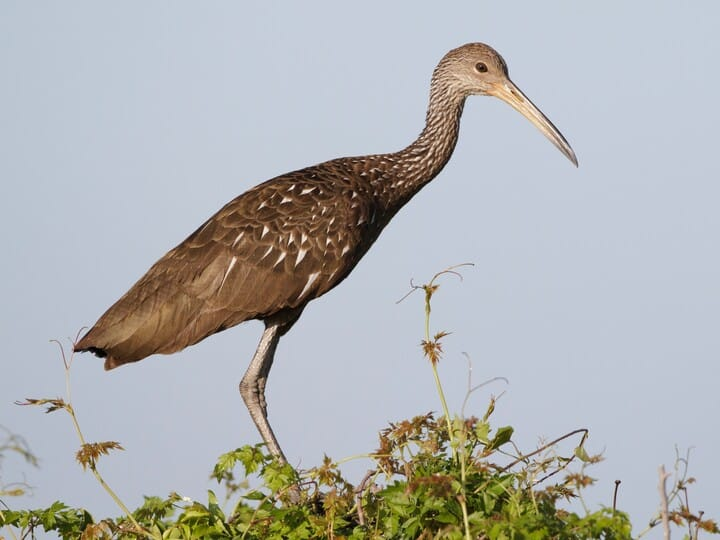
Alligators, wood storks, frigate-birds, palm trees, bald cypress, muskrats: the swamps and freshwater reservoirs were teeming with wildlife. We only had one pair of binoculars, so it was a struggle to get a fair share of the views. One of the first birds we positively identified right outside our passenger window was a Limpkin (Aramus guarauna), also called a carrao, courlan, and crying bird.
Looking like a cross between a crane and a rail, this wading bird has no close relatives. It is widespread in the Central and South American tropics, but enters the United States only in Florida and southern Georgia — which is the territory that has the dietary requirement for this bird: the fresh-water apple snail. Mostly solitary, Limpkins may be overlooked as they stalk about in marshes and swamps; they draw attention with their piercing banshee wails, often heard at dawn or at night. They are relatively large birds, with adults weighing up to three pounds and boasting a wingspan of up to forty inches.

What we noticed first when we spotted the Limpkin was the distinctive hitch in the bird’s walk, as if it had a bum leg. “That’s why they call it a LIMPkin,” said Linden, “it has a definite Limp in its walk.” Checking a bit deeper than Gene’s off-hand explanation, it turns out he was right. Purportedly, the Limpkin name comes from the bird’s gait, which appeared to early European settlers as a limp, perhaps when pursued by hunters with dogs. At such times, like the Killdeer that faints an injured wing, when predators approach its nests, the usually stolid Limpkin gallops away at unexpectedly high speeds. Pretty clever way to protect the young fry.
The end of the Limpkin story is coming, so hold on. Jim Bennett, Marty Schwartz and Neal Brendel had their sights set on winning the Sunshine Open. Bennett was not at his fighting weight (too much Christmas pudding), he went up two weight classes to 158#. There were 44 wrestlers who registered at that weight. He prevailed, but only after seriously challenging his endurance through 8 matches in two days.

When we headed back up the East Coast, leaving Miami it was 75 °F. We reached the New York State line a day and a half later. The temperature had plummeted to 25 °F, and it was a snowing white-out. The radiator on Jim Bennett’s Chevy had been having trouble holding water; therefore we had to refill it every 100 miles or so. When we finally got to West Point, it was 20°F and when we stopped the engine block froze solid. We caught a cab to the barracks at Army. Bennett’s car was indeed limping along, like the bird, but it had no extra zip. The frozen engine block was not worth fixing. The car was totaled. The final loss was painful for Bennett.

Army Coach, Leroy Alitz at an Iowa wrestling camp
We caught a ride back from West Point to New Haven from some of our Yale teammates. After the Sunshine Open and the pounding by Coach Alitz and the West Pointers, we felt like crying like banshees in pain and fatigue more than once.
Why did we go to the Sunshine Open, again? When we told our coach, Bert Waterman, the tales of our trip, he shook his head: “I could have told you before you left for Winter Break,” he opined. Some of us had to examine our hearts, minds, wallets and limping legs on that one.
 Henry E. Hooper