

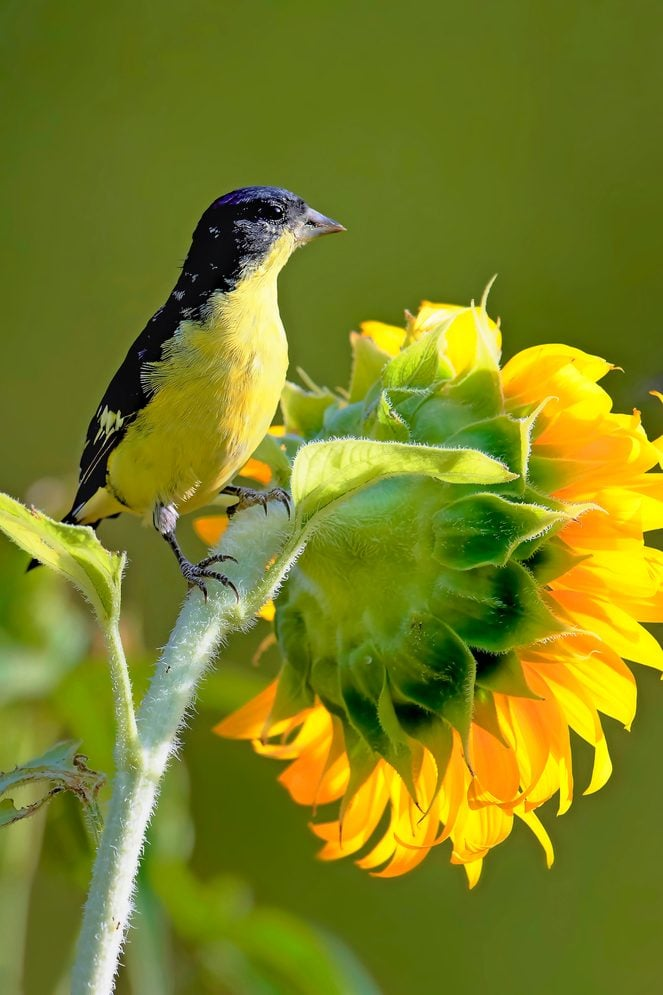
Lesser Goldfinch – male (Spinus psaltria)
Birds: Lesser Goldfinch
When it comes to goldfinches, why are they RANKED? There seems to be some sort of pecking order at work in the naming conventions. So, when someone says Lesser Goldfinch, what does the word “lesser” mean, exactly? Is it a hierarchy that compares the paler feathered goldfinch to the vibrant American Goldfinch. Or is it some sort of inside joke among birders?

Lesser Goldfinch – female (Spinus psaltria)
We are partial to the Lesser Goldfinch in Portland, OR, because that seems to be the most consistent species in our area. In the greater US we have several different goldfinch species: American Goldfinch, Lesser Goldfinch and Lawrence’s Goldfinches. While I have never seen a Lawrence’s Goldfinch, I love the others and the species in general. There are many American Goldfinch lovers out there, so many so that it has been named as the State Bird by three states: New Jersey, Iowa and our neighbor to the north, Washington!

Lawrence’s Goldfinch (Spinus lawrencei)
The Lawrence’s Goldfinch is exclusively found in the far western US and has the most limited range of the three North American goldfinches. Males are small gray finches with a black face patch and lemon yellow belly. Females have plain grayish faces. Lawrence’s Goldfinches have an interesting migration pattern. Instead of typical north-south migration, they move more east-west, going from the coast during the breeding season and moving inland for the non-breeding season. This goldfinch species breeds in California but winters through southern Arizona, New Mexico and northwest Mexico.
According to All About Birds, the Lawrence’s Goldfinch was named by John Cassin in 1850.[1] Cassin greatly admired his birdwatching colleague George Lawrence, a New York businessman and ornithologist, and named the species in his honor. [2]
Those other Goldfinches?
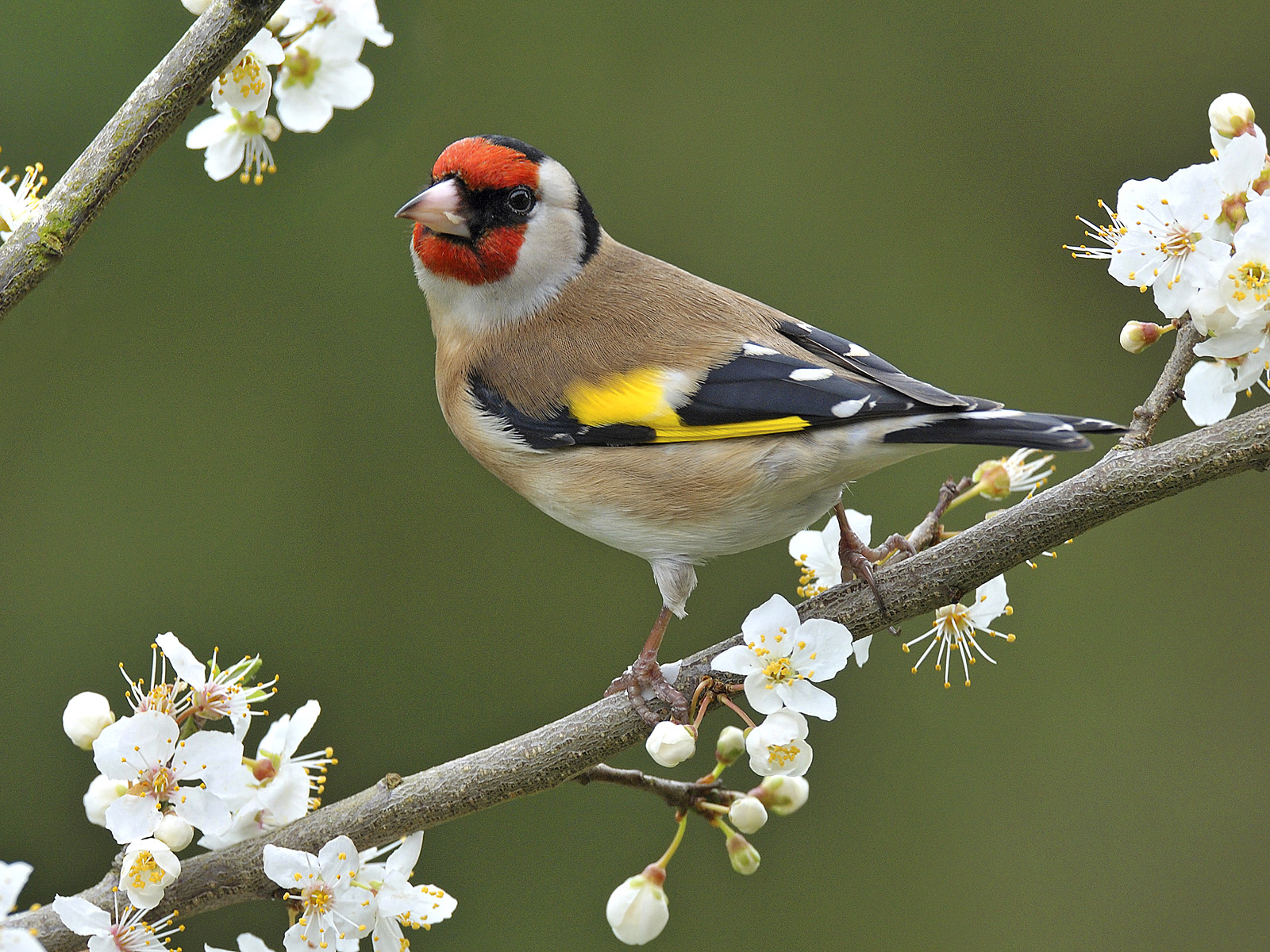
Once outside the US, the European Goldfinch is proof that these smallish finches can get even better and better looking! (See my separate post Birds: European Goldfinch.)

European Goldfinch (Carduelis carduelis)
Back to the US Goldfinches
In general goldfinches are small in stature. They are passerine songbirds with stubby cone-shaped bills. Their tails are short and notched, and their wings are long and pointed. According to Emma Greig, project leader for the Cornell Lab of Ornithology’s Project FeederWatch, the answer to this naming convention of the Goldfinches has more to do with SIZE of the bird, than with worldly status or colorful plumage. [3]
Simply put, Cornell Labs’ Greig says that US “Lesser Goldfinches are a wee-bit smaller than American Goldfinches.” American Goldfinches are from 4.5 – 5.5 inched long and have wingspans from 7.8 – 9.8 inches long. The Lesser Goldfinch weighs about one-third of an ounce and is about 4 inches long with wingspans of 5.9 – 7.9 inches in length.

American Goldfinch (Spinus tristis)
Lesser Goldfinches are known for olive green undertones. Males have yellow bellies and black caps. In the eastern part of their range, from Wyoming to Texas, they have black backs. Farther west, their backs appear green. Females sport muted olive above and yellow below. Both sexes have a white patch on their wings.

American Goldfinches – male/female at thistle feeder (Spinus tristis)
Beauty in Flight
Interestingly, it’s possible to identify finches and to distinguish them for other birds in flight, simply by focusing on their flight patterns and their calls. “Goldfinches undulate when they fly,” Cornell Labs’ Emma Greig goes on to say. “They do this thing where they flap their wings and go up a little bit, then close their wings and go down a little bit.” She says this could be a potential energy-saving strategy, as the bird flies in a series of one to three dives, glides, and wing accelerations. Their distinctive call during the dips, oftentimes allows birders to hear them more easily than to see them in flight.
Goldfinches have elaborate courtship displays that showcase their flying skills. Males perform swooping flights around females to demonstrate their aerial agility and fitness. Their display flights incorporate steep climbs, hovering, aerial pursuits, and dramatic dives. Being able to perform acrobatic feats signals the male’s flying prowess and overall health as a mate.

Flight Displays
Other Symbols of Hope and Faith
Goldfinches have long been symbols of joy, resilience, and spirituality in various cultures, appearing in art, literature, and folklore throughout history. Their bright colors and cheerful songs have made them a favorite subject in paintings and poetry, often representing happiness, hope, and the renewal of life.
In Christian symbolism, the European Goldfinch is closely associated with Christ’s Passion. Its red face was believed to have been stained while trying to remove thorns from Christ’s crown, making it a symbol of sacrifice and redemption in Renaissance religious art. The bird frequently appears in paintings of the Madonna and Child, signifying Christ’s future suffering and resurrection.
In folklore, goldfinches are often seen as harbingers of good fortune. In European traditions, spotting a goldfinch was thought to bring prosperity and happiness. Their strong association with thistles, a plant known for its resilience, also reinforces themes of endurance and survival.[4]
References:
[1] Birds of Cassin
 Henry E. Hooper