

Birds: Horned Lark
Gazing along the ridge line of the Boulder County public park, we spotted a bird that was cleverly camouflaged by the sage brush and ruddy, mottled trail stones. It was summer, 2023, and Tom Bagli had covered these hills many times. He did not have binoculars, so I gazed ahead with mine and could see that this was not your typical trail bird. It was a sparrow-like bird with a small beak. What caught our eye was the hint of yellow we saw around its neck. It was hard to identify as it zipped further ahead of us with each trail step.
When we got back to the house, I retrieved my bird guide. The bird was definitely a male horned lark, which is a small, common ground-dwelling passerine. The literature says that the Lark prefers open grassland habitat, with sparsely vegetated areas and few trees.
With the loss of more and more prairies in the states (for example more than 90% of the original grasslands have been lost in different regions, due to development, tree and shrub growth, and changing temperatures), the horned lark is a rare find in these parts. Not endangered, as is the subspecies Streaked Horn Lark in the Pacific Northwest, there are still tremendous development pressures on the lands once roamed by these beautiful birds.
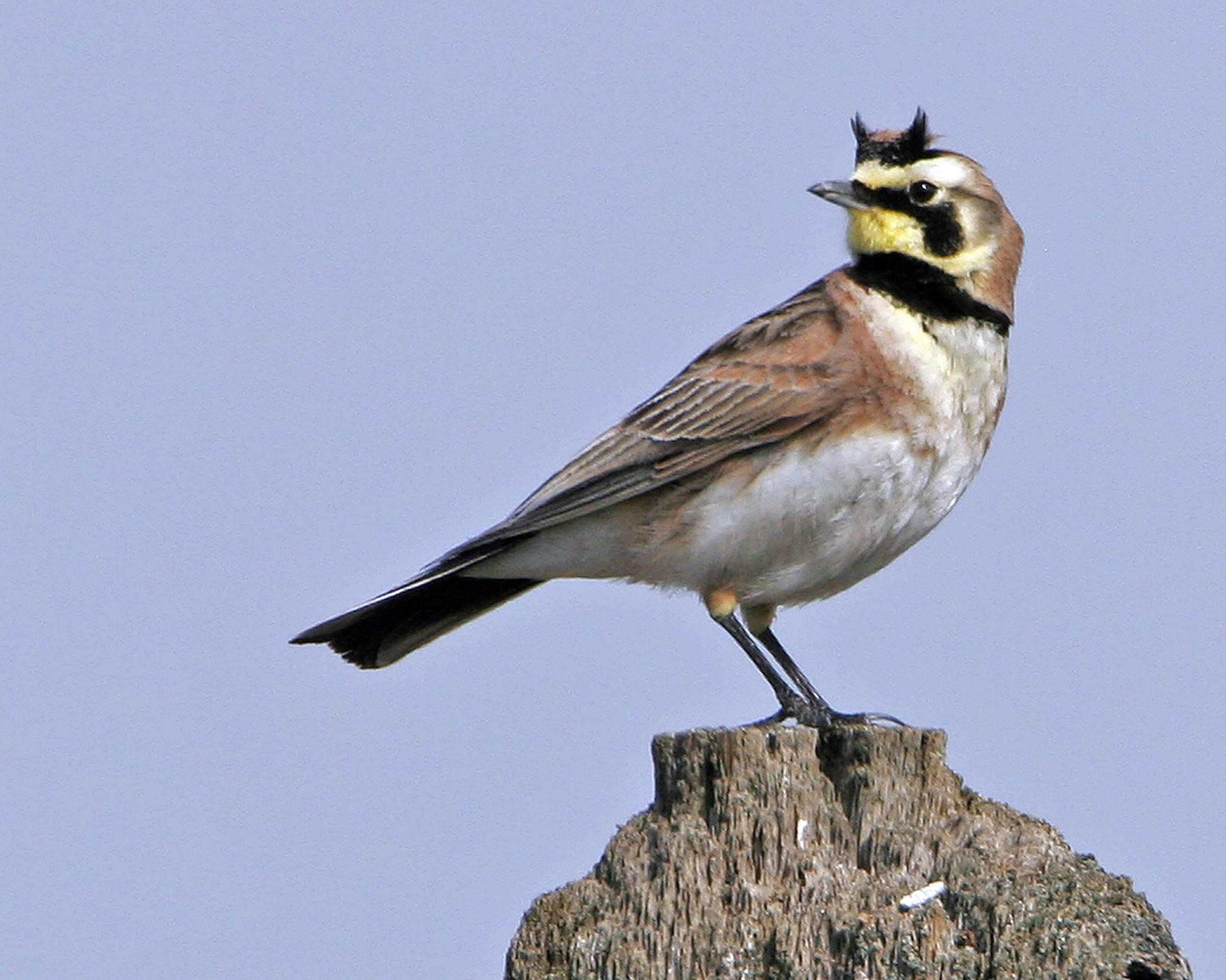
Horned Lark (Eremophila alpestris)
This is a distinctive-looking lark species, which is usually spotted on the ground. It’s coloring is mainly brown-grey above and pale below, with a striking black and yellow face pattern. Except for the central feathers, the tail is mostly black, contrasting with the paler body; this contrast is especially noticeable when the bird is in flight. In summer the male has black “horns”, which give this species its American name. North America has a number of races distinguished by the face pattern and back color of males. In Europe it is more likely spotted on the beaches and lake shores, earning the name Shore Lark.

Female Horned Lark, photo by Rich Hoeg
 Henry E. Hooper