
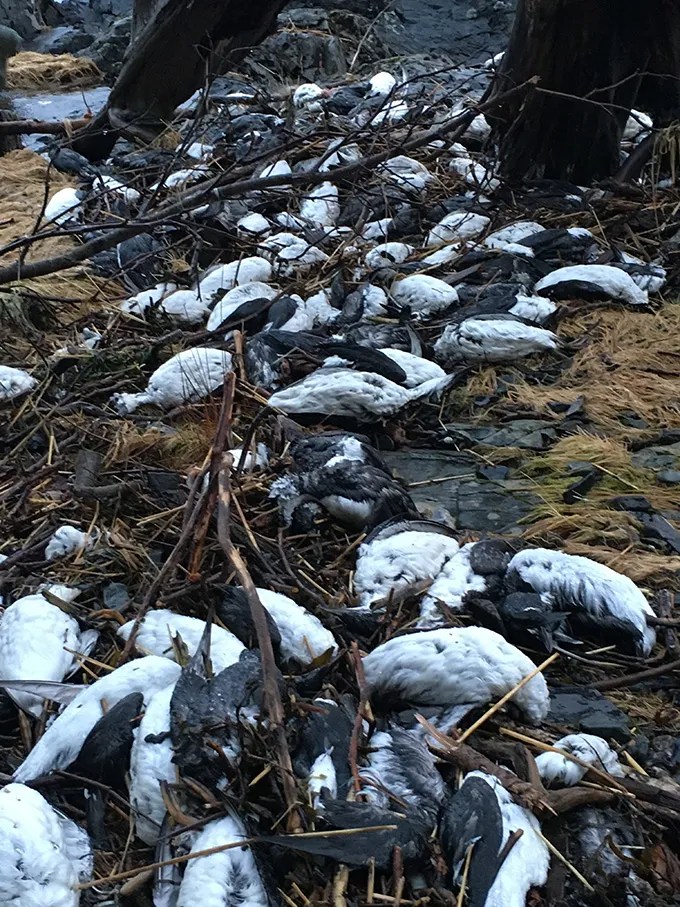
The discovery of millions of dead Common Murres (Uria aalga) in the PAC NW a decade ago
Birds: Common Murres
Between 2014 and 2016 about 4 million Common Murres (Uria aalge) were found dead in Alaska due to a marine heat wave. Known as an oceanic ‘Blob,’ this mysterious phenomenon produced the largest documented die-off of a warm-blooded animal in modern history.
What was the cause of this lfe ending of event? Researchers believe there is one primary causation factor and many contributing factors:
- Rising temperatures are the primary factor.
- Other factors may have included:
- Microplastics
- Ocean acidification
- Sea levels rising
- Chronic oil spills

The Murre Demise Story
The story begins in late 2014, when a brutal marine heat wave, nicknamed the “Blob,” parked itself over the Pacific Northwest, raising ocean temperatures far above normal for almost two years. The colossal cauldron cooked up an ecological chain reaction, slashing phytoplankton populations and in turn the forage fish that seabirds like common murres eat. In 2015 and 2016, the birds starved to death en masse.
Heather Renner, a wildlife biologist with U.S. Fish and Wildlife at the Alaska Maritime National Wildlife Refuge, headed up the research team from her base in Homer, Alaska. To get a better idea of the full impact on the murre population, the team used colony count data from 1995 to 2022, gathered across 13 colonies along the margins of the Bering Sea and the Gulf of Alaska. After getting bird counts before and after the heat wave, the researchers then extrapolated those results to the entire Alaskan murre population. [1]
Renner and her colleagues estimate that the heat wave killed 4 million murres between the Gulf of Alaska and Eastern Bering Sea. Roughly half the region’s murres died during a single winter.
Renner and her colleagues point out that with continued climate warming, heat waves like the Blob are expected to occur more frequently. This could imperil already vulnerable populations of many animals that have yet to recover in an ocean ecosystem reeling from the previous heat wave.
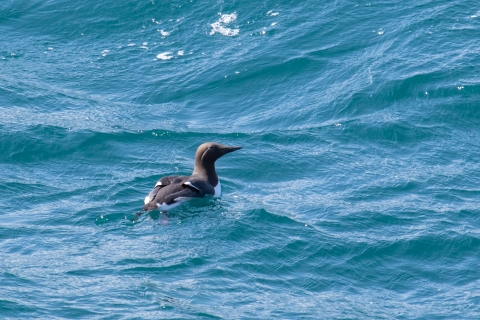
While there’s little immediate human control over marine heat waves, Renner says the findings underscore the importance of other conservation efforts for seabirds. This may include removing invasive predators or other species that — alongside climatic swings — create an additive stress on seabird populations. Biologists could only guess whether the birds had died off forever, relocated, or simply lacked the energy to breed. In the years immediately following the heatwave, the murres did return and began to breed again; however, the breeders were in much lower numbers.
Scientists warned: “The top of the food web is going away. [That news] should be an ominous thing for everybody.” The wild world is left with a half of a Common Murre species to muddle through. [1]
[1] https://www.fws.gov/story/2024-12/four-million-murres-missing
 Henry E. Hooper