
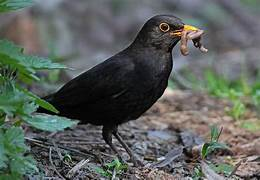
Birds: Blackbird (Turdus merula)
The first blackbird I heard was a Redwing Blackbird. At the time I was stranded in a broken down rental car in Northern California. The landscape was a marshy place with lots of cattails, dragonflies and mosquitoes. The bird’s distinctive call was shrill and memorable, as it flew between the reeds and the telephone wires. And the call was incessant. Two hours later the AAA truck arrived and fixed the rental and I was on my way again. I have forgotten the location, but will never forget that call.
The common Blackbird is actually a species of thrush, known as True Thrush (there are over 88 distinct species in that “true” genus, and over 65 are medium to larger species) [1]. It has lots of other monikers: it is also called the Eurasian Blackbird (especially in North America, to distinguish it from the unrelated New World blackbirds), or simply as the blackbird in countries where the geographic distinctions do not lead to confusion with a similarly-looking local species.
The blackbird breeds in Europe, North America, western Asia, and North Africa. Over the years the species has been introduced to Australia and New Zealand. It has a number of subspecies across its large range; a few former Asian subspecies are now widely treated as separate species. Depending on latitude, the common blackbird may be resident, partially migratory, or fully migratory.[2]
The word Turdus means Thrush in Latin. The adult male of the common blackbird (Turdus merula merula), which is found throughout most of Europe, is all black except for a yellow eye-ring and yellow bill. It has a rich and melodious song; the adult female and juvenile have mainly dark brown plumage, which camouflage the birds to maturity. This species breeds in woods and gardens, building a neat, cup-shaped nest, bound together with mud. It is omnivorous, eating a wide range of insects, earthworms, berries, and fruits.
Both sexes are territorial on the breeding grounds, with distinctive threat displays, but are more gregarious during migration and in wintering areas. Pairs stay in their territory throughout the year where the climate is sufficiently temperate. This common and conspicuous species has given rise to a number of literary and cultural references, frequently related to its song.
The many medium to large thrushes in the genus Turdus have several key characteristics in common: they all have rounded heads, longish-pointed wings, and “usually” melodious songs, though some can sound harsh during mating season.
The Beatles tune, Blackbird, is one of my favorite songs to pick on my guitar. One of the highlights of my parenthood years was to serve as musical accompaniment to my daughters at a Madeleine School talent show. Their voices were angelic and powerful as they sang all of the verses and bridges. I was proud to be “arising” on stage with them.


Brewers Blackbird
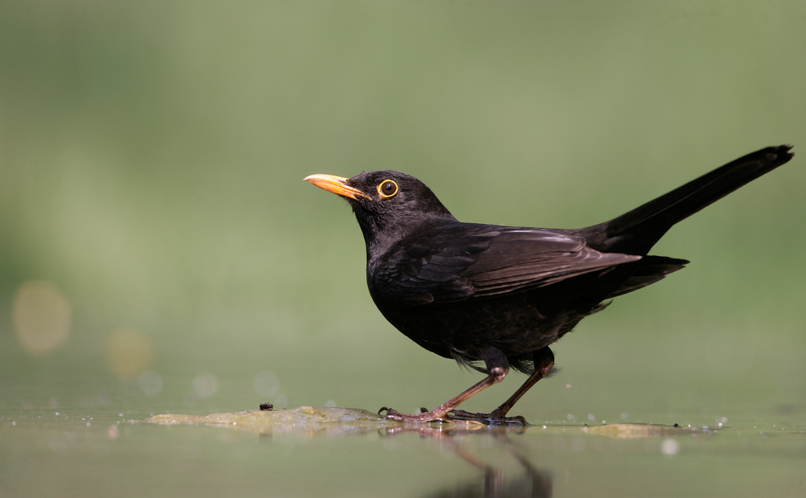
Eurasian Blackbird

Tricolored Blackbird

Redwing Blackbird

Yellow-headed Blackbird
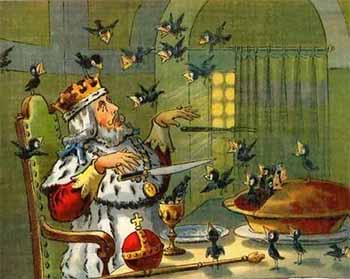
4 & 20 Blackbirds Baked in a Pie
 Henry E. Hooper