

Audubon’s warbler male (Setophaga auduboni)
Birds: Audubon’s Warbler?
Audubon’s warbler is a small bird in the Parulidae family. At one time this small fry was considered a distinct species; however, the discovery of a hybrid zone between the Audubon and the Myrtle warbler with the Black-Fronted warbler in the mix (discovered in 1973) has led to it being reclassified as a subspecies of the more abundant Yellow-Rumped warbler.
Audubon’s warbler can be found across western North America, breeding from the U.S. to Canada and wintering in Central America. It is an active bird, often seen flying between branches of trees. In the summer the males have a distinctive yellow throat and a dark head and back.[1]
Description
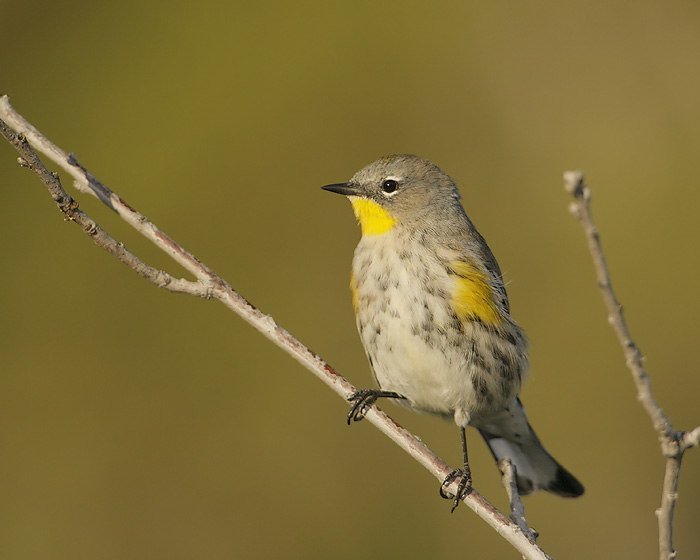
Audubon’s warbler female in summer plumage
In the spring and summer, the adult male has a dark back with a bright yellow throat, rump, and flank patch, and black head and back. The adult female’s throat and shoulders contain less yellow than the males and is further distinguished by the brown in its back and its white wing bars compared to the white wing panels of the males. The juvenile male is similarly colored but with more black in its tail and can be distinguished by its incomplete wing panel. The juvenile female is much browner than the adult female and has whitish shoulders and some yellow in the throat.
In the fall and winter, the adult male has a grey and black back with black lores and black streaks in the breast. However, there is significant overlap with the adult female so the identification of the adult male can be conclusive only if there is extensive black across the back and breast. The adult female and juvenile male are virtually indistinguishable and have lighter breast streaking and are browner than the adult male. The juvenile female is very dull and has a slightly-tinted yellow throat but there is considerable overlap between the juvenile female and adult female. The two can only be definitely distinguished in cases where the juvenile throat is white or the juvenile displays two feather ages in its greater converts. This hybrid form is distinguished from the myrtle warbler by its lack of a whitish eyestripe, its yellow throat, and con-colorous cheek patch.
The song is a simple trill, and they make a hard check call.

Warbler Sighting
Spotted while hoping among the scrub hemlock trees on the Timberline Trail on Mt. Hood in Oregon, (July, 2025) the male in our view was greedily catching bugs and small insects on the gravel and shrubs nearby. The moraine field had been covered with snow, just a few months ago, and he was happy to dine on the insects that were spawning in the newly uncovered earth. Occasionally he flew up to a nearby western hemlock to forage and check for other birds.
Since the bird we saw may NOT have had the white eye ring, it may in fact be a Yellow-Rumped Warbler and not an Audubon’s. Still it is fun to watch in the wild.
By the way, despite the terrible things that the racist John J, Audubon did and said in his life, I am an advocate for education around the bigotted man, rather than obliteration of his existence. Keep the name Audubon in the record books.
 Henry E. Hooper