

Magico, the Mexican Street Cat
Word Smith: Sentient
When we spend time with other species like cats and dogs, it becomes clear that these animals experience many of the same feelings that we do as humans. These animals tend to wear their hearts on their sleeves, with behaviors that clearly indicate whether they are feeling good or feeling bad. In real time they demonstrate that they are experiencing even deeper and more nuanced feelings that become self-evident: affection, distrust, caring, anger, concern and love.
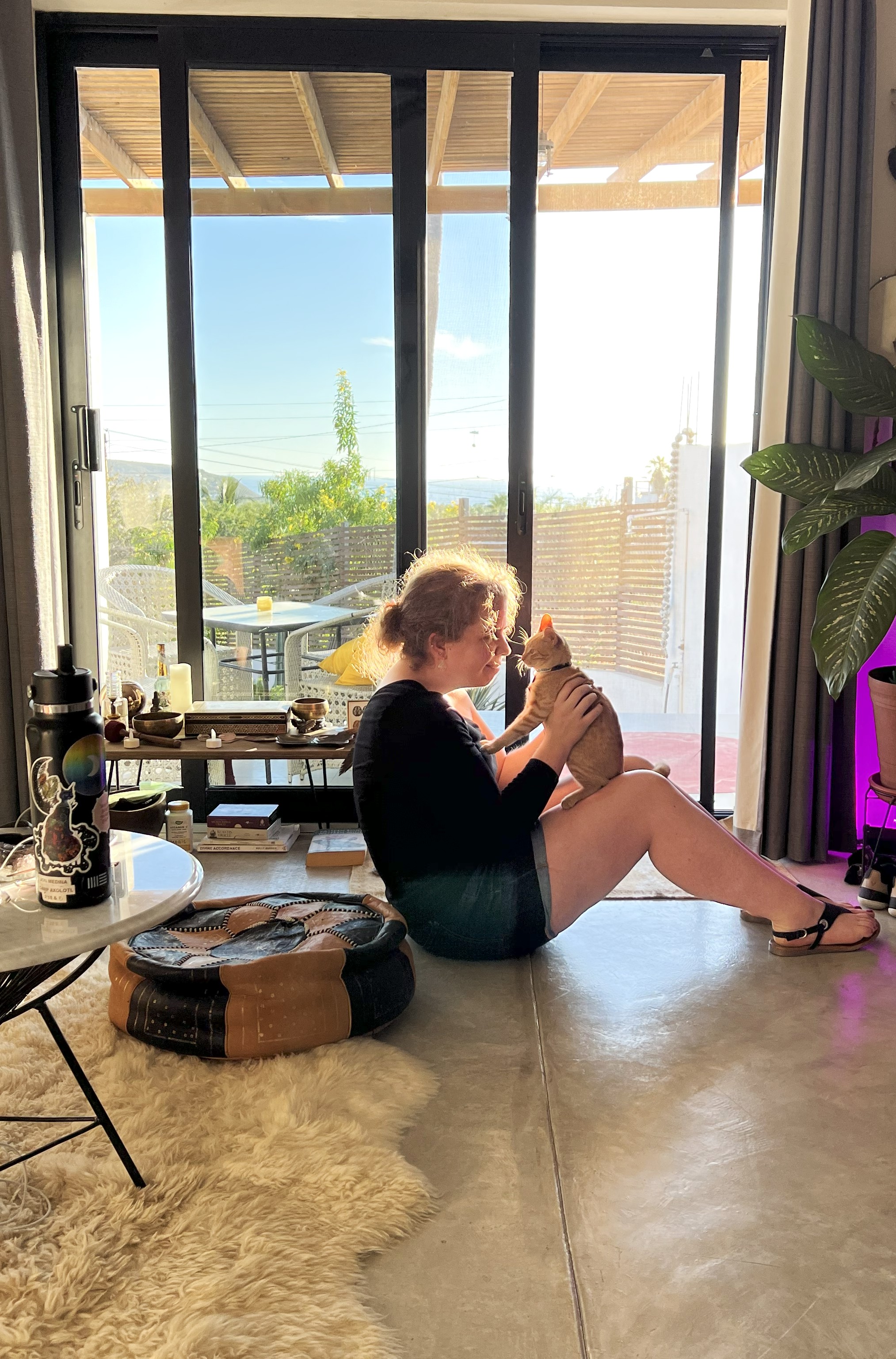
An example of sentience in our lives is Magico, pictured above. He is the male cat who found our daughter, Eleanor, when she called him into her life. The kitten showed up at the right time and became a powerful force in her life and the lives of everyone Magico met. (Sign-up to read Eleanor Medina’s Makaranda Method substack to discover the depths of this wonderful feline.)
One of the remarkable factors that lead me toward a relationship with Magico, was his singular ability to be around others without allowing their allergies to activate. I was just such a character, allergic to every animal who licked their own fur to tamp down their dander. Magico sat on my lap, walked across my shoulders, rubbed up against my leg, to zero allergic reaction. I had never met an animal with dander who was hypo-allergenic to me.

One Christmas, when Magico was quite young, Eleanor and her husband, Jon, brought Magico with them from Colorado to Portland. At the time, Magico was unfamiliar with ice. While they were visiting, the landscape was encrusted with an inch of ice that covered the trees and the land into a frozen tundra. Magico wanted to continue his “outside the house,” habits and he went for an early morning walk. Meowing to his loudest cry, Magico could not tolerate the quick change in temperature, and he cried out for help. Luckily, Jon found Magico crouched under the porch of a nearby neighbors house, and brought him back to the safety and warmth of our home. He experienced all of the feelings that we do in those frigid conditions.
Beyond house pets
But what about beings that are harder for us to read? For example, are crows or chickens sentient? Do fish have feelings? Can invertebrates, like octopus, crabs or lobsters, actually feel pain?
As countries around the world attempt to define animal sentience and draft laws based on their definitions, understanding the thoughts and feelings of all animals, is more important than ever.

Eleanor Medina with Magico in Baja, Mexico
What Does “Sentient” Mean? [1]
Simply put, the word “sentient” means the ability to have feelings. It’s the capacity for a creature to experience sensations and emotions.
It’s pretty easy to see that we humans are sentient. Imagine you wake up in the middle of the night, walk to your bathroom in the dark, but then you think you hear a noise downstairs, so you turn to run back to bed and accidentally stub your toe. In just a short timeframe, you’ve gone through the sensations and emotions of feeling groggy, frightened and then in pain—you’ll probably feel a bit grumpy the next morning, too.
Sentience is at the heart of how we perceive and interact with the world around us. It means that we have a point of view.
As it turns out, we humans have historically had an easier time recognizing our own sentience than we’ve had seeing it in the animals with whom we share the planet.
There was a time when philosophers and scientists believed that only humans were sentient and that all other animals were unfeeling, unthinking robots. Even René Descartes, the philosopher who coined the famous phrase, je pense, donc je suis (“I think, therefore I am”), thought animals were basically automated machines, no more intricate than a cuckoo clock.
Fortunately, we’ve come a long way since then. Psychologists and other scientists have spent decades researching how other animals experience the world around them, and what kind of emotions they feel when exposed to positive and negative stimuli.
What Makes a Being Sentient?
There are many ways to understand what makes a being sentient. Some of them are very complex. Some of them more simple.
When determining whether an animal is sentient, scientists will often ask a basic but important question: “Is there something human that it’s like, to be that animal?” [2] In other words, does a being have the capacity to have varied experiences, both good and bad, just as we do? Can they feel contrasting emotions? Pain and pleasure? Anxiety and relief? Boredom and enjoyment? Hunger and thirst? Fear and excitement? Hate and love? The list goes on, encompassing many of the same emotions that we experience, as humans.
Some scientists and proponents of animal ethics say it all comes down to the very simple question, “Can this being suffer?” The ability to suffer is an important ethical distinction, because it implies that not only does a creature have the ability to feel pain — the sensation of injury where they were hurt — but also an accompanying, negative emotion.
Are Animals Sentient?
There is a great deal of sentience across the animal kingdom. Mammals and other vertebrates usually get the most credit for being both intelligent and sentient. For example, anyone who has been lucky enough to live with a lovable feline would probably argue that their cat, just like Magico, has a distinct personality and expresses clear emotions. There’s scientific research to back up these claims, too. Cats and dogs, in particular, as the most frequently housed pets, express an array of emotions ranging from excitement, contentment, joy and love to distress, disgust, suspicion and anger. A typical kitten or puppy will develop emotionally to about the equivalent of a two-and-a-half year old person.
But what about non-mammals, whose sentience is harder to observe?

Birds
Birds’ brains don’t have a cerebral cortex, which is that portion of the brain most heavily associated with consciousness. And yet, a recent study led by Professor Andreas Nieder, the chair of Animal Psychology at the University of Tübingen, trained crows to respond to a visual stimulus on a screen. The study found that when presented with harder-to-perceive signals, different crows responded differently to the stimuli.
This wasn’t just a case of some birds having better eyesight than others. Instead, it suggests “higher processing levels of the brain” that allow members of the same species to have unique experiences. Even more importantly, sometimes the crows seemed to respond to something on the screen, even when nothing was getting projected, suggesting that their “eyes were playing tricks on them,” meaning these birds have some sense of “subjective reality.”

Fish
Because fish eat, sleep, and live in water, which is such stark contrast to us land-dwelling humans, it’s long been assumed that they are not able to think or feel emotions the way we do. That misconception, however, has been losing more and more credibility in the scientific community in recent years. Most of the research on fish sentience has sought to determine whether they can feel pain or not. The answer is: “Yes, they can.” In experiments, scientists have observed that fish avoid potentially painful situations, sacrifice a potential reward to avoid an accompanying painful outcome, and seek relief after undergoing a painful procedure. There is less, but equally promising, research on fish’s ability for feeling joy and optimism, as well. There was a NetFlix documentary made in 2020 by a shallow sea diver about an octopus, called My Octopus Teacher, that clearly expresses the invertibrate version of sentience as well. There’s much more for us to learn about the internal lives of ocean and lake creatures (vertibrate and invertibrate), but it’s clear that they deserve to be treated humanely, just like any other animal.

Insects
The psychology of insects is a rather underdeveloped area in animal science. Globally, there has been an increasing trend in the farming of insects as a source of food. This has some researchers concerned about the lack of attention that’s gone into ensuring the insects involved in this industry are being treated humanely. A recent research article published in Applied Animal Behaviour Science explores the ability of crickets to experience stress; cases in which locusts learned information through association; the memorization capabilities of beetles; and the complex, emotional cognitive capacities found in bees.
Sticking with bees for a moment, consider the following:
- Bees are essential pollinators, helping to fertilize plants and produce fruits and vegetables.
- They contribute to biodiversity by supporting the growth of various plant species.
- Honeybees alone are responsible for pollinating about one-third of the food we consume.
- The decline in bee populations threatens food security and ecosystem health.
- Supporting local beekeepers and planting bee-friendly flowers can help protect these vital insects.
But, are bees sentient?

The authors of the Applied Animal Behavior study, Helen Lambert, Angie Elwin, and Neil D’Cruze, conclude: “Our findings certainly support the notion that far more needs to be done to explore the cognitive capacities and emotional lives of insects.”

Crustaceans
In recent years, the question of whether or not crustaceans like crabs and lobsters are capable of suffering has been a hot-button topic in the scientific community. When used as a source of food, these arthropods are commonly slaughtered by being boiled alive — a horrifically inhumane method for a creature capable of feeling pain. In 2021, researchers for the London School of Economics and Political Science (LSE) reviewed years of data and studies in an attempt to clear up the debate in the eyes of animal welfare law. The researchers said they found substantial evidence of sentience in crabs, lobsters, crayfish and others. They strongly recommended that these animals receive explicit protection from abuse by UK law.
All crabcake, hardshell, or softshell crab lovers out there (Blue crab or Dungeness crab), take note: the crabs we eat die a painful death for our gastronomic pleasure. Is it a fair trade-off? It is in the UK for now, apparently.
Recognizing Animals as Sentient Beings
UK Sentience Bill
Government officials in the United Kingdom have been considering some landmark bills that would provide groundbreaking protections to a diverse array of animals. Specifically, the Animal Sentience Bill, would enshrine in law that animals are capable of feelings and emotions, and therefore are entitled to humane treatment. The bill would establish the country’s first Animal Sentience Committee “to scrutinize and report on whether the government is taking into account the adverse effect of any policy on the welfare of animals as sentient beings.”
While there is wide public support for this bill, it is currently in a Parliamentary limbo stage, known commonly as “ping pong,” in which a bill is rapidly sent back and forth between the two chambers before getting passed.
“Sentience” in this bill would be applied to all vertebrates. An early draft of the bill originally left out all invertebrate animals,) implying that any creatures without a backbone are inherently non-sentient. Thanks to the aforementioned research on their sentience, the bill would now recognize the sentience of invertebrates such as crabs, lobsters and octopuses. Unfortunately, these creatures would not receive any specific protections through the Animal Sentience Bill, but they would be considered in future policy-making decisions.
Sentience and animal welfare around the world
Many countries throughout Europe already recognize animal sentience as a legal principle. Several years ago Spain reformed its civil code to recognize animals as “living beings endowed with sentience” rather than simply “things,” or “moveable property.” Activists see it as an important first step toward providing the country’s animals with better protections down the line.
In 2019, Australia’s legislative assembly recognized animal sentience for the first time with its Animal Welfare Legislation Amendment Bill. Recognizing that the country’s “domestic animals, livestock, and wildlife” were capable of feeling emotions and pain, the bill laid out a zero-tolerance policy for animal abuse in any form.
While there are some laws against animal cruelty, the federal government in the United States has not passed any legislation recognizing animal sentience. Much of the country’s anti-cruelty regulations change from state to state. Certain states have explicitly recognized the sentience of animals, but others have not.
Respecting All Animals
And some animals long thought unable to think or feel pain are gaining new understanding and respect in the scientific community.
Whether it’s farm animals, fish, insects, or lobsters, the research always seems to find that these animals are more cognitively complex than we give them credit for.
It can be difficult to keep up on all the latest findings related to animal sentience. But there’s a surefire way to make sure that we humans are giving all animals the respect they deserve: By leaving all of them off of our plates!
Taking up a plant-based diet is a great first step to avoid engaging in cruelty against sentient beings. Get your free plant-based eating starter kit and be the change for animals today.
Other Sentient Beings?
Yes, many people are coming around now and recognizing that there are many animals and creatures that are sentient. But, what about other beings, such as plants and trees? Water and rocks? Although these objects seem to be coming from another dimension, and unrelated to sentience, perhaps they are closer to the point than we realize.
Researchers have studied trees and their behavior in some fascinating ways: their roots, for example communicate with other trees in search of water, in avoidance of invading insects, and the sustainance of the species. These revelations keep the door wide open for additional experiments and exploration of this important topic.
We share the earth with these creatures and our life is depedent on their success. So why not develop ethical standards around them as well? You can’t spend time looking at a giant redwood or bristle cone pine or baobab tree and miss the majesty of their existence. They live for hundreds, even thousands of years. Their lives are important to us and our planet. Why not protect them, as we do other creatures?

Coastal Redwoods, (Sequoia gigantea)
[1] This article was published by an organization called The Humane League and it is taken in context, as of 7/4/2025: https://thehumaneleague.org/article/sentient-meaning
[2] There are folks out there who reverse the question to ask, “Is there something animal that it is like, to be a human?” or “Is there something mineral or vegetable that it is like to be human?” The layered questions can delve existentially deep.
 Henry E. Hooper